Key takeaways
- Jasper starts at $49/user/month and focuses on content creation — it doesn't tell you whether ChatGPT, Perplexity, or Google AI Overviews actually cites your content
- The most valuable alternatives in 2026 close the full loop: write content, optimize it for AI search, and track whether it's getting cited by LLMs
- Budget alternatives like Rytr ($7.50/month) and Writesonic ($20/month) cover basic writing needs at a fraction of the cost
- For teams that care about AI search visibility specifically, pairing a writing tool with a dedicated GEO tracker (or using a platform that does both) is now the smarter play
- The gap between "AI writing tool" and "AI search optimization platform" is widening fast — the tools below reflect where the market has moved
Here's the honest problem with Jasper in 2026: it's a very capable AI writing tool, but it was built for a world where "ranking" meant Google's blue links. That world hasn't disappeared, but it's no longer the whole picture.
Today, a growing share of discovery happens through ChatGPT, Perplexity, Claude, and Google's AI Overviews. If your content isn't being cited by those systems, you're invisible to a chunk of your audience — and Jasper gives you no way to know whether that's happening or how to fix it.
That's the gap this guide addresses. The nine alternatives below range from budget-friendly writing tools to full-stack platforms that write content and track its performance in AI search. Some are direct Jasper replacements. Others do things Jasper never attempted.
Why people are leaving Jasper
Jasper's pricing is the most common complaint: $49/user/month on the Creator plan, $69/user/month on Pro, and custom enterprise pricing that reportedly runs $5,000–$70,000/year. For a solo marketer or small team, that's a hard number to justify.
But pricing isn't the only issue. The bigger structural problem is that Jasper is a content creation tool in an era that increasingly demands content optimization for AI search. It can help you write a blog post, but it can't tell you:
- Whether ChatGPT is citing that post when users ask relevant questions
- Which prompts your competitors are visible for that you're not
- What topics you need to cover to get cited by Perplexity or Google AI Overviews
For teams that care about those questions, Jasper is only half the solution.
The 9 best Jasper alternatives in 2026
1. Writesonic — best for SEO-focused content at a reasonable price
Writesonic is the most direct Jasper competitor on this list. It writes long-form content, has built-in SEO tools, and starts at $20/month — less than half of Jasper's entry price.
The platform includes a site audit feature, keyword research integration, and a blog writer that's genuinely good at producing publish-ready drafts. It's not going to win awards for creativity, but for teams that need consistent SEO content at volume, it does the job.
What it doesn't do: track AI search visibility. You'll know if your content is optimized for Google, but not whether Perplexity is citing it.

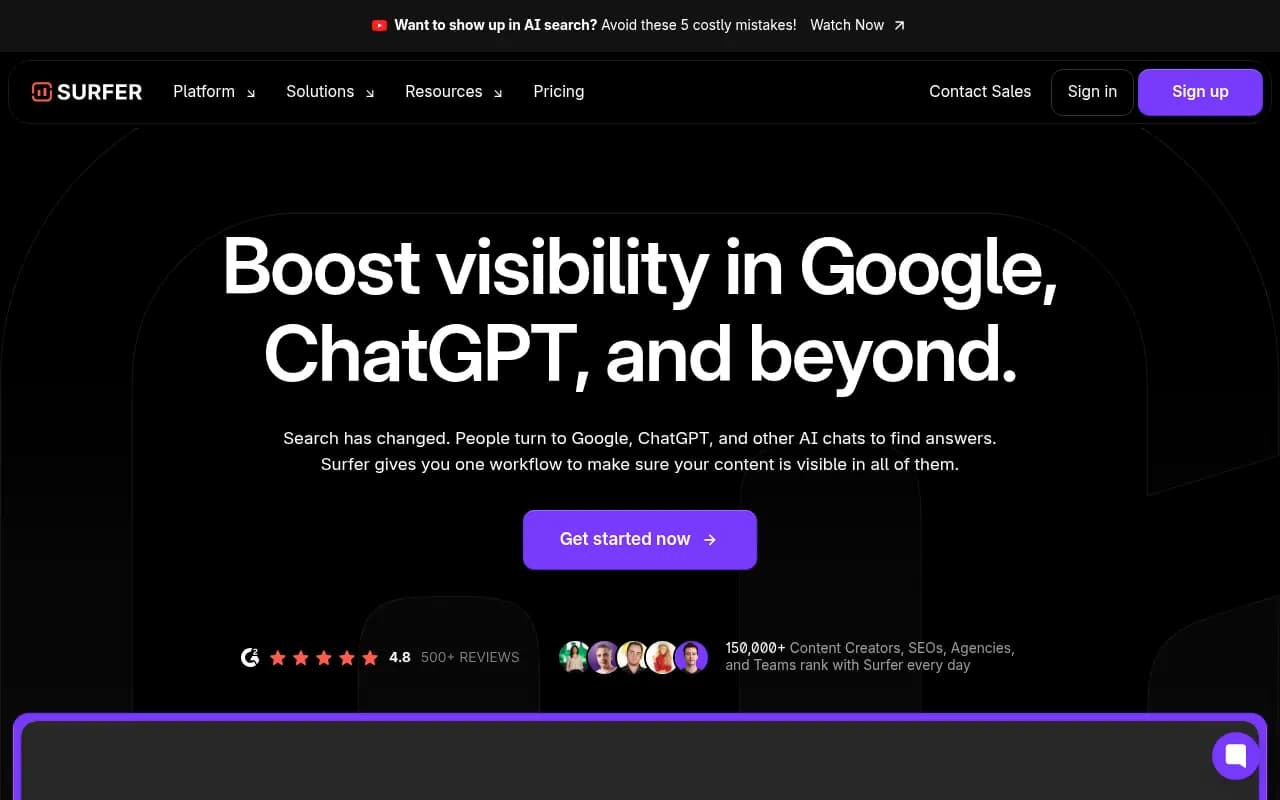
2. Surfer SEO — best for content that needs to rank in traditional search
Surfer SEO is less of a writer and more of an optimizer. You bring the content (or use its AI writer), and Surfer tells you exactly what to add, remove, or restructure to rank better in Google.
Its Content Score system is genuinely useful — it analyzes top-ranking pages for your target keyword and gives you a score based on how well your draft matches the patterns that tend to rank. The AI writer is decent but secondary to the optimization layer.
Like Writesonic, Surfer doesn't track AI search citations. It's built for traditional SEO, and it's very good at that specific job.
3. Copy.ai — best for GTM workflow automation
Copy.ai has moved well beyond AI copywriting. In 2026, it's positioning itself as a go-to-market workflow platform with 2,000+ integrations and a workflow builder that can automate content distribution, social posting, and campaign orchestration.
If Jasper's limitation for you is that it stops at content creation and doesn't connect to the rest of your marketing stack, Copy.ai is worth a serious look. The free plan includes 2,000 words/month, and paid plans start at $49/month.
The trade-off: Copy.ai is optimized for speed and workflow, not for deep SEO optimization or AI search visibility tracking.

4. Rytr — best for teams on a tight budget
Rytr is the budget option that actually works. At $7.50/month for unlimited content, it's hard to argue with the price. The output quality is solid for shorter content — social posts, email copy, product descriptions, short blog sections.
For long-form SEO content, it's less impressive than Writesonic or Surfer. But if you're a solo founder or small team that needs AI writing assistance without a $49/month commitment, Rytr is the honest answer.
5. Frase — best for research-heavy content briefs
Frase sits in an interesting middle ground: it's part research tool, part AI writer. You give it a keyword, and it pulls together a content brief based on what's already ranking — top questions, common headings, competitor summaries.
The AI writer then uses that research to generate a draft that's actually grounded in what users are searching for. For content teams that spend a lot of time on research before writing, Frase can cut that process significantly.
Pricing starts around $15/month, which makes it one of the better value options for research-forward content workflows.
6. MarketMuse — best for content strategy at scale
MarketMuse is the enterprise-tier option for content strategy. It analyzes your entire site, identifies topical gaps, scores your existing content, and prioritizes what to write next based on competitive opportunity.
It's more expensive than most alternatives on this list (plans start around $149/month), but for larger content teams managing hundreds of pages, the strategic layer it adds is genuinely valuable. You're not just writing content — you're building a content architecture.
MarketMuse doesn't track AI search citations either, but its topic modeling approach does produce content that tends to be comprehensive enough to get cited by AI systems.
7. Clearscope — best for content optimization with editorial teams
Clearscope is the tool that editorial teams actually like using. It's clean, simple, and focused on one thing: helping writers optimize content for search without making them feel like they're filling out a spreadsheet.
You get a keyword report that shows related terms, content grade, and competitor analysis. Writers use it while drafting to hit the right topics and depth. It integrates with Google Docs and WordPress, which makes adoption easy.
At $189/month for the Essentials plan, it's not cheap. But for teams where writer adoption is the bottleneck, Clearscope's UX is worth the premium.

8. Search Atlas — best for SEO automation
Search Atlas is trying to be the all-in-one SEO platform that handles everything from keyword research to content publishing. It has an AI writer, a site auditor, a rank tracker, and a backlink tool — all under one roof.
For teams that are paying for multiple separate tools, Search Atlas can simplify the stack. The AI writer is competent, and the SEO automation features (auto-publishing, internal linking suggestions) save real time.

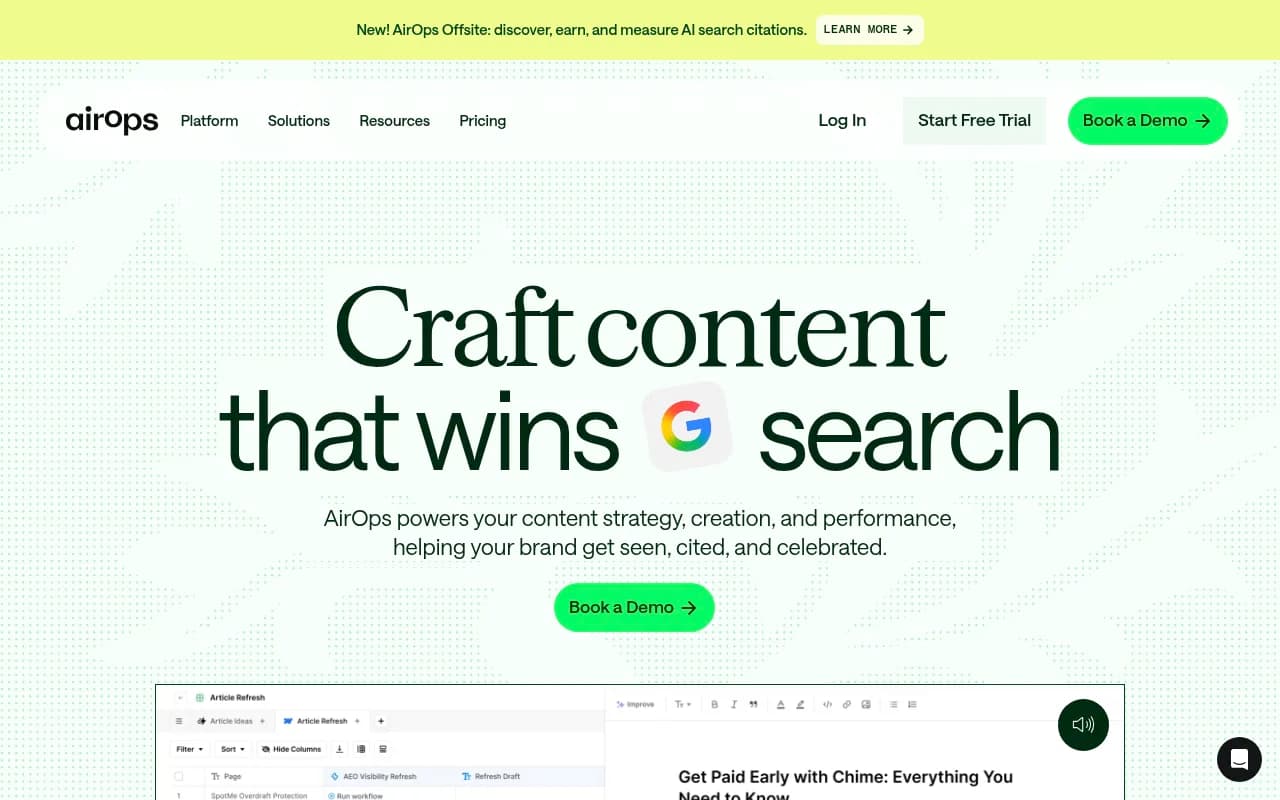
9. AirOps — best for content engineering at scale
AirOps is the most technically sophisticated option on this list. It's built for teams that want to treat content as a programmatic system rather than a manual process. You can build workflows that pull data, generate content, run quality checks, and publish — all without touching each piece individually.
It's particularly strong for teams doing large-scale content operations: product pages, comparison content, location pages. The learning curve is steeper than Jasper, but the ceiling is much higher.
The missing piece: tracking whether your content ranks in AI search
Here's what none of the tools above do particularly well: tell you whether ChatGPT, Perplexity, Claude, or Google AI Overviews is actually citing your content.
That's a separate problem from writing good content. You can produce a perfectly optimized article and still be invisible in AI search — because AI models have their own citation patterns, source preferences, and knowledge gaps that don't map neatly onto Google rankings.
To close that loop, you need a dedicated AI search visibility platform. Promptwatch is the one worth knowing about here — it tracks citations across 10 AI models, shows you which prompts your competitors are visible for that you're not, and has a built-in AI writing agent that generates content specifically engineered to get cited. It's the difference between writing content and knowing whether it's working.

Comparison table
| Tool | Starting price | Free plan | Best for | AI search tracking |
|---|---|---|---|---|
| Jasper | $49/user/mo | 7-day trial | Brand voice at scale | No |
| Writesonic | $20/mo | Limited | SEO content at volume | No |
| Surfer SEO | $89/mo | No | Traditional SEO optimization | No |
| Copy.ai | $49/mo | 2,000 words/mo | GTM workflow automation | No |
| Rytr | $7.50/mo | 10,000 chars/mo | Budget-conscious teams | No |
| Frase | $15/mo | No | Research-heavy briefs | No |
| MarketMuse | $149/mo | No | Enterprise content strategy | No |
| Clearscope | $189/mo | No | Editorial team optimization | No |
| Search Atlas | Custom | No | SEO automation | Partial |
| AirOps | Custom | No | Programmatic content at scale | Partial |
| Promptwatch | $99/mo | Free trial | AI search visibility + content | Yes (full) |
How to choose the right alternative
The right tool depends on what's actually frustrating you about Jasper.
If it's the price, Rytr or Writesonic will cover most of what you need at a fraction of the cost. Rytr if you're writing shorter content; Writesonic if you need long-form SEO articles.
If it's the workflow limitations, Copy.ai's GTM automation features are genuinely useful. It connects to more of your stack and can automate distribution, not just creation.
If it's the SEO optimization, Surfer SEO or Clearscope will give you a more rigorous optimization layer than Jasper's built-in tools. Surfer for data-heavy teams; Clearscope for editorial teams that prioritize UX.
If it's the strategic layer, MarketMuse is the upgrade. It tells you what to write, not just how to write it.
If it's the AI search visibility gap, that's a different category of problem. Writing tools don't solve it. You need something that tracks how AI models are responding to prompts in your category, shows you where competitors are getting cited, and helps you create content that fills those gaps. That's what platforms like Promptwatch are built for.
The honest answer for most teams in 2026 is a combination: a writing tool that fits your workflow and budget, plus a dedicated AI search visibility tracker that tells you whether any of it is working. The two categories are converging, but they haven't fully merged yet.
A note on AI search in 2026
The shift toward AI-mediated search is real and accelerating. ChatGPT now handles over a billion queries per week. Perplexity's user base has grown significantly. Google's AI Overviews appear on a large share of informational searches.
For content teams, this creates a new accountability question: you can measure Google rankings, but can you measure whether your content is being cited by AI systems? Most teams can't, because they don't have the tooling.
That's the gap that's opened up between traditional AI writing tools (Jasper, Writesonic, Copy.ai) and the newer generation of AI search optimization platforms. The writing tools are getting better at generating content. The optimization platforms are getting better at telling you whether that content is actually reaching people through AI search channels.
The smartest content strategies in 2026 are thinking about both.