Key takeaways
- Question-based keyword research is one of the most reliable ways to find content that matches real search intent — and these four tools are purpose-built for it.
- AlsoAsked pulls from People Also Ask data, making it the best choice for understanding how topics branch into related questions.
- AnswerThePublic is the most visual option and works well for early-stage brainstorming, but its data depth is limited.
- QuestionDB surfaces questions from Reddit and other community sources, giving you raw, unfiltered language your audience actually uses.
- KeywordsPeopleUse combines multiple data sources (autocomplete, PAA, Reddit, Quora) in one platform and adds clustering and content creation tools — making it the most complete option of the four.
Finding the right keywords used to mean chasing volume numbers. Type in a broad term, sort by monthly searches, pick the ones that seem winnable. That approach still works for transactional queries, but it falls apart when you're trying to create content that answers real questions.
People don't search the way keyword tools traditionally modeled them. They ask things. "How do I fix X?" "What's the difference between Y and Z?" "Why does this keep happening?" These question-based queries are where a lot of content opportunity lives — especially now that AI search engines like ChatGPT and Perplexity are pulling from exactly this kind of content to generate their answers.
The four tools in this guide are all built specifically for question-based research. They're not trying to replace Ahrefs or Semrush. They do something different: they surface what people are actually asking, in the language they use to ask it. Here's how they compare.
What makes question-based keyword research different
Standard keyword tools give you a list of terms with volume and difficulty scores. That's useful, but it tells you what people search for, not why or how they're thinking about it.
Question-based tools flip this. Instead of starting with a keyword and asking "how many people search for this?", you start with a topic and ask "what are people confused or curious about?" The output is a map of intent — the specific angles, concerns, and follow-up questions that cluster around any given subject.
This matters for a few reasons:
- Questions map directly to content structure. A question is already a heading, an FAQ entry, or a full article brief.
- They reveal gaps. If five related questions appear in PAA data but you've only written about one of them, you know exactly what to build next.
- They're increasingly important for AI search. Models like ChatGPT and Perplexity tend to cite content that directly answers specific questions. If your pages don't match the question format, they're less likely to get cited.
With that context, here's a close look at each tool.
AlsoAsked
AlsoAsked is built around one data source: Google's People Also Ask (PAA) boxes. When you search for something on Google, the PAA section shows a handful of related questions. AlsoAsked scrapes this data and builds a visual tree showing how questions branch out from your seed topic.
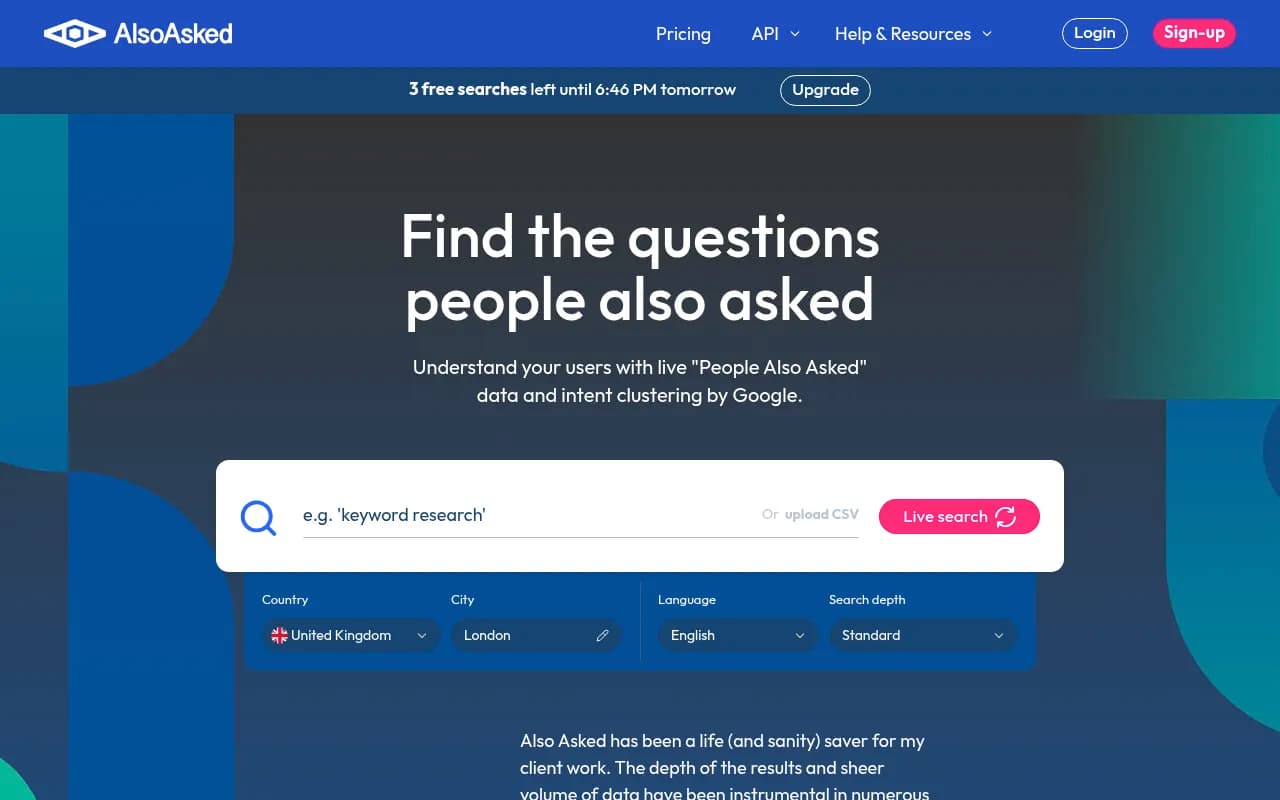
The visual format is genuinely useful. You can see at a glance how "how to make sourdough bread" branches into questions about starter, hydration, proofing time, and troubleshooting — and then how each of those branches further. It's a fast way to understand the full topic landscape around any query.
PAA data is also arguably more useful than autocomplete for understanding search intent. These are questions Google has determined are semantically related to a given query, which means they reflect how users actually think about a topic, not just what they type.
A few limitations worth knowing: AlsoAsked doesn't provide search volume data, so you can't easily prioritize by demand. The free plan is limited to 3 searches per day, and CSV exports require the paid Lite plan at $15/month. There's no content creation or clustering functionality — it's a research tool, full stop.
That said, for mapping PAA question trees and understanding topic relationships, it's one of the cleanest tools available.
AnswerThePublic
AnswerThePublic is the oldest of these four tools, and it shows — both in its strengths and its limitations. It pulls from Google Autocomplete data and organizes results into categories: who, what, why, where, how, which, when, and comparison queries. The output is a visual "sunburst" diagram that's become fairly iconic in the SEO world.
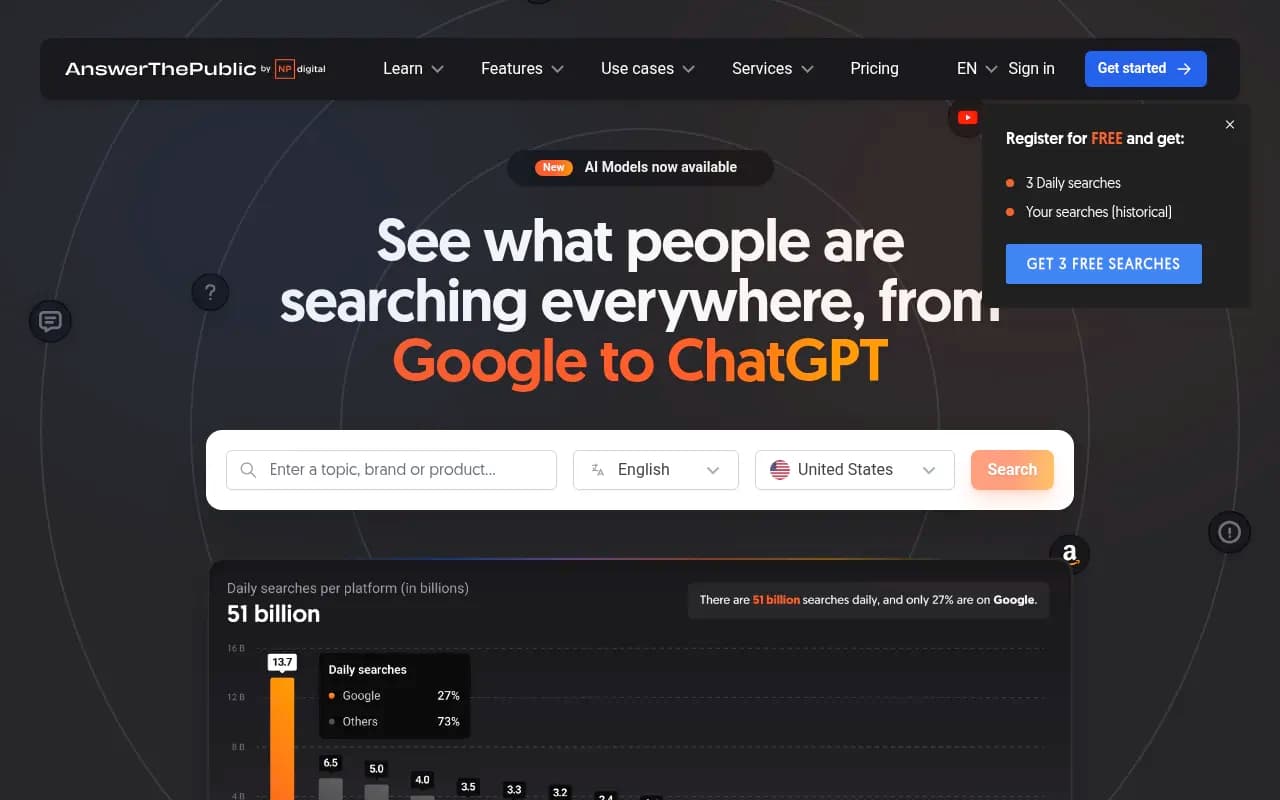
The visual presentation is AnswerThePublic's main selling point. It's easy to screenshot and share with clients or stakeholders as a quick overview of what questions exist around a topic. For brainstorming sessions and early-stage content planning, it's genuinely helpful.
The weaknesses are real, though. Autocomplete data has a ceiling. It tells you what Google suggests when someone starts typing, which is useful but not the same as knowing what questions people are actually asking and clicking on. Search volume data is available on paid plans, but as the KeywordsPeopleUse team notes, search volume for question-based queries is often near zero — which makes it a less reliable signal than it looks.
Pricing starts at $5/month for a basic plan, which is the most affordable entry point of the four tools here. But functionality stops at generating keyword lists. There's no clustering, no content generation, and no API access.
AnswerThePublic works best as a quick brainstorming tool, not a primary research platform.
QuestionDB
QuestionDB takes a different approach from the other three. Rather than pulling from Google's autocomplete or PAA data, it sources questions from Reddit and other community forums. The result is a database of real questions that real people have asked in natural language.
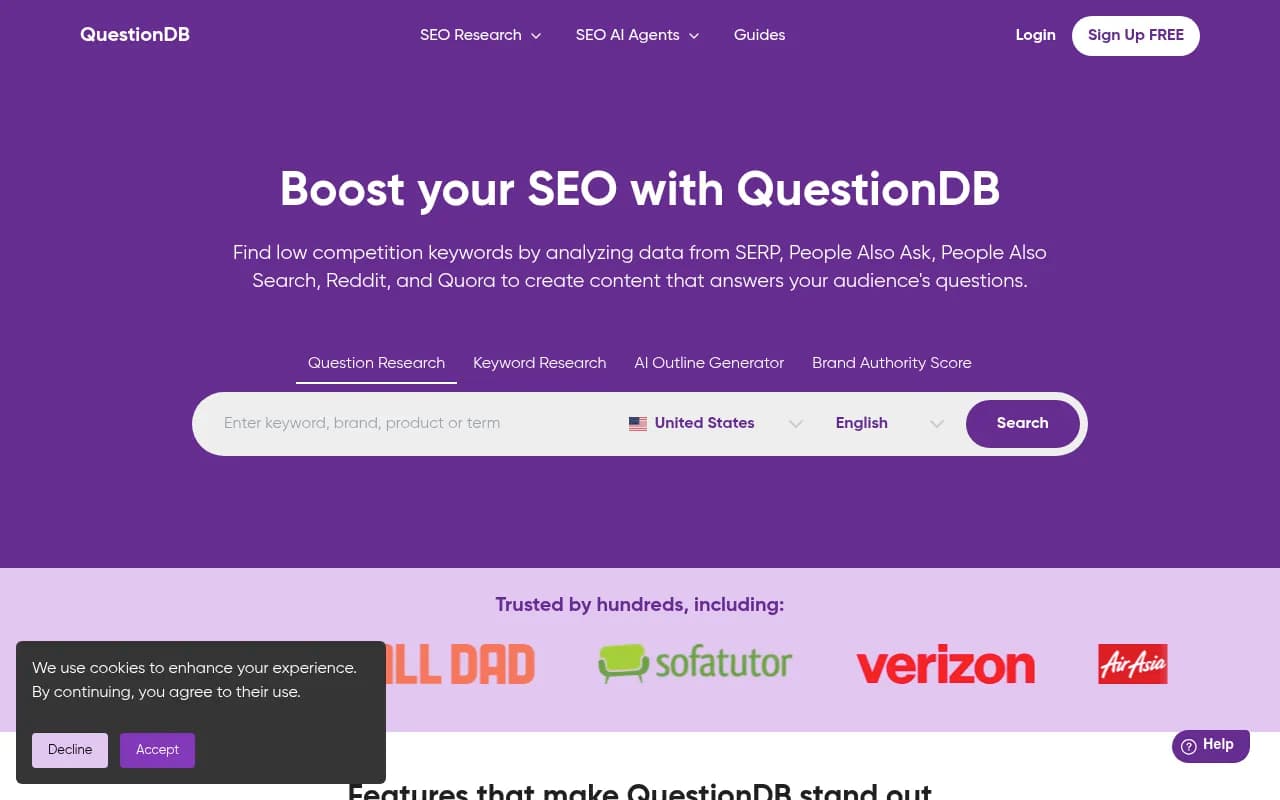
This is a meaningful distinction. Autocomplete and PAA data reflect what Google's algorithm surfaces — which is shaped by what gets clicked, what gets ranked, and what Google thinks is related. Reddit data reflects what people actually type when they're confused, curious, or looking for help from other humans. The language is messier, more specific, and often more useful for content that needs to sound like it was written by someone who understands the problem.
If you're writing content for technical audiences, niche communities, or any topic where people have strong opinions and specific vocabulary, QuestionDB often surfaces questions you won't find anywhere else.
The trade-off is that it's a narrower tool. It doesn't have the visual tree format of AlsoAsked or AnswerThePublic, and it doesn't combine multiple data sources. It's best used alongside another tool rather than as a standalone solution.
KeywordsPeopleUse
KeywordsPeopleUse is the most feature-complete of the four. It pulls from multiple sources — Google Autocomplete, People Also Ask, Reddit, and Quora — and combines them in a single visual interface. The idea is that no single source gives you the full picture, so combining them gets you closer to understanding what your audience actually wants to know.
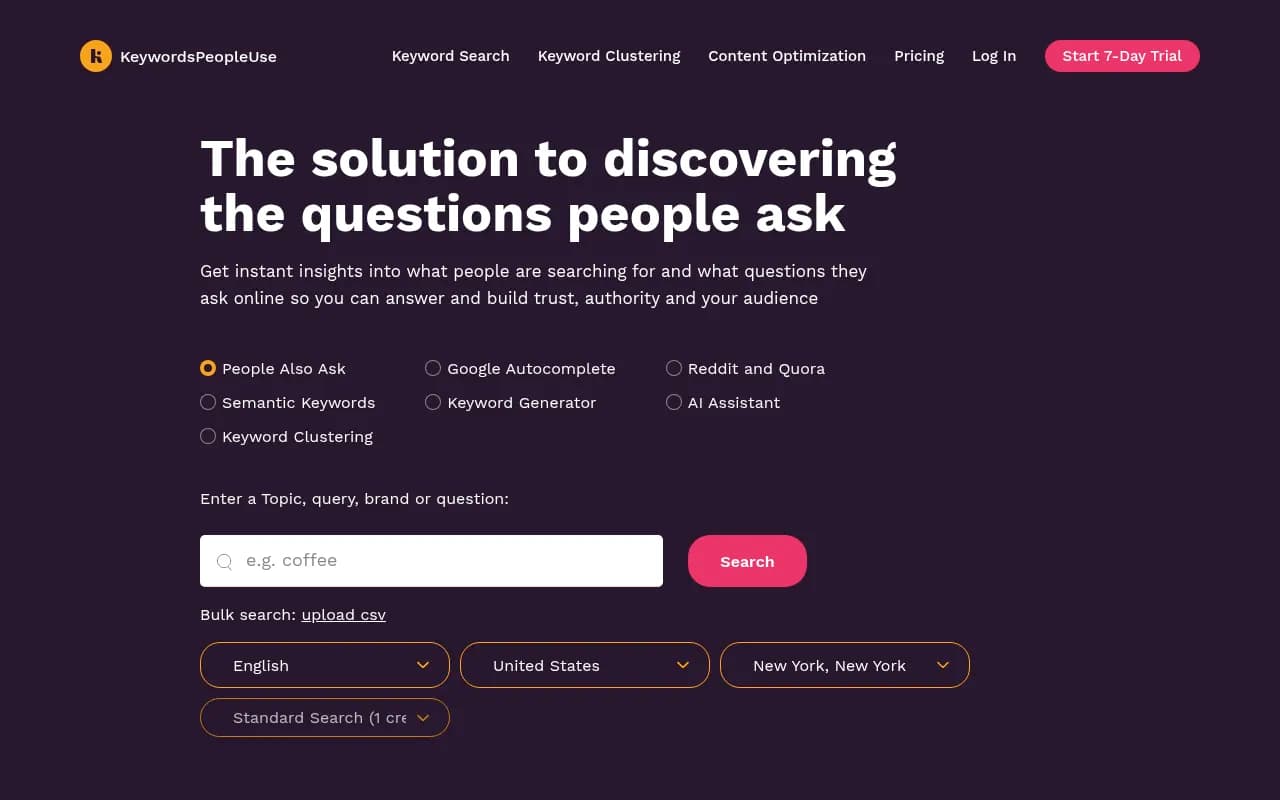
Beyond data aggregation, KeywordsPeopleUse adds functionality the other tools don't have: keyword clustering (grouping related questions into topic clusters), a content editor, an AI writing assistant, and CSV export. There's also an API for teams that want to build custom workflows.
The clustering feature is particularly useful. Once you've pulled a list of questions around a topic, you can group them into logical content hubs — which makes it much easier to plan a content calendar or identify which single piece of content could address multiple related queries.
The Reddit and Quora integration is worth calling out specifically. These sources surface conversational, community-driven language that autocomplete and PAA miss. If your audience asks questions on Reddit (and most audiences do), this data is genuinely valuable.
The main downside is the credit system. Like most tools in this category, KeywordsPeopleUse limits usage by plan tier, and hitting your credit limit mid-project is frustrating. Pricing starts at a free plan with limited searches, with paid plans scaling up from there.
Side-by-side comparison
| Feature | AlsoAsked | AnswerThePublic | QuestionDB | KeywordsPeopleUse |
|---|---|---|---|---|
| Data source | People Also Ask | Google Autocomplete | Reddit / forums | Autocomplete + PAA + Reddit + Quora |
| Visual format | Tree diagram | Sunburst diagram | List | Visual + list |
| Search volume data | No | Yes (paid) | No | No |
| Keyword clustering | No | No | No | Yes |
| Content creation tools | No | No | No | Yes (AI writer) |
| CSV export | Paid ($15/mo) | Paid | Yes | Yes (paid) |
| API access | No | No | No | Yes |
| Free plan | 3 searches/day | 3 searches/day | Yes (limited) | Yes (limited) |
| Starting price | $15/mo | $5/mo | Free / paid tiers | Free / paid tiers |
| Best for | PAA topic mapping | Quick brainstorming | Community language | Full research workflow |
Which tool should you use?
The honest answer is that these tools aren't really competing with each other — they're complementary. But if you have to pick one:
Use AlsoAsked if your main goal is understanding how topics branch in Google's PAA data. It's the cleanest tool for this specific job, and the visual tree format makes it easy to present findings to others.
Use AnswerThePublic if you need a quick overview of what questions exist around a topic and you're not ready to invest in a more powerful tool. The $5/month entry price is hard to argue with for occasional use.
Use QuestionDB if you're writing for niche communities or technical audiences where Reddit is a primary source of discussion. The community-sourced language will make your content feel more authentic.
Use KeywordsPeopleUse if you want a single tool that covers multiple data sources and gives you somewhere to go after the research — clustering, content creation, and export. It's the most complete workflow of the four.
For teams doing this at scale, it's worth pairing any of these tools with a broader SEO platform. Tools like Semrush or Ahrefs add the competitive context (who's ranking for these questions, what's the difficulty, what does the SERP look like) that question-focused tools don't provide.
A note on question research for AI search
One thing worth flagging in 2026: question-based content is increasingly important not just for traditional SEO but for AI search visibility. When someone asks ChatGPT or Perplexity a question, those models pull from content that directly addresses the query. Pages structured around specific questions — with clear, direct answers — tend to get cited more often than pages that bury the answer in long paragraphs.
If you're tracking how your content performs in AI search (not just Google), tools like Promptwatch can show you which of your pages are being cited by AI models and for which prompts — which closes the loop between question research and actual AI visibility.

The research workflow, then, looks something like this: use a question tool to find what people are asking, create content that answers those questions directly, then track whether AI models are actually citing it. The question research tools in this guide handle the first step well. The rest depends on how you build and measure.
Final thoughts
Question-based keyword research is one of the more underused approaches in content strategy, mostly because traditional SEO tools don't make it easy. The four tools here fix that problem in different ways.
AlsoAsked is the best pure PAA tool. AnswerThePublic is the most accessible entry point. QuestionDB gives you community language you won't find elsewhere. KeywordsPeopleUse is the most complete if you want research and content creation in one place.
None of them replace a full SEO platform, but all of them will surface content ideas you'd miss with a standard keyword tool. For content teams trying to write things people actually want to read, that's worth a lot.