Key takeaways
- Peec.ai is a solid entry point for AI visibility monitoring, but teams are hitting walls with cost, coverage gaps, and the lack of any optimization workflow.
- Google AI Mode has become a critical tracking target in 2026 -- most Peec.ai alternatives cover it, but depth varies significantly.
- The biggest dividing line between tools is whether they stop at monitoring or actually help you fix visibility gaps with content.
- Promptwatch is the only platform in this comparison rated as a "Leader" across all GEO categories -- it monitors 10 AI models and includes built-in content generation to close the loop.
- If you're already in an SEO suite, SE Ranking's AI add-on is the lowest-friction upgrade.
Peec.ai had a good run. When generative search first started eating into traditional SERP real estate, it was one of the first tools to give SEOs a clear view of where their brand appeared in AI-generated answers. Agencies loved the clean prompt-level snapshots. Content teams used it to spot gaps.
But 2026 is a different environment. Google AI Mode is now a mainstream search surface, not an experiment. ChatGPT Search, Perplexity, Claude, and Gemini are all sending meaningful traffic. And the teams I've seen struggling most aren't the ones without data -- they're the ones with dashboards full of data and no clear path to doing anything about it.
That's where Peec.ai starts to show its limits. Three complaints keep coming up in communities like r/GEO_optimization and TrafficThinkTank: costs that scale badly for large keyword sets, accuracy inconsistencies across industries, and a monitoring-only model that leaves you on your own when it comes to actually improving visibility.
This guide compares eight alternatives across the dimensions that matter most in 2026: AI model coverage (especially Google AI Mode), prompt-level analytics, content optimization capabilities, and pricing.
What to look for in a Peec.ai alternative
Before getting into specific tools, it's worth being clear about what "tracking Google AI Mode" actually requires -- because not all platforms handle it the same way.
Google AI Mode (the conversational, multi-step search experience Google rolled out broadly in 2025) is distinct from AI Overviews. AI Overviews appear in standard search results. AI Mode is a separate, chat-style interface that cites sources differently and responds to follow-up queries. Some tools track one but not the other. A few track both.
Beyond coverage, the questions worth asking:
- Does the tool track prompt-level visibility (not just brand mentions)?
- Can you see which specific pages are being cited, and by which AI model?
- Does it give you any guidance on what to do when you're not showing up?
- How does pricing scale as you add prompts, sites, or team members?
With that framing, here's how the main alternatives stack up.
The 8 best Peec.ai alternatives in 2026
1. Promptwatch
Promptwatch is the most complete platform in this comparison -- and the only one that covers the full cycle from finding gaps to fixing them.

On the monitoring side, it tracks 10 AI models: ChatGPT, Perplexity, Google AI Overviews, Google AI Mode, Claude, Gemini, Meta/Llama, DeepSeek, Grok, and Mistral. Page-level tracking shows exactly which URLs are being cited, how often, and by which model. That alone is more granular than what Peec.ai offers.
Where Promptwatch separates itself is the action loop. The Answer Gap Analysis identifies specific prompts where competitors are visible but you're not -- not as a vague "you're missing coverage here" signal, but as a concrete list of prompts with volume estimates and difficulty scores. Then the built-in AI writing agent generates content designed to get cited: articles, listicles, and comparisons grounded in 880M+ citations analyzed across models.
A few things that don't exist in Peec.ai at all: AI Crawler Logs (real-time logs of ChatGPT, Claude, and Perplexity bots hitting your site), Reddit and YouTube insights (surfacing discussions that directly influence AI recommendations), and ChatGPT Shopping tracking.
Traffic attribution is also handled properly -- via a code snippet, Google Search Console integration, or server log analysis -- so you can connect AI visibility to actual revenue rather than treating it as a vanity metric.
Pricing starts at $99/month for the Essential plan (1 site, 50 prompts, 5 articles). Professional is $249/month (2 sites, 150 prompts, crawler logs). Business is $579/month (5 sites, 350 prompts). Agency and enterprise pricing is custom.
Best for: Teams that want to move from monitoring to optimization. Multi-market brands tracking multiple languages, countries, and personas. Anyone who's frustrated with dashboards that show problems but don't help solve them.
2. Profound
Profound

Profound is the other enterprise-grade option in this space, and it's genuinely strong on the analytics side. Entity extraction, attribution mapping, and AI Overview tracking are all well-developed. It covers 9+ AI search engines and has a reputation for data accuracy.
The friction points are real, though. At $399/month for meaningful access, it's priced above most of this list. Onboarding takes longer than it should. And like Peec.ai, it's fundamentally a monitoring platform -- it shows you where you're invisible but doesn't help you create content to fix it.
For teams that need deep reporting and have the budget and technical capacity to act on the data themselves, Profound is a legitimate choice. For teams that need faster time-to-value or a clearer "do this next" workflow, it's harder to justify.
Best for: Enterprise visibility teams with dedicated SEO analysts who can interpret and act on data-rich outputs.
3. SE Ranking
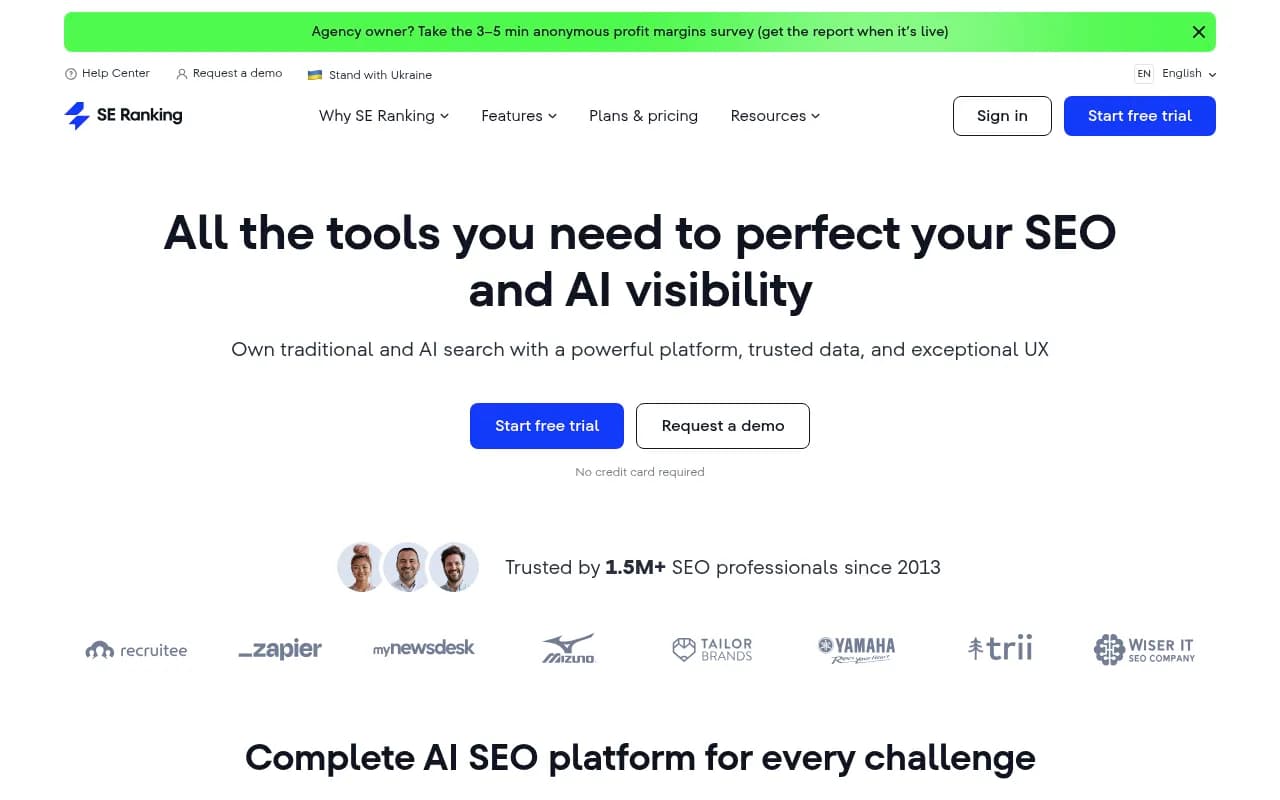
SE Ranking is an all-in-one SEO platform that added AI visibility tracking as an add-on module. If you're already using SE Ranking for traditional rank tracking, site audits, and keyword research, the AI visibility layer is the lowest-friction upgrade in this entire list -- everything lives in one dashboard, historical data is already there, and the learning curve is minimal.
The AI tracking module covers Google AI Overviews and, as of 2026, Google AI Mode. It's not as deep as Promptwatch or Profound on the LLM side -- ChatGPT and Perplexity coverage is more limited -- but for teams whose primary concern is Google's AI surfaces, it works well.
Pricing for the AI visibility add-on starts around $95/month on top of the base SE Ranking plan.
Best for: SE Ranking users who want AI visibility without switching platforms. Teams whose primary tracking target is Google AI Overviews and AI Mode rather than ChatGPT or Perplexity.
4. AthenaHQ

AthenaHQ focuses on multi-engine AI visibility: Google AI Overviews, Perplexity, ChatGPT, and Claude. The interface is clean and the data is reasonably reliable. It's positioned for brands competing in AI-native search and teams that need competitive intelligence across models.
The gap is on the optimization side. AthenaHQ is monitoring-focused -- it tells you where you stand but doesn't generate content or provide specific guidance on what to change. At $295/month, it's priced in a range where you'd expect more actionability.
Best for: Competitive intelligence teams that need multi-engine visibility data and have separate content workflows.
5. Semrush
Semrush added AI visibility features to its platform, including AI share of voice, sentiment analysis, and daily tracking for Google AI Mode and ChatGPT. For enterprise marketers already paying for Semrush, it's a reasonable way to add AI monitoring without a separate tool.
The limitations are worth knowing: Semrush uses fixed prompts rather than custom ones, which means you're tracking what Semrush decides to track rather than the specific queries your customers actually use. There's also no AI traffic attribution. The AI features feel like an addition to an SEO platform rather than a purpose-built GEO tool.
Best for: Enterprise teams already on Semrush who want basic AI visibility data without adding another vendor.
6. Otterly.AI
Otterly.AI

Otterly.AI is a monitoring-only tool that covers ChatGPT, Perplexity, and Google AI Overviews. It's simpler and cheaper than most alternatives here, which makes it genuinely useful for smaller teams or individuals who just want to know if their brand is showing up.
What it doesn't do: crawler logs, content generation, traffic attribution, Reddit/YouTube insights, or prompt volume data. It's a visibility snapshot tool, not an optimization platform. If you're coming from Peec.ai specifically because you need more depth, Otterly.AI probably isn't the answer.
Best for: Small teams or solo operators who need basic brand monitoring in AI answers at a low price point.
7. Scrunch AI
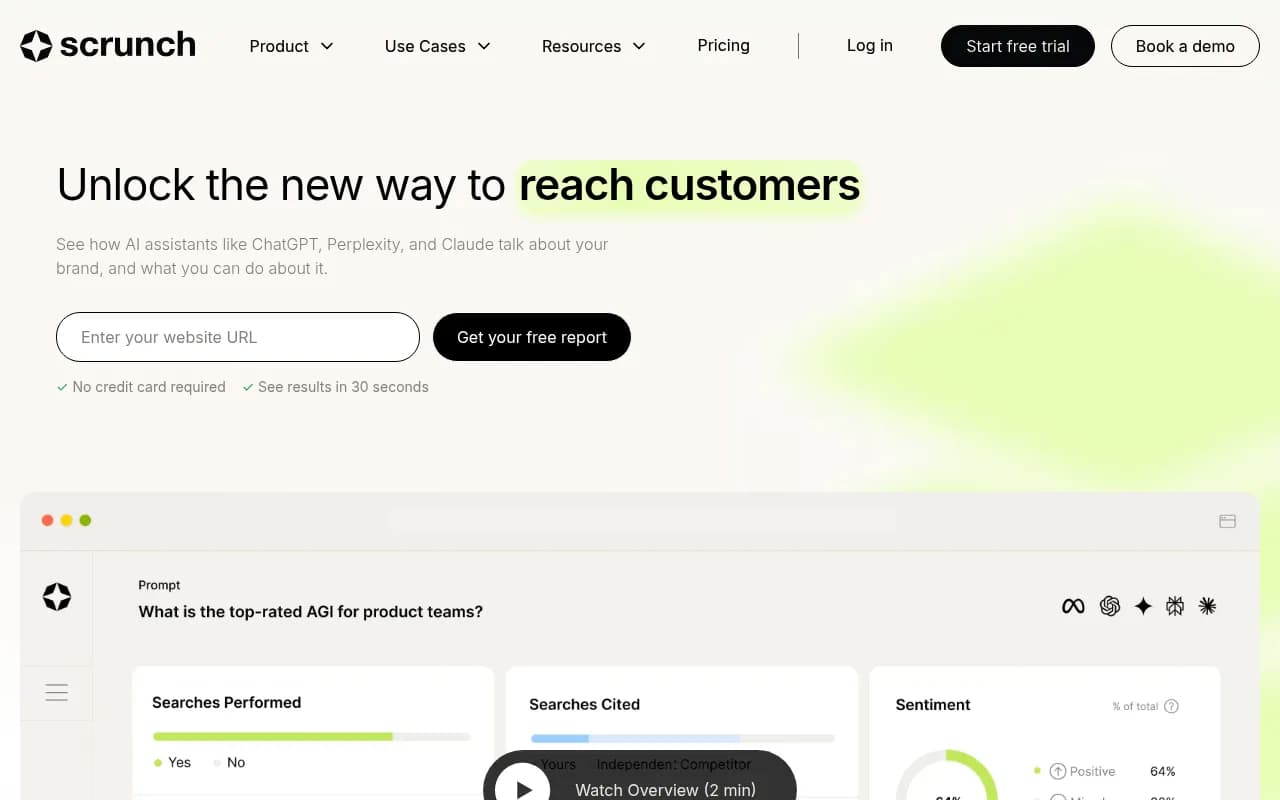
Scrunch AI takes a different angle -- it focuses on brand narrative and descriptor analysis. Rather than just tracking whether your brand appears, it analyzes how AI models describe your brand: the language they use, the associations they make, the competitors they mention alongside you.
This is genuinely useful for brand teams and PR-adjacent SEO work. If your concern is not just "are we visible" but "what are AI models saying about us," Scrunch AI has capabilities that most other tools in this list don't.
The trade-off is that it's narrower in scope. It's not a full GEO platform -- it's a brand intelligence tool with AI search capabilities.
Best for: Brand teams and communications leads who care about how AI models characterize their brand, not just whether they appear.
8. LLM Pulse
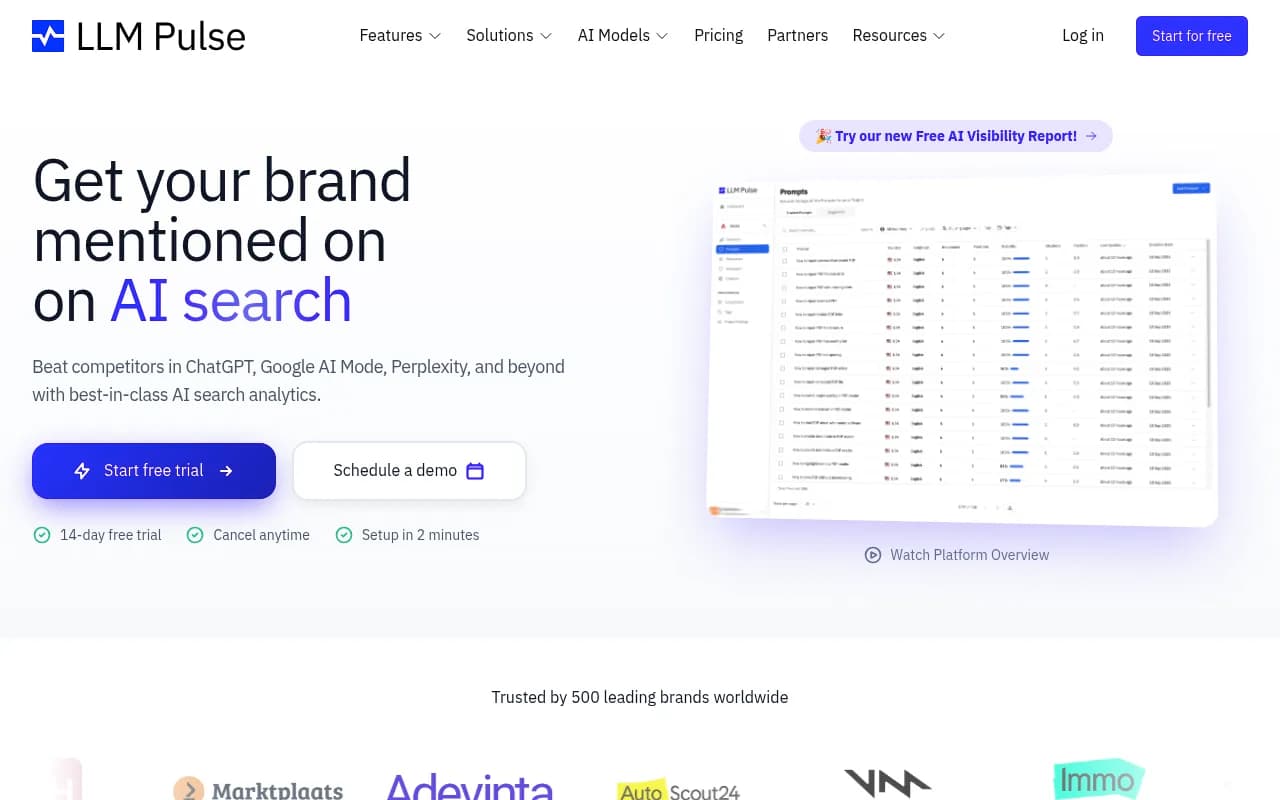
LLM Pulse is a newer entrant that tracks brand visibility across ChatGPT, Perplexity, and several other models. It's positioned as a lightweight alternative for teams that find the major platforms overpowered for their needs.
Coverage is more limited than Promptwatch or Profound, and it lacks advanced features like crawler logs or content generation. But for agencies with VC-backed clients who need quick visibility snapshots to share with stakeholders, it's functional.
Best for: Agencies that need shareable visibility reports without a heavy implementation lift.
Side-by-side comparison
| Tool | Google AI Mode | ChatGPT tracking | Content generation | Crawler logs | Traffic attribution | Starting price |
|---|---|---|---|---|---|---|
| Promptwatch | Yes | Yes | Yes (built-in) | Yes | Yes | $99/mo |
| Profound | Yes | Yes | No | No | Limited | $399/mo |
| SE Ranking | Yes | Limited | No | No | No | ~$95/mo add-on |
| AthenaHQ | Yes | Yes | No | No | No | $295/mo |
| Semrush | Yes | Yes | No | No | No | Varies |
| Otterly.AI | Yes | Yes | No | No | No | Low |
| Scrunch AI | Limited | Yes | No | No | No | Varies |
| LLM Pulse | Limited | Yes | No | No | No | Varies |
| Peec.ai | Yes | Yes | No | No | No | Varies |
Which tool should you actually use?
The honest answer depends on what's frustrating you about Peec.ai.
If the issue is cost at scale, SE Ranking's add-on is worth looking at -- especially if you're already in their ecosystem.
If the issue is coverage (you need more than Google AI Overviews and want ChatGPT, Claude, Perplexity, and Gemini all in one place), Promptwatch or Profound are the serious options. Profound is more expensive and monitoring-only. Promptwatch costs less and actually helps you fix what you find.
If the issue is that you're drowning in data but nothing is changing, that's a sign you need a platform built around optimization, not just tracking. That's where the monitoring-only tools -- Peec.ai, Otterly.AI, AthenaHQ -- all hit the same wall. You can see the gap. You just can't close it from inside the dashboard.
The r/GEO_optimization community put it plainly: "if you're comparing between profound and promptwatch, go with promptwatch." That tracks with what the data shows -- Promptwatch is the only platform in a 2026 comparison of 12 GEO tools rated as a "Leader" across all categories.
For most marketing teams in 2026, the question isn't whether to track Google AI Mode -- it's whether the tool you're using gives you any way to act on what you find. That's the bar worth measuring against.