Key takeaways
- Agency social media tools need to do more than schedule posts -- client workspaces, approval workflows, and white-label reporting are the features that actually matter at scale
- Planable leads for collaboration and approval workflows; Sendible is the go-to for white-label portals; SocialPilot offers the best price-to-feature ratio for agencies managing many SMB clients
- Hootsuite and Sprout Social are powerful but priced for enterprise budgets -- most agencies don't need everything they offer
- Buffer and Later work well for smaller agencies or freelancers but lack the multi-client infrastructure that growing teams need
- The tools below are compared across the dimensions agencies actually care about: client isolation, approval flows, reporting, and pricing
Managing social media for one brand is manageable. Managing it for 15 clients simultaneously -- each with their own brand voice, approval chain, posting calendar, and reporting expectations -- is a completely different operation. Most scheduling tools are built for the first scenario. Only a handful are genuinely built for the second.
This guide cuts through the noise. We looked at the tools agencies actually use in 2026, focusing on the features that separate a good agency tool from a generic scheduling app: proper client workspaces, multi-step approval workflows, white-label reporting, and pricing that doesn't punish you for growing.
What agencies actually need from a scheduling tool
Before comparing tools, it's worth being specific about what "agency features" actually means. A lot of tools claim to support agencies while offering nothing more than a shared login and a basic calendar.
The features that genuinely matter:
- Client workspaces: Each client should live in its own isolated environment. Content, calendars, and analytics for Client A shouldn't bleed into Client B.
- Approval workflows: Clients need to review and approve content before it goes live. The best tools let you build multi-step flows (internal review, then client sign-off) without requiring clients to create an account.
- White-label reporting: You should be able to send clients reports with your agency's branding, not the tool's logo plastered everywhere.
- Bulk scheduling: Uploading a month of content for multiple clients via CSV or batch upload saves hours.
- Team permissions: Different roles for account managers, copywriters, designers, and clients -- with appropriate access levels for each.
- Pricing that scales: Per-user pricing can get expensive fast. Agency-friendly tools typically offer per-client or per-workspace pricing instead.
With that framework in mind, here's how the main contenders compare.
The tools compared
Planable
Planable is the tool most agencies reach for when collaboration is the priority. Its entire design is built around the content review process -- you create posts, they show up in a visual feed or calendar, and clients or teammates can comment, suggest edits, or approve directly in the interface.
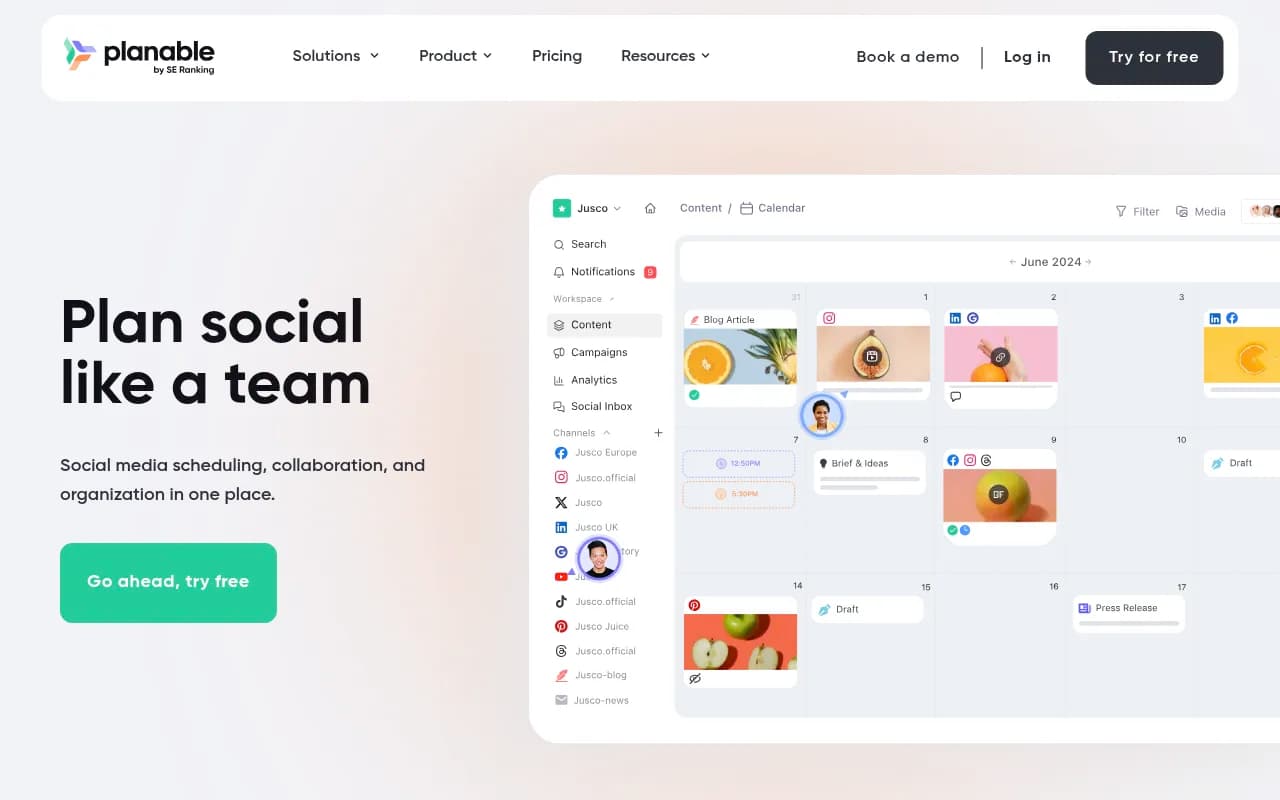
The approval workflow is genuinely good. You can set up multi-level approvals (internal first, then client), require all approvers to sign off before a post can be scheduled, and lock approved content so it can't be accidentally edited. Clients don't need a Planable account to review -- they get a shareable link.
Where Planable is weaker: analytics and reporting. It's primarily a publishing and collaboration tool, not a reporting platform. If your clients expect detailed performance reports, you'll need to pull data from elsewhere or use a separate reporting tool.
Pricing starts at around $33/month for small teams, with agency plans available. It's not the cheapest option, but for agencies where client approval friction is the biggest pain point, it's hard to beat.
Sendible
Sendible is the closest thing to a purpose-built agency platform in this list. It has white-label portals (clients log in to a branded URL with your agency's logo), client-level dashboards, and reporting that you can customize and schedule to send automatically.
The approval workflow is solid -- you can route posts through internal review before they ever reach the client. The content calendar is clean, bulk scheduling works well, and there's a decent asset library for storing client brand materials.
Sendible also supports a wide range of networks, including some less common ones like Google Business Profile, which matters for agencies with local business clients.
Pricing is higher than some alternatives -- plans start around $89/month and agency tiers can run $240+/month. But if white-labeling is non-negotiable for your agency, Sendible is one of the few tools that actually does it properly.
SocialPilot
SocialPilot is the value pick for agencies. It covers the core agency feature set -- bulk scheduling, white-labeling, client approvals, analytics -- at a price point that's noticeably lower than Hootsuite or Sprout Social.
The client management setup is practical: each client gets their own workspace, you can assign team members to specific clients, and the approval flow lets clients review content via a link without needing an account. The white-label option lets you rebrand the client-facing portal with your agency's logo and domain.
Analytics are functional but not deep. You get the standard engagement metrics and can export reports, but if a client wants sophisticated attribution or cross-channel analysis, SocialPilot won't satisfy that need alone.
Where SocialPilot shines is the combination of price and breadth. For agencies managing 10-20 SMB clients who need reliable scheduling, basic reporting, and a clean approval process, it's probably the most cost-effective option available.
Hootsuite
Hootsuite is the tool most people have heard of, and for good reason -- it's been around long enough to build out a genuinely comprehensive feature set. AI-assisted scheduling, a large app marketplace, team inboxes, and solid analytics are all there.
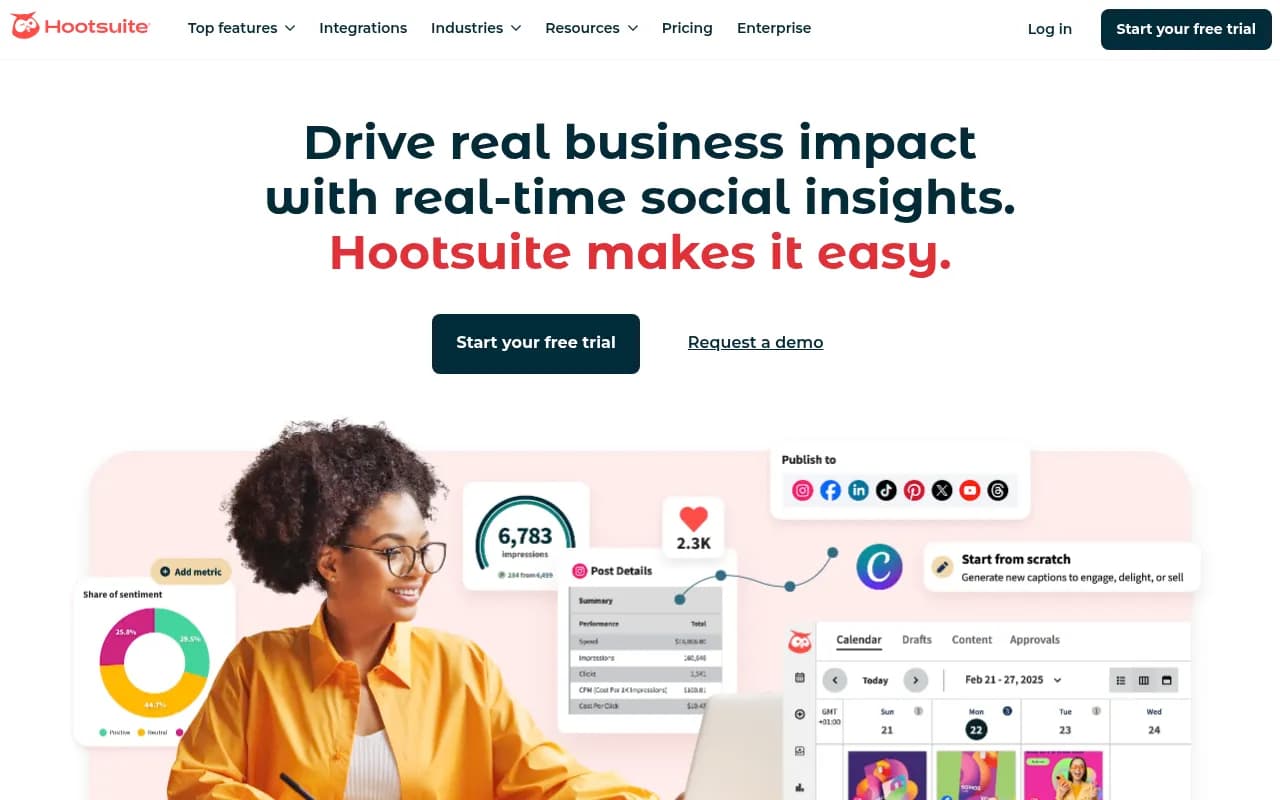
For agencies, Hootsuite's strengths are its depth and integrations. If you're managing enterprise clients who need sophisticated reporting, social listening, or integration with CRM tools, Hootsuite can handle it. The team permission system is granular, and the reporting is among the best in this category.
The honest downside: it's expensive. Agency plans run into the hundreds of dollars per month, and the pricing model can get complicated as you add users and social profiles. Smaller agencies often find they're paying for capabilities they don't use. There's also a learning curve -- Hootsuite is not a tool you set up in an afternoon.
Sprout Social
Sprout Social sits at the premium end of the market. The analytics are genuinely excellent -- probably the best in this comparison -- and the platform handles enterprise-level social management well. Approval workflows, team collaboration, and reporting are all polished.
The catch is price. Sprout Social's plans start at $249/month per seat, which puts it out of reach for most small-to-mid agencies unless they're billing clients at a rate that justifies it. It's a tool that makes sense when you're managing large brand accounts where the reporting quality directly affects client retention.
If you're a boutique agency managing a handful of high-value clients and you need to show up to quarterly reviews with beautiful, data-rich reports, Sprout Social is worth considering. If you're running a high-volume SMB agency, the math probably doesn't work.
Buffer
Buffer is simple, affordable, and honest about what it is. It's a scheduling tool with clean UX, good multi-network support, and a decent analytics layer. The AI assistant helps with caption writing, and the interface is genuinely easy to use.
For agencies, Buffer's limitations are real. There's no proper client workspace isolation, approval workflows are basic, and white-labeling isn't available. It works well for freelancers managing a few clients or very small agencies where everyone is in the same Slack channel. Once you have more than 4-5 clients with distinct approval needs, Buffer starts to feel like the wrong tool.
That said, Buffer's pricing is hard to argue with. The free tier covers basic scheduling, and paid plans start at $6/month per channel. For a solo social media manager with a small client roster, it's a perfectly reasonable choice.
Later
Later built its reputation on visual Instagram scheduling -- the drag-and-drop calendar and link-in-bio tool made it popular with lifestyle brands and influencer-adjacent agencies. It's expanded since then to cover more networks and add analytics.

For agencies, Later has similar limitations to Buffer. The approval workflow is basic, there's no white-label reporting, and client workspace management isn't as structured as Planable or Sendible. Where Later still excels is visual content planning -- if you're running an agency focused on Instagram or TikTok for fashion, food, or lifestyle brands, the visual calendar is genuinely useful.
Loomly
Loomly is a solid mid-market option that often gets overlooked. It has a clean interface, good approval workflows, and a content calendar that's easy to navigate. The "Post Ideas" feature surfaces content suggestions based on trending topics, which some agencies find useful for sparking client content.
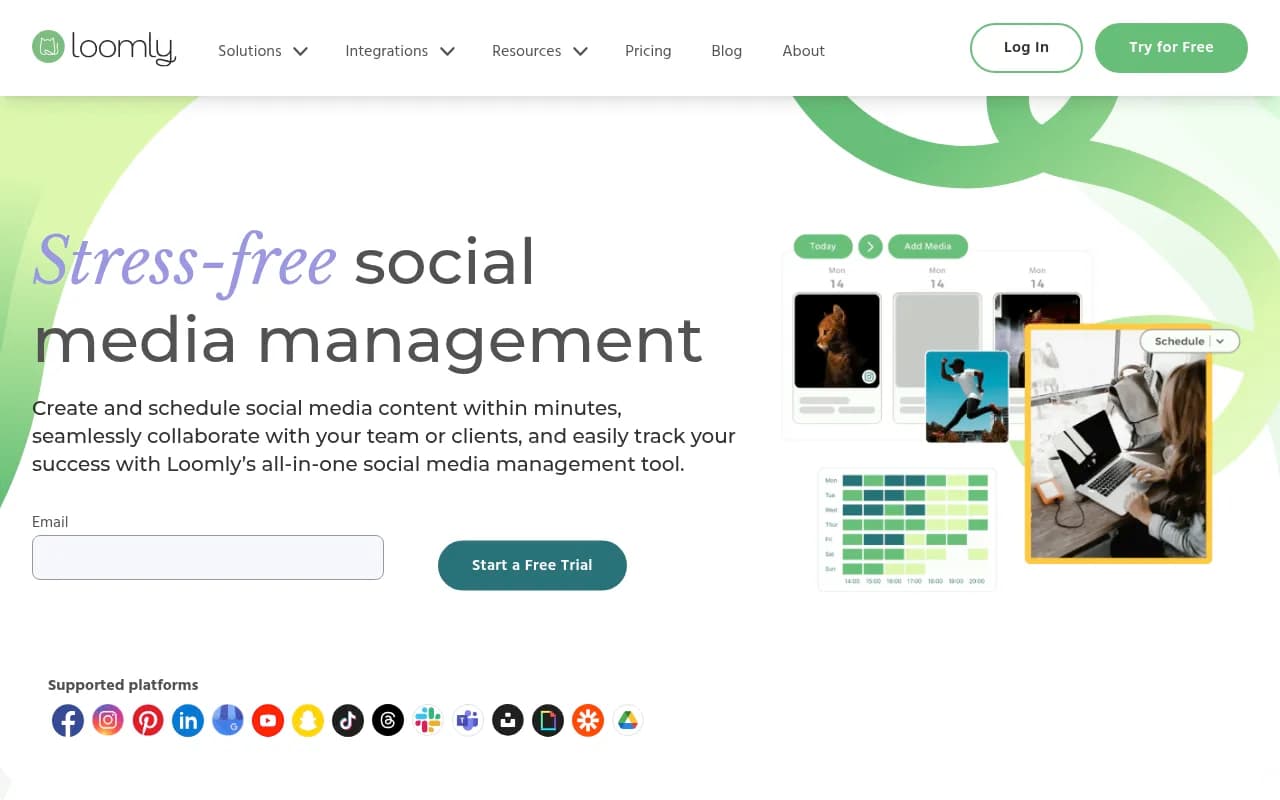
The approval flow in Loomly is straightforward: you can require client approval before posts are scheduled, and clients can comment or approve via email without logging in. White-label reporting is available on higher tiers.
Loomly sits between Buffer (too basic) and Sendible (more expensive, more features) in terms of both price and capability. It's a reasonable choice for agencies that want a clean, no-fuss tool without paying Sendible prices.
Agorapulse
Agorapulse is worth mentioning specifically for agencies that care about social inbox management alongside scheduling. Its unified inbox -- where you can manage comments, DMs, and mentions across all clients from one place -- is one of the better implementations in this category.
Approval workflows are solid, reporting is good, and there's a client-facing report feature. Pricing is mid-range, making it accessible for growing agencies.
FeedHive
FeedHive is a newer entrant that's gained traction for its AI content tools and content recycling features. If you manage clients who need a steady stream of content and want to repurpose evergreen posts automatically, FeedHive handles that well.

It's lighter on the enterprise agency features (white-labeling, complex approval chains) but punches above its weight for content volume and AI-assisted creation.
Feature comparison table
| Tool | Client workspaces | Approval workflows | White-label reporting | Bulk scheduling | Starting price (agency) |
|---|---|---|---|---|---|
| Planable | Yes | Multi-step, excellent | Limited | Yes | ~$33/mo |
| Sendible | Yes | Yes | Yes (branded portal) | Yes | ~$89/mo |
| SocialPilot | Yes | Yes (link-based) | Yes | Yes | ~$50/mo |
| Hootsuite | Yes | Yes | Yes | Yes | ~$99/mo |
| Sprout Social | Yes | Yes | Yes (premium) | Yes | ~$249/seat |
| Buffer | Limited | Basic | No | Yes | $6/channel |
| Later | Limited | Basic | No | Yes | ~$18/mo |
| Loomly | Yes | Yes | On higher tiers | Yes | ~$42/mo |
| Agorapulse | Yes | Yes | Yes | Yes | ~$79/mo |
| FeedHive | Limited | Basic | No | Yes | ~$19/mo |
Pricing as of mid-2026. Always verify current pricing on each tool's website.
How to choose the right tool for your agency
The honest answer is that the right tool depends on what's actually causing friction in your workflow right now.
If client approvals are your biggest headache, Planable is the most purpose-built solution. The approval UX is genuinely better than anything else in this list.
If white-labeling is non-negotiable, Sendible is the clearest choice. The branded client portal is a real differentiator, not a checkbox feature.
If you're managing many SMB clients on tight margins, SocialPilot gives you the most agency functionality per dollar. It's not the most polished tool, but it covers the essentials without breaking the budget.
If your clients are enterprise brands with serious reporting expectations, Sprout Social or Hootsuite are worth the premium. The analytics depth justifies the cost when you're presenting to a CMO.
If you're a solo freelancer or very small agency, Buffer or Later are perfectly fine. Don't pay for features you don't need.
One thing worth noting: none of these tools solve the content strategy problem. They help you schedule, approve, and report on content -- but figuring out what content to create, which topics resonate, and how your clients' brands are performing across the broader digital landscape is a separate challenge. For agencies managing clients who care about their presence in AI search results (increasingly common in 2026), tools like Promptwatch can help track how brands appear in ChatGPT, Perplexity, and Google AI Overviews -- a visibility layer that social scheduling tools don't touch.

A note on AI features in 2026
Most of the tools in this list have added AI caption generation, hashtag suggestions, and optimal posting time recommendations in the last 18 months. Honestly, the quality varies a lot. Hootsuite's AI tools are reasonably good. Buffer's AI assistant is useful for quick drafts. For most of the others, the AI features are more marketing than substance.
The more interesting AI development is in content ideation and performance prediction -- FeedHive's recycling logic and Loomly's content suggestions are early versions of something that will probably get more useful over time. But right now, if AI content generation is a core requirement, you're better off using a dedicated tool alongside your scheduling platform rather than relying on the built-in features.
Final thoughts
The social media scheduling tool market has matured. The core scheduling functionality is table stakes -- every tool on this list handles it competently. What separates them is the agency infrastructure: how well they handle client isolation, how smooth the approval process is, and how professional the reporting looks when it lands in a client's inbox.
Planable and Sendible are the two tools most worth evaluating first if you're running a genuine agency operation. SocialPilot is the right call if budget is the primary constraint. And if you're already on Hootsuite or Sprout Social and the pricing is working, there's probably no compelling reason to switch -- both are solid platforms that will keep improving.
The best tool is the one your team actually uses consistently and your clients find easy to interact with. Start with a free trial of your top two candidates and see which one causes less friction in your real workflow.