Key takeaways
- Google AI Overviews now appear on a large share of commercial and informational queries, making visibility tracking essential for any SEO strategy in 2026.
- Semrush, Ahrefs, and SE Ranking all offer AI Overview tracking as part of broader SEO platforms -- useful if you want everything in one place, but limited in depth.
- Promptwatch is the only platform in this comparison that goes beyond monitoring to help you close visibility gaps with content gap analysis and built-in content generation.
- If you're already paying for Semrush or Ahrefs, their AI Overview features are worth using -- but they won't tell you what to do next.
- For teams serious about winning in AI search (not just watching their scores), a dedicated GEO platform is worth the investment.
Google AI Overviews aren't a future thing anymore. They're showing up on millions of queries right now, and for many brands, they've already reshuffled who gets traffic and who doesn't. The old playbook -- rank in position 1, get the click -- doesn't work the same way when an AI-generated summary sits above everything else and answers the question directly.
So the obvious question is: how do you track whether your brand is appearing in those AI Overviews? And more importantly, what do you do when you're not?
This guide compares four tools that marketers are actually using for this: Promptwatch, Semrush, Ahrefs, and SE Ranking. They take very different approaches, and the right choice depends a lot on what you need to do after you've seen the data.
What makes Google AI Overview tracking different from regular rank tracking
Before getting into the tools, it's worth being clear about why this is a distinct problem.
Traditional rank tracking is relatively simple: you enter a keyword, the tool checks where your URL appears in the SERP, and you get a position number. Repeatable, consistent, easy to trend over time.
AI Overviews don't work like that. They're generative -- the content changes between queries, between users, between regions. A brand might be cited in an AI Overview for one phrasing of a question and completely absent for a slightly different phrasing. The "rank" isn't a position number; it's whether your domain appears as a cited source, and how prominently.
This means good AI Overview tracking needs to handle:
- Whether an AI Overview appears at all for a given query (they don't show up on everything)
- Whether your domain is cited in the overview
- Which specific pages are being cited
- How this changes over time and across different query phrasings
- How your citation share compares to competitors
Most traditional SEO tools have bolted on some version of this. The purpose-built GEO platforms were designed for it from the start. That difference shows up in the depth of data you get.
The four tools compared
Promptwatch
Promptwatch is a dedicated AI search visibility platform, not an SEO tool that added AI features. That distinction matters more than it might seem.

Where most tools stop at showing you whether you're cited in AI Overviews, Promptwatch is built around what comes next. The core workflow is: find the gaps, create content to fill them, track the results. The Answer Gap Analysis feature shows you exactly which prompts competitors are getting cited for that you're not -- not just that a gap exists, but the specific topics and questions where AI models are looking for answers your site doesn't provide.
From there, the built-in AI writing agent generates content grounded in citation data from over 880 million citations analyzed. This isn't generic SEO content -- it's built to match the patterns that AI models actually cite.
For Google AI Overviews specifically, Promptwatch tracks citation share at the page level, so you can see which of your URLs are being pulled into overviews and which aren't. The AI Crawler Logs feature is genuinely useful here: you can see when Googlebot (and other AI crawlers) are visiting your pages, which pages they're reading, and whether there are crawling errors that might be affecting your indexability in AI systems.
Pricing starts at $99/month for the Essential plan (1 site, 50 prompts), with Professional at $249/month adding crawler logs and more prompts. A free trial is available.
What Promptwatch does that the others don't: closes the loop between visibility data and content action. You're not just watching a dashboard -- you're using the data to produce content that improves your scores.
Semrush
Semrush added AI Overview tracking through its AI Toolkit, and if you're already a Semrush customer, it's worth knowing what's there.
The AI Toolkit integrates with Semrush's existing keyword and rank tracking infrastructure, which means you can see AI Overview presence alongside traditional SERP data in the same interface. For teams that don't want to manage multiple tools, this is genuinely convenient.
The tracking covers Google AI Overviews, ChatGPT, Gemini, and a few other AI engines. Pricing for the AI Toolkit starts at $99/month per domain (on top of your existing Semrush subscription), which adds up quickly if you're tracking multiple sites.
The limitation is that Semrush's AI features are monitoring-oriented. You can see where you appear and where you don't, but the platform doesn't help you figure out what content to create or optimize to change that. The prompts used for tracking are also fixed -- you can't define custom queries that match how your actual customers are searching.
For teams that want AI Overview data alongside their existing Semrush workflows, it's a reasonable add-on. For teams that want to actually improve their AI visibility, it leaves a lot of work to do manually.
Ahrefs
Ahrefs has built AI visibility tracking into its platform across six AI indexes, including Google AI Overviews. The Brand Radar feature shows you how your domain appears in AI-generated responses, and it integrates with Ahrefs' existing keyword research and backlink data.
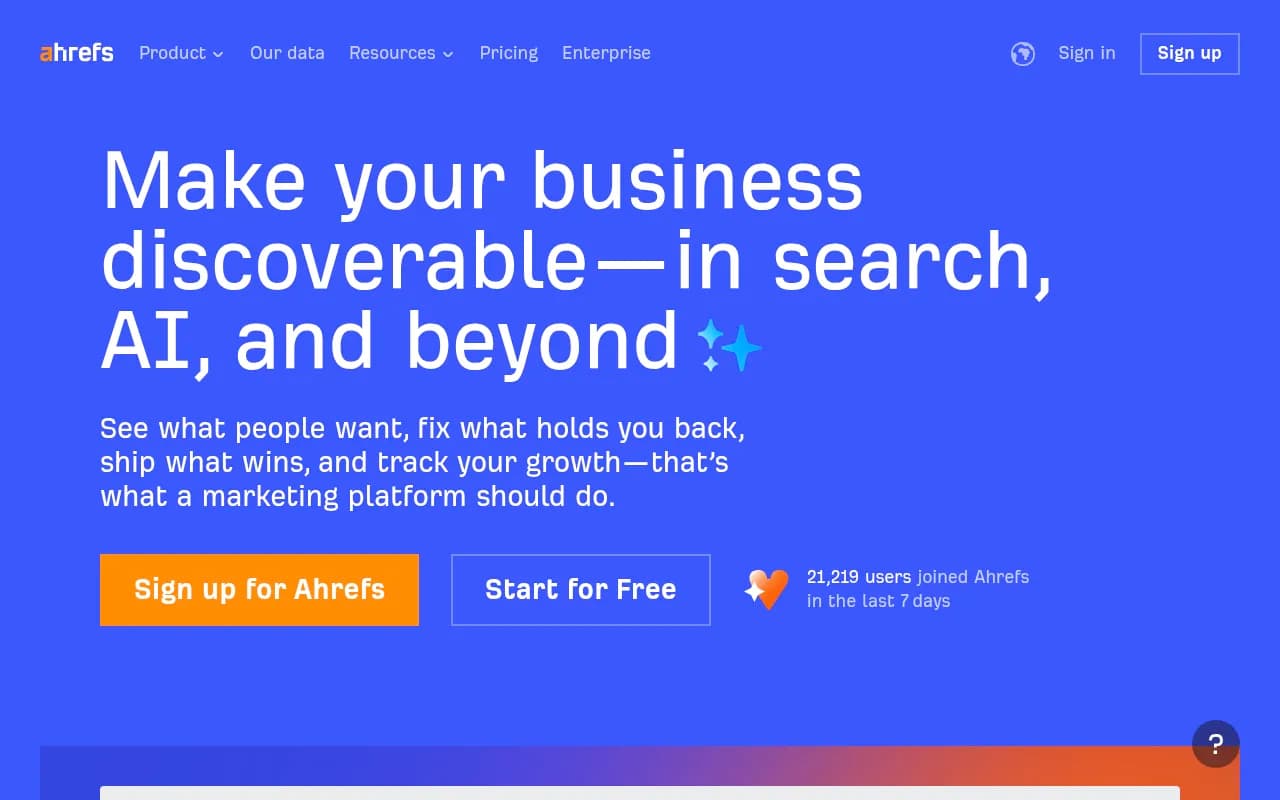
The strength here is the same as with Semrush: if you're already using Ahrefs for traditional SEO, having AI visibility data in the same place is convenient. Ahrefs' underlying data quality is strong, and the UI is generally well-regarded.
The weaknesses are similar too. The prompts used for AI tracking are fixed -- you can't customize them to match your specific business or customer queries. There's no AI traffic attribution, so you can't connect AI visibility to actual website traffic or revenue. And like Semrush, there's no content generation or optimization workflow built in. You see the data; what you do with it is up to you.
Ahrefs is worth considering if you're a heavy Ahrefs user and want a basic layer of AI visibility data without adding another tool. But it's not designed for teams whose primary goal is improving their AI search presence.
SE Ranking
SE Ranking has been building out its AI visibility features more aggressively than most traditional SEO platforms, and it's worth taking seriously as a mid-market option.
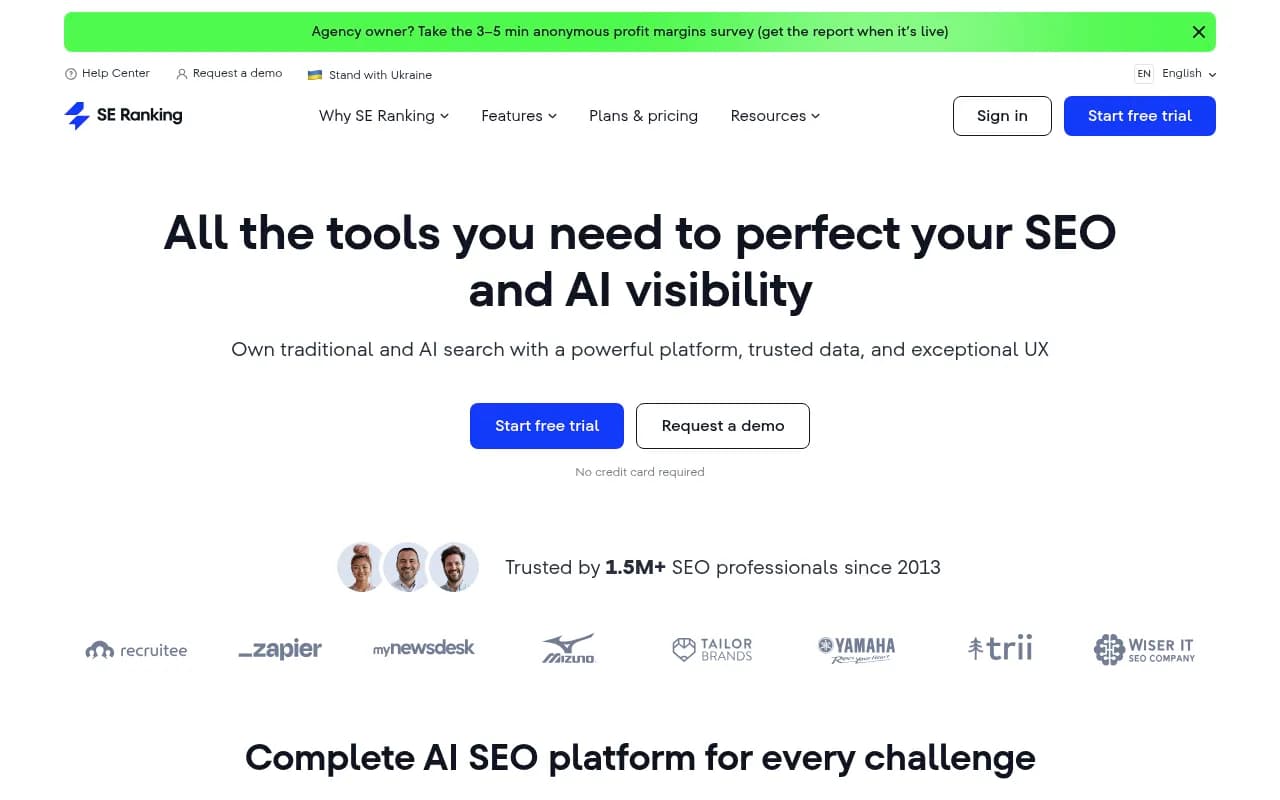
The platform tracks AI Overview presence alongside traditional rank tracking, and its pricing is generally more accessible than Semrush or Ahrefs for smaller teams. SE Ranking also has a companion product called SE Visible that's specifically focused on AI search visibility tracking.
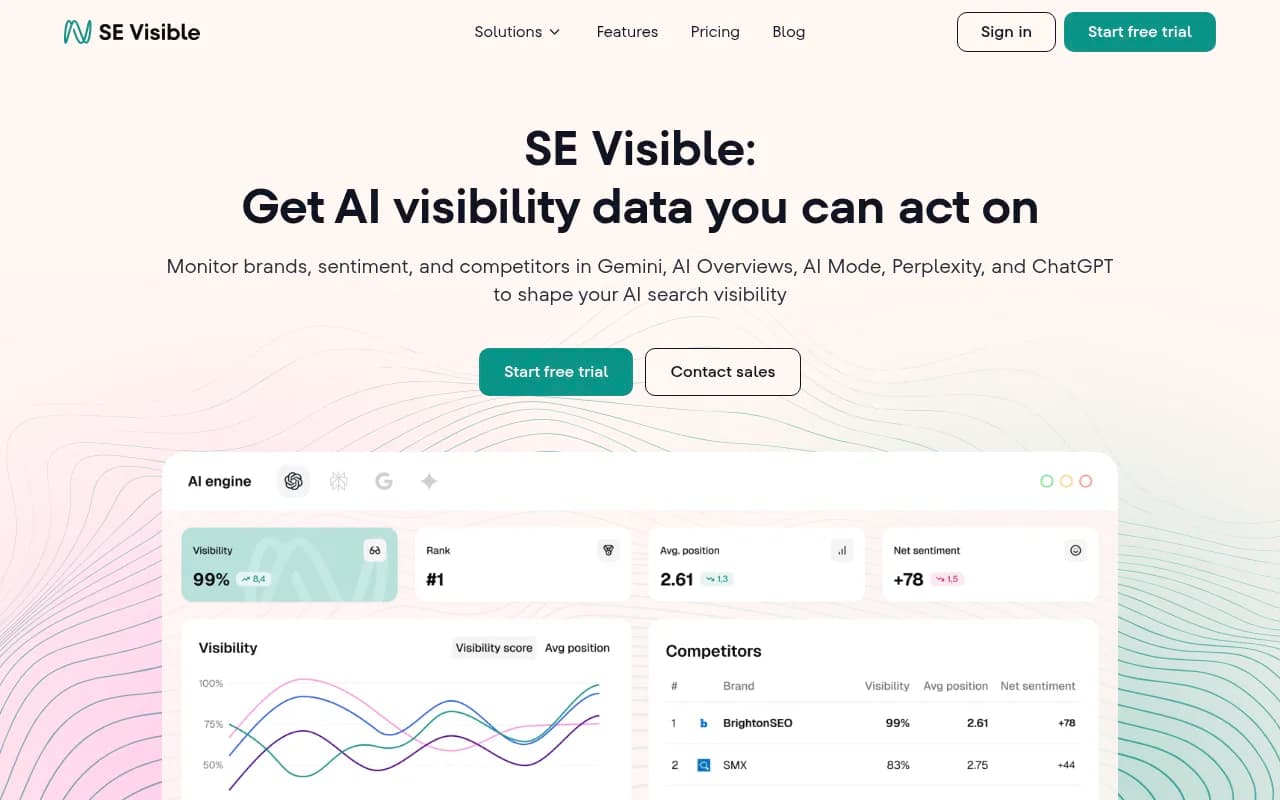
The AI tracking in SE Ranking covers Google AI Overviews and a handful of other AI engines. The interface is clean and the data is reasonably granular. For teams on tighter budgets who want AI Overview tracking without paying Semrush prices, SE Ranking is a sensible option.
The same fundamental limitation applies: SE Ranking shows you the data but doesn't help you act on it. There's no content gap analysis, no built-in content generation, no crawler logs showing how AI bots are interacting with your site.
Feature comparison
| Feature | Promptwatch | Semrush | Ahrefs | SE Ranking |
|---|---|---|---|---|
| Google AI Overviews tracking | Yes | Yes | Yes | Yes |
| Custom prompt tracking | Yes | No (fixed) | No (fixed) | Limited |
| Citation share by page | Yes | Limited | Limited | Limited |
| AI crawler logs | Yes | No | No | No |
| Answer gap analysis | Yes | No | No | No |
| Built-in content generation | Yes | No | No | No |
| AI traffic attribution | Yes | No | No | No |
| Reddit/YouTube citation tracking | Yes | No | No | No |
| ChatGPT Shopping tracking | Yes | No | No | No |
| Multi-LLM coverage | 10 models | 4 models | 6 indexes | Limited |
| Starting price | $99/mo | $99/mo + base plan | Included in plan | From ~$65/mo |
| Free trial | Yes | Yes | Limited | Yes |
Which tool is right for you
The honest answer depends on what you're trying to do.
If you're already paying for Semrush or Ahrefs and just want a basic sense of whether your brand is appearing in AI Overviews, use what you have. The data is there, it's reasonably accurate, and you don't need another subscription to get started.
If AI search visibility is a strategic priority -- meaning you want to understand why you're not appearing in certain overviews and actually do something about it -- then a dedicated platform makes more sense. Promptwatch is the only tool in this comparison that treats visibility tracking as the starting point rather than the end goal. The Answer Gap Analysis and content generation features mean you're not just watching a number; you're using the data to move it.
SE Ranking sits in an interesting middle ground. It's more affordable than Semrush for teams that don't need the full SEO suite, and its AI tracking is solid for the price. If budget is the main constraint and you just need monitoring, it's worth a look.
One thing worth noting: the gap between "monitoring" and "optimization" is where most teams get stuck. You can have a dashboard full of visibility scores and still have no idea what to write next. That's the problem Promptwatch is specifically built to solve, and it's why it stands apart from the others in this comparison.
What to look for beyond the basics
A few things that don't always show up in feature lists but matter a lot in practice:
Prompt customization. Fixed prompts are a significant limitation. Your customers don't search the way a tool's default prompt library assumes they do. If you can't define the actual questions your audience is asking, you're tracking the wrong thing.
Page-level citation data. Knowing your domain appears in AI Overviews is useful. Knowing which specific pages are being cited -- and which aren't -- is what lets you make decisions. Most tools aggregate at the domain level; fewer go to the page level.
Crawler visibility. AI models can only cite content they've crawled and indexed. If Googlebot or the GPTBot isn't visiting your pages, or is encountering errors when it does, that's a fixable problem -- but only if you know about it. Crawler logs are underrated.
Trend data. A single snapshot of your AI visibility isn't very useful. You need to see how it changes over time, especially after you publish new content or make site changes.
Competitor benchmarking. Your visibility score in isolation doesn't tell you much. Seeing how you compare to specific competitors for specific queries is where the data becomes actionable.
The bottom line
Google AI Overviews are now a real traffic driver (and traffic stealer) for many industries. Tracking your visibility in them isn't optional anymore if you care about organic search performance.
Semrush and Ahrefs have added AI Overview tracking to their platforms, and if you're already using them, that data is worth checking. But both tools leave you on your own when it comes to figuring out what to do with what you find.
SE Ranking is a reasonable budget option for monitoring.
Promptwatch is the only platform here that's built around the full cycle: find the gaps, fix them with content, track the improvement. For teams that want to actually improve their AI search visibility rather than just measure it, that's a meaningful difference.