Key takeaways
- Fact-checking what AI says about your brand is a different job from fact-checking your own content. Tools like Snopes or ClaimBuster verify text you wrote. You need tools that check text an AI wrote about you.
- Only a handful of platforms compare AI answers against your own ground truth. Promptwatch (Fact Check, Business plan and up) and Profound (FactCheck) are the two clearest examples.
- The most common root cause is boring: outdated pages on your own site. ChatGPT cites product and landing pages more than any other content type, so stale pricing or specs there become wrong answers.
- A cheap DIY route exists (answer-page monitoring plus a fixed prompt set), but it won't scale past a few dozen prompts.
- Whatever you buy, keep a human in the loop and re-test after every fix.
Two kinds of fact-checking, and why people mix them up
Search "AI fact-checking tools" and you'll mostly get tools built for writers: Google Fact Check Explorer, Snopes, ClaimBuster, TinEye. They answer the question "is this sentence in my draft true?" Useful, but it isn't your problem here.
Your problem is the reverse. ChatGPT, Gemini, Perplexity and Google AI Overviews are writing sentences about your company, and you didn't approve any of them. A wrong price. A feature you don't have. A competitor's differentiator pinned on you. A rebrand read as a shutdown.
Profound's research across 50,000 LLM responses found that 47% of response content is unsolicited, meaning the AI is adding its own commentary about the brand rather than answering the question asked. That is a lot of surface area for errors, and it's vendor research, so weigh it accordingly. Still, it matches what most teams see when they first audit their answers.
The categories of error worth hunting for:
- Wrong or invented pricing tiers
- Phantom features
- Competitor strengths attributed to you
- Rebrands mistaken for discontinuation
- Invented founding dates, headquarters, funding or partnerships
- Old training-data views that hide a pivot
Answers also differ by platform. Something correct on Perplexity can be fabricated on ChatGPT, so a single manual spot check proves very little.
What a brand fact-checking tool needs to do
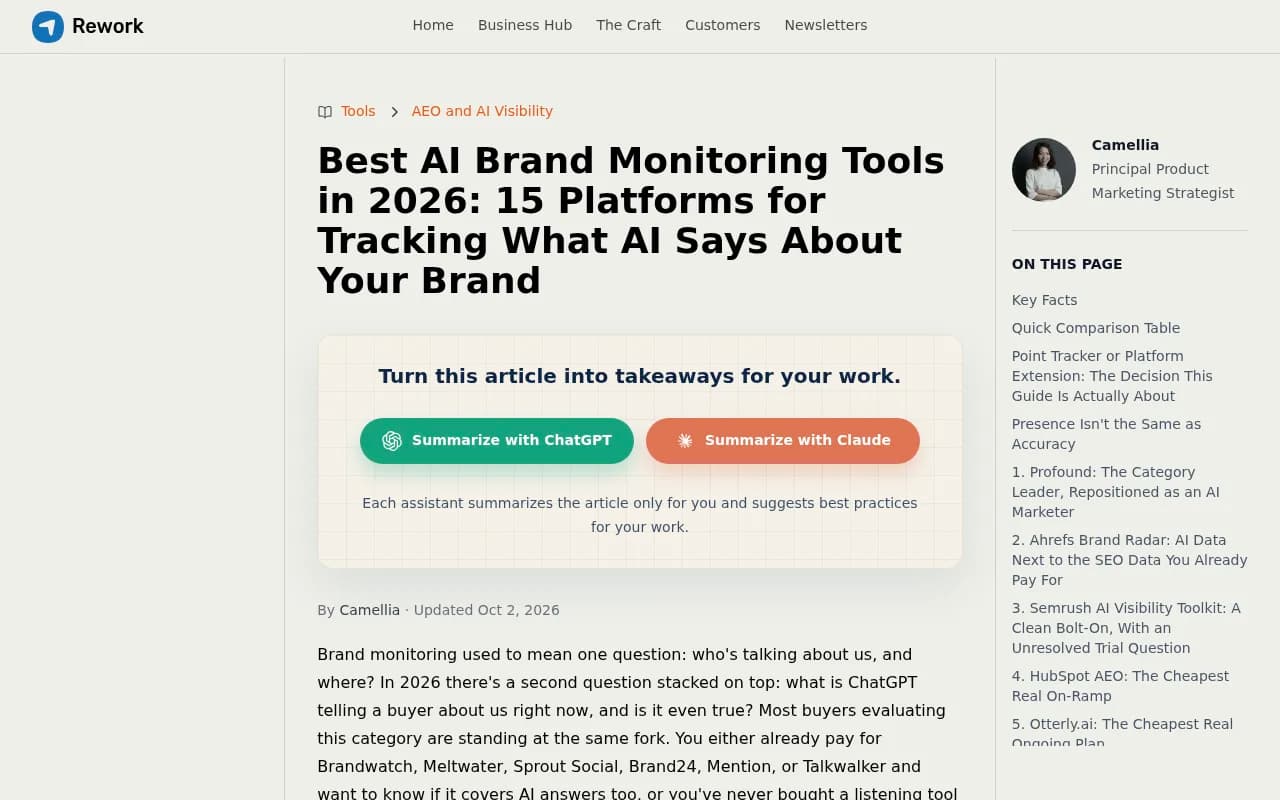
Mention counts and share of voice are everywhere. Accuracy checking is not. Rework's 15-tool roundup of brand monitoring platforms notes that mention and citation counts are confirmed on all 15 ranked tools, while misinformation or fact-accuracy flagging shows up on a much shorter list. Promptwatch's own comparison makes a similar point: 18 of 21 platforms track prompts and citations, but few check accuracy against your own pages. Both are vendor-influenced sources, but the direction is consistent.
When you evaluate tools, look for:
- A ground truth you control. The tool should compare AI claims against your pages or documents, not against another model's opinion.
- Claim-level output. "Accuracy: 82%" is a vanity number. You want the individual claim, marked right or wrong.
- Source attribution. Which page or domain is the AI learning the wrong thing from?
- Multi-model coverage, ideally from real interfaces rather than only APIs, since user-facing answers can differ.
- A path to a fix, plus re-testing to confirm it worked.
The tools, compared
| Tool | Checks accuracy against your own facts | Traces wrong claims to sources | Helps fix and re-test | Entry pricing (verify with vendor) |
|---|---|---|---|---|
| Promptwatch | Yes (Fact Check, Business plan and up) | Yes, down to the page on your site | Yes (Action Board, Content Agent, Content Refresh) | Business $579/mo |
| Profound | Yes (FactCheck, launched July 14, 2026) | Yes, by URL and domain | Yes (refresh, creation and outreach agents) | Enterprise, custom |
| Goodie AI | Brand Command flags wrong answers | Limited | Limited | Check vendor |
| Meltwater / Talkwalker | Misinformation flagging in listening suites | Partly | Not an AI-content workflow | Custom |
| Indexly / LLMClicks | Hallucination flagging | Limited | Limited | Indexly from about $99/mo |
| PageCrawl (DIY) | No, change detection only | No | No | About $80/year (Standard, 100 monitors) |
Pricing varies across sources, and I haven't verified every pricing page, so treat the table as a starting point for sales conversations.
Promptwatch
Promptwatch is the option I'd look at first if you want accuracy checking inside a broader AI visibility workflow, rather than as a standalone feature. Two pieces matter here.
Brand Narrative pulls the individual claims AI makes about you and your competitors out of every tracked response ("affordable for small teams," "its mobile app lacks features"), groups repeated claims, and shows how often and which models say each one. It scores themes like Pricing, Features, Support and Reputation from 0 to 100 so you can compare against competitors. It is on every plan.
Fact Check then lets you mark a claim Accurate or Inaccurate and reads the pages crawled from your site to find the ones that state it, or state its opposite, with quotes and a recommended next step. That tells you which page AI is learning the wrong thing from. It is available on Business ($579/mo), Agency Scale and Enterprise, and it uses Agent Credits.
The part that separates it from a dashboard is what happens next. Wrong claims feed the Action Board, Content Refresh gives git-diff-style updates for existing pages, and the Content Agent can publish corrections to WordPress, Webflow or Framer. Crawler logs and Page Tracker then show whether AI bots read the updated page and whether it gets cited. Monitoring runs against the real interfaces of ChatGPT, Google AI Overviews, Gemini, Perplexity, Copilot and others, in the country and language you pick.

The honest caveats: the full accuracy workflow sits on the Business tier, so smaller teams on Essential ($95/mo) get Brand Narrative but not Fact Check. Confirm current plans at promptwatch.com/pricing. If you want to see where you stand first, the free AI visibility report and the 7-day free trial are the low-commitment starting points. For head-to-head detail, see Promptwatch vs Profound.
Profound FactCheck
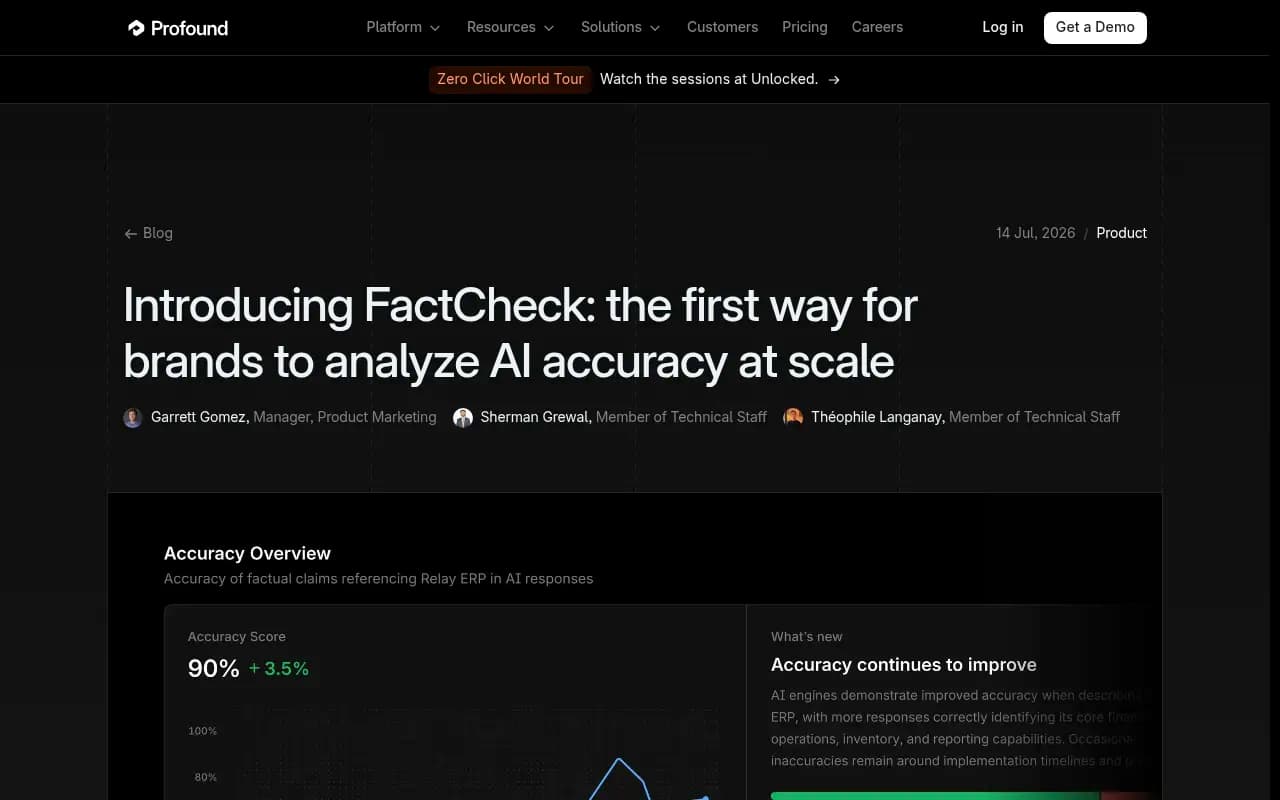
Profound launched FactCheck on July 14, 2026, and its process is clearly laid out:
- Tag prompts as the FactCheck type in Prompt Designer. These work best for deterministic answers such as pricing, specs, features, availability and policies. You can tag from a handful up to 1,000.
- Build a Knowledge Base as ground truth from a domain crawl, specific pages, file uploads, or Google Drive and Notion sync. FAQ-style content works best.
- Profound queries the major answer engines and a claim-detection model compares each verifiable claim to the Knowledge Base. The company says this is not "one AI grading another."
- Results land in a FactCheck tab with an accuracy score, inaccurate claims by theme, side-by-side comparison, source attribution and a per-page breakdown.
Profound

It then connects inaccurate claims to agents: a Content Refresh Agent for your own pages, a Content Creation Agent for competitor-sourced claims, and an Outreach Agent that drafts update requests to third-party publishers. That outreach angle is a real strength.
The limits are practical. Public pricing shows a free trial and a custom Enterprise tier, so expect a sales call. And results are only as good as your Knowledge Base. One early customer reportedly found the biggest source of wrong claims was its own site, with pages untouched for years. Everything above comes from Profound's own materials. I found no independent head-to-head accuracy test of FactCheck-style features from any vendor, so treat all accuracy claims as unverified until you run your own pilot.
Goodie AI
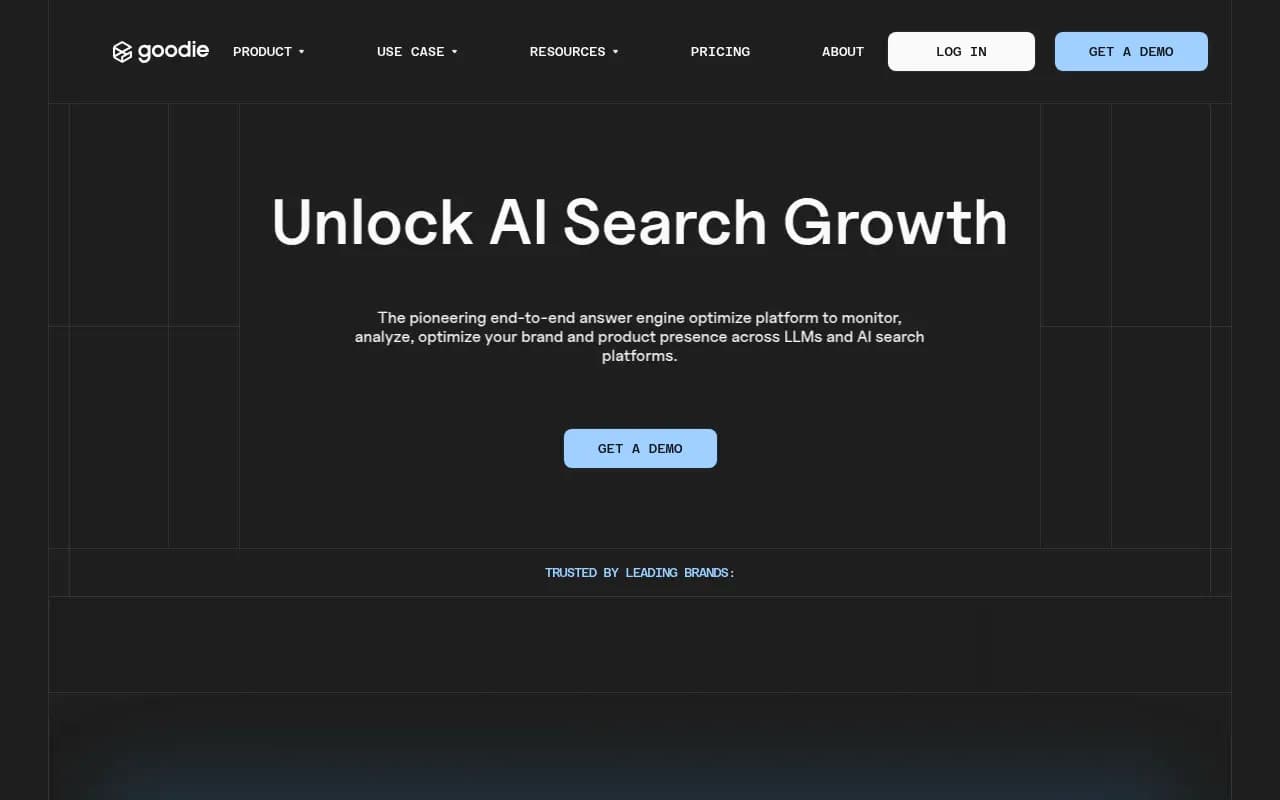
Goodie's Brand Command feature is built around the same idea in plainer language: know when AI gets your brand wrong before your customers do. It's a lighter option, and the catalog description is blunt that it focuses on monitoring.
Meltwater and Talkwalker
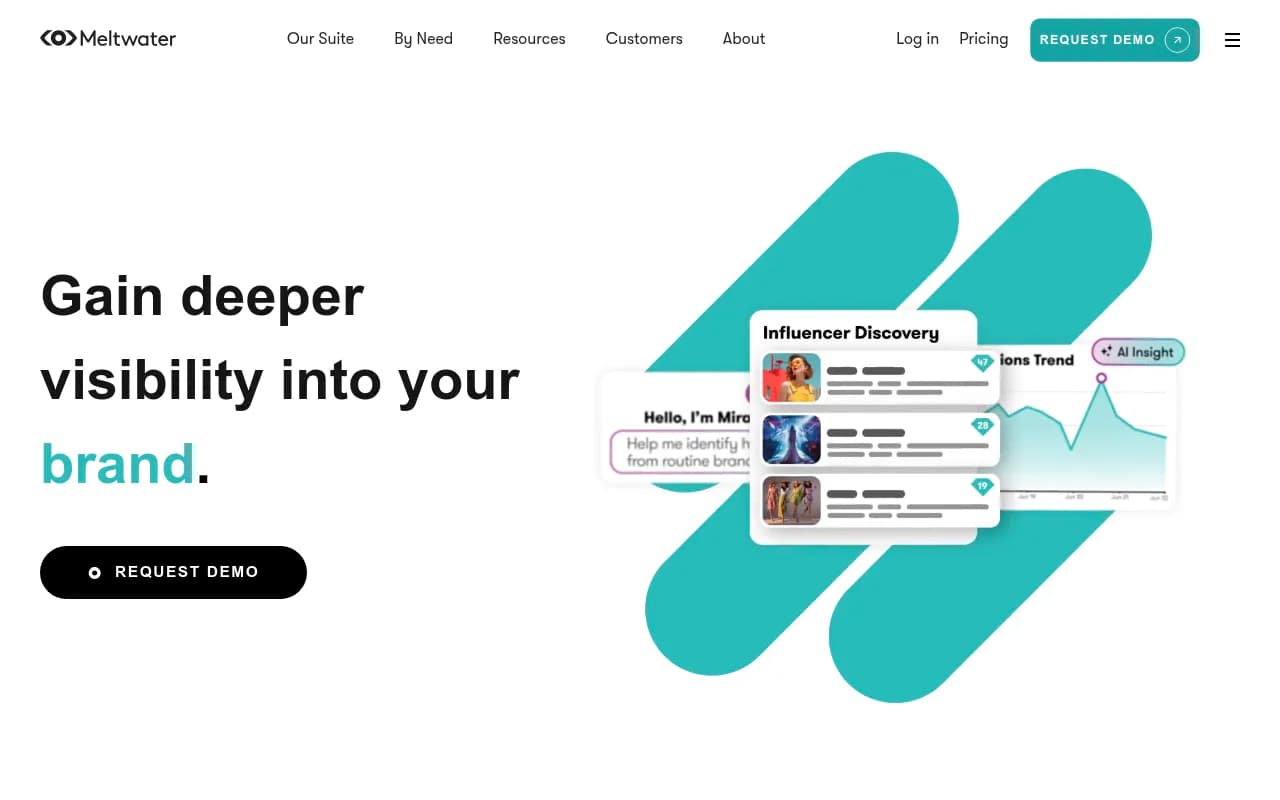
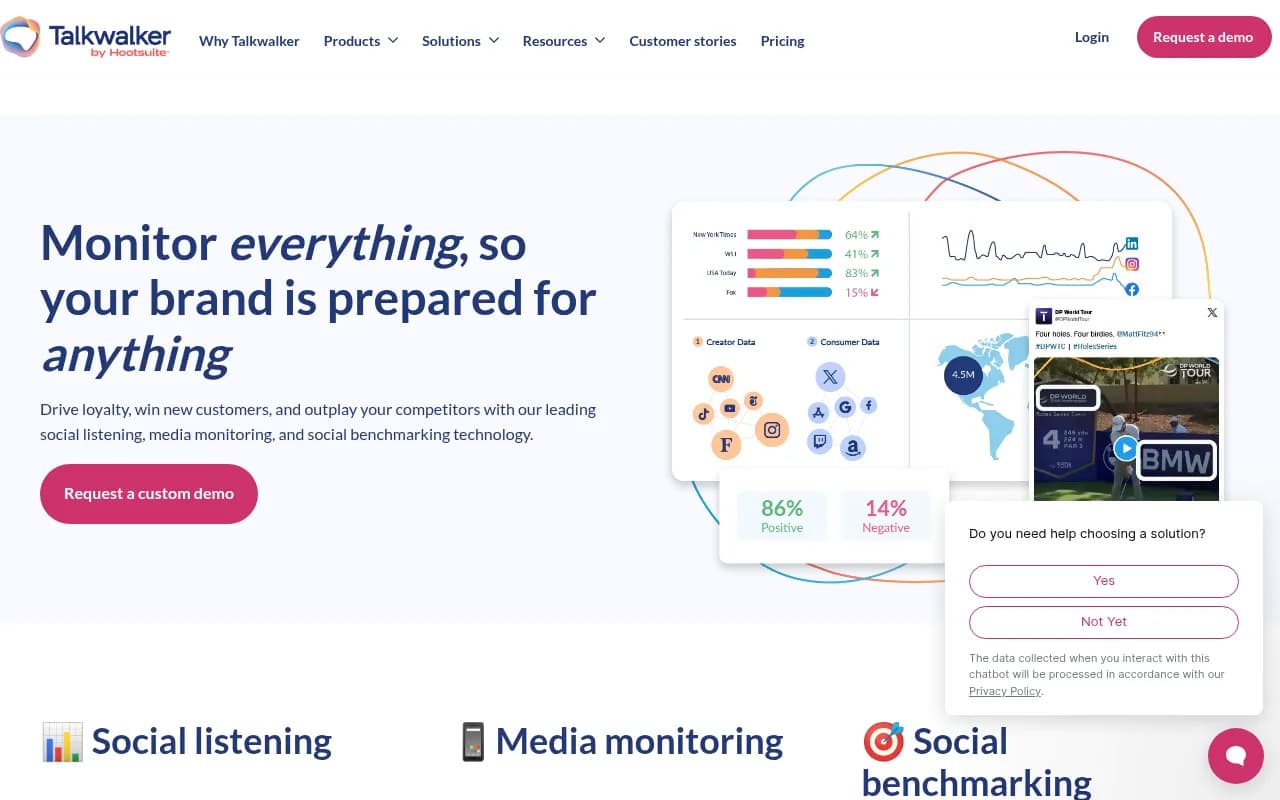
If you already run a listening suite, check what you have before buying anything new. Rework's review says Meltwater's GenAI Lens and Talkwalker's LLM Insights are real extensions with AI-answer tracking, and lists both among tools with misinformation flagging. Brandwatch, Sprout Social and Mention, by contrast, talk about AI answers in their marketing but hadn't shipped a feature that tells you what ChatGPT says about you.
Hallucination detectors: Indexly and LLMClicks
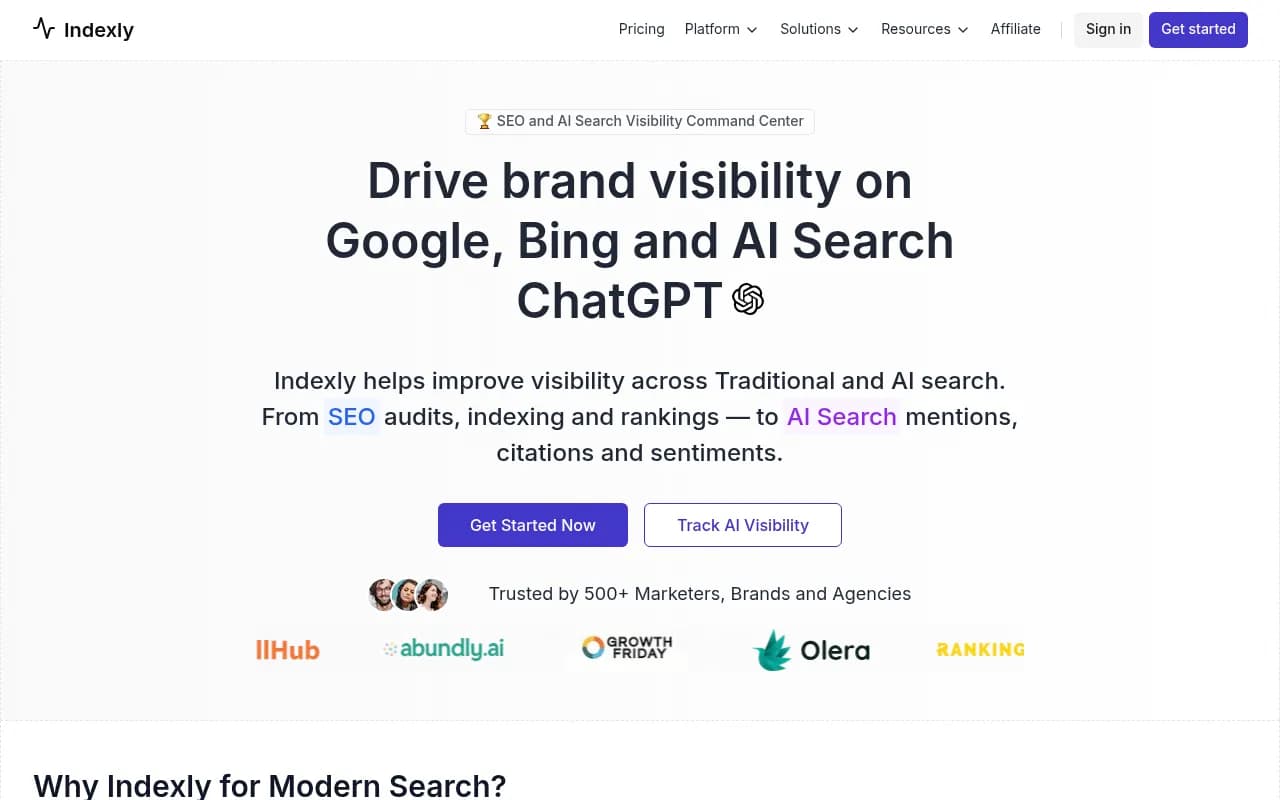
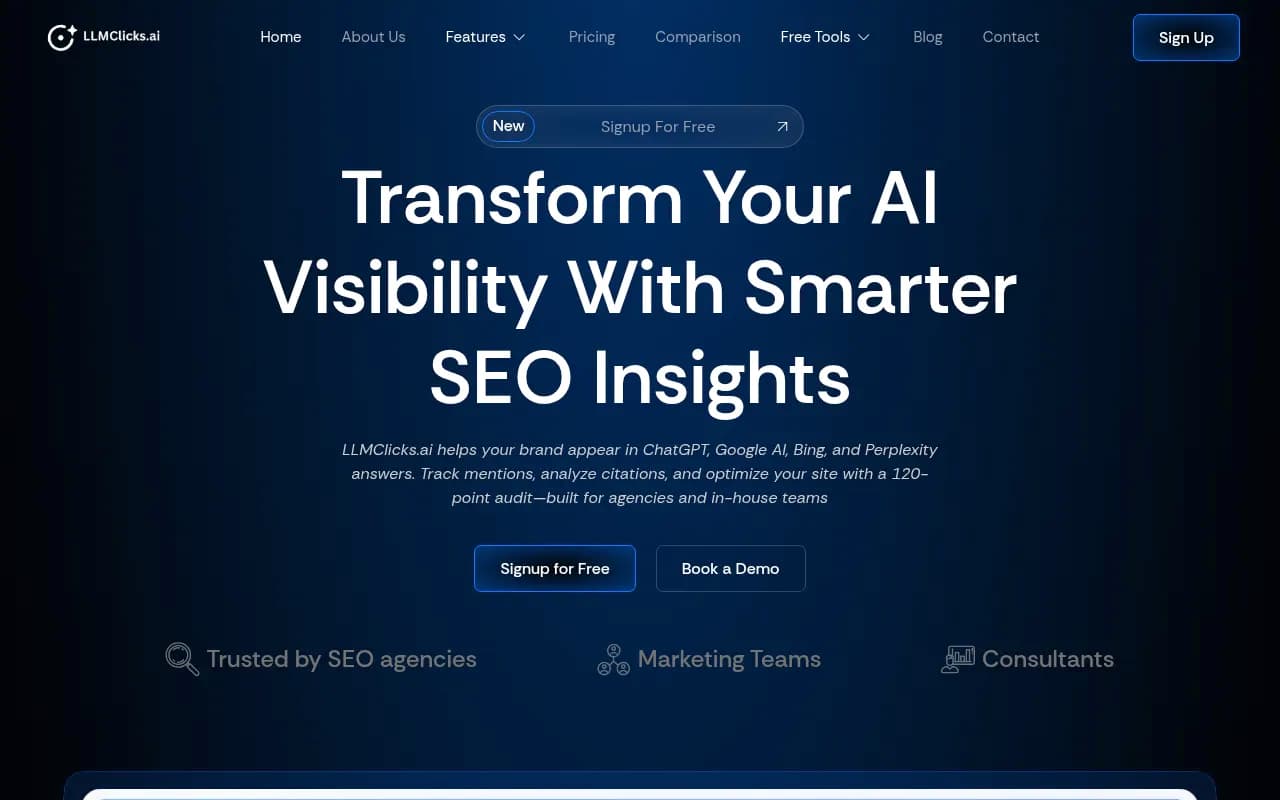
Both appear in the catalog with hallucination flagging. Indexly lists it from about $99/mo. These are worth a look on a tight budget, but I'd ask each vendor what the ground truth is. If the tool can't compare against your own pages, it's flagging oddities rather than checking facts.
The cheap DIY route
PageCrawl monitors Perplexity, AI Overviews and Copilot answer pages for changes. The Standard plan is about $80/year for 100 monitors. Its suggested starting point is three monitors (brand, category, and brand vs competitor) checked daily. That tells you when an answer changes, not whether the new answer is right, so you still read the result yourself.
Where the other trackers fit
Most other AI visibility trackers measure mentions and positions, not accuracy. Peec AI, Otterly.AI, Rankshift, Semrush and Ahrefs Brand Radar are fine for share of voice, and I wouldn't buy them for fact-checking. Otterly Lite starts at $29/mo and Peec's Starter at about $95/mo, though Peec's pricing varies by source, so verify it. If you want to browse the wider field, the GEO software directory is a good place to compare.

Otterly.AI

Why the wrong answer is usually your own fault
This is the uncomfortable bit. According to Promptwatch Data on ChatGPT citation share by content type (Sep 28 to Oct 4, 2026), product pages are 22.4% of classified ChatGPT citations and landing pages are 16.8%. Together that is 39% of citations going to pages that describe what a company sells. For branded prompts (ones naming a company), product pages are 23.3% and landing pages 22.8%, almost half of branded citations.
So when ChatGPT answers "how much does X cost," it is most likely quoting your own pricing page, or a stale copy of it. Reviews climb to 5.6% of branded citations, more than 3x their overall share, and social posts to 3.0%. Promptwatch's advice from that report is to keep specs, prices and positioning on product pages complete and factual, add an FAQ page for common brand questions, and collect reviews on trusted category sites.
That matches Profound's anecdote about a customer whose worst offender was its own neglected site. Audit your own pages before you blame the model.
Source counts matter too. Promptwatch's older average sources per response report (dated September 2025, so the numbers may have moved) found ChatGPT cites about 5 sources per web-search answer, Google AI Overviews about 10, and Perplexity almost exactly 10 each day. More sources means more places a wrong claim can come from. For a broader view, see the Promptwatch Data hub.
A workflow that works with any tool
The CDP.com glossary and PageCrawl's guide both land on a similar loop, and it's the one I'd follow.
1. Build a fixed prompt set
Cover three types: category prompts, "X vs competitor" prompts, and branded prompts (pricing, features, integrations, support, history). Run them at a fixed cadence and log mentions, rank, sentiment and accuracy. Manual results get skewed by chat history, memory, region and personalization, which is another reason to use a tool that queries from a clean state.
2. Write down your ground truth
A short, current document: pricing tiers, feature list, supported integrations, locations, founding facts, policies. Every tool above is only as good as this. Profound says as much about its own Knowledge Base, and the same applies to Promptwatch's pages-based checks.
3. Triage by severity
Not every hallucination is equally urgent. A wrong price or a false safety claim beats a wrong founding year. In regulated sectors, pharma, financial services and healthcare, the audit trail matters as much as the fix. Secondary sources describe legal cases where companies were held responsible for chatbot statements, including Air Canada's fabricated bereavement fare policy, but verify those before citing them anywhere formal.
4. Fix at the source, in this order
- Your own outdated pages first.
- Review sites and third-party listings.
- Publish clear, extractable facts, such as an FAQ page.
- Use platform feedback channels (Perplexity, Google, ChatGPT).
- Re-run the same prompts to confirm the correction landed.
Step five gets skipped constantly. It's the whole point of the exercise.
5. Watch your sentiment classifier
Automated sentiment tools misread inverted framing and drift over time. Keep a hand-labeled sample of about 50 answers and re-score it quarterly.
Which setup fits your team
| Situation | What I'd pick |
|---|---|
| Small team, no budget, want to know if there is a problem | Free AI visibility report, a manual prompt set, and PageCrawl-style monitoring |
| Marketing team that wants detection and the fix in one place | Promptwatch Business, since Fact Check, Action Board and Content Refresh live together |
| Enterprise with a sales-led buying process and outreach to publishers | Profound FactCheck, or Promptwatch Enterprise |
| Already on Meltwater or Talkwalker | Test their AI add-ons before buying another tool |
| Agency | Promptwatch agency plans (Kick-off $199/mo up) for tracking and Brand Narrative, though Fact Check on agency plans starts at Scale ($799/mo) |
Agencies that want a partner to run this whole process rather than buy software can look at 1001 SEO Media, which publishes this site and handles GEO work for clients.
Mistakes to avoid
- Treating one chat session as evidence. Run a repeatable prompt set across models.
- Buying a visibility tracker and expecting accuracy checking. Ask the vendor to demo a wrong claim being traced to a source.
- Fixing the AI instead of the source. You can't edit ChatGPT, but you can edit your pricing page.
- Trusting vendor accuracy claims without a pilot. No independent benchmark of these features exists yet, so run the same 20 prompts through two tools and compare their findings by hand.
- Quoting the big scary hallucination-cost statistics. Several circulating figures, like a "$67 billion" number, are unsourced, and I'd leave them out of any internal pitch.
Bottom line
Pick a tool that checks claims against your own pages, shows you the source, and lets you re-test. Promptwatch and Profound are the two I'd shortlist, with the difference being price transparency and how much of the fix happens inside the product. Start with the free report or a trial, run a 20-prompt pilot on your pricing and feature questions, and see how many wrong claims trace back to a page you can edit this week.