Key takeaways
- Zapier is the fastest path to automation for non-technical marketing teams — 7,000+ integrations, minimal setup, but expensive at scale.
- Make (formerly Integromat) hits the sweet spot for mid-market teams: complex branching logic, 3,000+ integrations, and roughly 60% cheaper than Zapier for comparable workflows.
- n8n is the only truly self-hostable option, making it ideal for teams with compliance requirements or high execution volumes — and it has the strongest native AI capabilities of the three.
- For GEO and AI visibility workflows specifically, the right choice depends less on the automation tool and more on what data you're pulling from your visibility platform and where it needs to go.
- Tools like Promptwatch expose the kind of structured data (citation scores, prompt gaps, visibility by LLM) that these automation platforms can actually work with.
Workflow automation and AI visibility are converging fast. A year ago, most marketing teams were still treating GEO (Generative Engine Optimization) as a manual reporting exercise — someone logging into a dashboard, screenshotting a chart, pasting numbers into a spreadsheet. That's changing. Teams that are serious about AI search visibility in 2026 are building automated pipelines: pull citation data, flag drops, trigger content briefs, update dashboards, notify Slack. The whole loop, hands-free.
The problem is that Zapier, Make, and n8n are genuinely different tools, and picking the wrong one for your GEO stack creates friction that compounds over time. This guide cuts through the noise and gives you a practical framework for connecting your AI visibility data to the rest of your marketing stack.
What "connecting GEO data" actually means
Before comparing tools, it's worth being specific about what you're actually automating. GEO workflows typically fall into a few categories:
- Pulling visibility scores and citation data on a schedule and pushing them to a BI tool, spreadsheet, or CRM
- Monitoring for drops in brand mentions across LLMs and triggering alerts
- Taking competitor visibility data and routing it into content briefs or editorial calendars
- Connecting prompt gap analysis to content creation workflows
- Attributing AI-driven traffic back to specific pages and reporting it to stakeholders
Each of these has different requirements. Some are simple two-step Zaps. Others involve branching logic, conditional routing, and multi-step transformations that would break a basic automation tool.
Promptwatch is one of the few platforms that exposes enough structured data through its API and integrations to make these workflows genuinely useful. It tracks 10 AI models, surfaces prompt-level visibility scores, and flags exactly which content gaps are costing you citations. That's the kind of output you can actually route into an automation pipeline.

The three platforms at a glance
| Zapier | Make | n8n | |
|---|---|---|---|
| Best for | Non-technical teams, fast setup | Mid-market teams with complex logic | Engineering-led teams, compliance-sensitive |
| Integrations | 7,000+ | 3,000+ | ~1,500 native (unlimited via HTTP) |
| Pricing model | Per task | Per operation | Per execution (cloud) or free (self-hosted) |
| Starting price | ~$20/month | ~$9/month | $20/month cloud, $0 self-hosted |
| AI capabilities | Basic (via integrations) | Limited native AI | Strong native AI agent support |
| Self-hosting | No | No | Yes |
| Learning curve | Low | Medium | High |
| Best GEO use case | Simple alert/reporting pipelines | Multi-step visibility workflows | Custom AI agents, high-volume tracking |
Zapier: the safe default for marketing teams
Zapier is what most marketing teams reach for first, and for good reason. The interface is genuinely intuitive, the integration library is enormous, and you can have a working automation in 15 minutes without touching a line of code.
For GEO workflows, Zapier works well when your needs are relatively straightforward. Connecting a webhook from your visibility platform to a Slack channel, pushing weekly citation scores to Google Sheets, or triggering a HubSpot task when a competitor's visibility score crosses a threshold — all of these are well within Zapier's comfort zone.
Where Zapier starts to hurt is pricing at scale. The task-based model means every step in every workflow counts. A workflow that pulls data from Promptwatch, transforms it, filters it, and pushes it to three destinations could burn through 5-6 tasks per run. At 10,000+ tasks per month, you're looking at $100-500+ depending on your plan. For teams running frequent visibility checks across multiple brands or markets, this adds up fast.
The other limitation is complexity. Zapier's conditional logic has improved, but it's still not designed for workflows with heavy branching, loops, or data transformation. If you need to iterate over a list of 50 prompts, calculate percentage changes, and route each one differently based on its score, you'll hit walls.
When to choose Zapier for GEO automation:
- Your team has no developers and needs something running this week
- Your workflows are linear (trigger -> action, maybe one filter)
- You're connecting well-known SaaS tools that Zapier already supports natively
- Volume is under 10,000 tasks/month
Make: the visual powerhouse for complex visibility workflows
Make (formerly Integromat) occupies a genuinely useful middle ground. It's more powerful than Zapier for complex workflows, meaningfully cheaper, and still visual enough that a technically-minded marketer can build in it without writing code.
The scenario builder is where Make shines. You can build workflows with routers (conditional branching), iterators (looping over arrays), and aggregators (combining multiple data points into one output) — all visually. For GEO workflows, this matters. Imagine pulling a weekly visibility report from your AI monitoring platform, iterating over each prompt, routing high-priority drops to a Slack alert and low-priority ones to a spreadsheet, then aggregating a summary for an email digest. That's a real workflow, and Make handles it cleanly.
Make charges per operation (each module execution), not per task in the Zapier sense. For complex multi-step workflows, this is often significantly cheaper. The 60% cost savings figure cited in comparisons is realistic for teams running sophisticated automations.
The learning curve is real, though. Make's interface rewards investment — the more time you spend with it, the more you can do. But if you're handing this off to someone who's never used it, expect a few hours of orientation before they're productive.
When to choose Make for GEO automation:
- You need complex branching logic (different actions for different visibility thresholds)
- You're iterating over lists of prompts, competitors, or pages
- Cost is a concern and you're running high-volume workflows
- Your team has at least one technically-minded person who can own the setup
n8n: the developer's choice for custom AI pipelines
n8n is different in kind, not just degree. It's open-source, self-hostable, and built with developers in mind. The cloud version starts at $20/month with per-execution pricing. The self-hosted version is free.
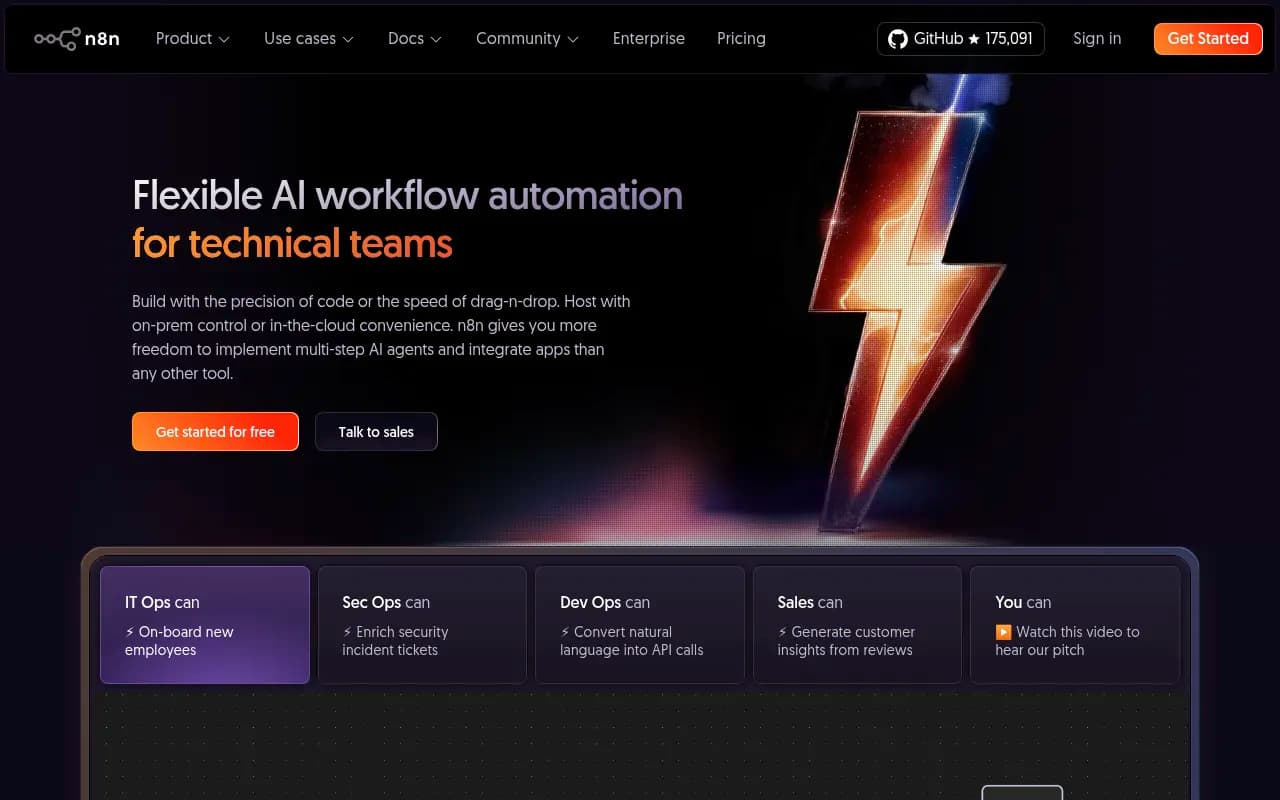
For GEO and AI visibility workflows, n8n has two specific advantages that the others don't match. First, the AI capabilities are native and deep — you can build multi-agent workflows where one node queries an LLM, another processes the output, and a third routes the result based on semantic content. This opens up workflows that simply aren't possible in Zapier or Make, like automatically generating a content brief from a detected prompt gap, having an AI agent draft an outline, and pushing it to your CMS.
Second, self-hosting means your data never leaves your infrastructure. For enterprise teams with compliance requirements around brand data, competitive intelligence, or customer information, this is a genuine differentiator. Most GEO platforms handle sensitive data — competitor visibility scores, traffic attribution, prompt performance — and some legal teams will want that data processed on-premise.
The tradeoff is maintenance. Self-hosted n8n requires someone to manage the server, handle updates, and debug infrastructure issues. The cloud version removes that burden but adds cost. And the learning curve is steep — n8n assumes you're comfortable with JSON, expressions, and at least some programming concepts.
When to choose n8n for GEO automation:
- You have developers on the team or a technical marketing ops person
- You need multi-agent AI workflows (not just data routing)
- Compliance or data sovereignty requirements rule out cloud-only tools
- You're running high execution volumes where per-task pricing would be prohibitive
- You want to build custom integrations with platforms that don't have native connectors
Practical GEO workflow examples
Here's how each tool handles three common AI visibility automation scenarios:
Scenario 1: Weekly visibility report to Slack and Google Sheets
Pull citation scores for 20 tracked prompts, compare to last week, flag any drops over 10%, post a summary to Slack, and log everything to a spreadsheet.
- Zapier: Straightforward. Use a scheduled trigger, a few filter steps, a Slack action, and a Google Sheets action. Probably 4-6 tasks per run. Works fine.
- Make: Slightly more setup but handles the comparison logic more cleanly. The iterator/aggregator pattern is well-suited here.
- n8n: Overkill for this use case unless you're already using it for other workflows.
Scenario 2: Competitor visibility spike triggers content brief
When a competitor's citation score for a specific prompt crosses a threshold, automatically create a content brief in your CMS with the prompt, competitor context, and suggested angle.
- Zapier: Possible but clunky. The conditional logic and data transformation get messy.
- Make: Good fit. Router handles the threshold logic, and you can format the brief data cleanly before pushing to your CMS.
- n8n: Excellent fit, especially if you want an AI agent to generate the brief content rather than just routing data.
Scenario 3: AI agent that monitors prompt gaps and drafts articles
Continuously monitor which prompts competitors rank for but you don't, generate article outlines for the top gaps, and push drafts to a review queue.
- Zapier: Not really designed for this. You'd be fighting the tool.
- Make: Partial fit. Can handle the data routing and some AI calls, but the agent-style loop logic is awkward.
- n8n: This is exactly what n8n is built for. Multi-agent workflows with LLM nodes, loops, and conditional routing.
Connecting to your AI visibility platform
The automation tool is only as useful as the data flowing into it. Most GEO platforms expose data via webhooks, APIs, or scheduled exports. A few things to check before committing to a workflow:
- Does your visibility platform have a native connector in your chosen automation tool, or will you need to use a generic HTTP/webhook node?
- What data format does it export? JSON is easiest to work with across all three platforms.
- Does it support real-time webhooks (for instant alerts) or only scheduled pulls?
- Are there rate limits that would affect high-frequency monitoring?
Promptwatch's API exposes citation data, prompt-level visibility scores, and competitor comparisons in structured JSON — which means it works cleanly with all three automation platforms via HTTP nodes or webhooks. For teams building serious GEO pipelines, that structured output is what makes the automation actually useful rather than just moving numbers around.
Pricing reality check
Pricing comparisons between these tools are often misleading because the models are so different. Here's a more honest breakdown for GEO-specific use cases:
| Scenario | Zapier | Make | n8n (cloud) |
|---|---|---|---|
| 1,000 prompt checks/month (simple) | ~$20/mo | ~$9/mo | ~$20/mo |
| 10,000 prompt checks/month (simple) | ~$50-100/mo | ~$16-29/mo | ~$20/mo |
| 50,000 operations/month (complex) | $200-500+/mo | ~$29-59/mo | ~$50/mo |
| High-volume, compliance-sensitive | Not suitable | Not suitable | $0 (self-hosted) |
The gap widens significantly at scale. For teams running daily visibility checks across multiple brands, markets, and LLMs, Make or n8n will be meaningfully cheaper than Zapier.
Which tool should you actually use?
The honest answer is that most marketing teams should start with Make. It's powerful enough for real GEO workflows, cheap enough to scale, and visual enough that you don't need a developer to maintain it. Zapier is fine if you're already paying for it and your workflows are simple. n8n is the right call if you have technical resources and want to build something genuinely custom.
What matters more than the automation tool is having a visibility platform that gives you data worth automating. Tracking citation scores, prompt gaps, and competitor visibility across 10 AI models generates the kind of structured, actionable data that makes these pipelines worthwhile. Without that foundation, you're just automating noise.
For teams serious about AI search visibility, the workflow looks like this: monitor with a platform like Promptwatch, pull the data into Make or n8n, route gaps to your content team, track what gets published, and close the loop with traffic attribution. That's a real GEO pipeline, not just a dashboard you check once a week.