Key takeaways
- Half of B2B software buyers now start their research in an AI chatbot, not Google -- and that number jumped 71% in just four months (G2, 2026)
- ChatGPT is the preferred LLM for 47% of B2B buyers, making it the highest-priority surface to optimize for
- Market share and Google rankings don't translate to AI visibility -- brands with strong SEO can be completely absent from ChatGPT recommendations
- The fix isn't one tactic; it's a system: measure your current mention rate, publish content structured for AI reuse, and earn off-site citations that AI models trust
- Tools like Promptwatch can track your visibility across ChatGPT and other AI engines, identify which prompts competitors are winning, and help you create content to close those gaps
The buyer behavior shift you can't ignore
Here's something that should make every B2B SaaS marketer uncomfortable: a significant chunk of your potential customers are already forming opinions about your product before they ever visit your website, read a review on G2, or talk to your sales team. They're asking ChatGPT.
According to G2's 2026 survey of over 1,000 B2B software buyers, 50% now start their software buying journey in an AI chatbot. That figure jumped 71% compared to G2's survey just four months earlier. And 87% say AI chatbots are changing how they research software.
This isn't a niche early-adopter behavior. It's mainstream. And it's accelerating.
The practical implication: if a buyer asks ChatGPT "what's the best project management tool for a 50-person SaaS company?" and your product doesn't appear in the answer, you never entered the consideration set. You didn't lose the deal -- you were never in the race.
For B2B SaaS specifically, this matters more than in almost any other category. Software buying is comparison-heavy, research-intensive, and full of "tell me what to pick" questions -- exactly the kind of queries where AI chatbots shine.
Why your Google rankings don't protect you here
This is the part that surprises most teams. You can be winning SEO -- first-page rankings, strong domain authority, healthy organic traffic -- and still be invisible in ChatGPT recommendations.
Metricus ran an audit across CRM software brands and found something telling: a well-known CRM that dominated Google search results was absent from AI recommendations for specific buyer segments. The product hadn't changed. The buyer's language had. The brand's content didn't cover that vocabulary, so AI models had nothing to pull from.
AI models don't know your market share. They know what sources say about you, how consistently that information appears across multiple sources, and whether your language matches the way buyers actually phrase their questions.
A category leader with 30% market share can score below 60% on AI visibility while a smaller competitor with strong third-party coverage scores above 80%. That's a real competitive threat -- and most marketing teams aren't measuring it.
How ChatGPT actually decides who to recommend
Before you can improve your visibility, it helps to understand what's actually happening when ChatGPT generates a tool recommendation.
ChatGPT (particularly in its web-browsing mode) synthesizes information from multiple sources: your own website, third-party review sites, comparison articles, Reddit discussions, YouTube videos, and editorial coverage. It weights sources it considers authoritative and cross-references claims across multiple sources.
A few things that actually influence whether you get recommended:
Source consistency. If your product is described consistently across your site, G2, Capterra, Reddit, and editorial articles, AI models build a clearer "entity" for you. Inconsistent messaging -- different positioning on different pages, outdated descriptions on third-party sites -- creates noise.
Vocabulary match. ChatGPT answers questions using the language buyers use. If buyers ask "best CRM for real estate agents" and your content only talks about "sales pipeline management," you're invisible for that query even if your product is a perfect fit.
Third-party corroboration. Your own website claiming you're the best tool for X carries less weight than multiple independent sources saying the same thing. Reddit threads, comparison listicles, review site entries, and editorial mentions all contribute to how AI models perceive your brand's authority in a category.
Content structure. AI models prefer content that directly answers questions. Listicles, comparison tables, FAQ sections, and "best X for Y" articles get reused more often than long-form narrative content that buries the answer.
The four-part system for improving ChatGPT visibility
Step 1: Measure where you actually stand
You can't improve what you're not measuring. Start by running a set of high-intent prompts that your buyers would realistically ask -- things like:
- "What's the best [your category] tool for [your target segment]?"
- "Compare [your product] vs [competitor]"
- "What tools do [your ICP job title] use for [use case]?"
Run these in ChatGPT (with web browsing enabled), Perplexity, and Google AI Overviews. Note where you appear, where competitors appear, and what sources get cited.
Doing this manually gives you a baseline. Doing it at scale -- across dozens of prompts, multiple models, tracked over time -- requires a dedicated tool.
Promptwatch is built specifically for this. It tracks your brand's visibility across ChatGPT, Perplexity, Google AI Overviews, Gemini, and seven other AI engines, and shows you exactly which prompts competitors are winning that you're not. The Answer Gap Analysis feature shows you the specific content your site is missing -- not vague recommendations, but the exact topics and angles AI models want answers to.

For teams that want a lighter-weight starting point, tools like Otterly.AI and Rankshift also track AI mentions, though they focus more on monitoring than on helping you act on what you find.
Otterly.AI


Step 2: Fix the vocabulary gaps
Once you know which prompts you're missing, the next step is figuring out why. Nine times out of ten, it comes down to a vocabulary mismatch.
Go through the prompts where competitors appear but you don't. What language are they using that you're not? What buyer segments, use cases, or job titles are they addressing that your content ignores?
This is where a lot of B2B SaaS companies discover blind spots. Your product might be genuinely excellent for "operations teams at Series B startups," but if your website only talks about "mid-market companies," you're invisible for the more specific query.
Create a list of the prompt clusters you want to win -- grouped by buyer persona, use case, and comparison scenario. These become your content priorities.
Step 3: Publish content that AI models can actually reuse
The content formats that get cited most often in AI responses are:
- "Best [category] tools for [specific use case or segment]" listicles
- Direct comparison articles ("Tool A vs Tool B")
- FAQ pages that answer specific buyer questions
- "How to choose a [category] tool" guides with clear criteria
- Use-case-specific landing pages that address a narrow buyer need
What these have in common: they answer a specific question directly, they use the vocabulary buyers use, and they're structured so AI models can extract and reuse the key points.
Generic "why our product is great" content doesn't get cited. Content that answers "what's the best [tool type] for [specific situation]" does.
A few structural tips that help:
- Use clear H2/H3 headings that mirror the question being answered
- Include comparison tables -- AI models love structured data they can reference
- Add FAQ sections at the end of key pages
- Be explicit about who the product is and isn't right for (specificity signals authority)
For creating this content at scale, tools like AirOps and Jasper can help generate structured, AI-optimized content briefs and articles.
Step 4: Build off-site citations
Your own website is one input. The sources AI models trust most are independent -- review sites, editorial coverage, community discussions, and comparison content published by third parties.
The highest-leverage off-site channels for B2B SaaS AI visibility:
Review platforms. G2, Capterra, and TrustRadius entries get cited frequently in AI responses. Make sure your profiles are complete, up-to-date, and use the vocabulary your buyers use. Encourage customers to leave reviews that describe specific use cases.
Reddit. This one surprises people, but Reddit discussions are heavily cited by AI models -- especially Perplexity and ChatGPT with web browsing. Participating authentically in relevant subreddits (r/SaaS, r/entrepreneur, category-specific communities) and having your product mentioned in genuine discussions builds a citation trail that AI models pick up.
Comparison and listicle sites. Getting included in "best [category] tools" articles on well-trafficked sites creates exactly the kind of third-party corroboration AI models weight highly. This is worth actively pursuing through PR and outreach.
YouTube. Tutorial videos and product reviews on YouTube get cited by AI models more than most marketers realize. A handful of genuine product walkthroughs or comparison videos can meaningfully improve your off-site citation profile.
The prompts that matter most for B2B SaaS
Not all prompts are equal. For B2B SaaS, the highest-value prompt types to optimize for are:
| Prompt type | Example | Why it matters |
|---|---|---|
| Category discovery | "Best [category] tools for [segment]" | Earliest stage -- shapes the consideration set |
| Direct comparison | "[Your product] vs [competitor]" | Mid-funnel -- buyers are evaluating options |
| Use case specific | "Best tool for [specific workflow]" | High intent -- buyer has a defined need |
| Persona-specific | "What [job title] uses for [task]" | Targets your ICP directly |
| Problem-first | "How to [solve problem] without [pain point]" | Captures buyers who don't know category names yet |
The category discovery prompts are where most brands focus, but the use-case-specific and problem-first prompts are often less competitive and easier to win. A smaller competitor can dominate "best CRM for real estate agents" even if they can't compete on "best CRM" broadly.
What to track and how to know it's working
AI visibility isn't like traditional SEO where you can check rankings weekly and see clear movement. Changes happen more slowly, and the signal is noisier. That said, there are concrete metrics worth tracking:
- Mention rate: What percentage of your target prompts include your brand name?
- Sentiment: When you are mentioned, are you described accurately and positively?
- Citation sources: Which of your pages (or off-site pages) are being cited?
- Competitor gap: Which prompts are competitors appearing in that you're not?
- Traffic from AI: Are you seeing referral traffic from ChatGPT, Perplexity, or other AI engines?
Platforms like Promptwatch track all of this in one place -- including page-level citation data that shows exactly which of your pages are getting pulled into AI responses, and an analytics timeline that shows when a page moves from being crawled to being cited.
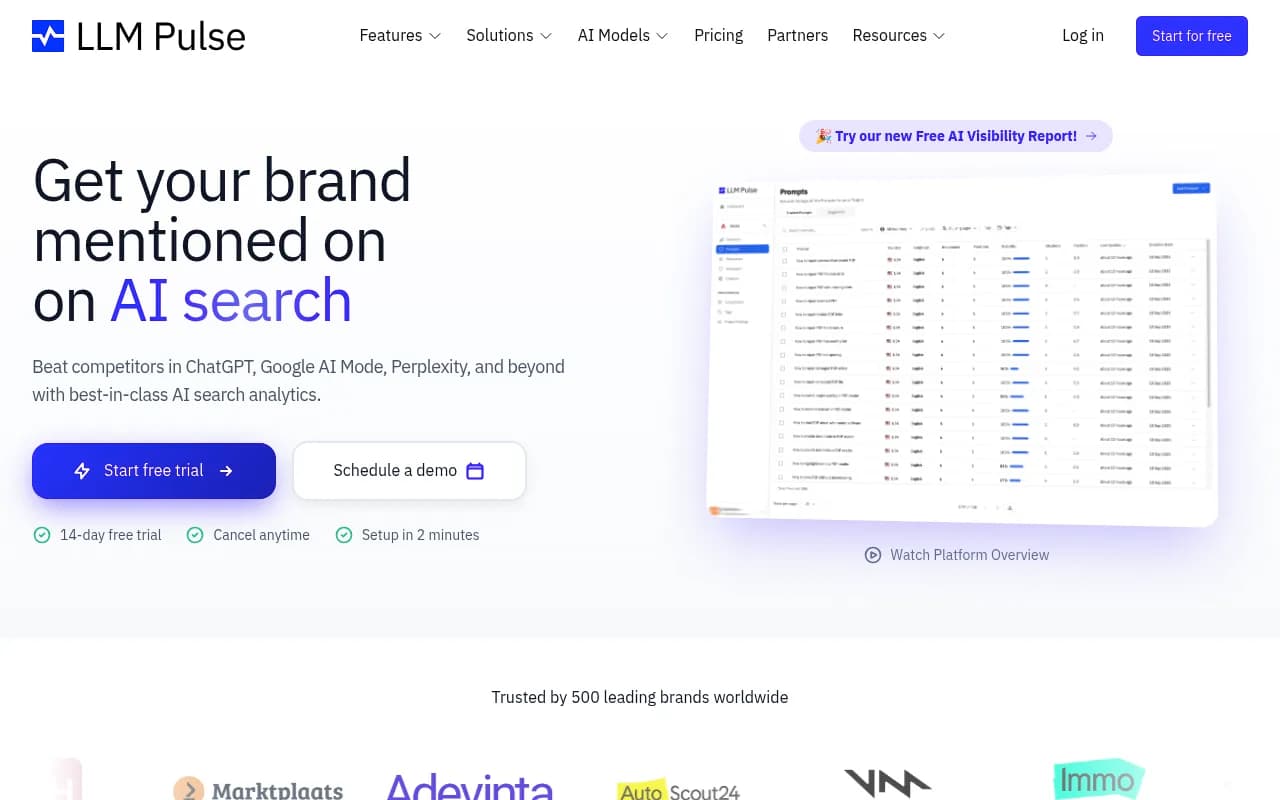
For teams that want to start simpler, tools like LLM Pulse and Peec AI offer more basic mention tracking across AI engines.

A practical starting point for this week
If you're reading this and haven't started yet, here's a concrete first step: open ChatGPT with web browsing enabled and run five prompts that your ideal buyer would realistically ask. Note which competitors appear and which sources get cited.
That 20-minute exercise will tell you more about your AI visibility situation than any amount of theorizing. You'll probably find at least one prompt where a direct competitor is being recommended and you're not -- and that's your starting point.
From there, the path is: identify the vocabulary gap, create content that addresses it directly, and build the off-site citation profile that gives AI models independent corroboration. It's not fast, but it compounds. Brands that started this work 12 months ago are now showing up consistently in buyer research conversations. The ones that wait another 12 months will have a harder gap to close.
Tools comparison: AI visibility platforms for B2B SaaS
| Tool | Monitoring | Content gap analysis | Content generation | Crawler logs | Best for |
|---|---|---|---|---|---|
| Promptwatch | Yes (10 engines) | Yes | Yes | Yes | Full-cycle optimization |
| Otterly.AI | Yes | No | No | No | Basic monitoring |
| Peec AI | Yes | No | No | No | Lightweight tracking |
| LLM Pulse | Yes | No | No | No | Simple mention tracking |
| Rankshift | Yes | No | No | No | Cross-engine tracking |
| AthenaHQ | Yes | Limited | No | No | Monitoring-focused teams |
| Profound | Yes | Limited | No | No | Enterprise monitoring |
The core difference between Promptwatch and most alternatives is that monitoring-only tools show you where you're invisible but leave you to figure out the fix yourself. Promptwatch's Answer Gap Analysis and Content Agents close that loop -- you see the gap, then you have a tool to fill it.

Profound

The bottom line
B2B SaaS buyers are already using ChatGPT to decide which tools to evaluate. That's not a prediction -- it's what the data shows right now, and the adoption curve is still steep. The brands that show up consistently in those early-stage conversations will have a structural advantage in pipeline generation that compounds over time.
The good news is that this is still early enough that deliberate effort creates real differentiation. Most of your competitors aren't doing this systematically yet. The ones who start now -- measuring, publishing structured content, building off-site citations -- will be much harder to displace in 12 months.