Key takeaways
- Semrush and Ahrefs both sell AI visibility as an extension of an SEO platform. That is convenient if you already pay for them, but the AI layer is lighter on monitoring depth and leaves the fixing to you.
- People who leave Profound are usually looking for one of three things: lower cost, more action (not just reporting), or data Profound does not expose, such as crawler logs and AI-referred traffic. An SEO suite add-on rarely delivers any of those.
- Pricing is not apples to apples. Semrush's toolkit is reported at about $99/mo on top of a base plan, and Ahrefs Brand Radar is free on paid plans at lower tiers but capped, with bigger prompt pools sold separately. Verify everything on the vendors' own pricing pages.
- Engine coverage differs per vendor and changes often. Check that the surfaces your buyers use (ChatGPT, AI Overviews, AI Mode, Copilot, Claude) are actually tracked before you sign.
- The sharper question is whether your tool only reports or also helps you ship the fix and measure it. That is where dedicated platforms pull away from suite add-ons.
The short version of the switcher story
If you have used Profound and you are unhappy with something, the reflex is to look at the SEO tools you already know. Semrush and Ahrefs both have AI visibility products, both have familiar interfaces, and your finance team may already pay for one of them.
I think that reflex is usually wrong, and not because Semrush or Ahrefs are bad. They are excellent at what they were built for. The issue is that a Profound switcher is, almost by definition, someone who already decided AI visibility deserves its own tool. Moving to an add-on bolted onto a keyword and backlink suite reverses that decision. You trade a dedicated product for a convenience.
This guide walks through what you actually give up, what you gain, and which kinds of teams should still pick the suite.
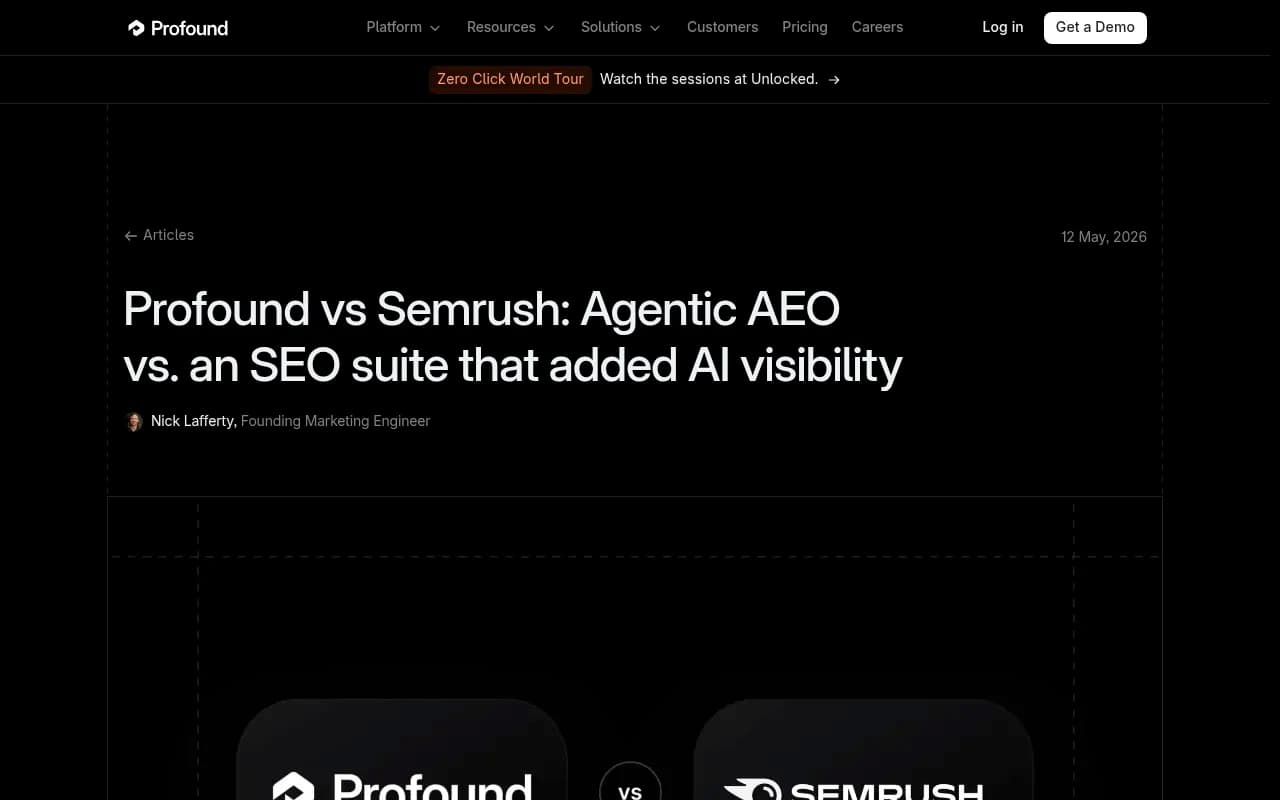
A caveat on that page: it is Profound's own marketing, so treat its framing as vendor-written. Its useful point, shared by plenty of independent reviewers, is that SEO suites grafted AI features onto an architecture built for blue-link rankings.
Why AI visibility is not rank tracking
Before comparing products, it helps to be clear about why the category split exists at all.
Classic SEO tracks a position for a keyword. AI answers do not have positions in the same sense. They have mentions, citations, tone, and the order in which brands are named. And they behave differently per engine. Promptwatch's average sources per response data shows ChatGPT citing about 5 sources per web-search answer, Google AI Overviews about 10, and Perplexity almost exactly 10 every day, while Copilot swung from under 2 to nearly 17 within a few weeks. One engine does not predict another.
It also moves in steps. Promptwatch's ChatGPT query fanout data shows average searches per response easing from 2.15 in early December to about 1.84 by early March, with query length dropping sharply over the same period. A prompt set built from keyword lists goes stale quickly when the retrieval behavior underneath it keeps changing. That is the core argument for a tool built around AI behavior rather than adapted from rank tracking.
One more figure you will see in vendor material: Profound claims 88% of AI answers cite different sources than traditional search would surface. That comes from Profound's own page, so read it as a vendor claim. Otterly's roundup cites a similar idea from The Digital Bloom, saying roughly 80% of LLM citations do not rank in Google's top 100 for the same query. Different numbers, same direction.
What Semrush's AI add-on actually is
Semrush launched its AI Visibility Toolkit in 2025 as an add-on, and Profound's comparison says it is now bundled into Semrush One plans. Adobe's acquisition of Semrush in April 2026 is also relevant context if you are thinking about roadmap risk.
What you get: prompt tracking, brand performance reports, prompt research, and a visibility overview, sitting next to your keyword and competitive data. For a team already living in Semrush, that single-vendor convenience is real.
What reviewers consistently say it lacks:
- Independent write-ups describe it as a strong monitoring layer but a lighter optimization layer. It tells you where you are invisible and leaves execution to you.
- Engine coverage and citation-source depth are narrower than dedicated platforms, and you bring your own prompts.
- Cost is not trivial. Otterly's roundup lists the AI Toolkit at $99/mo on top of a Semrush base plan starting around $199/mo. Rework's comparison notes the toolkit costs the same $99/mo for existing customers as for new ones, so loyalty does not discount it.
- Rework also reports the toolkit tracks 25 prompts across four AI engines at that price, with 50-prompt packs at $60/mo beyond it.
There is a separate catalog entry for the add-on itself.
What Ahrefs Brand Radar actually is
Ahrefs is the depth specialist, famous for backlink data. Brand Radar is its AI visibility product.
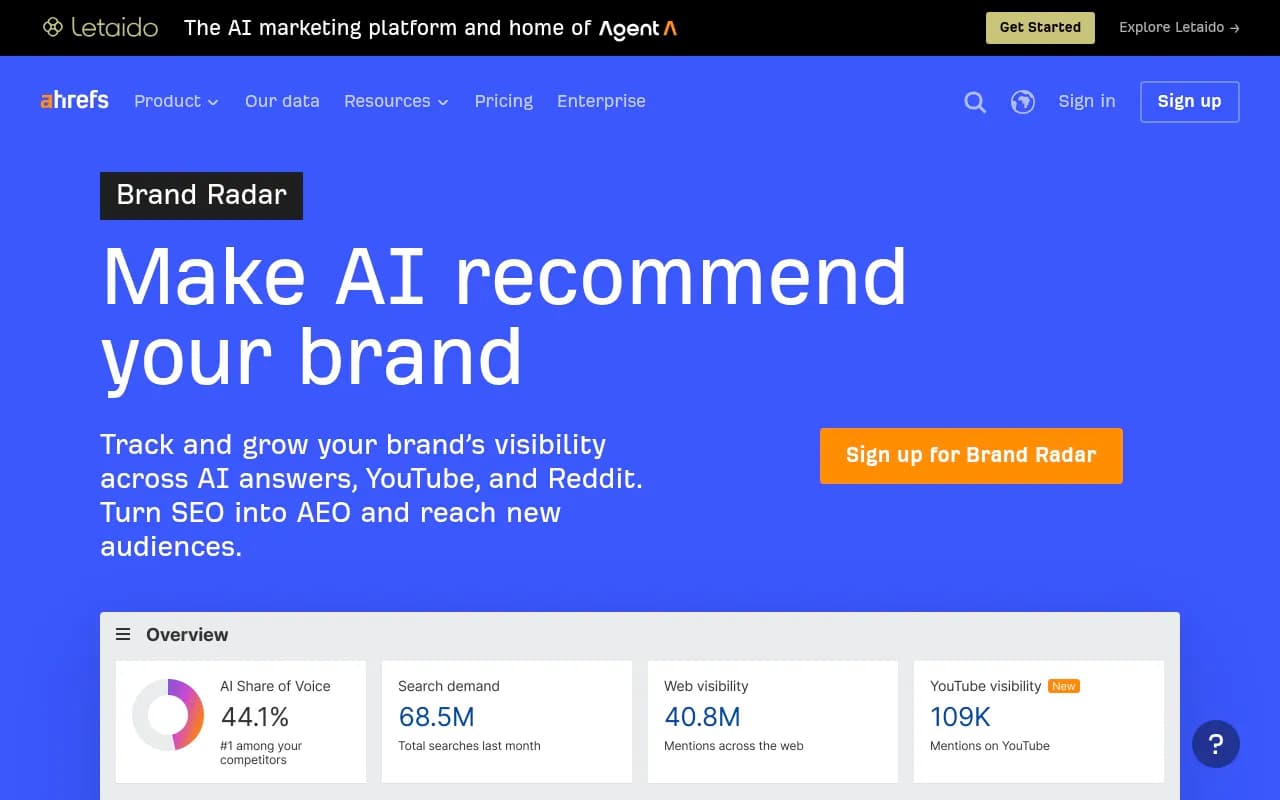
The pricing story is messier than Semrush's. Rework says core Brand Radar tracking is included for paid Ahrefs plans from Lite up, with $50/mo standalone, and a separate $199/mo AI Visibility Index product with a much bigger prompt pool and up to seven engines. Other roundups quote from $129/mo. These numbers conflict across sources and change often, so confirm on ahrefs.com.
The limitations that come up repeatedly:
- It is an add-on to an SEO tool, not a purpose-built AI visibility product.
- Engine lists are partial. Brandlight's review notes no Claude tracking, and Rework says Ahrefs is the only one of the two that names Copilot, Google AI Mode, or Claude at all.
- It stops short of executing anything. AirOps makes the same point about both suites: neither Semrush nor Ahrefs publishes or refreshes content for you.
- Profound's own comparison adds that support teams are SEO specialists rather than AI visibility specialists. That is a vendor claim, but a fair thing to ask about on any sales call.
Side by side
| Semrush AI Visibility Toolkit | Ahrefs Brand Radar | Dedicated AI visibility platform | |
|---|---|---|---|
| Built for | SEO suite extension | SEO suite extension | AI search from day one |
| Entry price (reported, verify) | About $99/mo add-on | Included on paid plans or $50/mo standalone; larger tiers $129 to $199/mo | Varies; roughly $95 to $579/mo for Promptwatch brand plans |
| Engine coverage | Narrower, four engines per pricing page | Wider but no Claude per one review | Typically 8 or more, real interfaces |
| Fixes the gaps for you | No | No | Varies; some write and publish content |
| AI crawler logs | No | No | Some platforms |
| AI traffic attribution | Limited | Limited | Some platforms |
| Best fit | Existing Semrush teams | Existing Ahrefs teams | Teams treating AI as its own channel |
Why switchers skip both
Talk to people who have left Profound and the reasons cluster. None of them is "I wanted my keyword tool to do it."
They want the fix, not another dashboard
The most common frustration with monitoring-first tools is that the report ends and the work starts. Both Semrush and Ahrefs sit squarely in that camp. A switcher who left Profound because they wanted more action is not going to find it in a suite add-on whose own reviewers describe execution as left to the user.
They want to know whether AI can even read their site
This is the gap I find most underrated. A citation problem can be a content problem or an access problem, and a prompt tracker cannot tell you which. IP-verified AI crawler logs can. Neither suite offers that as a core feature. Promptwatch's AI crawler logs show which bots hit which pages and where they hit errors, and its crawler traffic data tracks weekly verified requests across OpenAI, Anthropic, Google, Perplexity, and Mistral.
They want revenue evidence
A visibility score is not a business outcome. Teams that have to defend budget want AI-referred sessions and conversions next to the visibility numbers. Suites keep that in separate analytics tools or not at all.
They are price-sensitive in a specific way
The suite route looks cheap if you already own the base plan. If you do not, a $199/mo base plus a $99/mo add-on for 25 prompts is not cheap. Dedicated tools usually give you more prompts and engines for the same money.
The dedicated platforms worth looking at
There are plenty. I will focus on the ones switchers actually evaluate.
Promptwatch
Promptwatch is the one I would put first for a Profound switcher who wants the work done, not just tracked. It monitors the real interfaces of ChatGPT, Google AI Overviews, Google AI Mode, Gemini, Perplexity, Copilot, Meta AI, Alexa and others, then closes the loop: a content gap analysis, a Content Agent that writes and publishes to WordPress, Webflow, or Framer, and page-level tracking that shows whether each published page gets crawled, cited, and clicked. IP-verified crawler logs and visitor analytics are included, which neither Semrush nor Ahrefs provide.

Plans run from Essential at $95/mo to Business at $579/mo, with agency plans from $199/mo and a 7-day free trial on monthly billing. The Content Agent and faster-than-daily tracking start at Business. Confirm current numbers at promptwatch.com/pricing. If you want a direct read on the trade-offs, see Promptwatch vs Profound, Promptwatch vs Semrush, and Promptwatch vs Ahrefs. You can also run the free AI visibility report first, which needs no login.
Profound itself
Fair is fair: if your complaint with Profound is narrow, staying may be right. It is strong on measurement, with a large prompt dataset and an agentic layer. Entry pricing in third-party roundups is $99/$399/custom, but Profound is the vendor behind those comparison pages, so check its pricing directly.
Profound

Lighter trackers
If all you need is a cheap pulse check, trackers like Peec AI and Otterly.AI are the accessible end of the market. Roundups put Peec from about $95/mo and Otterly from about $29/mo. They monitor; they do not write, publish, or read crawler logs.

Otterly.AI

Other options in the catalog
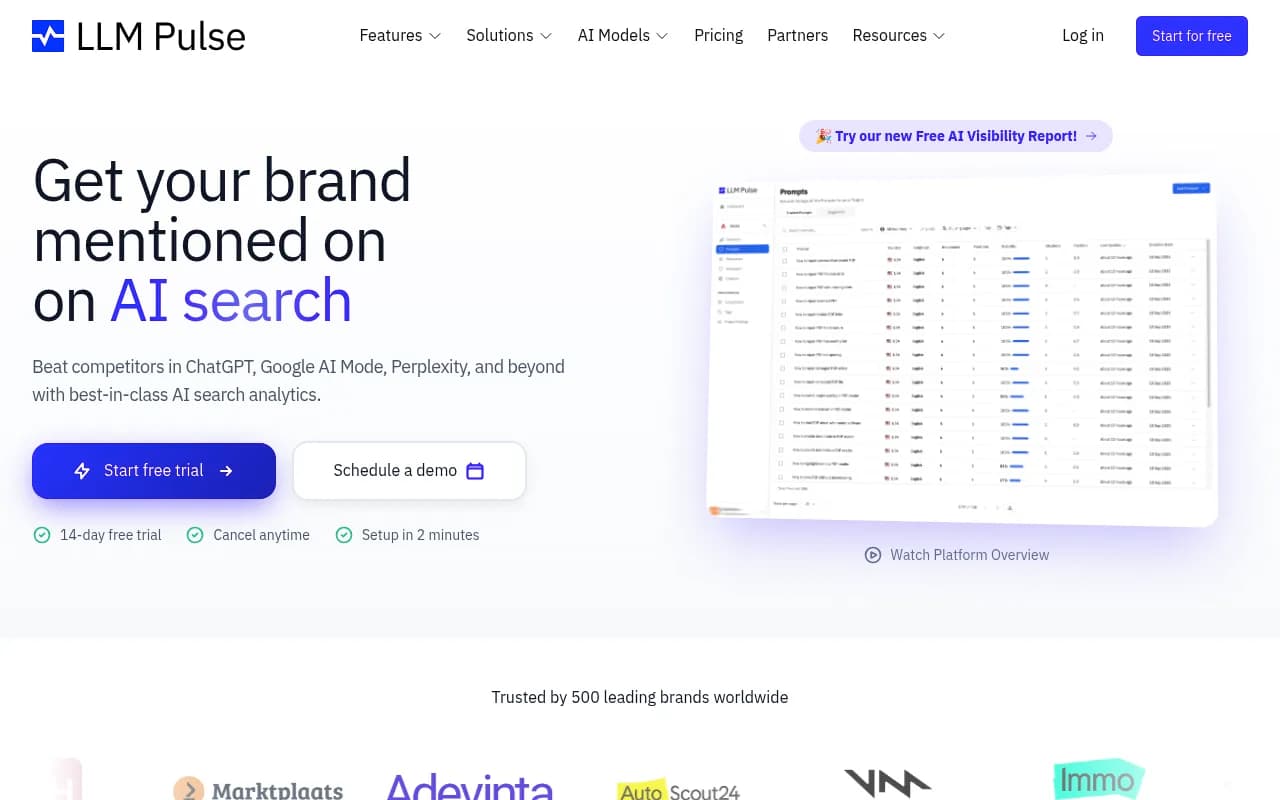
Scrunch, AthenaHQ, Rankshift and LLM Pulse are all monitoring-focused and sit between the lightweight trackers and the full platforms.


To see more of the field, the GEO software directory at bestgeosoftware.com is a good place to browse.
When the suite add-on is the right call
I would not tell everyone to skip Semrush or Ahrefs. A few cases where it genuinely makes sense:
- You already pay for the suite, AI visibility is a secondary concern, and Google AI Overviews is the engine you care about most.
- Your team will not adopt a new tool this quarter, and an imperfect number in a familiar dashboard beats no number.
- You only need a directional pulse for stakeholder reporting, not a program that changes content.
- Procurement is slow and adding a line to an existing contract takes days instead of months.
Brandlight's roundup lands in a similar place: suite tools are natural picks for teams standardized on an SEO suite, while a dedicated platform matters more as AI visibility becomes strategic. Note that Brandlight sells a competing product, so weigh that accordingly.
A decision framework
| If this is you | Lean toward |
|---|---|
| Already on Semrush, AI is a side project | Semrush AI Visibility Toolkit |
| Already on Ahrefs Lite or higher, want a free starting point | Ahrefs Brand Radar |
| Left Profound for cost and want more prompts | A dedicated platform with a lower entry price |
| Left Profound because you want fixes, not reports | An action-oriented platform such as Promptwatch |
| Need to prove AI traffic and conversions | A platform with visitor analytics and crawler logs |
| Agency running multiple client projects | A dedicated platform with agency plans |
| Only need a cheap pulse check | Peec AI or Otterly.AI |
Questions to ask before you buy anything
Whichever way you lean, put these to every vendor:
- Does it track the real user interface of each engine, or API output? The two can differ.
- Which engines exactly are covered on my plan, and is Claude, Copilot or AI Mode missing?
- Who chooses the prompts, and how are volumes estimated?
- Can it show whether AI crawlers reach my pages and what errors they hit?
- What happens after the report? Who writes, who publishes, who measures?
- What is the real monthly cost for the prompts I need, including add-ons?
The last one matters more than it sounds. Rework put it well: the two suite vendors do not sell in the same unit, so a straight price comparison is meaningless. Normalize to cost per tracked prompt per engine before comparing.
Who publishes this guide
This site is published by 1001 SEO Media, an SEO and generative engine optimization agency that uses Promptwatch for its own GEO work. That is a disclosure, not a reason to take the recommendation on faith. Run the free report and a trial of whichever tools you shortlist and compare the output on your own domain.
Bottom line
Switchers skip Semrush and Ahrefs because the problem that made them leave Profound, whether it was cost, a lack of action, or missing crawler and traffic data, does not get solved by an add-on built for ten blue links. If you are already inside one of those suites and AI is secondary, use the add-on and move on. If AI search is becoming a real acquisition channel, start with a dedicated platform and verify its pricing and engine coverage on the vendor's own site before you commit.