Key takeaways
- All four platforms track AI visibility, but they diverge sharply on what they do after they show you the data
- AthenaHQ is the strongest pure monitoring tool; Relixir goes deepest on content automation; Promptwatch is the only platform rated "Leader" across all categories in a 2026 comparison of 12 GEO tools
- Evertune targets Fortune 500 brands with model-level brand sentiment analysis -- impressive depth, but the price and complexity reflect that
- If your team needs to close the loop from visibility gap to published content to revenue attribution, only Promptwatch and Relixir attempt all three steps
- Free trials are available for Promptwatch; Evertune and AthenaHQ are primarily demo-first
The GEO platform market has matured fast. A year ago, most tools were glorified dashboards that showed you a brand mention score and called it a day. In 2026, the gap between monitoring-only tools and genuine optimization platforms has become the defining question for enterprise buyers.
This comparison focuses on four platforms that have earned serious attention from enterprise marketing and SEO teams: Evertune, AthenaHQ, Promptwatch, and Relixir. They're not the only players worth knowing, but they represent four distinct philosophies about what a GEO platform should actually do.
Let's get into it.
What "enterprise GEO" actually means in 2026
Before comparing platforms, it's worth being precise about what enterprise teams actually need -- because "enterprise GEO" gets thrown around loosely.
At minimum, an enterprise GEO platform needs to:
- Track brand mentions across multiple AI engines (not just ChatGPT)
- Handle multiple brands, sub-brands, or client accounts
- Produce data that can be exported or connected to BI tools
- Show why you're visible or invisible, not just whether you are
The harder question is what comes next. Knowing you're invisible for a prompt is useful. Knowing which content to create, having a tool that generates it, and then confirming the new content actually improved your visibility -- that's a different category of product entirely.
The four platforms below sit at different points on that spectrum.
The platforms at a glance
| Platform | Primary strength | Content generation | AI engines tracked | Pricing model |
|---|---|---|---|---|
| Evertune | Model-level brand sentiment | No | 6+ | Enterprise/custom |
| AthenaHQ | Revenue attribution | No | 8+ | Custom (demo-first) |
| Promptwatch | Full optimization loop | Yes (built-in AI agent) | 10 | $99–$579/mo + custom |
| Relixir | End-to-end content automation | Yes (automated) | 6+ | Enterprise/custom |
Evertune

Evertune targets Fortune 500 brands that want to understand how AI models perceive their brand, not just whether they appear. The platform's differentiator is model-level brand analysis -- it can tell you that Claude describes your brand one way while Gemini frames it differently, and track how that narrative shifts over time.
That's genuinely useful for large brands where brand perception management is a dedicated function. If you have a team whose job is to monitor how your company is characterized in media and AI outputs, Evertune gives them data they can actually work with.
The limitations are real, though. Evertune doesn't generate content. It doesn't tell you which specific pages to create or optimize. It shows you the gap in brand narrative and leaves the remediation to your team. For an enterprise with a full content operation, that might be fine. For a team that needs to move from insight to execution quickly, it's a bottleneck.
Pricing is enterprise-custom and demo-first, which means you won't get a number without a sales conversation. That's a reasonable approach for a product targeting Fortune 500 buyers, but it makes it harder to evaluate independently.
Best for: Large brands with dedicated brand intelligence functions who need deep model-level narrative tracking and have separate content teams to act on the findings.
AthenaHQ

AthenaHQ has built a strong reputation for one specific thing: connecting AI visibility to revenue. Its attribution capabilities are more developed than most competitors, and for enterprise teams that need to justify GEO investment to a CFO, that matters.
The platform tracks brand mentions across 8+ AI engines, monitors sentiment and competitive positioning, and produces reporting that can be tied to pipeline and revenue metrics. That's a meaningful differentiator in a market where most tools produce visibility scores that are hard to connect to business outcomes.
Where AthenaHQ falls short is on the action side. It's fundamentally a monitoring and attribution platform. It will tell you that you're losing ground to a competitor on a specific set of prompts, and it will help you quantify what that costs in revenue terms. What it won't do is help you fix it. There's no content gap analysis, no built-in writing tool, no crawler log data showing how AI bots interact with your site.
For teams that have already solved the "what to create" problem and just need better measurement, AthenaHQ is a strong choice. For teams that are still trying to figure out where to start, the monitoring data without the optimization layer can feel like a lot of information and not much direction.
Best for: Enterprise marketing teams with existing content operations who need to prove GEO ROI and connect visibility metrics to revenue attribution.
Promptwatch
Promptwatch takes a different approach from both Evertune and AthenaHQ. Rather than optimizing for depth in one dimension (brand narrative or revenue attribution), it's built around a complete optimization loop: find the gaps, create content to fill them, track whether it worked.

The Answer Gap Analysis is the core of this. It shows you exactly which prompts your competitors appear for that you don't -- not as an abstract score, but as a specific list of questions and topics where your content is missing. That's actionable in a way that a visibility score isn't.
From there, the built-in AI writing agent generates content grounded in citation data from 880M+ citations analyzed. It's not generic content generation -- it's articles and comparisons built around the specific prompts and topics where you need visibility. The output is designed to get cited by ChatGPT, Claude, Perplexity, and other AI engines.
The tracking layer closes the loop. Page-level tracking shows which specific pages are being cited, by which models, and how often. Traffic attribution (via code snippet, GSC integration, or server log analysis) connects visibility improvements to actual traffic and revenue.
A few capabilities that matter for enterprise use specifically:
- AI Crawler Logs show which pages ChatGPT, Claude, Perplexity, and others are actually reading -- and flag errors. Most competitors don't have this at all.
- Prompt Intelligence includes volume estimates and difficulty scores, so you can prioritize high-value prompts instead of guessing.
- Reddit and YouTube tracking surfaces discussions that influence AI recommendations -- a channel most platforms ignore.
- Multi-language and multi-region monitoring with customizable personas.
- Looker Studio integration and API for custom reporting.
Promptwatch monitors 10 AI models: ChatGPT, Perplexity, Google AI Overviews, Google AI Mode, Claude, Gemini, Meta/Llama, DeepSeek, Grok, Mistral, and Copilot. That's the broadest coverage of the four platforms compared here.
Pricing is transparent and starts at $99/month for the Essential plan (1 site, 50 prompts, 5 articles). Professional is $249/month (2 sites, 150 prompts, 15 articles, crawler logs, state/city tracking). Business is $579/month (5 sites, 350 prompts, 30 articles). Agency and enterprise pricing is custom. A free trial is available.
In a 2026 comparison of 12 GEO platforms, Promptwatch was the only tool rated "Leader" across all evaluation categories -- the distinction being that most competitors stop at monitoring while Promptwatch is built around taking action.
Best for: Marketing and SEO teams that need to move from visibility gap to published content to measurable results, without stitching together multiple tools.
Relixir
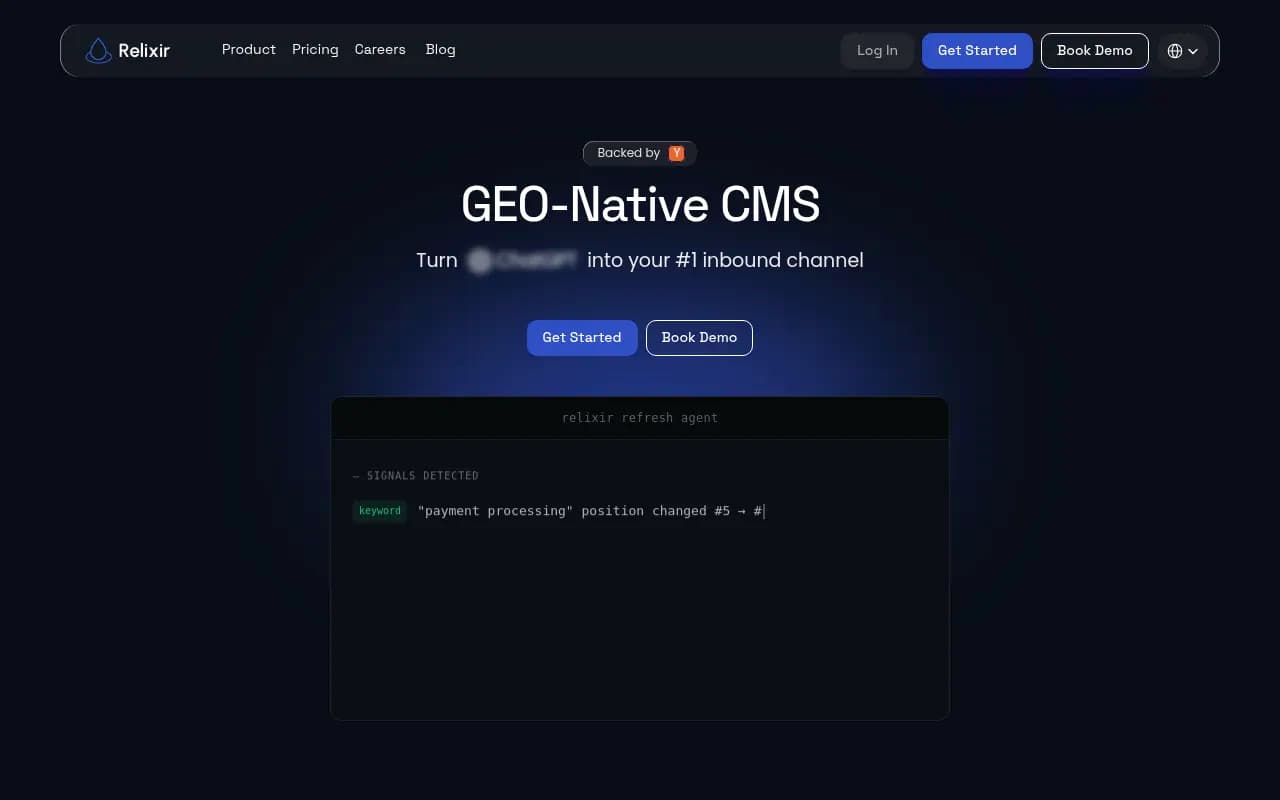
Relixir positions itself as an end-to-end GEO engine, and it takes the content automation angle further than most. Where Promptwatch's content generation is guided by human editorial judgment (you review and approve), Relixir leans harder into automated publishing pipelines. For enterprise teams managing very high content volumes, that automation depth is appealing.
The platform covers the core GEO workflow: prompt tracking, competitive analysis, content generation, and visibility monitoring. It's built for enterprise scale and the pricing reflects that -- like Evertune and AthenaHQ, Relixir is primarily a demo-first, custom-pricing product.
The trade-off with Relixir's automation-first approach is control. Automated content pipelines can move fast, but they require careful oversight to ensure quality and brand voice consistency. Teams with strong editorial processes and clear content standards can make this work well. Teams that are still developing those standards may find the automation gets ahead of them.
Relixir also doesn't have the same breadth of AI engine coverage or the Reddit/YouTube tracking that Promptwatch offers. For teams focused primarily on ChatGPT and Perplexity visibility, that's fine. For teams that need comprehensive multi-model coverage, it's worth noting.
Best for: Enterprise brands with high content volume needs and established editorial standards who want to automate GEO content production at scale.
Head-to-head: the features that actually matter
| Feature | Evertune | AthenaHQ | Promptwatch | Relixir |
|---|---|---|---|---|
| AI engines tracked | 6+ | 8+ | 10 | 6+ |
| Answer gap analysis | No | Limited | Yes | Yes |
| Built-in content generation | No | No | Yes | Yes |
| AI crawler logs | No | No | Yes | No |
| Revenue/traffic attribution | No | Yes (strong) | Yes | Limited |
| Reddit/YouTube tracking | No | No | Yes | No |
| Prompt volume & difficulty scoring | No | No | Yes | No |
| ChatGPT Shopping tracking | No | No | Yes | No |
| Multi-region/language | Yes | Yes | Yes | Yes |
| Transparent pricing | No | No | Yes ($99–$579/mo) | No |
| Free trial | No | No | Yes | No |
| API access | Yes | Yes | Yes | Yes |
The monitoring-only trap
One pattern worth naming directly: most enterprise GEO buyers start by evaluating platforms on monitoring quality, because that's the most measurable dimension. How many AI engines? How accurate are the citations? How granular is the competitive data?
Those are valid questions. But they can lead teams to invest in a monitoring platform and then discover they have no clear path to improving what they're monitoring.
AthenaHQ and Evertune are both excellent at showing you where you stand. The problem is that "where you stand" changes based on what content exists on your site, how AI crawlers interact with it, and which third-party sources (Reddit threads, YouTube videos, review sites) are shaping AI recommendations. Monitoring alone doesn't move any of those levers.
The platforms that include content generation and optimization tools -- Promptwatch and Relixir -- are built on the premise that visibility is an output, and the inputs are content, structure, and source authority. That's a more complete model, even if it's harder to evaluate in a demo.
Which platform fits which team
Choose Evertune if: You're a large brand with a dedicated brand intelligence function, you need model-level narrative analysis, and you have separate content teams who can act on the findings. Budget is not the primary constraint.
Choose AthenaHQ if: Your primary challenge is proving GEO ROI to leadership, you need strong revenue attribution, and your content operation is already running well without a GEO-specific tool.
Choose Promptwatch if: You need the full loop -- gap analysis, content creation, and results tracking -- in one platform. Especially relevant if you want transparent pricing, a free trial before committing, and the broadest AI engine coverage available (10 models including Google AI Mode, DeepSeek, and Grok).
Choose Relixir if: You're running high-volume content operations and want to automate GEO content production at scale, and you have strong editorial processes to maintain quality in an automated pipeline.
A note on the broader market
These four platforms aren't the only options worth knowing. Profound has strong analytics depth and enterprise adoption. Scrunch AI covers enterprise GEO with a different feature mix. Peec AI has built a reputation for regional data integrity that's worth examining if multi-market accuracy is critical.
The broader market has also produced some interesting niche players. Tools like Otterly.AI and Peec AI serve teams that need lightweight monitoring without the complexity of a full enterprise platform.
Otterly.AI


Profound


For most enterprise teams, though, the decision comes down to the four platforms in this comparison -- and specifically to the question of whether you need monitoring, attribution, optimization, or all three.
The bottom line
The GEO platform market in 2026 has a clear fault line: tools that show you data, and tools that help you act on it.
Evertune and AthenaHQ are excellent at showing you data -- brand narrative depth and revenue attribution, respectively. If your team has the capacity to translate that data into action independently, either is a strong choice.
Promptwatch and Relixir are built around the premise that showing you data isn't enough. Both include content generation. Promptwatch adds crawler logs, prompt intelligence, Reddit/YouTube tracking, and the broadest AI engine coverage of the four -- and it's the only one with transparent pricing and a free trial.
If you're evaluating enterprise GEO platforms and you want to start somewhere concrete, Promptwatch's free trial is the lowest-friction way to see what the full optimization loop looks like in practice.