Key takeaways
- Google AI Overviews now appear on over 50% of searches, and roughly 60% of citations come from URLs not ranking in the top 20 organic results -- meaning traditional SEO rank alone won't get you cited.
- Only 12% of AI Mode citations match exact URLs in the organic SERP (Moz, February 2026), so content structure and topical authority matter more than position.
- Pages not updated quarterly are 3x more likely to lose citations, according to AirOps' 2026 State of AI Search report.
- The 12 content patterns below are grounded in citation data, not theory -- each one addresses a specific signal Google's AI uses to decide what to include in its summaries.
- Tools like Promptwatch can help you track which of your pages are being cited in AI Overviews and identify the gaps where competitors are getting mentioned instead.
There's a strange thing happening in Google search right now. You can rank #1 for a keyword and still not appear in the AI Overview that sits above your result. Moz analyzed nearly 40,000 queries in early 2026 and found that 88% of AI Mode citations don't match any URL in the organic SERP for that query. Even at the domain level, only 1 in 5 citations overlaps.
That's not a bug. It's how the system was designed. Google's AI isn't just pulling from its top-ranked pages -- it's pulling from whatever content best answers the question, regardless of where it ranks.
Which means the game has changed. Getting cited in AI Overviews requires a different kind of content strategy than getting to page one. Here are 12 patterns that consistently produce citations, based on what the data shows is actually working.
Why AI Overviews cite what they cite
Before getting into the patterns, it helps to understand the selection logic. Google's AI Overviews are trying to synthesize a trustworthy, complete answer. The signals it uses include:
- Semantic completeness (does the page fully address the topic?)
- E-E-A-T signals (experience, expertise, authoritativeness, trustworthiness)
- Freshness (when was the content last updated?)
- Structured clarity (can the AI parse and extract the answer easily?)
- Off-site validation (do third parties mention or link to this content?)
The 12 patterns below map directly to these signals. Some are structural. Some are about content depth. A few are about where you publish, not just what you publish.
Pattern 1: Answer the question in the first paragraph
Google's AI doesn't read your whole page before deciding whether to cite it. It looks for the answer near the top. Pages that bury the key information after a long preamble get skipped.
The pattern that works: state the direct answer in the first 2-3 sentences, then expand. Think of it like an inverted pyramid. The AI can extract the summary immediately, and the rest of the page provides supporting depth.
This isn't just good writing advice -- it's how AI extraction works. If the answer isn't findable quickly, the AI moves on to a page where it is.
Pattern 2: Use sequential heading structures with schema markup
The AirOps 2026 State of AI Search report found that sequential headings combined with rich schema correlate with 2.8x higher citation rates. That's a significant lift from a structural change.
What "sequential headings" means in practice: H2s that follow a logical progression through the topic, H3s that break down each section, no skipped levels. The AI can map your content structure and understand what each section covers. Disorganized heading hierarchies make that harder.
Schema markup (FAQ schema, HowTo schema, Article schema) gives the AI explicit signals about what your content is and how it's structured. Pages with relevant schema are easier to parse and more likely to be cited.
Pattern 3: Write for semantic completeness, not keyword density
This is probably the biggest shift from traditional SEO. Google's AI evaluates whether a page covers a topic completely -- not whether it repeats a keyword enough times.
Semantic completeness means covering the related subtopics, the common questions, the edge cases, and the context that a knowledgeable person would include. A page about "project management software" that doesn't mention collaboration features, pricing models, or integrations is semantically incomplete, even if it's 3,000 words long.
Tools like Clearscope or MarketMuse can help you identify the semantic gaps in your content.

Pattern 4: Update content at least quarterly
Pages not updated quarterly are 3x more likely to lose citations, per the AirOps data. This is one of the clearest signals in the research, and it's one most brands underestimate.
The AI Overviews system appears to weight freshness heavily -- especially for topics where information changes (pricing, regulations, best practices, product comparisons). A page that was authoritative in 2024 but hasn't been touched since can lose its citation status as newer, fresher content appears.
The practical implication: build a content refresh calendar. Identify your highest-performing pages (or the ones you want to get cited) and schedule quarterly reviews. Even small updates -- adding a new data point, updating a statistic, adding a new section -- can reset the freshness signal.
Pattern 5: Earn citations from community platforms
About 48% of AI Overview citations come from community platforms like Reddit and YouTube, according to the AirOps report. That's not a small slice -- it's nearly half.
This matters because most brand content strategies focus entirely on owned domains. But the AI is drawing heavily from places where real people discuss real experiences. A Reddit thread where your product is recommended, a YouTube review that mentions your brand favorably, a forum post that cites your research -- these all feed into the citation pool.
The strategy here isn't to spam Reddit. It's to be genuinely present in the communities where your customers talk. Answer questions. Share research. Participate in discussions. When your brand shows up authentically in community content, the AI picks it up.
Moz's analysis of AI Mode citations found YouTube is the second most cited external source overall -- which means video content is a legitimate citation channel, not just a brand awareness play.
Pattern 6: Build topical authority through content clusters
Google's AI doesn't just evaluate individual pages -- it evaluates domains. A site that has published 40 pieces of content about a topic signals deeper expertise than a site with one comprehensive guide, even if that guide is excellent.
The pattern: build content clusters. A pillar page covering the broad topic, supported by multiple cluster pages covering specific subtopics in depth. Each cluster page links back to the pillar, and the pillar links out to clusters. This architecture signals topical authority to both traditional Google and its AI systems.
The key is that the cluster pages need to be genuinely useful, not thin. Five deep, specific articles outperform twenty shallow ones.
Pattern 7: Include original data, research, or proprietary insights
The AI Overviews system has a strong preference for content that contains information it can't find elsewhere. Original surveys, proprietary data, first-party research, case studies with real numbers -- these stand out.
This makes sense from a synthesis perspective. If the AI is trying to give users the best possible answer, it wants to include information that adds something new, not just paraphrase what's already in ten other articles.
You don't need to run a massive research study. Even a small survey of your customers, an analysis of your own platform data, or a compilation of publicly available data presented in a new way can qualify as original research.
Pattern 8: Demonstrate E-E-A-T through author signals and first-person experience
Google's E-E-A-T framework (Experience, Expertise, Authoritativeness, Trustworthiness) has become more important as AI Overviews have expanded. The "Experience" component is relatively new -- it rewards content written by people who have actually done the thing they're writing about.
Practical signals: named authors with credentials, author bio pages that establish relevant expertise, first-person accounts of using a product or implementing a strategy, and specific details that only come from direct experience (not generic advice that could apply to anything).
A review that says "I used this tool for six months and here's what I found" is more likely to be cited than a review that describes features without any personal context.
Pattern 9: Format content for direct extraction
Google's AI needs to extract information from your page and present it in a summary. Content that's formatted for extraction gets cited more often than content that requires interpretation.
Formats that work well:
- Numbered lists for processes and steps
- Definition-style paragraphs that start with the term being defined
- Comparison tables with clear headers
- Short, declarative sentences for key facts
- FAQ sections with direct answers
Content that's harder to extract: dense paragraphs with multiple ideas mixed together, passive voice constructions, hedged statements that don't commit to a clear answer.
Pattern 10: Optimize for the specific query type, not just the keyword
AI Overviews behave differently depending on the query type. Informational queries get different treatment than commercial queries, which get different treatment than navigational queries.
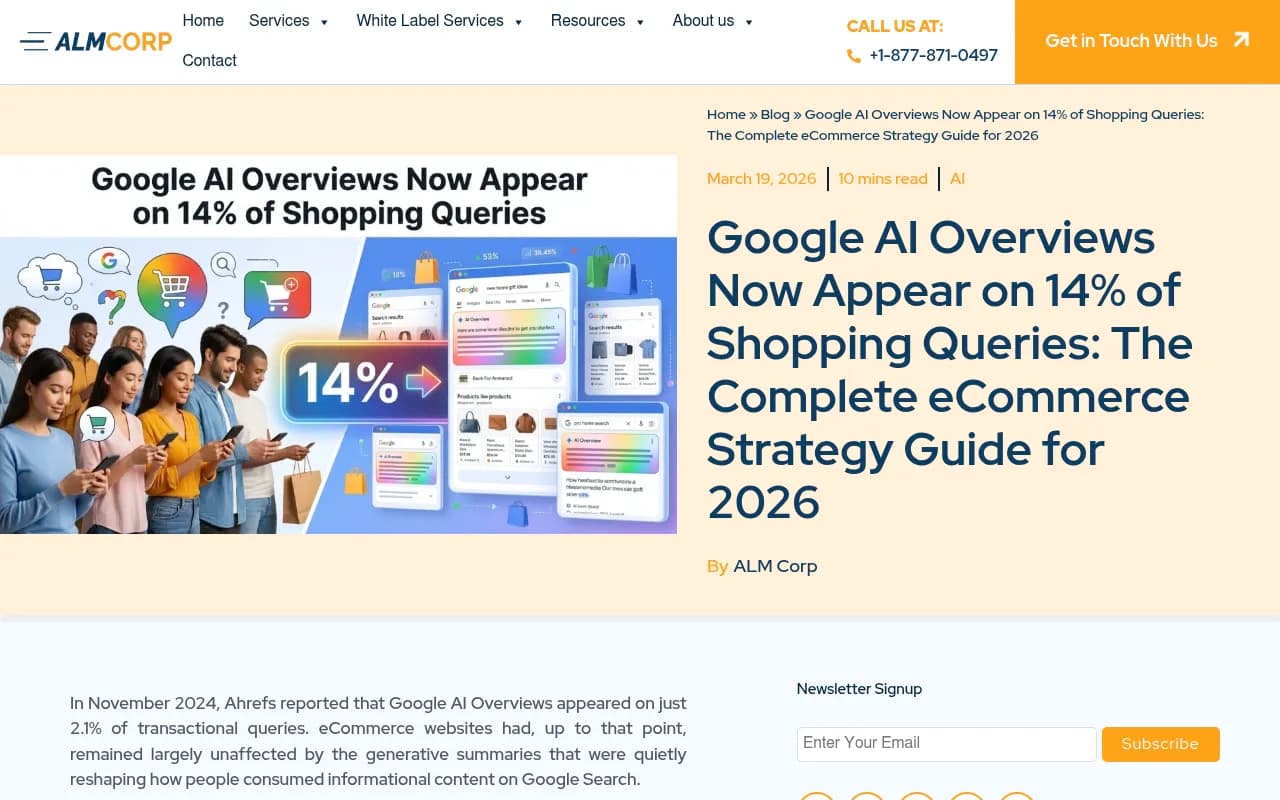
The research from Visibility Labs found that by early 2026, AI Overviews appeared on 14% of shopping queries -- up from 2.1% in late 2024. That's a massive shift for eCommerce brands.
For informational queries: focus on comprehensive, well-structured explanations with clear definitions and examples.
For commercial/shopping queries: include specific product details, pricing context, comparison information, and trust signals like reviews and ratings. The AI is trying to help users make decisions, so content that aids decision-making gets cited.
For "best X" or comparison queries: structured comparison content with clear criteria and specific recommendations tends to perform well.
Pattern 11: Build third-party mentions and citations
The AirOps data found that 85% of brand mentions in AI responses originate from third-party pages rather than owned domains. That's a striking number. The AI trusts what others say about you more than what you say about yourself.
This means your PR and link-building efforts directly feed your AI citation potential. Getting mentioned in industry publications, earning backlinks from authoritative sources, being cited in research -- all of this builds the off-site credibility that influences AI Overviews.
Practically: pursue digital PR campaigns that earn genuine coverage. Contribute expert quotes to journalists. Publish research that other sites want to cite. Build relationships with industry publications in your space.
The brands that show up consistently in AI Overviews tend to have strong off-site mention profiles, not just strong on-site content.
Pattern 12: Monitor your citation status and close the loop
This last pattern is less about content and more about process. Only 30% of brands stay visible from one AI answer to the next, and just 20% remain present across five consecutive runs of the same query, according to the AirOps research. AI citation is volatile. You can be cited today and gone tomorrow.
The brands that maintain consistent visibility are the ones that track what's happening and respond quickly. That means knowing which of your pages are being cited, which queries are triggering citations, and where competitors are appearing that you're not.
Promptwatch tracks AI Overviews alongside other AI search engines, showing you page-level citation data and the specific prompts where you're visible or missing. Its Answer Gap Analysis shows exactly which queries competitors are cited for that you're not -- which is where the content opportunities are.

How these patterns work together
No single pattern is a silver bullet. The brands that consistently appear in AI Overviews tend to be doing most of these things simultaneously:
| Pattern | Primary signal addressed | Difficulty |
|---|---|---|
| Answer in first paragraph | Extractability | Low |
| Sequential headings + schema | Structure | Low |
| Semantic completeness | Topical depth | Medium |
| Quarterly content updates | Freshness | Medium |
| Community platform presence | Off-site validation | High |
| Topical authority clusters | Domain expertise | High |
| Original data and research | Unique value | High |
| E-E-A-T author signals | Trustworthiness | Medium |
| Extraction-friendly formatting | Extractability | Low |
| Query-type optimization | Relevance | Medium |
| Third-party mentions | Off-site credibility | High |
| Citation monitoring | Iteration | Medium |
The low-difficulty patterns (formatting, headings, first-paragraph answers) are table stakes. They're easy to implement and they help, but they won't overcome weak topical authority or poor off-site credibility.
The high-difficulty patterns (community presence, original research, third-party mentions) are where real competitive advantage lives. They take time to build but they're also harder for competitors to copy quickly.
A note on the negative citation risk
One finding worth flagging: a Fortune analysis from March 2026 found that Google AI Overviews are 44% more likely to speak negatively about a brand than ChatGPT. That's not a reason to avoid AI Overviews -- you can't opt out -- but it is a reason to take your reputation management seriously.
Negative brand mentions in community platforms (Reddit, review sites, forums) can feed into AI Overview responses just as positive ones do. Monitoring what's being said about your brand across the web, and addressing legitimate complaints publicly, is part of the AI citation strategy now.
Where to start
If you're new to optimizing for AI Overviews, the quickest wins are:
- Audit your top 20 pages and rewrite the opening paragraphs to answer the query directly
- Add FAQ schema to any page targeting informational queries
- Set up a content refresh schedule for your most important pages
- Start tracking which queries trigger AI Overviews in your space and whether you're being cited
For tracking, tools like Promptwatch give you page-level citation data across AI Overviews and other AI search engines. For content optimization, tools like Clearscope or Surfer SEO can help you close semantic gaps.
The underlying principle across all 12 patterns is the same: create content that a knowledgeable, trustworthy source would produce, make it easy to extract, keep it fresh, and build the off-site credibility that tells the AI your content is worth citing. That's not a hack -- it's just good content strategy applied to a new distribution channel.