Key takeaways
- For most single-location businesses, a tracker plus a few hours a week covers the basics. Agencies earn their fee on multi-location rollouts, messy sites, and competitive markets.
- If you already pay an SEO agency, test whether it can own AI answer work before adding a second retainer.
- A tracker tells you where you are invisible. It does not fix schema, reviews, listings, or content. Someone still has to do that work.
- Third-party price ranges vary widely and mostly come from vendors with something to sell. Treat them as rough anchors and get quotes.
- A hybrid works well: track in-house, hire for scoped projects such as schema, citations, or content sprints.
The real question behind this decision
People frame this as agency versus software. That is slightly off. A prompt tracker is a measurement tool. An agency is labor plus judgment. They solve different problems, and the choice is really about who does the work and who is accountable for the outcome.
Local businesses have an extra wrinkle. AI answers for "best plumber near me" or "dentist open Saturday in Leeds" depend on location, on listings and reviews, and on which sources the engine pulls from. A generic national tracker can miss that completely.
So before spending money, work out which of these you actually need:
- Measurement: do I know whether ChatGPT, Gemini, Perplexity, and AI Overviews mention me?
- Diagnosis: do I know why they do or don't?
- Execution: is someone fixing the causes?
- Accountability: is anyone on the hook if nothing improves?
Trackers cover the first, and sometimes the second. Agencies sell the third and fourth. Some tools now push into execution too, which blurs the line a bit.
What local SEO and GEO actually involve
Traditional local SEO is about getting a business to rank in the map pack and organic results: Google Business Profile, citations, reviews, location pages, and links. GEO (generative engine optimization) is about getting your brand named, cited, or recommended inside the answer an AI tool writes. One Reddit thread on the topic puts it neatly: SEO is about getting a URL to rank, GEO is about getting an entity recognized and cited.
The overlap is large. Clean technical foundations, consistent business data, strong reviews, and useful pages help both. The difference is the measurement layer and a few extra tasks, such as making sure AI crawlers can read your site and that your facts are stated plainly on pages the engines cite.
It also helps to know how crowded the answer is. According to Promptwatch Data's average sources per response report, ChatGPT cites about 5 sources per web-search answer, while Google AI Overviews and Perplexity cite about 10. Five slots means every local competitor is fighting for a very small number of spots, so a measurement setup that treats each engine separately matters.
What a tracker can and can't do for a local business
A prompt tracker runs a set of questions across AI engines on a schedule and records whether you appear, where, with what sentiment, and which sources get cited. For a local business that looks like tracking prompts such as "best Italian restaurant in Bristol" and "emergency electrician near me" and watching share of voice against nearby competitors.
What you get:
- A baseline of whether you show up at all
- Competitor comparisons for the same prompts
- A list of sources AI engines cite, which tells you where to get listed or reviewed
- Trend lines, so you can tell if work you did moved anything
What you don't get automatically:
- Fixes. A dashboard that says you're invisible is not a plan.
- Location realism. Many trackers query from a country or region, not from the street where your customers stand. Check this before you buy.
- Judgment about what matters for your business versus what is just noise.
Local tools worth knowing
There are two families here. Classic local SEO tools handle listings, rankings in the map grid, and reviews. AI visibility trackers handle the generative side.
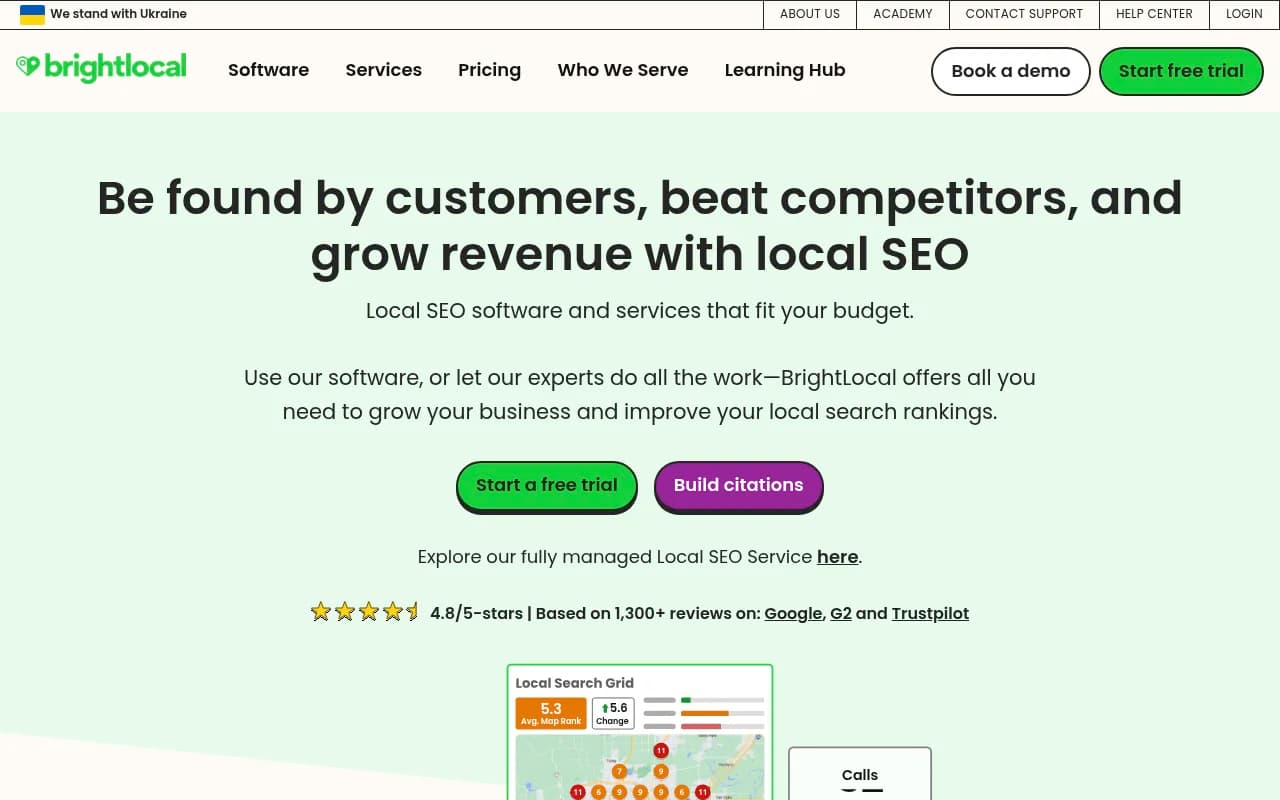
On the classic side, BrightLocal is a long-standing platform for multi-location businesses.
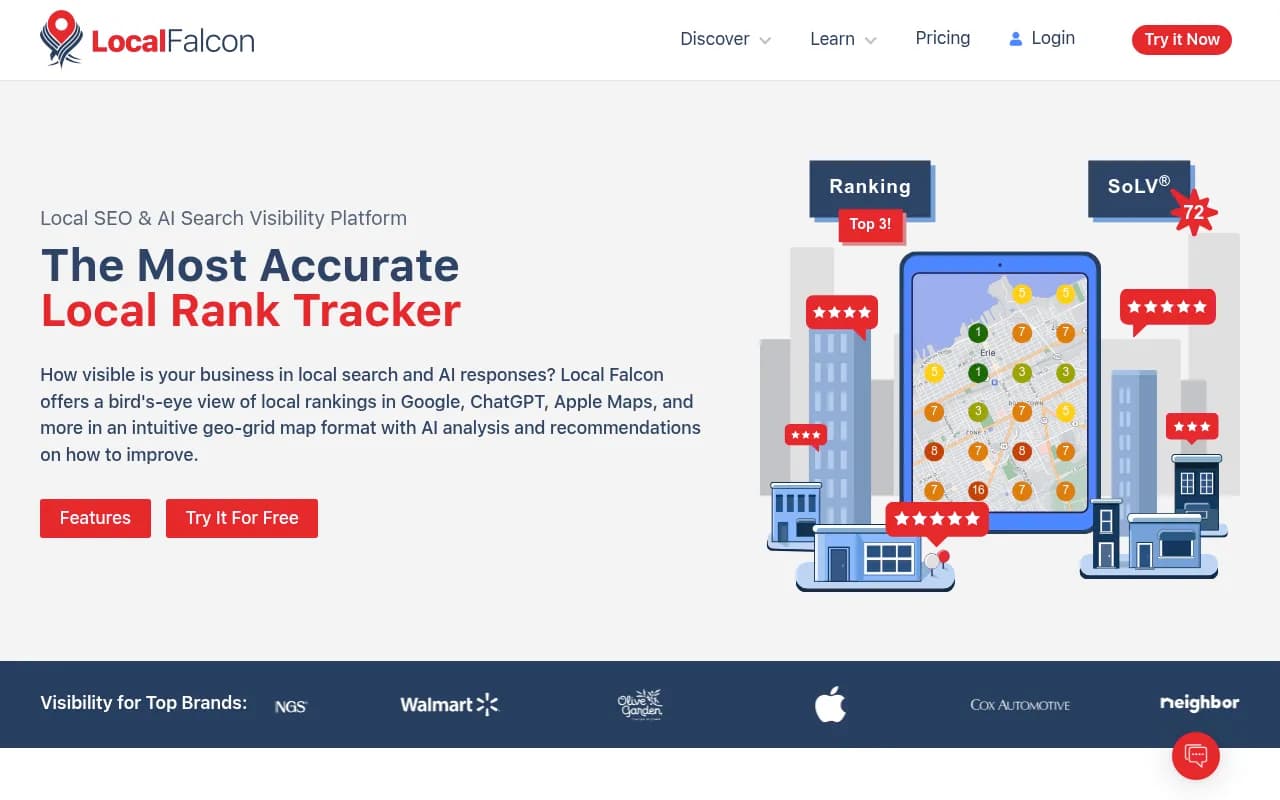
Local Falcon shows geo-grid rank tracking, which is useful for seeing how map visibility shifts block by block.
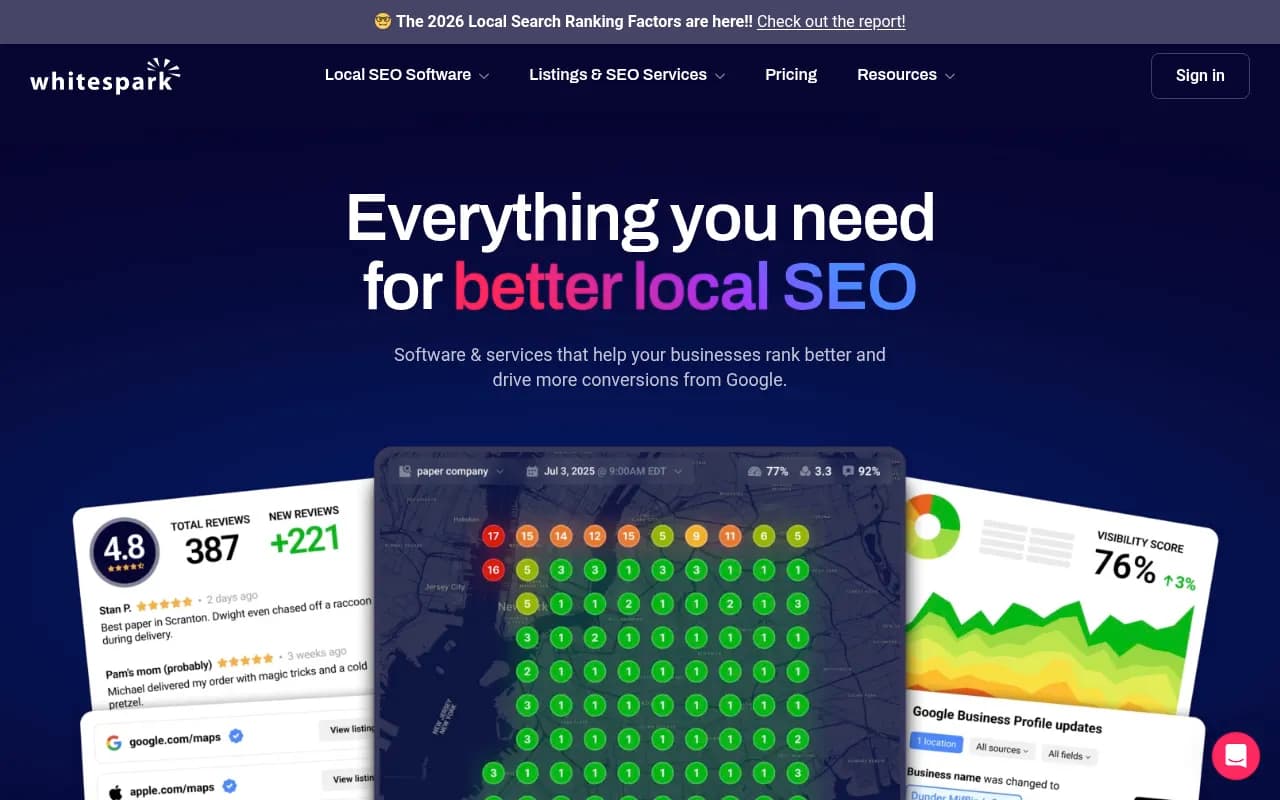
Whitespark is a solid pick for citation building and local ranking work.
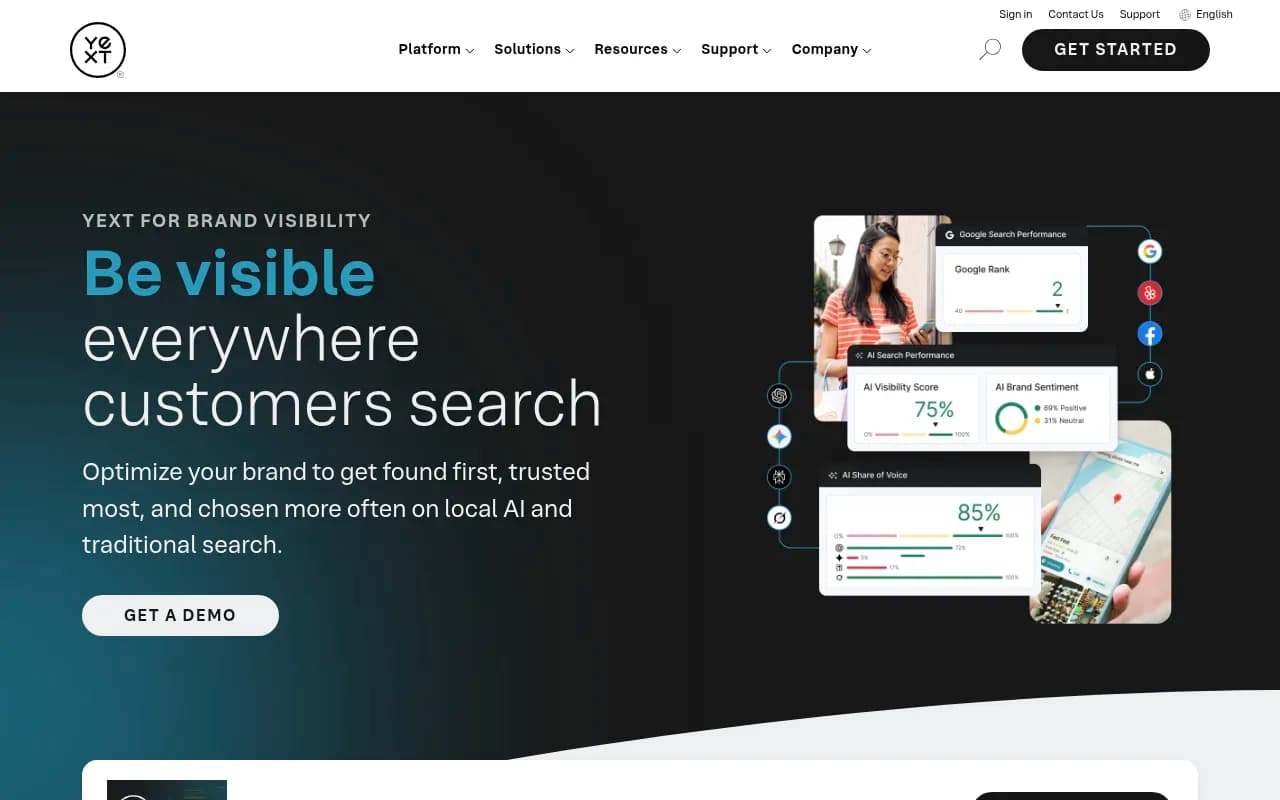
For listings and reputation at scale, platforms like Yext and Uberall cater to multi-location brands.
On the AI visibility side, tools like Promptwatch go beyond monitoring. It tracks ChatGPT, Gemini, Perplexity, Google AI Overviews, and other engines from the real interfaces, and its local GEO/SEO targeting lets you pin a monitor to exact coordinates (accuracy radius from 20 m to 5 km) so ChatGPT, AI Overviews, and AI Mode answer as if asked from that spot. That feature is on the Business plan and above. It also includes IP-verified AI crawler logs, so you can tell whether bots can even read your site, and a Content Agent that writes and publishes pages against the gaps it finds.

Others worth a look for the monitoring side include Otterly.AI, Peec AI, and Rankshift. Those are mostly monitoring-focused, so expect to handle fixes yourself.
Otterly.AI



If you want to browse more options, the GEO software directory at bestgeosoftware.com lists a wide range.
What an agency does that software doesn't
An agency brings people who have seen the same problem across many clients. The value is mostly in these areas:
- Schema and technical work across many pages, especially custom JSON-LD for service and location pages
- Review and citation acquisition programs
- Content production that matches how locals ask questions
- Reporting that connects work to calls, bookings, and revenue
- Someone to blame, which sounds cynical but is a real feature of a contract
One contractor-focused guide suggests hiring when schema work spans more than 10 service or location pages, when you have fewer than 50 reviews and need to accelerate, or when a competitor already shows up consistently in AI results. That comes from a single vendor blog, so read it as a rule of thumb, not a law. It does match what I would expect, though.
Onely's November 2026 piece is worth reading for its test, even though Onely sells GEO work and says so. Its core advice: if you already have an SEO agency, check whether it can own the AI answer work before hiring someone new. Their summary is that a specialist only earns its fee for a gap the incumbent lacks the skill, capacity, or authority to close. I agree with that, and it applies just as much to local work.
What it costs
Pricing in this space is murky. A vendor guide from geotoolbox.ai lists a small or local engagement at roughly $1,000 to $5,000 with citations showing in 2 to 4 weeks, and notes that bolting GEO onto an existing SEO retainer often runs a 20 to 30 percent uplift. Another source puts DIY GEO at $0 to $500 per month in tools for a single-location contractor. These figures come from companies selling related products, and I could not verify them independently, so use them as anchors for a conversation, not a budget.
For tools, Promptwatch's published pricing (confirm at promptwatch.com/pricing) runs from Essential at $95 per month to Professional at $245 and Business at $579. For a local business that wants coordinate-level targeting, the Business plan is the first tier that includes it. Agencies managing clients get Kick-off at $199, Growth at $399, and Scale at $799 per month.
| Option | Typical monthly cost | Who does the work | Best for |
|---|---|---|---|
| DIY with a basic tracker | Roughly $0 to $500 (vendor estimate) | You | Single location, simple site |
| Tracker with execution features | $95 to $579 (Promptwatch plans) | You plus the tool's agents | Owners with limited time |
| GEO add-on to existing SEO retainer | Often a 20-30% uplift (vendor estimate) | Your current agency | Already paying for SEO |
| Local SEO and GEO agency | Roughly $1,000 to $5,000 for small engagements (vendor estimate) | Agency specialists | Multi-location, competitive markets |
| Hybrid | Tool cost plus scoped project fees | Mixed | Most mid-sized local businesses |
The cost section in that geotoolbox guide is useful as a starting point, with the caveat that the publisher sells its own tool.
When to do it yourself
DIY makes sense when these are mostly true:
- You have one location, or two close together
- Your website is small and you can edit it
- You already have a reasonable review count and a claimed, accurate Google Business Profile
- You can spare a few hours a week
- No local competitor dominates AI answers yet
A workable DIY routine looks like this:
- Build 20 to 50 prompts that mirror how customers actually ask, including "near me" and neighborhood phrasing.
- Track them across ChatGPT, Gemini, Perplexity, and AI Overviews separately.
- Review which domains get cited and make sure you appear on the ones that matter, such as directories and review sites.
- Fix your own pages: clear service descriptions, address, hours, pricing, FAQs, and schema.
- Check that AI crawlers are not blocked. Free utilities such as the Agentic Readiness Check and AI Crawler URL Inspector help here.
- Re-run the prompts monthly and note what changed.
For your own Google data, Google Search Console is free and tells you what queries actually reach you.
When to hire an agency
Hire when the bottleneck is capacity or skill, not information. Typical signs:
- Five or more locations, each needing its own pages, listings, and reviews
- A site on a platform you can't easily edit, or with heavy JavaScript rendering
- A competitor who already appears consistently in AI answers for your core prompts
- Low review volume and no process to build it
- You need reporting tied to revenue for a boss or an investor
- You tried DIY for three months and nothing moved
If you want a sense of who is out there, the catalog includes agencies such as Grow and Convert, First Page Sage, and Siege Media, though several of these skew toward B2B and content rather than local.
One caveat if you manage agencies or clients yourself: 1001 SEO Media, which publishes this site, is a full-service SEO and GEO agency with no long-term contracts, so it is one of the options in this category. Weigh it the same way you would weigh any other, using the vetting questions below.
Questions to ask any agency
- Which AI engines do you measure, and from what location?
- Show me a local client where AI citations improved, and what you changed.
- What do you report beyond rankings and visits?
- Who owns the tracking data if we leave?
- What is the contract length, and what happens at month three if there is no movement?
- Do you use a tracker, and can I see the raw prompts and responses?
Be wary of guarantees about being named by ChatGPT. Nobody controls that, and any agency promising it is selling confidence, not a method.
Do you need a GEO agency if you already have an SEO agency?
Usually not. The research I reviewed was consistent here: the technical, content, and authority work overlaps heavily, and many competent SEO agencies handle both. Onely's framing is the one I would use: give your incumbent the chance to show how it measures and improves your presence in AI answers. If it can show accountable work across ranked results and AI answers, keep it. Add GEO help only for a defined gap.
One caution from the same source: only about 1% of visits to Google AI Overviews led to clicks on cited sources in a US browsing-panel study. I could not verify that study directly, so treat it cautiously. The point it makes still holds. An agency reporting only rankings and visits may miss a form of visibility, but missing it does not automatically justify a second retainer.
The hybrid approach most local businesses should consider
In practice, the sensible middle path is this:
- Own the measurement. Use a tracker so you hold the data and can judge any vendor.
- Buy scoped projects, not open-ended retainers: a schema implementation, a citation cleanup, a review acquisition system, a content sprint.
- Review after 90 days with real numbers. Promptwatch publishes a 90-day GEO program guide that works as a decent template for that review.
- Pull work in-house once the process is stable.
This keeps you from paying for monitoring you could run yourself while still getting expert hands where they matter. It also protects you from the common failure of an agency reporting vanity metrics because you had no independent view.
One more thing to watch is sources. Per Promptwatch Data, reddit.com's share of ChatGPT citations fell from roughly 4% to about 0.5% on August 14, 2026. Citation sources shift quickly, so whichever route you choose, track weekly rather than assuming last quarter's playbook still works. Related data, like how ChatGPT's citations break down by content type, is also worth a look when planning pages.
Decision framework
| Your situation | Likely best choice |
|---|---|
| One location, simple site, a few hours a week | Tracker, DIY fixes |
| One location, no time | Tracker with execution features, or a small agency project |
| Already have an SEO agency | Ask them to own AI answers first; add a tracker for verification |
| 5+ locations | Agency or platform plus agency, with a tracker you control |
| Competitor dominates AI answers | Agency for an acceleration project, tracker for proof |
| Unclear what's wrong | Free AI visibility report, then decide |
If you are unsure where you stand, Promptwatch's free AI visibility report gives a no-login baseline of how ChatGPT, Gemini, and Perplexity talk about your brand. That costs nothing and tells you whether the problem is large enough to justify spending on an agency.
Bottom line
Start with measurement. Spend a month finding out whether you appear, where, and who beats you. If the gaps are ones you can close with your own site and listings, a tracker and some weekends will do. If they involve many locations, technical debt, or a rival that is already entrenched, hire help for a defined scope and keep the data in your own hands so you can check the work.