Siege Media Review 2026
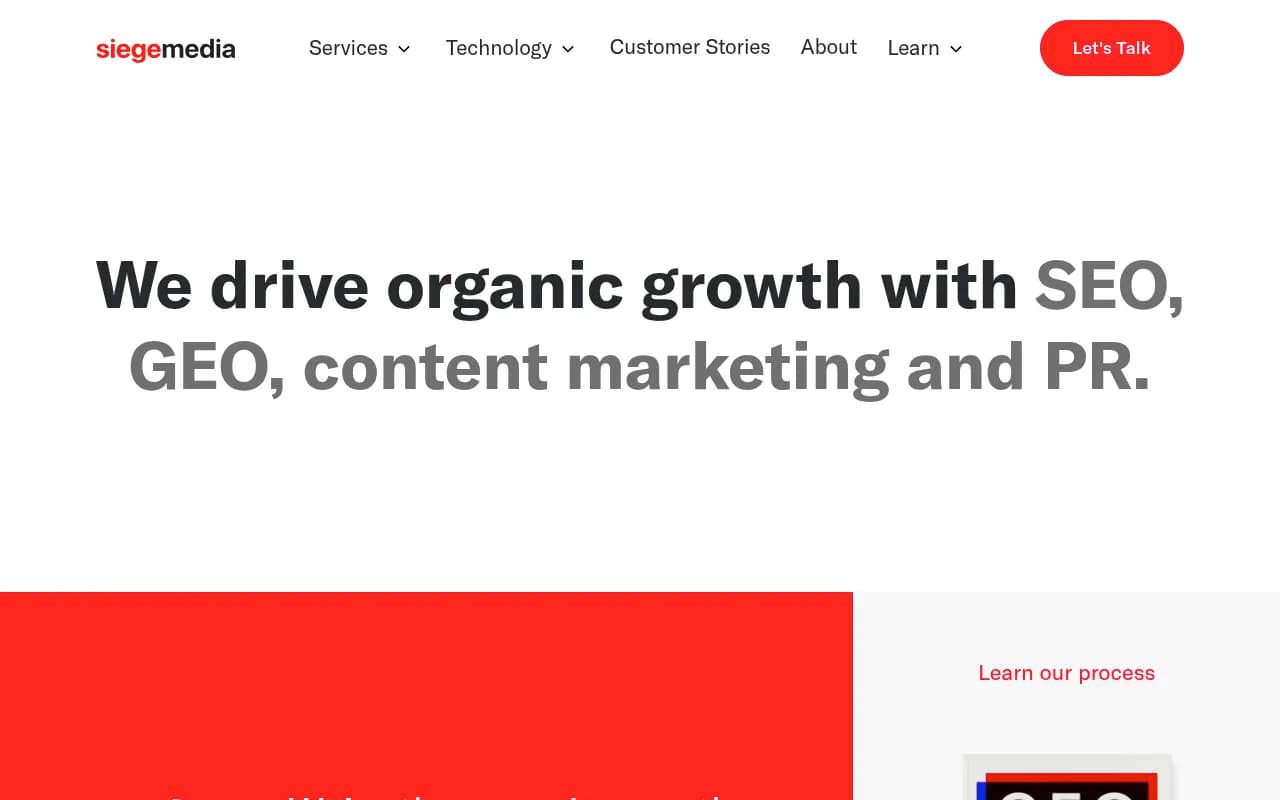
Siege Media is a premium organic growth agency offering SEO, content marketing, digital PR, GEO, and graphic design for mid-market and enterprise brands. Known for data-driven content strategies and measurable traffic value results.
Key takeaways
- Siege Media is a full-service organic growth agency, not a SaaS tool -- you're hiring a team, not subscribing to software
- Strong track record with recognizable brands: Zapier, Zendesk, Instacart, HubSpot, Airbnb, Zillow, and dozens more
- Services span SEO, content marketing, digital PR, GEO (Generative Engine Optimization), and graphic design under one roof
- Pricing is firmly mid-market to enterprise: content marketing retainers typically start around $6,000/month, SEO from $3,000/month
- Not a fit for early-stage startups or anyone with a tight budget -- this is a premium agency with premium expectations
Siege Media is an organic growth agency founded by Ross Hudgens and based in San Diego, California. The firm has been operating since around 2012 and has built a reputation in the SEO and content marketing world for producing work that actually earns links and rankings rather than just filling a content calendar. The agency's pitch is simple: they use search data to find opportunities you can realistically win, then create content that outperforms what competitors have published. That's a claim a lot of agencies make, but Siege Media has the case studies to back it up.
The target audience is mid-market to enterprise brands that are serious about organic growth and have the budget to invest in it properly. Their client roster reads like a who's who of well-funded tech and fintech companies: Zapier, HubSpot, Zendesk, Instacart, Chime, Zillow, TransUnion, Airbnb, Asana, and Zoom, among others. These aren't small businesses testing the waters with a $1,500/month retainer. Siege Media works with companies that have real marketing budgets and real expectations for ROI.
What's notable about Siege Media in 2026 is that they've moved beyond traditional SEO and content marketing to explicitly offer GEO (Generative Engine Optimization) services -- optimizing content to appear in AI-generated answers from ChatGPT, Perplexity, Google AI Overviews, and similar platforms. This puts them ahead of most traditional content agencies that are still catching up to the AI search shift.
Key features
SEO services
Siege Media's SEO work covers the full stack: technical audits, keyword research, on-page optimization, and link building through content. They're not a link scheme shop -- their link acquisition comes primarily through creating content that earns editorial links naturally, which is a more durable approach. Their SEO retainers typically start around $3,000/month for smaller campaigns, with enterprise engagements running considerably higher. The Zapier case study is a good benchmark: 852% increase in organic traffic and $6.1M increase in traffic value from their content-led SEO work.
Content marketing
This is the core of what Siege Media does. They research which topics have genuine search demand, assess whether a client can realistically rank for them given their domain authority, and then produce content that's designed to outperform existing results. The content is written by experienced writers (not outsourced to cheap freelancers) and goes through editorial review. Retainers typically run $6,000 to $60,000+ per month depending on volume and complexity. The Zendesk engagement produced 10,675+ links and a $731,924 increase in traffic value -- numbers that are hard to argue with.
Digital PR
Siege Media runs digital PR campaigns designed to earn coverage and links from major publications. This isn't press release distribution -- it's creating data-driven stories, original research, and visual assets that journalists actually want to cover. Pricing for digital PR ranges from around $5,000/month for brands with compelling existing stories to $15,000/month or more when original content needs to be created. The Zebra campaign earned 1,580+ organic links and $7.7M in traffic value, which illustrates what a well-executed digital PR program can do.
GEO (Generative Engine Optimization)
Siege Media has built out a dedicated GEO service, which they describe as optimizing content to appear in AI-generated answers. This includes structuring content so AI models can extract and cite it, identifying which prompts and questions your brand should be answering, and creating content specifically engineered for AI visibility. They've published original research on this topic -- including a 2026 study on where AI gets its buying advice -- which suggests they're doing real work here rather than just rebranding existing SEO services with a new acronym.
DataFlywheel
This is Siege Media's proprietary methodology for compounding organic growth. The idea is that each piece of content they create earns links, which builds domain authority, which makes future content rank more easily, which earns more links. It's a flywheel effect rather than a one-time campaign. In practice, this means they prioritize content that has link-earning potential, not just traffic potential -- a meaningful distinction that separates them from agencies that chase keyword volume without thinking about authority building.
Graphic design
Siege Media has an in-house design team that creates custom visuals, infographics, and data visualizations to support content and digital PR campaigns. This matters because visual assets are often what makes a piece of content linkable -- a well-designed infographic or original data visualization gives journalists and bloggers something to embed and credit. Having this capability in-house means the content and design teams can work together from the start rather than treating design as an afterthought.
Original research and thought leadership
The agency publishes its own research studies, which serve double duty: they demonstrate expertise to prospective clients and they model the kind of content they create for clients. Recent examples include their 2026 study on AI buying advice and their work on product page mapping for GEO. This is a good signal -- agencies that produce original research tend to understand content strategy at a deeper level than those that just publish generic how-to posts.
Who is it for
Siege Media is built for mid-market and enterprise brands with established marketing budgets and a genuine commitment to organic growth as a channel. The sweet spot is a company doing $10M+ in revenue that has tried content marketing before but hasn't gotten the results they expected, or a well-funded startup (Series B and beyond) that wants to build a durable organic moat. Think SaaS companies with 50-500 employees, fintech brands competing in high-CPC keyword spaces, and e-commerce companies that want to reduce their dependence on paid acquisition.
The agency particularly shines in competitive verticals where content quality and link authority actually matter: financial services, insurance, SaaS, health, and e-commerce. Their fintech client list alone -- Chime, Quicken Loans, TransUnion, Zillow, Kraken, Lemonade -- shows they understand how to navigate YMYL (Your Money Your Life) content requirements and produce work that earns trust signals in Google's eyes.
Who should not use Siege Media: early-stage startups with limited budgets, local businesses that need local SEO rather than national content campaigns, and companies that want to keep content production in-house and just need strategic guidance. Siege Media is a full-service agency, not a consulting firm that advises while you execute. If you're not ready to hand over content production and trust their process, the relationship won't work well.
Integrations and ecosystem
As an agency rather than a software platform, Siege Media doesn't have a traditional integrations list. They work within whatever tech stack their clients use -- Google Analytics, Google Search Console, Ahrefs, SEMrush, and similar tools are standard parts of their workflow. They produce deliverables (content, reports, strategy documents) that clients can publish on their own CMS.
Their GEO service likely involves monitoring AI search visibility, though the specific tools they use internally aren't publicly disclosed. They publish their methodology and research publicly on their blog, which gives prospective clients a reasonable window into how they think and work.
No API, no browser extension, no mobile app -- this is a services business, not a software product.
Pricing and value
Siege Media doesn't publish a standard pricing page, which is typical for agencies at this level. Based on their own published content about industry pricing:
- SEO retainers: Starting around $3,000/month for smaller campaigns; enterprise engagements run higher
- Content marketing: $6,000 to $60,000+ per month depending on volume and scope
- Digital PR: $5,000 to $15,000+ per month
- GEO services: Pricing not publicly disclosed; likely bundled with SEO or content retainers
These are not cheap. But the value calculation is different from a software subscription -- you're paying for a team of experienced strategists, writers, designers, and PR specialists who are accountable for results. The $148M+ in annual client traffic value they claim across their portfolio suggests the ROI can be substantial for the right client.
For comparison, hiring an equivalent in-house team (SEO manager, content strategist, writers, designer, PR specialist) would cost significantly more in salary and benefits. The agency model makes sense for companies that want senior-level expertise without the overhead of building a full internal team.
There's no free trial or freemium tier -- this is a custom engagement that starts with a discovery call and proposal process.
Strengths and limitations
What Siege Media does well:
- Proven results at scale: The case studies are specific and verifiable -- traffic percentages, link counts, traffic value increases. Zapier's 852% organic traffic increase and The Zebra's $7.7M traffic value gain aren't vague claims.
- Content quality: Their in-house writing and design teams produce work that's genuinely better than what most agencies deliver. The editorial standards are high, which is why the content earns links.
- GEO capability: Most traditional content agencies are still figuring out AI search. Siege Media has a dedicated GEO service and is publishing original research on the topic, which puts them ahead of the curve.
- Full-service under one roof: SEO, content, PR, design, and GEO from a single team means the strategy is coherent rather than fragmented across multiple vendors.
- Thought leadership: Ross Hudgens and the Siege Media team are active in the SEO community and publish genuinely useful content. This signals that the people running the agency actually understand the craft.
Limitations and honest caveats:
- Price point excludes most small businesses: The minimum engagement cost puts Siege Media out of reach for companies without a serious marketing budget. This isn't a criticism exactly, but it's a real constraint.
- Not a technology platform: If you want dashboards, real-time data, or software-driven insights, Siege Media isn't that. They're a services business. For AI visibility tracking specifically, a dedicated platform like Promptwatch would complement (or in some cases replace) what an agency can offer on the monitoring and optimization side.
- Long time-to-results: Organic growth is inherently slow. Content marketing and SEO campaigns typically take 6-12 months to show meaningful results. Companies that need quick wins from paid channels won't find that here.
- Limited transparency on GEO methodology: The GEO service is newer and the methodology isn't as well-documented as their SEO and content work. It's worth asking detailed questions about how they measure AI visibility and what success looks like.
Bottom line
Siege Media is one of the better content-led SEO agencies operating in 2026, with a track record that holds up to scrutiny and a client list that speaks for itself. If you're a mid-market or enterprise brand that's serious about building organic traffic as a durable growth channel -- and you have the budget to do it properly -- they're worth a serious look.
Best use case: a Series B+ SaaS or fintech company that wants to build a content-driven organic moat and needs a full-service team to execute it without building that capability in-house.
Frequently asked questions
What is Siege Media?
How much does Siege Media cost?
Who are Siege Media's typical clients?
Does Siege Media offer GEO or AI search optimization?
Is Siege Media a good fit for small businesses?
What results has Siege Media achieved for clients?
Similar and alternative tools to Siege Media