Key takeaways
- Start with 20-40 prompts across 2-3 AI models. That is the range most practitioners converge on, though it is expert opinion rather than a measured threshold.
- ChatGPT has no ranking positions, so you are really sizing a sample for mention rate, not a leaderboard.
- Answers are crowded. Promptwatch Data shows almost half of ChatGPT responses cite 10 or more unique domains, so any single prompt is a noisy reading.
- Keep the list identical between runs, track for at least 30 days, and keep brand-specific prompts separate from category prompts.
- Manual tracking stops being practical somewhere around 50 prompts a week. After that, a tool earns its price.
First, what are you actually sizing?
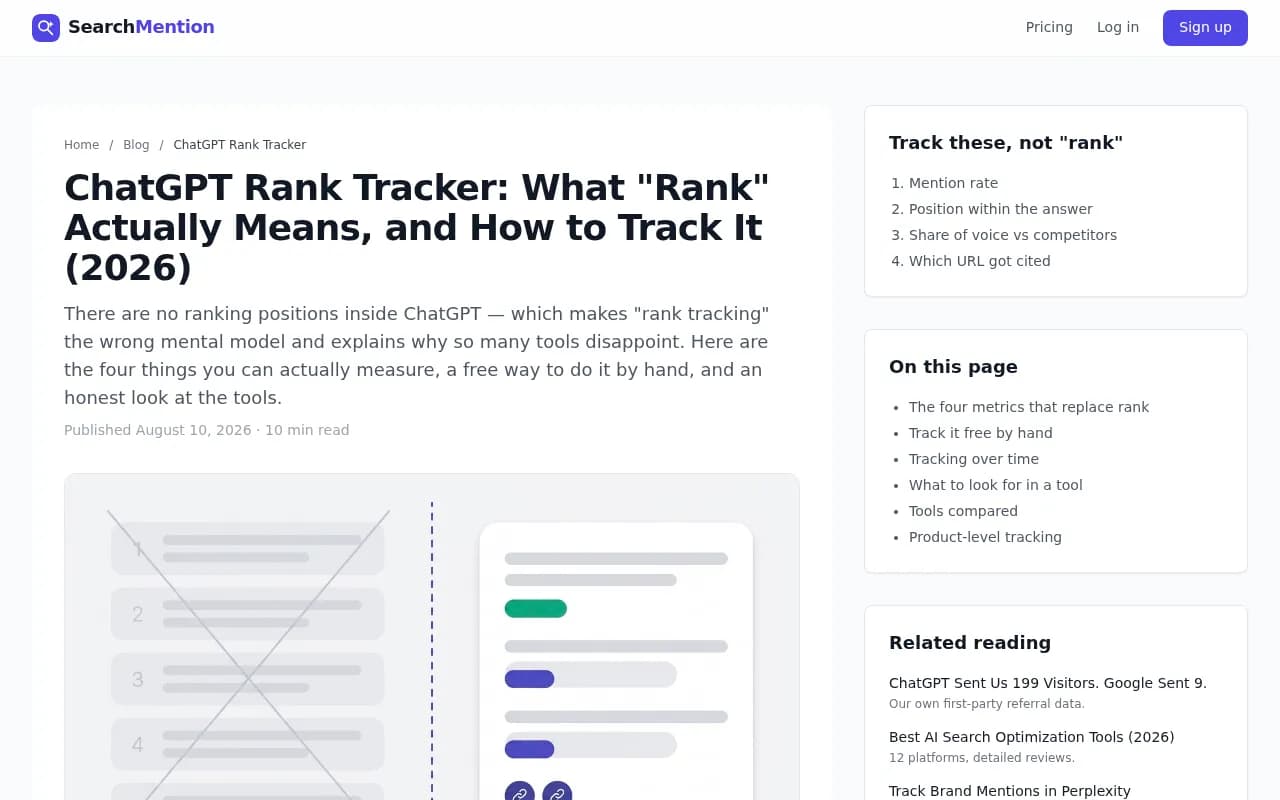
People search for a ChatGPT rank tracker and expect a number like "position 3." That number doesn't exist. ChatGPT writes one answer that might name three brands and link a handful of sources. You are in it or you are not.
So the useful metric is mention rate: out of the prompts you track, what percentage produce an answer that names you? If you track 20 prompts and get named in 6, your mention rate is 30%. That number is comparable week to week, which a single screenshot never is.
This changes the sizing question. You are not asking "how many keywords should I rank-track?" You are asking "how big a sample do I need before this percentage means something?" Sampling thinking, not keyword thinking.
Why one prompt tells you almost nothing
I'd argue the strongest reason to track more than a handful of prompts is how crowded ChatGPT answers are. According to Promptwatch's data on unique domains per ChatGPT response (Sep 28 to Oct 4, 2026, responses with at least one citation):
- 47.6% of responses cite 10 or more domains, and 66.1% cite at least 8.
- Only 6% cite three domains or fewer.
- For organic prompts with no brand named, 52.5% cite 10 or more domains.
- For brand-specific prompts, the most common count is 5 domains, and 40.7% cite five or fewer.
With that many sources competing in each answer, whether you appear on any one prompt is partly luck. Promptwatch's own advice from that report is to measure citations across many organic prompts, not just one. That is the whole argument for a prompt set instead of a spot check.
There is also a drift problem. Promptwatch's query fanout data shows average fanouts per response fell from 2.15 in early December to about 1.84 by early March, then to 1.0 in April. The number of searches ChatGPT runs behind each answer shifts with model updates, so your results can move even when nothing about your content changed. A bigger, stable sample smooths that out. It doesn't remove it.
The practical range: 20-40 prompts to start
The most common recommendation, including in SE Ranking's guide to choosing prompts, is to start with 20-40 prompts across 2-3 AI models and track for at least 30 days before drawing conclusions. A hand-run guide from SearchMention suggests 10-20 buyer questions for the free manual version. Another practitioner guide uses 25 for manual runs and 50 for a fuller baseline.
I want to be straight about this: none of these are measured thresholds. I couldn't find a dataset showing that 30 prompts gives you a stable mention rate and 15 doesn't. Promptwatch's report catalog has no run-to-run variance study either. Treat the ranges as sensible defaults from people who do this daily, not as statistics.
A sample 30-prompt split
SE Ranking suggests distributing prompts across journey stages. Scaled to a total of about 30, it looks like this:
| Prompt group | Suggested count | What it covers |
|---|---|---|
| Awareness | 10 | Problem-led questions, "how do I..." and "what is..." |
| Consideration | 15 | "Best X for Y," comparisons, use-case fits |
| Brand evaluation | 5 | Questions that name you directly |
The brand evaluation group should be tracked separately. Brand-specific prompts draw on fewer sources, so they are a more stable but much narrower signal. Mix them into category prompts and your mention rate looks better than reality.
Sizing by persona or topic instead
If your business serves distinct buyer types, count prompts per persona rather than overall. Kevin Indig, Growth Advisor, recommends roughly 15 prompts per persona and about five consecutive runs of the prompt set once a week. Three genuinely different personas would put you at 45 prompts.
Helen Pollitt offers a reframe I like: track topics, not individual prompts. Your topic, say "content marketing software," becomes a variable you plug into several prompt structures. You are measuring how often that topic comes up and how often you appear.
Erika Varangouli makes the same point from the other direction. It's futile to track every prompt under the sun. Organize by audience personas, use cases, product features and topics instead.
In practice, that means your 30 prompts are not 30 unrelated questions. They are maybe 6 topics with 5 phrasings each.
Prompts are only one of three multipliers
Cost and effort scale with prompts times models times rerun frequency. A set of 30 prompts on 3 models, run weekly five times each, is 450 responses a week. Double any one factor and the bill doubles.
| Setup | Prompts | Models | Runs per week | Responses per week |
|---|---|---|---|---|
| Lean manual | 20 | 1 (ChatGPT) | 1 | 20 |
| Standard | 30 | 3 | 1 | 90 |
| Repeated sampling | 30 | 3 | 5 | 450 |
| Persona-based | 45 | 3 | 5 | 675 |
The models question matters. SE Ranking suggests starting with ChatGPT for its user base, Perplexity for citation-heavy behavior, and Google AI Overviews or AI Mode for ties to traditional search. Promptwatch's average sources per response data offers one useful wrinkle: Perplexity cites almost exactly 10 sources every day, so it works as a stable test bench where changes more likely reflect your content than engine noise. Copilot, by contrast, swung from under 2 to nearly 17 sources within weeks, so judge it on monthly trends.
If you only care about ChatGPT, you can drop the model multiplier and spend it on more prompts or more repeat runs instead. Repeat runs are usually the better buy, because they attack the variance problem directly.
How to build the list so it stays useful
- Pull questions from sales calls, support tickets, Search Console queries and comparison searches. Real buyer language beats invented prompts.
- Group by decision, not by wording. Five rephrasings of one question are one topic, not five.
- Write the list down and freeze it. Changing prompts between runs makes the trend line meaningless.
- Keep a separate list for new ideas, and start their history from zero when you add them.
- Keep prompt wording and location stable so later results compare to the baseline.
- Review monthly. Retire prompts that tell you nothing, add ones the data suggests.
For ideas on where to source prompts, tools like AlsoAsked and AnswerThePublic surface real question phrasing, though neither tells you what ChatGPT will do with it.
Manual tracking: where it breaks
The free version is simple. Write 10-25 buyer questions, paste them into a logged-out ChatGPT session weekly, and record whether you are mentioned, where, with what sentiment, and alongside whom. Plan on roughly 20 minutes a week at 10-20 prompts.
It breaks on volume. One practitioner guide puts the honest limit at about 50 prompts per week. Add repeat runs and multiple models and you hit that ceiling at around 10 prompts. SearchMention's rule of thumb is to pay for a tool when the manual version starts eating an hour a week, not before. I agree with that. A baseline made by hand teaches you what you actually want to measure.
When a tool is worth it
Once you outgrow the spreadsheet, prompt count becomes the real unit of cost. Thin tiers with few prompts produce samples too small to trust, so check how many prompts and models each plan really covers.
A few options from our catalog, with different strengths:
Promptwatch tracks the real interfaces of ChatGPT, Gemini, Perplexity, Google AI Overviews and others, and reports prompt volumes and difficulty so you can prioritize which prompts deserve a slot. It also covers crawler logs and content gap analysis, which matter once you know where you're missing. The free Explore plan gives 10 prompts on ChatGPT only, which is enough for a starter baseline; paid plans begin at 50 prompts and scale to 350 on Business. Check promptwatch.com/pricing for current numbers.

Otterly.AI is a simpler prompt-monitoring option if you only want mention tracking.
Otterly.AI

Peec AI is another monitoring-focused tracker aimed at marketing teams.

SE Ranking's AI visibility product suits teams already living in that suite.

| Tool | Strength | Watch out for |
|---|---|---|
| Promptwatch | Prompt volumes, many models, optimization workflow | More than you need for 10 prompts |
| Otterly.AI | Simple monitoring | Limited beyond tracking |
| Peec AI | Marketing-team dashboards | Monitoring-focused |
| SE Ranking | Fits an existing SEO stack | AI tracking is one module among many |
For a wider look, the directories at ai-rank-tools.com and bestgeosoftware.com list more trackers by category.
Sizing by situation
| Situation | Prompts | Models | Notes |
|---|---|---|---|
| Solo founder, one product | 10-20 | ChatGPT | Run by hand, weekly |
| Small team, one category | 20-40 | 2-3 | Split by journey stage |
| Multiple personas | ~15 per persona | 2-3 | Repeat runs about five times weekly |
| Agency, several clients | 30-50 per client | 2-3 | Automate; manual won't scale |
| Multi-location or regional | 20-40 per region | ChatGPT plus AI Overviews | Keep location stable |
How to read the results
The signal is in the trend. A mention rate across 20 prompts dropping from 40% to 15% over three weeks is worth investigating. A swing from 30% to 35% in one week is probably noise. With a small set, one prompt flipping moves the rate by 5 points at 20 prompts, and over 3 points at 30. Know that before you panic.
Also read beyond mention rate. Look at position within the answer, which sources got cited, and whether the description of you is accurate. If you are mentioned but never cited, that points to a content or crawlability issue, not a coverage one.
A starting plan
- Week 1: write 20-30 prompts, freeze them, run them in ChatGPT, and log mention, position, cited sources and competitors.
- Weeks 2-4: rerun weekly with the identical list. Resist editing.
- Day 30: compute mention rate, decide which prompts are dead weight, and add a second model.
- After that: add personas or topics only where you have a decision to make, and move to a tool when manual work passes an hour a week.
If you take one number away, make it this: 20-40 prompts, frozen, run for 30 days. That's enough to know whether you're being named, and cheap enough to be wrong about and adjust.