Key takeaways
- Frase and Surfer SEO solve different problems -- Frase handles research and outlining, Surfer handles real-time content scoring and optimization
- Using them together creates a complete content workflow: research in Frase, write and score in Surfer
- AI search (ChatGPT, Perplexity, Google AI Overviews) rewards content that is structured, authoritative, and topically complete -- the same things this workflow produces
- The combination works best when you treat Frase as the brief-building layer and Surfer as the quality-control layer
- For tracking whether your content actually gets cited in AI search, you'll need a separate tool like Promptwatch -- neither Frase nor Surfer covers that gap
Search in 2026 is genuinely two different games running at the same time. Google's traditional organic results still matter. But AI Overviews now appear in 58% of queries, and millions of people are asking ChatGPT and Perplexity questions before they ever open a browser tab. The content that wins citations in those AI answers is optimized differently from content that chased keyword density in 2019.
The good news: Frase and Surfer SEO, used together, produce content that performs well in both environments. The workflow isn't complicated, but most teams either use one tool without the other, or use both without a clear division of labor. This guide fixes that.
Why you need both tools (and what each one actually does)
The honest answer to "Frase vs. Surfer" is that it's the wrong question. They're not competing for the same job.
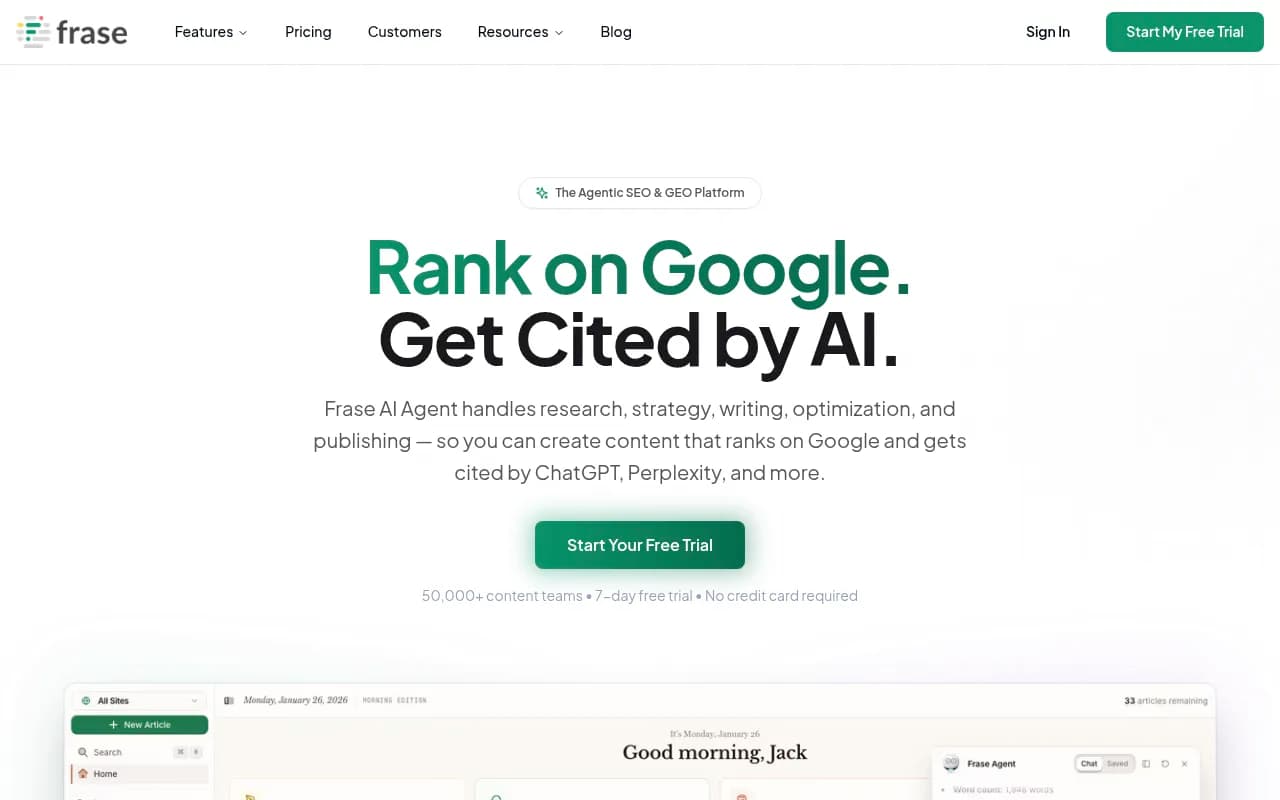
Frase is a research and briefing tool. It pulls the top-ranking pages for your target query, analyzes what topics they cover, extracts questions from "People Also Ask" and related searches, and turns all of that into a structured content brief. It's where you figure out what to write.
Surfer SEO is a content scoring and optimization tool. It analyzes the same top-ranking pages and gives you real-time feedback as you write -- keyword usage, heading structure, word count, NLP terms -- so you can see whether your draft is competitive. It's where you figure out how well you're writing it.
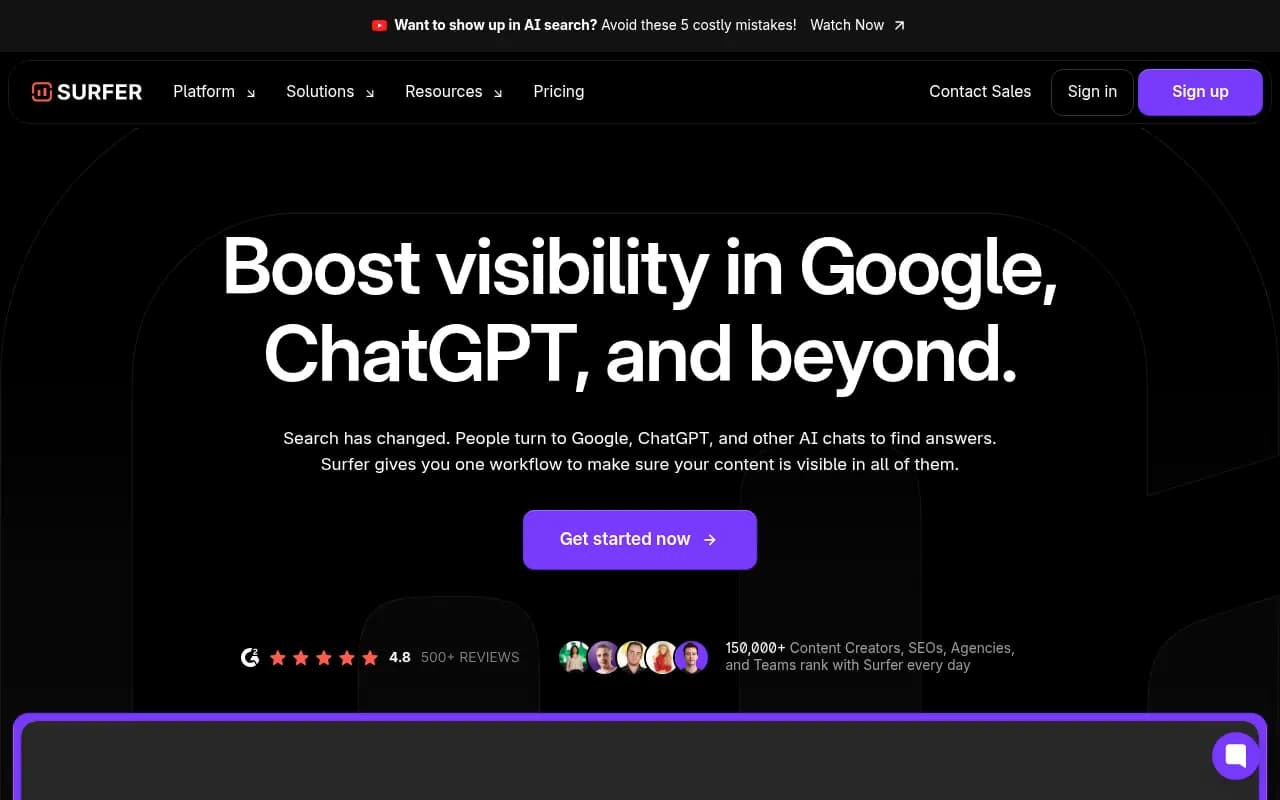
Put simply: Frase tells you what the content needs to contain. Surfer tells you whether your draft actually contains it well enough to compete.
The research from Digital Applied's 2026 AI SEO tools comparison puts it clearly: "The most effective AI SEO operations in 2026 combine two to three tools rather than relying on one platform to do everything. A typical high-performing stack pairs Frase for research and briefing, Surfer for content scoring."
The workflow, step by step
Step 1: Start with Frase for SERP research and brief creation
Open Frase and enter your target keyword. Frase will immediately pull the top 20 organic results and start analyzing them. What you're looking for at this stage:
- Which subtopics appear across multiple top-ranking pages (these are non-negotiable to include)
- Questions from PAA and related searches that your audience is actually asking
- Average word count, heading structure, and content depth of competitors
- Any obvious gaps -- topics that nobody is covering well
Frase's brief builder turns this into a structured outline with suggested headings, questions to answer, and statistics to reference. This is the most time-consuming part of the workflow if you do it manually, and Frase compresses it to about 10-15 minutes.
One thing worth noting: Frase's AI writing features are decent but not the main reason to use it. The research layer is where it earns its place in the stack.
Step 2: Build your outline in Frase, then move to Surfer to write
Once your brief is ready in Frase, you have two options:
- Export the brief and open Surfer's Content Editor for the same keyword
- Write in Frase's editor while keeping Surfer's editor open in a second tab for reference
Most experienced teams prefer option 1. The Frase brief becomes your writing blueprint, and Surfer becomes your real-time quality checker. You're not trying to get both tools to do the same thing -- you're using each for what it does best.
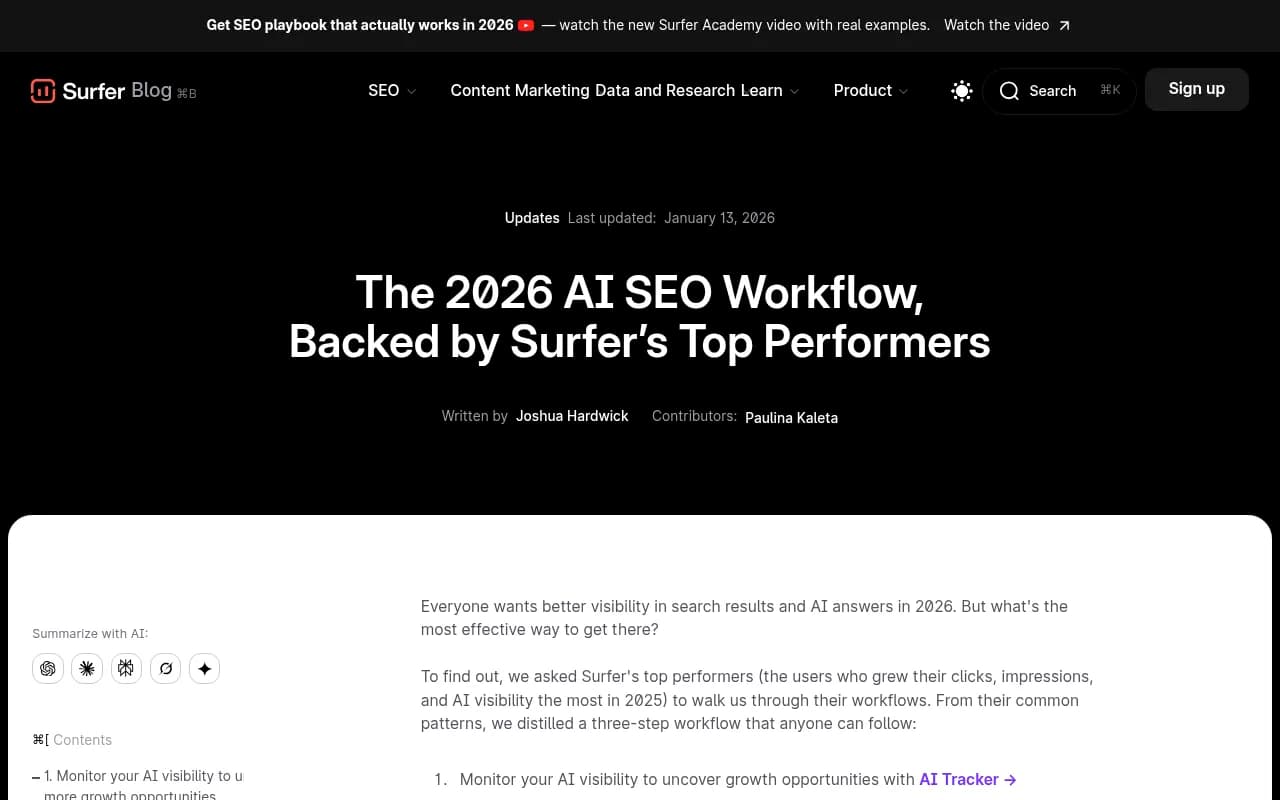
In Surfer's Content Editor, you'll see a content score (typically out of 100) that updates as you write. The research from Surfer's own 2026 top-performer analysis shows that their best-performing users treat the content score as a directional signal, not a target to game. Aim for a score in the 70-80 range and focus on natural coverage of the NLP terms Surfer surfaces.
Step 3: Use Frase's topic coverage alongside Surfer's NLP terms
Here's where the combination gets genuinely powerful. Frase shows you topic coverage as a percentage -- how much of what competitors discuss are you covering? Surfer shows you specific NLP terms and their recommended usage frequency.
These two signals are complementary. Frase's topic coverage catches broad thematic gaps ("you haven't discussed pricing at all, but 8 of your 10 competitors do"). Surfer's NLP terms catch specific terminology gaps ("you've used 'content brief' twice but the top pages use it 7-9 times").
Run both checks before you consider a draft done. A piece that scores 75 in Surfer but has 60% topic coverage in Frase is missing something. A piece with 95% topic coverage in Frase but a Surfer score of 45 is probably thin or poorly structured.
Step 4: Structure for AI citation, not just Google ranking
This is the step most teams skip, and it's the one that matters most for AI search in 2026.
AI models cite content that is:
- Clearly structured with descriptive headings (H2s and H3s that answer specific questions)
- Factually dense with specific data points, not vague claims
- Authoritative in tone -- it answers questions directly rather than hedging
- Topically complete -- it doesn't leave obvious follow-up questions unanswered
Frase's brief naturally pushes you toward topical completeness by surfacing the questions your competitors answer. Surfer's heading structure recommendations push you toward clear organization. But you need to consciously write for the AI citation pattern too.
Practically, this means:
- Write direct answers in the first sentence after each heading (AI models often pull the first 1-2 sentences after an H2)
- Use numbered lists and definition-style explanations for anything that could be a "what is" or "how to" query
- Include specific statistics with sources -- AI models prefer citable claims
- Don't bury your main point in the middle of a paragraph
Step 5: Run a final Frase optimization check before publishing
Before you publish, go back to Frase and run the optimizer against your finished draft. Frase will show you your final topic coverage score and flag any questions from the PAA data that you haven't answered.
This is a 5-minute check that catches the things Surfer doesn't measure -- thematic completeness rather than keyword density. If your topic coverage is below 70%, you're probably missing something that will hurt your ability to rank against competitors who cover it.
Where this workflow has limits
Being direct about this: Frase and Surfer together are excellent for creating content that's competitive in traditional search and reasonably well-positioned for AI citation. But they don't tell you whether your content is actually being cited in AI search.
Neither tool monitors what ChatGPT, Perplexity, or Google AI Overviews are actually saying about your topic. Neither shows you which of your pages are being cited, which competitors are getting cited instead of you, or what content gaps are causing AI models to ignore your site.
For that, you need a dedicated AI visibility platform. Promptwatch covers this -- it tracks citations across 10 AI models, shows you which pages are being cited and how often, and includes answer gap analysis that shows exactly which prompts your competitors appear in but you don't.

The practical workflow for serious teams in 2026: use Frase to research and brief, Surfer to write and score, and Promptwatch to track whether your content is actually getting cited in AI answers. Each tool does one thing well.
Tool comparison: what each covers
| Capability | Frase | Surfer SEO | Promptwatch |
|---|---|---|---|
| SERP research and competitor analysis | Yes | Partial | No |
| Content brief generation | Yes | No | No |
| Real-time content scoring | No | Yes | No |
| NLP term recommendations | No | Yes | No |
| AI search citation tracking | No | Basic (AI Tracker) | Yes (10 models) |
| Answer gap analysis | No | No | Yes |
| Content generation for AI gaps | No | No | Yes |
| Crawler log analysis | No | No | Yes |
| Reddit/YouTube citation tracking | No | No | Yes |
Surfer does have an AI Tracker feature that monitors some AI visibility signals, which is worth using if you're already a Surfer subscriber. But it's a monitoring layer, not a full GEO platform -- it won't show you the specific content gaps causing AI models to cite competitors instead of you.
Pricing reality check
One thing that comes up often: is it worth paying for both tools?
Frase starts at $45/month. Surfer's entry plan is around $89/month. Together you're looking at roughly $134/month for the research-and-write workflow described here.
The Miniloop comparison from 2026 notes that "true feature parity is Frase Basic ($45) vs Surfer Scale ($219)" -- meaning if you want the full feature set of both tools, the cost climbs. For most content teams producing 4-8 articles per month, the Basic/entry tiers of both tools are sufficient.
The overlap between the tools is real but manageable. Both do some form of competitor analysis. Both have AI writing features. The question is whether the unique value each brings -- Frase's research depth, Surfer's real-time scoring -- justifies the combined cost. For teams where content quality directly affects revenue, it usually does.
Common mistakes to avoid
A few patterns that consistently produce bad results with this stack:
Writing to the Surfer score instead of the reader. A content score of 85 doesn't mean the article is good. It means you've used the right terms at the right frequency. If the piece reads like a keyword-stuffed checklist, it won't get cited by AI models and it won't convert readers. Use the score as a floor, not a ceiling.
Skipping the Frase research phase. Some teams jump straight into Surfer because the interface is faster. The problem: Surfer tells you how to optimize what you're writing, but it doesn't tell you what to write. Without Frase's topic coverage analysis, you'll produce content that scores well but misses entire subtopics that your competitors cover.
Ignoring heading structure. Both tools surface heading recommendations, and both are worth following. AI models parse heading structure to understand what a page is about. A wall of text with no clear H2/H3 hierarchy is hard for AI to cite accurately, even if the content is good.
Publishing and forgetting. The workflow doesn't end at publish. AI models crawl and re-evaluate content over time. Pages that get cited today can lose citations if competitors publish better content. Tracking your AI visibility over time -- not just your Google rankings -- is the only way to know if your content is actually working.
A practical starting point
If you're new to this workflow, start with one article and run it through the full process:
- Enter your target keyword in Frase, review the top 10 competitors, and build a brief
- Open Surfer's Content Editor for the same keyword
- Write against the Frase brief while monitoring your Surfer score
- Check Frase's topic coverage when your draft is complete
- Revise until you hit 70%+ topic coverage in Frase and 70+ content score in Surfer
- Publish and track whether the page gets cited in AI search
That last step is where most teams have a blind spot. You've done the work to create competitive content -- the next question is whether AI models are actually finding and citing it. That's a different measurement problem, and it requires different tooling.
The Frase-plus-Surfer workflow is genuinely one of the better content production setups available in 2026. It's not magic -- you still need to write well, cover topics thoroughly, and build the kind of authority that makes AI models trust your site. But it gives you a structured, repeatable process for producing content that competes in both traditional search and AI answers.
Other tools worth knowing
If you're building out a broader content and SEO stack, a few other tools fit naturally alongside this workflow:
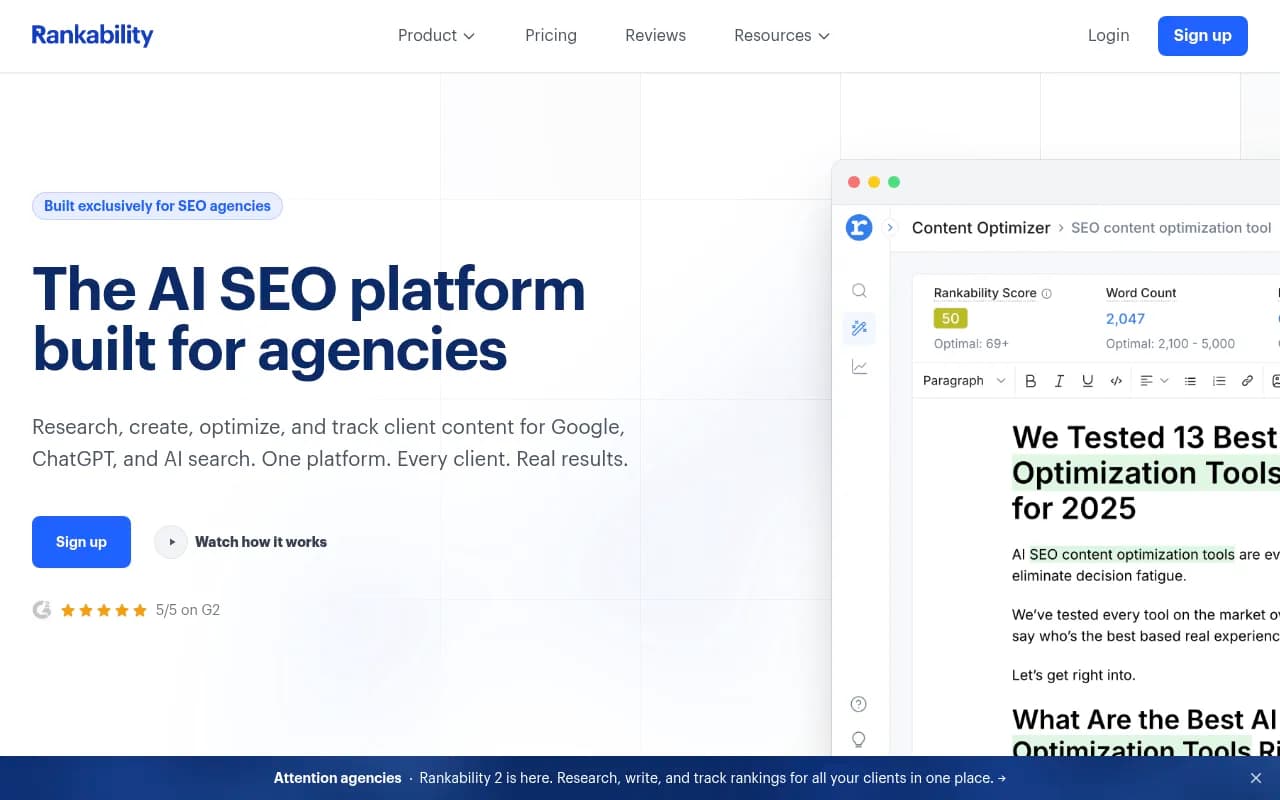
Rankability fills a semantic gap that neither Frase nor Surfer fully addresses -- entity-based scoring that identifies the conceptual coverage modern search algorithms evaluate. Worth considering for teams doing heavy content audits.

Clearscope is another content optimization option that some teams prefer over Surfer for its cleaner interface and grading system. It doesn't replace Frase's research depth, but it's a viable alternative to Surfer in the write-and-score layer.
MarketMuse takes a more strategic approach -- it maps your entire site's topical authority rather than optimizing individual articles. Useful for planning content calendars and identifying where your site has authority gaps that make it harder to rank for certain topics.
The core workflow -- research in Frase, write and score in Surfer, track AI citations in Promptwatch -- covers most of what a content team needs. The additional tools are worth exploring once that foundation is solid.