Key takeaways
- Jasper and HubSpot's AI Content Writer are content generation tools built to help marketing teams produce more output faster — they are not AI visibility platforms.
- Neither Jasper nor HubSpot tracks whether your content actually gets cited by ChatGPT, Perplexity, Google AI Overviews, or any other AI search engine.
- Promptwatch is a dedicated GEO (Generative Engine Optimization) platform that tracks AI citations, identifies content gaps, generates content designed to be cited, and measures the results.
- These tools solve different problems. For most teams in 2026, the real question isn't which content writer to use — it's whether you have any visibility into how AI search engines are treating your brand.
- The best setup for many teams: a content tool for volume, Promptwatch for AI visibility strategy and optimization.
Why this comparison matters in 2026
A year ago, comparing Jasper to HubSpot's AI writer made obvious sense. Both help marketers write faster. Pick the one that fits your workflow.
But in 2026, there's a third variable that changes the whole equation: AI search. ChatGPT, Perplexity, Google AI Overviews, and Gemini are now answering questions that used to send traffic to websites. Brands that get cited in those answers get the traffic. Brands that don't are invisible, even if they rank on page one of Google.
That shift is why a tool like Promptwatch belongs in this comparison at all. It's not a content writer. It's the platform that tells you whether your content is working in AI search — and helps you fix it when it isn't.
So this guide covers three distinct tools solving three related but different problems:
- Jasper: high-volume AI content generation for marketing teams
- HubSpot AI Content Writer: AI writing built into a marketing CRM
- Promptwatch: AI search visibility tracking and GEO optimization
Understanding the difference between these categories is more useful than comparing feature lists.
What Jasper actually does
Jasper started as an AI copywriting tool and has evolved into something closer to a full marketing content platform. In 2026, it operates with a campaign-level model: you define your brand voice, set campaign goals, and Jasper generates content across formats — blog posts, social copy, email sequences, landing pages, ad creative.
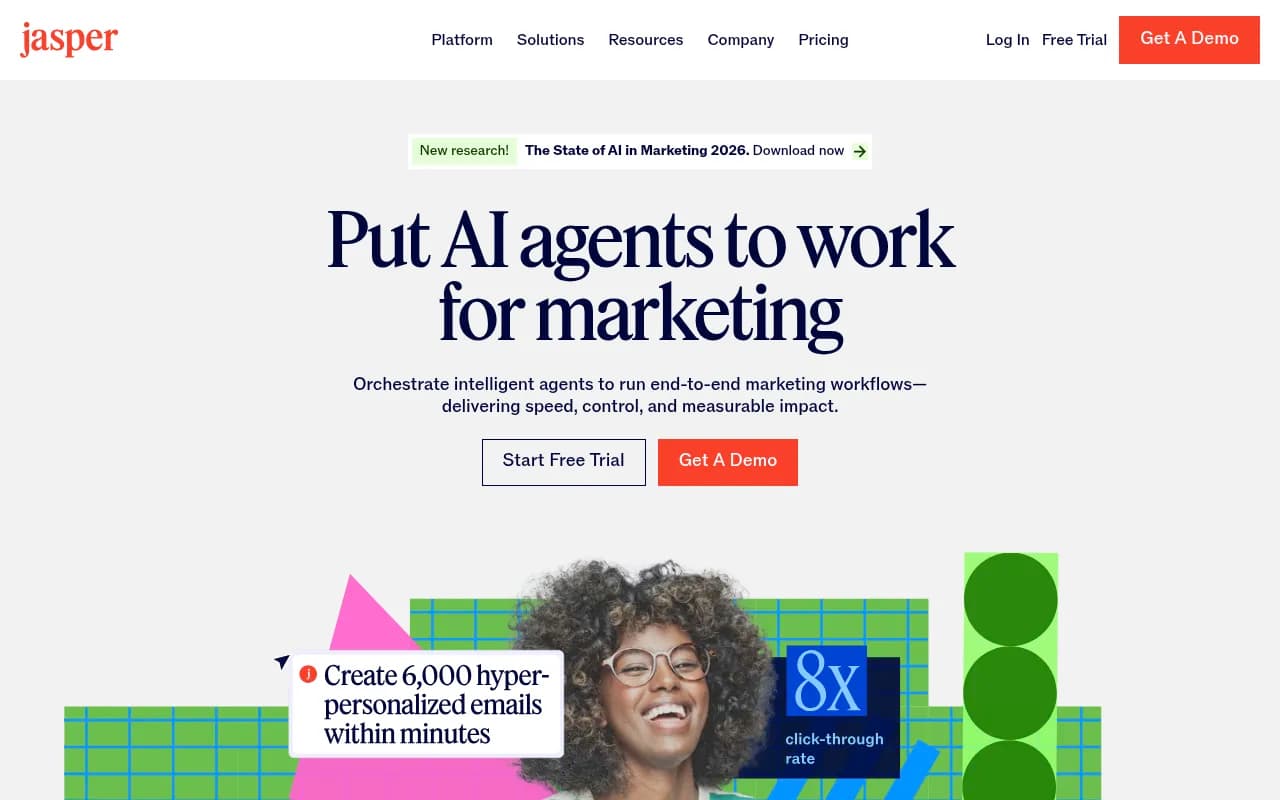
The core strength is volume and brand consistency. Large marketing teams and agencies use Jasper to maintain a consistent voice across dozens of content types without every piece going through a senior writer. The brand voice feature is genuinely useful — it learns from your existing content and applies that style across new outputs.
Jasper also has a document editor, a browser extension, and integrations with tools like Surfer SEO for on-page optimization. For teams producing a high volume of content across multiple channels, it's a solid production tool.
What Jasper doesn't do: it has no visibility into whether your content gets cited by AI search engines. It doesn't track your brand mentions in ChatGPT or Perplexity. It doesn't show you which prompts your competitors are winning that you're not. It generates content, but it can't tell you if that content is doing anything in AI search.
What HubSpot AI Content Writer does
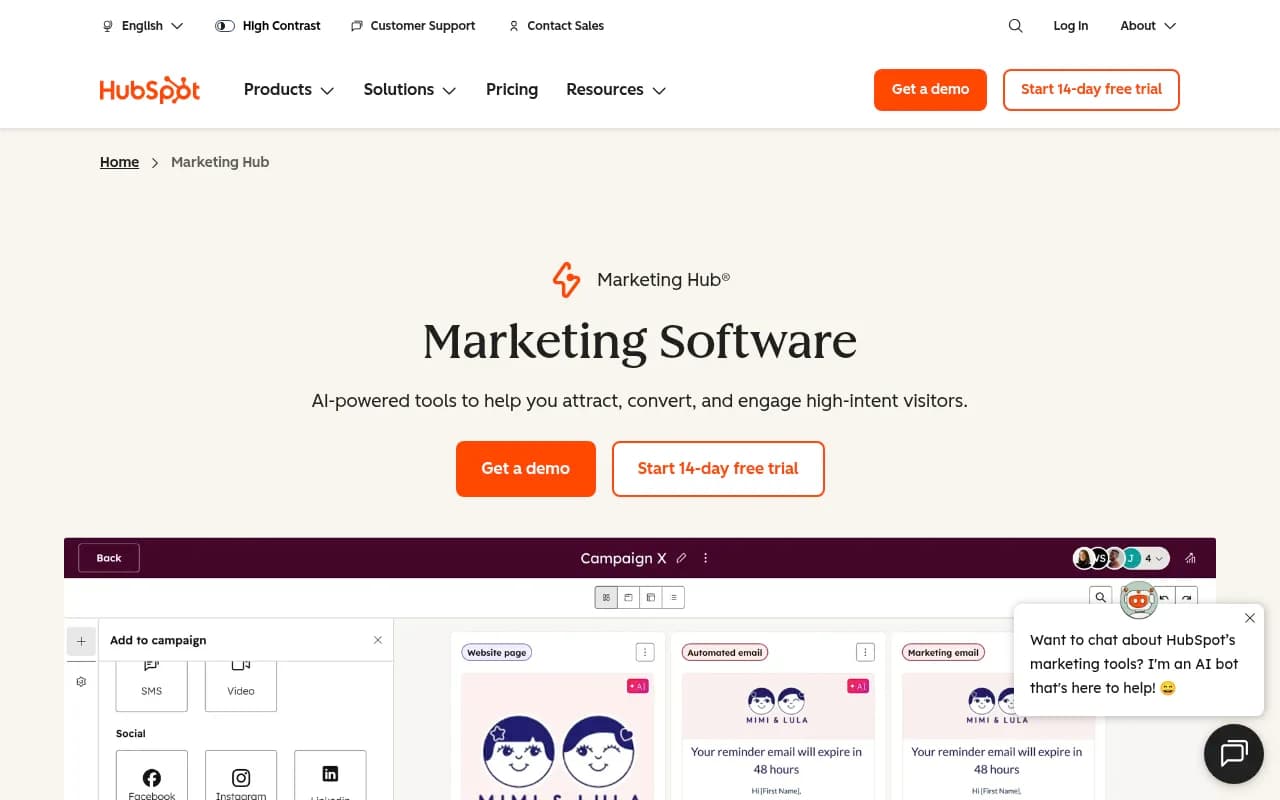
HubSpot's AI Content Writer is less a standalone product and more an embedded capability inside HubSpot's marketing platform. If you're already using HubSpot for CRM, email, landing pages, and social, the AI writer is a natural extension — it helps you draft content without leaving the platform.

The practical value is workflow integration. You can draft a blog post, an email, a landing page, and social copy all inside HubSpot, with your CRM data informing personalization. For teams that live in HubSpot, this removes a lot of context-switching.
The limitation is that HubSpot's AI writer is a drafting tool, not an optimization tool. It doesn't analyze what AI search engines are citing. It doesn't identify content gaps based on AI prompt data. HubSpot does have some SEO features (keyword suggestions, on-page recommendations), but these are traditional SEO tools, not GEO tools.
HubSpot's broader marketing platform is genuinely powerful for email automation, lead nurturing, and CRM-connected content. But if your question is "how do we show up in ChatGPT's answers?" — HubSpot doesn't answer that.
What Promptwatch actually does
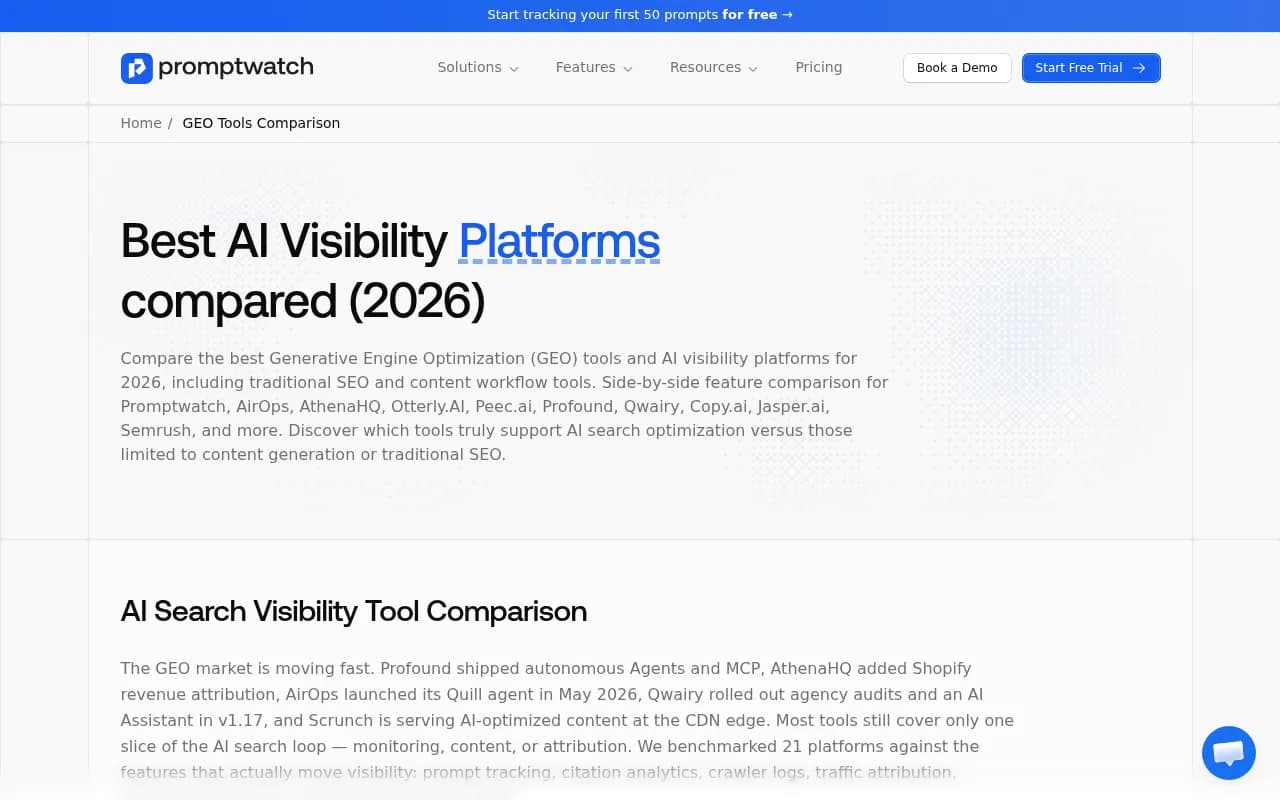
Promptwatch is built around a different problem: not how to write content, but how to make sure AI search engines find, read, and cite your content.

The platform tracks how your brand appears across 10 AI models — ChatGPT, Perplexity, Google AI Overviews, Google AI Mode, Claude, Gemini, Meta/Llama, DeepSeek, Grok, and Mistral. For each prompt you track, you can see whether you're cited, how often, and what your competitors' citation rates look like.
The part that separates Promptwatch from monitoring-only tools is what happens after you see the data. The Answer Gap Analysis shows exactly which prompts your competitors are visible for that you're not — and what content your site is missing. Content Agents then generate articles, comparisons, and listicles grounded in that gap data, not generic SEO filler.
Promptwatch also has AI Crawler Logs, which show in real time when AI crawlers like GPTBot and ClaudeBot hit your pages, which pages they read, what errors they encounter, and when a crawled page moves to an actual citation. Most competing platforms don't have this at all.
The result is a closed loop: find gaps, create content to fill them, track whether citations improve.
Feature comparison
| Feature | Jasper | HubSpot AI Writer | Promptwatch |
|---|---|---|---|
| AI content generation | Yes (core feature) | Yes (embedded) | Yes (gap-driven) |
| Brand voice / style guide | Yes | Partial (via HubSpot settings) | Yes (brand instructions) |
| Traditional SEO optimization | Via Surfer integration | Basic (HubSpot SEO tools) | No |
| AI search visibility tracking | No | No | Yes (10 AI models) |
| Prompt/citation monitoring | No | No | Yes |
| Answer gap analysis | No | No | Yes |
| AI crawler logs | No | No | Yes |
| Reddit & YouTube insights | No | No | Yes |
| ChatGPT Shopping tracking | No | No | Yes |
| Competitor AI visibility heatmaps | No | No | Yes |
| Traffic attribution from AI | No | No | Yes |
| CRM integration | Limited | Native (HubSpot CRM) | No |
| Email/social content | Yes | Yes | No |
| Pricing starts at | ~$49/mo | Included in HubSpot plans | $99/mo |
| Free trial | Yes | Yes (HubSpot free tier) | Yes |
The category problem: content generation vs. GEO
Here's the honest framing. Jasper and HubSpot's AI writer compete with each other. Promptwatch competes with platforms like Profound, Otterly.AI, AthenaHQ, and Peec.ai.
The mistake many marketing teams make in 2026 is treating content generation and AI visibility as the same problem. They're not.
You can produce 50 articles a month with Jasper and still be invisible in ChatGPT, because the content isn't structured around the prompts AI models are actually answering. You can have a perfectly optimized HubSpot blog and still not appear in a single Perplexity citation, because you have no data on what Perplexity is citing or why.
GEO requires a different input: real prompt data, citation analysis, crawler behavior, and gap identification. That's what Promptwatch is built to provide.
The content tools and the GEO platform are solving sequential problems. You need to know what to write before you write it, and you need to track whether what you wrote is working after you publish it.
Who should use what
Jasper is the right fit if:
- You have a large marketing team producing high content volume across multiple channels
- Brand voice consistency across many writers is a real operational problem
- You need to generate ad copy, email sequences, social posts, and blog content from one tool
- You're not yet focused on AI search visibility (though you probably should be)
HubSpot AI Content Writer is the right fit if:
- You're already deep in the HubSpot ecosystem and want AI writing without adding another tool
- Your content strategy is closely tied to CRM data, lead nurturing, and email automation
- You want AI drafting as a convenience feature, not a core production system
- Traditional SEO and email marketing are your primary channels
Promptwatch is the right fit if:
- You want to understand and improve how your brand appears in AI search engines
- You're losing traffic to AI-generated answers and need to know why
- You want to identify which content gaps are costing you citations
- You need to prove to stakeholders that your GEO efforts are moving the needle
- You're an agency managing AI visibility for multiple clients
Can you use them together?
Yes, and for many teams this is the practical answer.
Jasper or HubSpot handles content production volume. Promptwatch handles the strategy layer: which prompts to target, what content gaps exist, whether published content is getting crawled and cited, and how visibility scores change over time.
The workflow looks like this: Promptwatch's Answer Gap Analysis identifies a cluster of prompts your competitors are winning. You use that data to brief a piece of content, write it in Jasper or HubSpot, publish it, and then watch Promptwatch's crawler logs to see when AI engines pick it up. A few weeks later, you check whether your citation rate for those prompts has improved.
That's a more deliberate content strategy than most teams have right now. Most teams are still writing content based on keyword volume and hoping AI search engines notice.
The monitoring-only trap
One thing worth flagging: there are a lot of AI visibility tools in 2026 that only monitor. They show you a dashboard of where you appear in AI answers, and that's it. No content recommendations, no gap analysis, no way to act on the data.
Platforms like Otterly.AI and Peec.ai fall into this category. They're useful for awareness, but they don't help you fix anything.
Otterly.AI


Promptwatch's differentiation is that it completes the loop. The monitoring data feeds directly into content recommendations, and the content tools are built around the same prompt data the monitoring uses. You're not just watching a dashboard — you're using the data to make decisions and then tracking whether those decisions worked.
Pricing reality check
Jasper's pricing starts around $49/month for individuals and scales up significantly for team plans with brand voice and campaign features. HubSpot's AI writer is bundled into HubSpot's marketing plans, which start free but get expensive quickly as you add contacts and features.
Promptwatch starts at $99/month for the Essential plan (1 site, 50 prompts, 5 articles), $249/month for Professional (2 sites, 150 prompts, 15 articles, crawler logs), and $579/month for Business (5 sites, 350 prompts, 30 articles). Agency and enterprise pricing is custom.
The price comparison isn't really apples-to-apples because these tools do different things. The more useful question is: what's the cost of being invisible in AI search? For most brands, that's a much larger number than any of these subscription fees.
Bottom line
Jasper is a content production tool. HubSpot's AI writer is a drafting convenience for HubSpot users. Neither one tells you whether your content is working in AI search.
If you're a marketing team in 2026 that isn't tracking your AI search visibility, you're flying blind. You don't know which prompts are sending traffic to competitors instead of you. You don't know which pages AI crawlers are reading or ignoring. You don't know whether your content investments are translating into citations.
Promptwatch solves that problem. Jasper and HubSpot solve a different one.
For teams that can only pick one: if your content production is already working and you just need more volume, Jasper or HubSpot makes sense. If you don't know whether your content is being cited by AI search engines at all, that's the more urgent problem to fix first.