Key takeaways
- Jasper AI, AirOps, and Copy.ai are primarily content creation tools -- they help you write faster, but none of them track whether your content actually gets cited by ChatGPT, Perplexity, or other AI models.
- Promptwatch is the only platform in this comparison built specifically for AI search visibility: it tracks where you appear (and where you don't), generates content engineered to get cited, and closes the loop with traffic attribution.
- If your goal is raw content volume, Jasper or Copy.ai can help. If your goal is ranking in AI search, you need a platform that shows you the gaps and helps you fix them.
- The biggest mistake marketers make in 2026 is confusing "AI-assisted writing" with "AI search optimization." They are not the same thing.
Let's be honest about what's happening here. Jasper, AirOps, and Copy.ai are excellent tools -- but they were built to solve a content production problem, not an AI search visibility problem. Comparing them to Promptwatch is a bit like comparing a word processor to a rank tracker. They overlap in one area (content creation) but exist for entirely different reasons.
That said, plenty of marketing teams are genuinely trying to figure out which of these platforms belongs in their stack for 2026. So let's break it down properly.
What problem are you actually trying to solve?
Before diving into features, it's worth being clear about the two distinct challenges:
Challenge 1: Creating content faster. You need blog posts, landing pages, email copy, and social content -- and you want AI to help you produce it without burning out your team.
Challenge 2: Getting cited in AI search. When someone asks ChatGPT "what's the best project management tool for remote teams?" or asks Perplexity "which CRM is easiest to set up?" -- you want your brand in the answer. This requires knowing which prompts you're missing, understanding why competitors appear and you don't, and creating content that AI models actually want to cite.
Jasper, AirOps, and Copy.ai are primarily built for Challenge 1. Promptwatch is built for Challenge 2, with content creation as a supporting capability rather than the main event.
Most teams need both. The question is whether you buy separate tools or find a platform that connects them.
The four platforms at a glance
| Platform | Primary purpose | AI search tracking | Content generation | Traffic attribution | Pricing (starting) |
|---|---|---|---|---|---|
| Promptwatch | AI search visibility + optimization | Yes (10 models) | Yes (citation-grounded) | Yes (GSC, logs, snippet) | $99/mo |
| Jasper AI | Marketing content creation | No | Yes (broad) | No | ~$49/mo |
| AirOps | Content engineering for AI search | Partial | Yes (SEO-focused) | No | Custom |
| Copy.ai | AI copywriting and workflows | No | Yes (broad) | No | $49/mo |
Jasper AI: the marketing content machine
Jasper has been around long enough to have real credibility. It's a mature platform with a large template library, brand voice controls, and an agent layer that can run multi-step content workflows. For marketing teams that need to produce a lot of content across channels -- ads, emails, social, long-form -- it's genuinely capable.
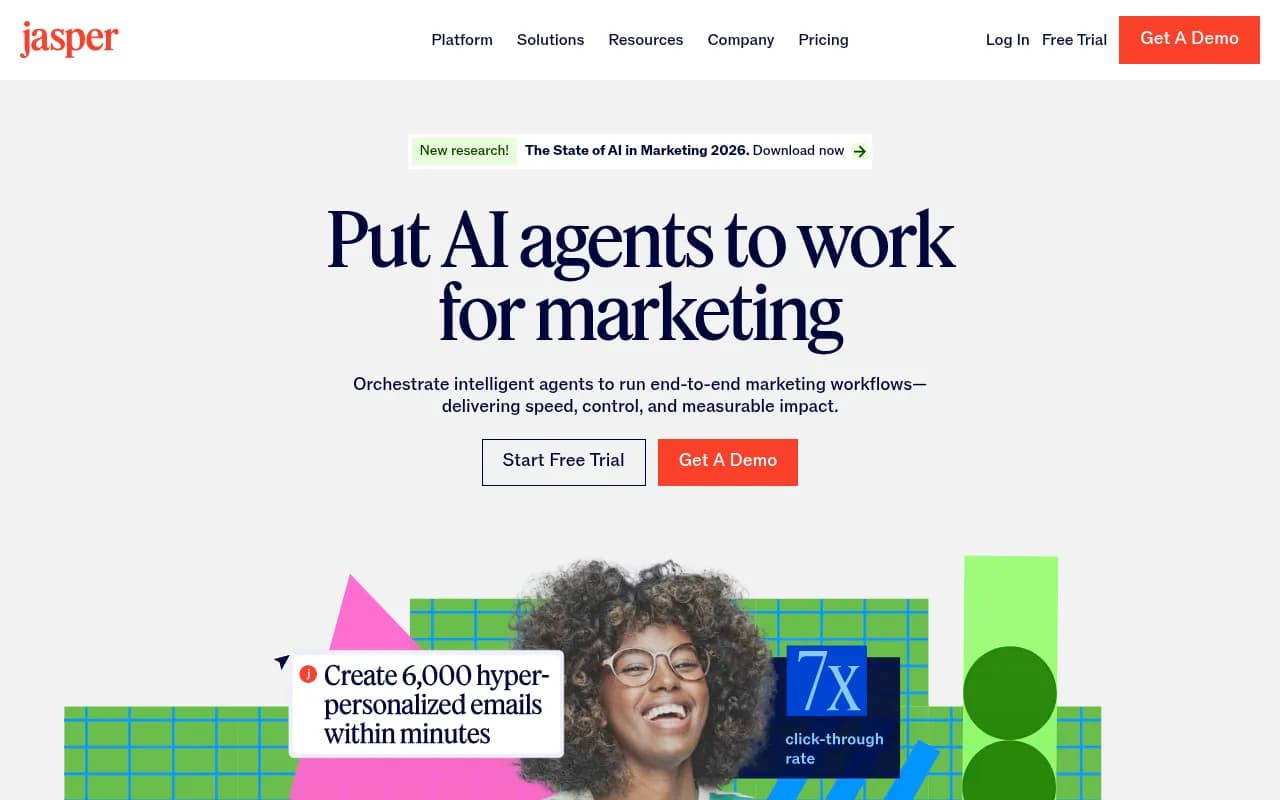
Where Jasper falls short for AI search is that it has no visibility into how AI models respond to prompts about your brand or category. You can write a great article with Jasper, publish it, and have zero idea whether ChatGPT ever cites it. There's no prompt tracking, no gap analysis, no citation data. You're writing in the dark.
Jasper's "AI search" features are mostly about writing content that follows SEO best practices -- which is necessary but not sufficient for GEO. The platform doesn't run queries against LLMs, doesn't show you where competitors appear, and doesn't tell you which topics AI models want to answer but can't find on your site.
It's a strong tool for content production. It's not an AI search optimization platform.
AirOps: content engineering with an AI search angle
AirOps sits in an interesting middle ground. It's positioned as a "content engineering" platform -- the idea being that you build structured workflows to produce content at scale, with more control over the process than a simple AI writer gives you.
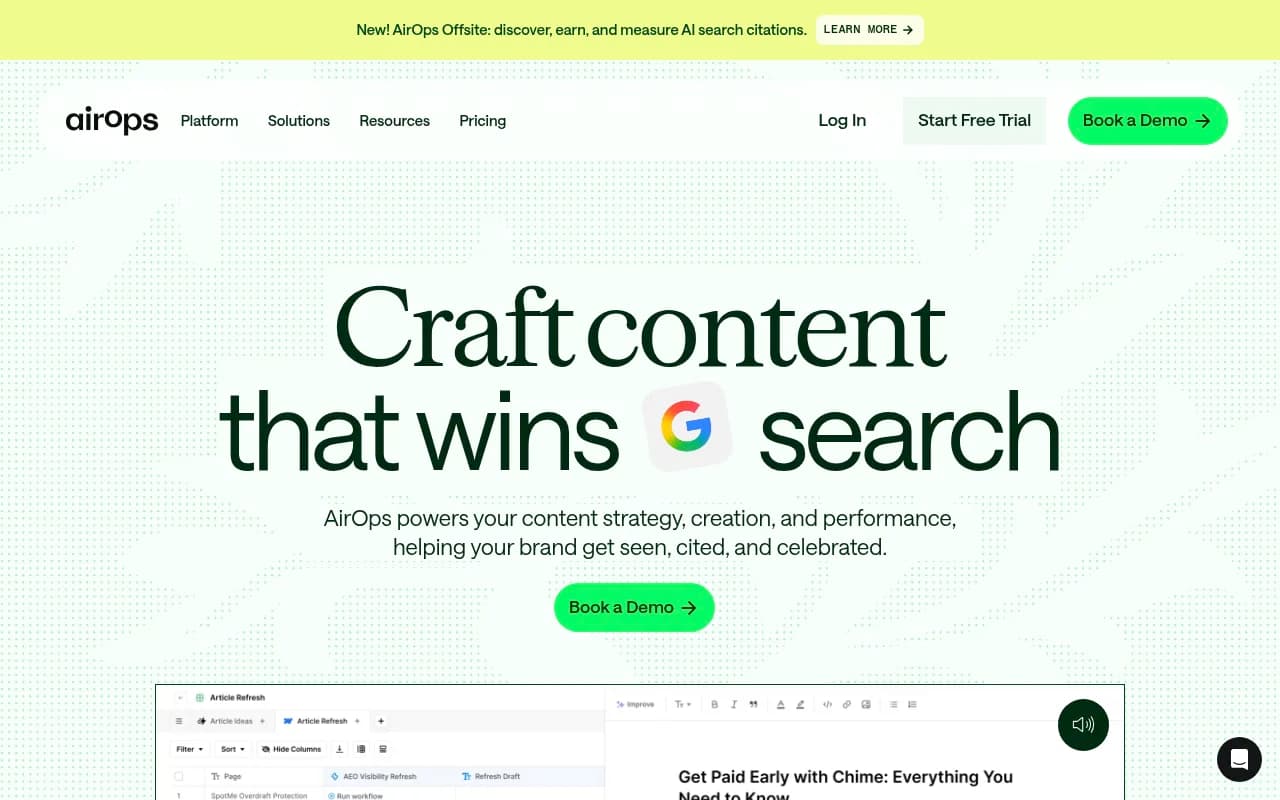
AirOps has leaned into the GEO narrative more than Jasper or Copy.ai. Their workflows can be configured to produce content that targets specific search intents, and they've built some tooling around optimizing for AI Overviews and LLM responses. This is more sophisticated than a generic AI writer.
But AirOps is still fundamentally a content production platform. It doesn't monitor your actual AI search visibility -- you can't see your brand's mention rate across ChatGPT, Perplexity, Gemini, and Claude. It doesn't show you which prompts competitors are winning that you're not. And it doesn't close the loop by attributing traffic from AI search back to specific pages or revenue.
If you already know exactly what content to create and just need a powerful system to produce it efficiently, AirOps is worth evaluating. If you need to figure out what to create in the first place -- and then verify it's working -- you need something else alongside it.
Copy.ai: fast, flexible, and good at what it does
Copy.ai is the most accessible of the three content tools. It's fast, the interface is clean, and it covers a wide range of use cases from short-form copy to longer workflows. The platform has added "GTM AI" positioning in recent years, with workflow automation for sales and marketing teams.

Like Jasper, Copy.ai has no AI search monitoring capabilities. It's a writing tool. A good one. But if you're trying to understand why your brand doesn't appear when someone asks Perplexity for a software recommendation in your category, Copy.ai won't help you answer that question.
The pricing is competitive, and for teams that just need to produce content faster, it's a reasonable choice. For teams trying to build a systematic AI search presence, it's a piece of a much larger puzzle -- and not the most important piece.
Promptwatch: built for the full optimization loop
Promptwatch is the only platform in this comparison that was designed from the ground up to solve the AI search visibility problem end-to-end.

The core difference comes down to what happens after you create content. With Jasper, AirOps, or Copy.ai, you publish and hope. With Promptwatch, you can actually see whether AI models are citing your pages, which prompts you're winning, and which ones competitors are taking from you.
The workflow looks like this:
Find the gaps. Answer Gap Analysis shows you the specific prompts where competitors appear in AI responses but you don't. Not vague categories -- the actual questions, with data on which AI models are answering them and which sources they're pulling from. This is where most teams discover they're invisible for entire segments of their funnel.
Create content that gets cited. The built-in AI writing agent generates articles grounded in real citation data -- over 880 million citations analyzed. It knows what sources AI models trust, what angles they respond to, and what format tends to get cited. This is different from generic AI writing because it's engineered around what AI models actually want to reference, not just what reads well to humans.
Track the results. Page-level tracking shows which specific pages are being cited by which models, how often, and in response to which prompts. Traffic attribution (via a code snippet, Google Search Console integration, or server log analysis) connects AI visibility to actual sessions and conversions. You can see the business impact, not just the visibility score.
Promptwatch also covers things the content tools don't touch at all: AI crawler logs showing which pages ChatGPT and Perplexity are actually reading, Reddit and YouTube tracking (both major sources that influence AI recommendations), ChatGPT Shopping monitoring, and competitor heatmaps across 10 AI models.
The platform monitors OpenAI/ChatGPT, Perplexity, Google AI Overviews, Google AI Mode, Claude, Gemini, Meta/Llama, DeepSeek, Grok, Mistral, and Copilot. That's meaningful coverage -- most competitors track three or four models at most.
Pricing starts at $99/month for the Essential plan (1 site, 50 prompts, 5 articles per month), $249/month for Professional (2 sites, 150 prompts, 15 articles, crawler logs), and $579/month for Business (5 sites, 350 prompts, 30 articles). Agency and enterprise pricing is available for larger teams.
Head-to-head: what each platform actually delivers
| Capability | Promptwatch | Jasper AI | AirOps | Copy.ai |
|---|---|---|---|---|
| AI model monitoring (ChatGPT, Perplexity, etc.) | Yes (10 models) | No | No | No |
| Brand mention tracking | Yes | No | No | No |
| Competitor visibility comparison | Yes | No | No | No |
| Answer gap analysis | Yes | No | Partial | No |
| Citation-grounded content generation | Yes | No | Partial | No |
| AI crawler logs | Yes | No | No | No |
| Traffic attribution from AI search | Yes | No | No | No |
| Reddit/YouTube source tracking | Yes | No | No | No |
| ChatGPT Shopping monitoring | Yes | No | No | No |
| Prompt volume and difficulty scoring | Yes | No | No | No |
| Generic AI writing | Yes (focused) | Yes (broad) | Yes (structured) | Yes (broad) |
| Brand voice controls | Limited | Yes | Yes | Yes |
| Multi-language/region | Yes | Yes | Yes | Yes |
The pattern is clear. For content production breadth and brand voice consistency, Jasper and Copy.ai have more mature tooling. For AI search optimization -- the actual problem of getting cited by AI models -- Promptwatch is in a different category entirely.
Who should use what
Use Jasper if you're running a content-heavy marketing operation and need a reliable AI writing platform with strong brand controls and a wide template library. Don't expect it to tell you anything about your AI search performance.
Use AirOps if you're building structured content workflows at scale and want more control over the production process than a standard AI writer provides. It's a better fit for technical teams comfortable with workflow configuration.
Use Copy.ai if you need fast, versatile AI copywriting across multiple formats and want a clean interface without a steep learning curve. Good for teams that are still figuring out their AI content strategy.
Use Promptwatch if you're serious about AI search visibility -- meaning you want to know where you appear, where you don't, why competitors are getting cited instead of you, and what content to create to change that. It's the only platform here that closes the full loop from gap identification to content creation to traffic attribution.
For many teams, the right answer is Promptwatch plus one of the content tools. Promptwatch tells you what to create and whether it's working. Jasper or Copy.ai can help you produce supporting content at scale. They're not mutually exclusive.
The monitoring-only trap
One thing worth flagging: there's a whole category of AI visibility tools that only do monitoring. They show you a dashboard of where your brand appears, and that's it. No gap analysis, no content recommendations, no traffic attribution.
That's better than nothing, but it leaves you stuck. Knowing you have 23% visibility in your category is interesting. Knowing exactly which prompts you're missing, what content would fix it, and whether that content is actually driving traffic -- that's actionable.
This is the core gap in the market that Promptwatch addresses. Most competitors (including several well-funded ones) stop at the monitoring layer. The optimization layer is where the actual value is.
The bottom line
In 2026, AI search isn't a trend to watch -- it's a channel that's actively influencing purchase decisions. ChatGPT alone is approaching a billion weekly active users. Perplexity, Google AI Mode, and Claude are all sending traffic and shaping brand perception.
If you're using Jasper, AirOps, or Copy.ai to create content but have no visibility into whether that content is getting cited by AI models, you're flying blind. You might be producing great content that AI models never reference. Or you might be missing entire topic areas where competitors are building authority while you're absent.
The tools in this comparison serve real purposes. But only one of them was built to answer the question that actually matters in 2026: is your brand showing up when AI models answer questions in your category, and if not, what are you going to do about it?