Key takeaways
- Jasper is the strongest platform for brand-voice consistency and high-volume content production, but it doesn't tell you whether that content is being cited by AI engines.
- Writer leads on enterprise governance, knowledge-graph integration, and compliance-heavy deployments — but like Jasper, it has no native citation tracking or GEO feedback loop.
- Promptwatch is the only platform in this comparison built specifically for AI search visibility: it tracks citations across 10+ AI models, identifies content gaps, and generates content designed to get cited — not just content that sounds good.
- If your goal is AI search visibility and GEO performance, you need Promptwatch. If your goal is brand-safe content at scale, Jasper or Writer fits better — but you'll still need a GEO layer on top.
- The three tools aren't direct competitors. Many enterprise teams use Jasper or Writer for production and Promptwatch for visibility measurement and optimization.
These three platforms get compared a lot in 2026, usually by people who are trying to figure out which one to buy. The honest answer is that they're solving different problems, and comparing them head-to-head is a bit like comparing a content management system to a rank tracker. Useful to understand the overlap, but the framing matters.
That said, there's real overlap in the Venn diagram — all three touch AI-generated content, all three claim some relevance to how brands appear in AI search, and all three are being evaluated by enterprise marketing teams with overlapping budgets. So let's actually work through what each one does, where they're strong, and where they fall short.
What each platform is actually built for
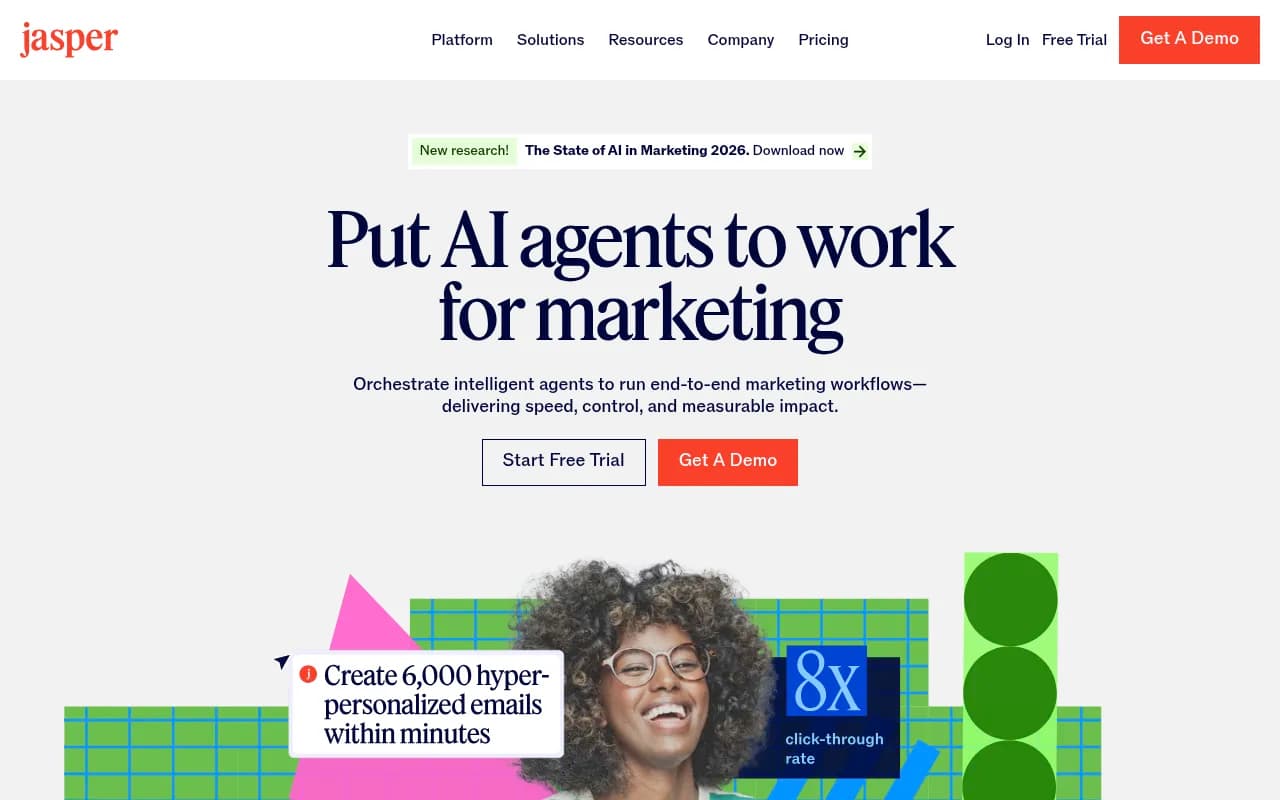
Jasper: brand voice at scale
Jasper has been the default choice for marketing-led content teams since around 2022, and in 2026 it's still the strongest platform for brand-voice consistency across high-volume output. The core of the product is Jasper IQ — an intelligence layer that embeds brand voice, visual guidelines, and content rules into every generation. You train it on your tone, your product language, your style guide, and it applies that context across blog posts, social copy, email sequences, and ad creative.
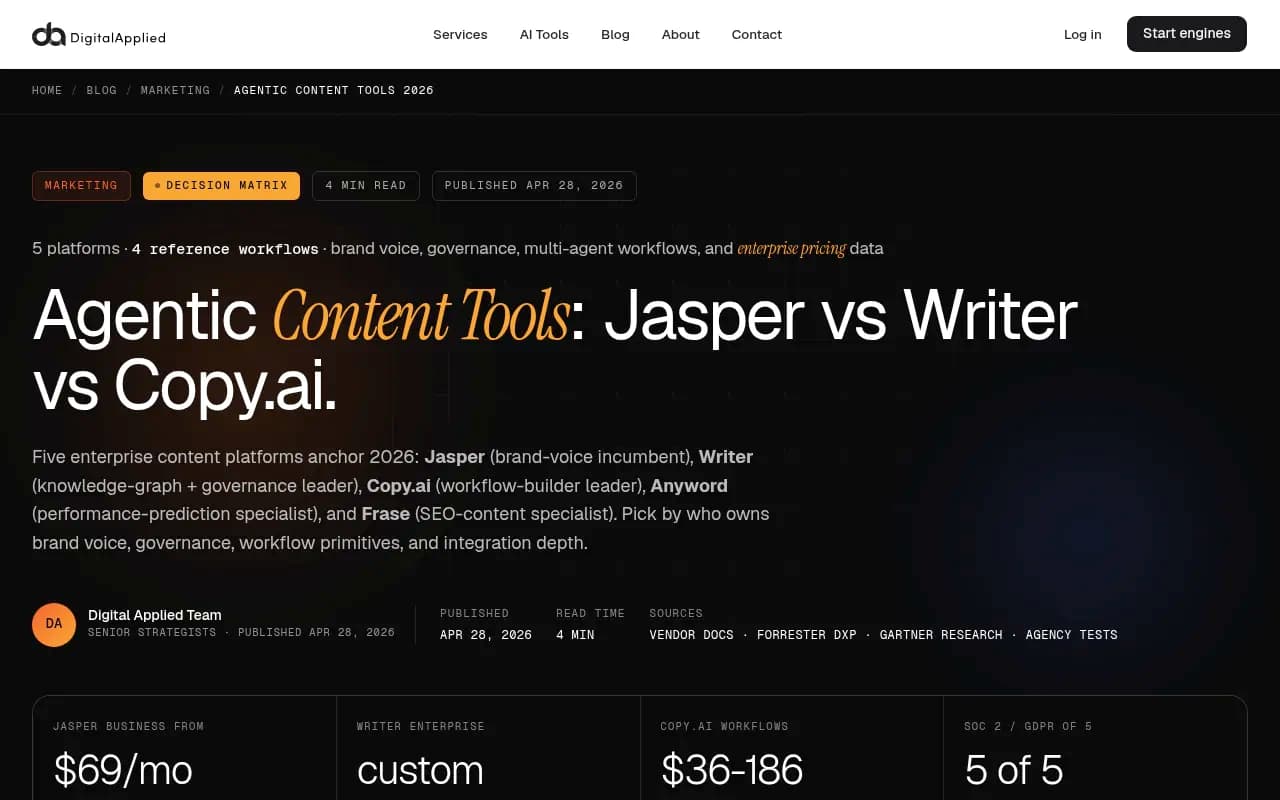
The platform has evolved significantly. Jasper now ships purpose-built agents for optimization, research, and translation, plus content pipelines that let teams build repeatable workflows. The MCP integration means Jasper can connect to external tools and data sources. Pricing starts at $69/seat for the Business tier, with enterprise contracts above $499/seat.
Where Jasper falls short: it's a content production platform, not a visibility platform. It doesn't tell you which prompts your brand is being cited for in ChatGPT or Perplexity. It doesn't show you which competitors are winning AI citations that you're missing. It generates content, but it doesn't close the loop on whether that content is actually working in AI search.
Writer: enterprise governance and knowledge graphs
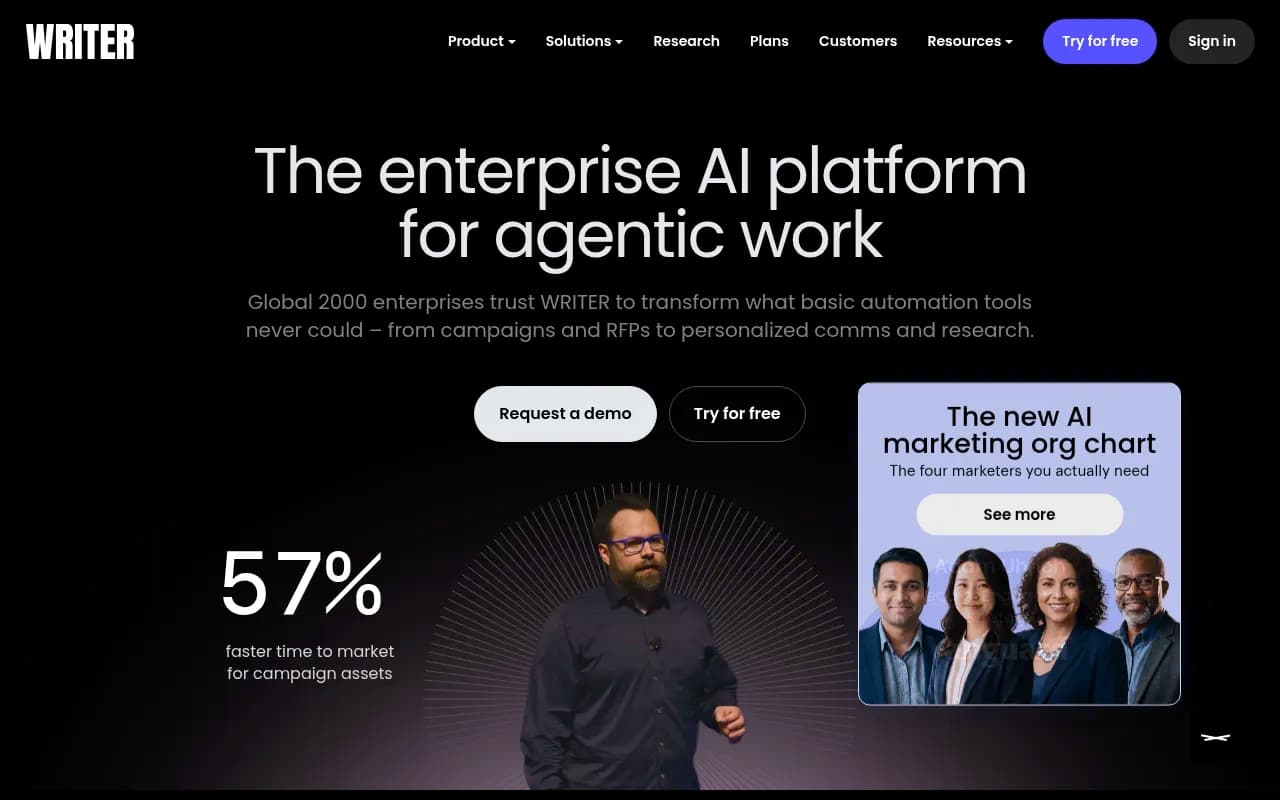
Writer is the pick for IT-led deployments where governance is non-negotiable. The platform leads on SSO, role-based access controls, full audit logs, prompt redaction, output classification, and content-policy engines. Its knowledge-graph integration ties generated content to your organization's actual source-of-truth documents — product specs, legal guidelines, internal wikis — which matters a lot when you're producing content at scale and can't afford factual drift.
Writer is sold on annual enterprise contracts with custom pricing. It's not the cheapest option, but for regulated industries (finance, healthcare, legal) or large organizations where content governance is a compliance requirement, it's the most defensible choice.
The gap is the same as Jasper's: Writer produces content, but it doesn't measure AI search visibility. There's no citation tracking, no prompt monitoring, no feedback loop that tells you whether the content Writer helped you produce is being recommended by AI engines.
Promptwatch: AI search visibility and GEO optimization
Promptwatch is a different category of tool entirely. It's not a content production platform — it's an AI search visibility platform. The core job is tracking how your brand appears across AI engines (ChatGPT, Perplexity, Google AI Overviews, Claude, Gemini, Grok, DeepSeek, Copilot, Meta AI, Mistral), identifying where competitors are being cited and you're not, and then helping you fix those gaps.
The distinction that matters: Promptwatch is built around an action loop, not just a monitoring dashboard. It finds the gaps (Answer Gap Analysis shows exactly which prompts competitors rank for that you don't), generates content designed to fill those gaps (Content Agents produce articles grounded in real prompt data and citation analysis), and tracks whether that content gets cited after you publish it. AI Crawler Logs show you in real time which pages AI crawlers are reading, how often they return, and when a page moves from crawl to citation.
That's a fundamentally different value proposition from Jasper or Writer. Promptwatch isn't trying to replace your content production workflow — it's trying to make sure the content you produce actually gets picked up by AI search engines.

Feature comparison
| Feature | Jasper | Writer | Promptwatch |
|---|---|---|---|
| Brand voice training | Strong (core feature) | Strong (knowledge graph) | Not applicable |
| Content generation | Yes (agents, pipelines) | Yes (governance-first) | Yes (GEO-optimized) |
| AI citation tracking | No | No | Yes (10+ models) |
| Prompt monitoring | No | No | Yes |
| Answer gap analysis | No | No | Yes |
| AI crawler logs | No | No | Yes |
| Traffic attribution from AI | No | No | Yes |
| Reddit/YouTube insights | No | No | Yes |
| ChatGPT Shopping tracking | No | No | Yes |
| Enterprise governance | Moderate | Strong (SOC 2, audit logs) | Moderate |
| Knowledge graph integration | No | Yes | No |
| Multi-agent workflows | Yes | Yes | Content Agents |
| Pricing (entry) | $69/seat/mo | Custom (enterprise) | $99/mo (1 site) |
| Free trial | Yes | Demo only | Yes |
| Best for | Marketing-led content teams | IT-led, compliance-heavy orgs | GEO, AI search visibility |
Brand voice: where Jasper and Writer actually differ
Both platforms claim strong brand voice, but the mechanism is different.
Jasper's Brand IQ is trained on your existing content and style guide. It learns your tone, vocabulary, and formatting preferences, then applies them across every output. This works well for marketing teams that produce a lot of content in a consistent voice — think SaaS companies with a defined brand personality, or media companies with editorial standards.
Writer's approach is more structural. The knowledge graph ties content to source documents, which means the "brand voice" is less about tone and more about factual consistency. Writer is better at ensuring that generated content reflects your actual product positioning, pricing, and feature set — not just your writing style. For companies where factual accuracy matters as much as tone (think financial services or enterprise software), Writer's approach is more defensible.
Neither platform, though, tells you whether your brand voice is resonating in AI search. You can produce perfectly on-brand content with Jasper or Writer and still be invisible in ChatGPT responses because the content doesn't address the specific questions users are asking AI engines. That's the gap Promptwatch fills.
GEO output: what "AI-optimized content" actually means
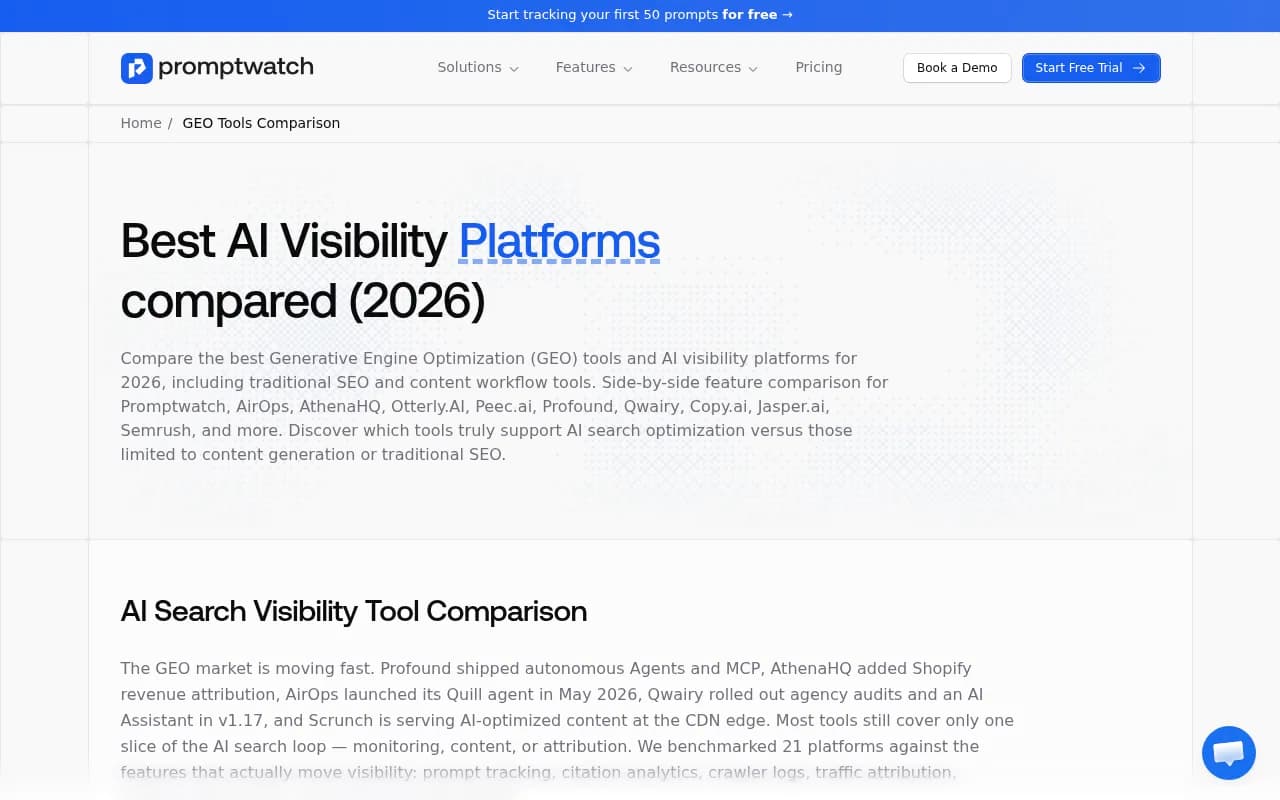
This is where the comparison gets interesting, because all three platforms now claim some relevance to GEO (Generative Engine Optimization).
Jasper added a GEO & AI Optimization module in 2025-2026 that helps marketers measure brand performance across AI answer engines and produce content at scale. It's a meaningful addition, but it's primarily a production tool with some monitoring bolted on. The content it generates is brand-governed, but it's not necessarily grounded in real prompt data or citation analysis.
Writer doesn't have a dedicated GEO feature set. Its value proposition is governance and knowledge integration, not AI search optimization.
Promptwatch's content generation is built differently. Content Agents produce articles, listicles, comparisons, and briefs grounded in real prompt data — actual queries users are typing into AI engines — plus citation data, prompt volumes, persona targeting, competitor analysis, and screenshots. The content is designed to answer the specific questions AI models are already exposing as gaps. That's a meaningful difference from content that's merely well-written and on-brand.
Citation tracking: the missing layer in Jasper and Writer
Neither Jasper nor Writer tracks citations. This is the clearest gap in both platforms for teams that care about AI search performance.
Citation tracking matters because AI search engines don't work like Google. They don't just rank pages — they synthesize answers and cite sources. Whether your brand gets cited in a ChatGPT response to "best project management software for remote teams" depends on whether AI crawlers have indexed your relevant content, whether that content answers the question comprehensively, and whether your domain has enough authority signals in the AI training data.
Promptwatch tracks all of this. Page-level citation tracking shows which specific pages are being cited, by which models, and how often. AI Crawler Logs show when GPTBot, ClaudeBot, and other AI crawlers visit your site, which pages they read, and whether those pages eventually get cited. The timeline from publish to crawl to citation is visible in Agent Analytics, which lets you understand the lag between publishing content and seeing it appear in AI responses.
For enterprise teams running GEO campaigns, this is the feedback loop that makes optimization possible. Without it, you're publishing content and hoping for the best.
Pricing reality check
Jasper's $69/seat Business pricing sounds accessible, but enterprise deployments with multiple seats and the full feature set (Jasper IQ, agents, pipelines) run significantly higher. The $499+ enterprise tier is where most serious marketing teams land.
Writer doesn't publish pricing — it's custom enterprise contracts, typically annual. Expect to negotiate.
Promptwatch's pricing is more transparent: $99/month for the Essential plan (1 site, 50 prompts, 5 articles), $249/month for Professional (2 sites, 150 prompts, 15 articles, crawler logs), and $579/month for Business (5 sites, 350 prompts, 30 articles). Agency and enterprise pricing is custom. There's a free trial available.
For teams that need both content production and AI visibility, the realistic stack is Jasper or Writer for production plus Promptwatch for visibility — and that combination is often cheaper than enterprise tiers of either content platform alone.
Which platform for which team
The answer depends on what problem you're actually trying to solve.
If your primary challenge is producing high-volume, on-brand content across a large marketing team, Jasper is the default choice. It has the longest track record in brand-voice modeling, the most mature agent and pipeline infrastructure, and the broadest integration ecosystem. The GEO module is a useful addition, but it's not the core value.
If your primary challenge is enterprise governance — compliance, audit trails, factual consistency across a large organization — Writer is the stronger pick. It's built for IT-led deployments where content policy and knowledge integration matter more than tone.
If your primary challenge is AI search visibility — understanding where your brand appears in AI responses, why competitors are being cited instead of you, and what content to create to fix that — Promptwatch is the right tool. It's the only platform in this comparison with the full GEO stack: prompt tracking, citation analytics, crawler logs, content gap analysis, GEO-optimized content generation, and traffic attribution.
Most enterprise teams end up using two of these three. The content production platform (Jasper or Writer) handles the creation workflow. Promptwatch handles the visibility measurement and optimization loop. They're complementary, not competing.

The broader context: what the 2026 GEO market looks like
The enterprise AI content market split into two distinct categories around 2024-2025. On one side: content production platforms (Jasper, Writer, Copy.ai) focused on brand voice, governance, and workflow automation. On the other: AI visibility platforms (Promptwatch, Profound, AthenaHQ, Otterly.AI) focused on monitoring and optimizing how brands appear in AI search responses.
The gap between these categories is closing. Jasper added GEO features. Some visibility platforms added content generation. But as of mid-2026, no content production platform has matched the depth of a dedicated GEO tool on citation tracking and prompt monitoring, and no GEO platform has matched Jasper or Writer on brand-voice modeling and governance.
For teams that want to explore the broader GEO monitoring space alongside Promptwatch, tools like Profound and AthenaHQ offer monitoring-focused alternatives, while platforms like Anyword specialize in performance prediction for ad copy.
The practical implication: if you're evaluating these platforms for a single purchase, be clear about which problem you're buying for. Content production and AI search visibility are related but distinct challenges, and the best tool for one isn't necessarily the best tool for the other.
For teams that need to show up in AI search results — not just produce content that might eventually get indexed — Promptwatch is the only platform in this comparison built specifically for that outcome.