Key takeaways
- Most tools in this category fall into three camps: monitoring-only trackers, content generators, and platforms that connect the two. Knowing which camp a vendor sits in matters more than comparing feature checklists.
- A tracker tells you that you are invisible. It rarely tells you why, and almost never fixes it. Crawler logs, citation analytics, and a prioritized action list are the capabilities that separate the camps.
- Agentic means the tool plans, writes, publishes, and then checks whether the fix worked. If it only generates a draft, it is a writing tool with a dashboard.
- Pricing in this category changes constantly, and several numbers circulating in competitor blog posts are out of date. Confirm every price on the vendor's own page.
- You can test any vendor in about 15 minutes with the checklist near the end of this guide.
Why this comparison exists
Search for "Promptwatch alternatives" or "Profound alternatives" and you get a pile of listicles that rank 11 or 14 tools on price and model coverage. Useful, up to a point. But they bury the more important question: what does the tool do after it tells you your brand is missing from an answer?
The core mechanic behind most AI visibility products is simple. Schedule a set of prompts, store the responses, build a dashboard. Tim Soulo's roundup of Profound alternatives makes this point bluntly: a single developer can build that in weeks, which is why there are 40-plus tools that feel interchangeable. KIME's comparison lands in the same place, saying the differentiator in 2026 is whether a tool also tells you how you were described and then helps you fix it.
I agree with that, and I'd go a step further. Two tools with identical prompt tracking can be completely different products once you look at what happens next. So this guide sorts tools by what they do, not by how long their feature lists are.
Omnia's guide (a competitor, so read it with that in mind) makes a similar split: some tools are monitoring, some generate content, a few attempt the full stack.
The three camps
Monitoring-only trackers
These answer one question: was my brand mentioned, where, and how often? You get visibility scores, share of voice, sentiment, and citation lists. What you do with them is your problem.
That is not worthless. Monitoring is the foundation, and some trackers are cheap and good at it. The trouble starts when a team buys one expecting results. A dashboard showing 12% share of voice does not move that number.
Content-first tools
These write articles, optimize drafts, or generate pages at scale. Some have bolted on visibility tracking. The weakness is grounding: without citation data, crawler data, and prompt-level gaps, they write content for topics you guessed at. Omnia raises a fair criticism of this pattern, that generating an article and diagnosing why you lose specific prompts are different problems.
Agentic platforms
These close the loop. They find the gap, explain it (crawl errors, missing pages, weak third-party citations), plan the content, write it, publish it, and track whether the page got crawled, cited, and clicked. Underperformers come back as new tasks.
The word agentic gets abused. Here is my working test: if you removed the human from the weekly workflow, would the product still produce and ship useful work? If the answer is "it would produce a draft and wait," it is not agentic yet.
What separates the camps in practice
Four capabilities do most of the sorting.
Crawler logs
If an AI system cannot read your page, nothing else matters. IP-verified crawler logs show when GPTBot, ClaudeBot, PerplexityBot and others visit, what they read, and what errors they hit. Most trackers do not offer this at all.
The mix is also shifting under your feet. Promptwatch's AI crawler traffic data (June 8 to September 6, 2026) shows OpenAI at 79.8% of IP-verified AI crawler requests in the week of Aug 31 to Sept 6, down from 94.8% in early June. Separately, Meta-WebIndexer grew from about 2% to nearly 38% of tracked AI crawler requests between mid-July and August 9, 2026. If a big crawler is near zero in your logs, you are probably blocked by robots.txt or a CDN rule. A prompt tracker cannot tell you that. You can read the full weekly series in Promptwatch's AI crawler traffic report.
Citation and source intelligence
Knowing you were absent is one thing. Knowing which pages, Reddit threads, or videos the engine cited instead is what lets you act. This also needs to track engine behavior that keeps changing. For example, Reddit's share of ChatGPT citations fell from roughly 4% to 0.5% on August 14, 2026, and from Sep 28 to Oct 4, 2026, ChatGPT drew 0.46% of its citations from social platforms while Google AI Overviews drew 12.2%. A tool that treats all engines the same will send you to the wrong channel.
Traffic and revenue attribution
Mentions are a vanity metric until you tie them to visits and conversions. Look for visitor analytics or at least Search Console and analytics integrations that connect AI referrals to pages.
An action layer that ships
A prioritized to-do list is the minimum. Publishing to your CMS and measuring the result is the real thing.
Twelve tools, sorted
A caveat first. The research I had for this guide did not include verified current pricing or agentic details for most of these vendors, so I describe categories and positioning from vendor descriptions and published comparisons, and I leave out numbers I cannot support. Check each pricing page before you buy.
| Tool | Camp | What stands out | Watch out for |
|---|---|---|---|
| Promptwatch | Agentic | Crawler logs, citation analytics, Content Agent with CMS publishing, Action Board | Larger feature set than a small team may need at first |
| Profound | Monitoring (enterprise) | Real-user prompt volume data, front-end capture, shopping module | Model coverage is gated by plan, per Tim Soulo's roundup |
| Otterly.AI | Monitoring | Low-cost ongoing tracking, unlimited team members | Only 15 prompts on the entry plan, per Rework |
| Peec AI | Monitoring | Clean tracking for marketing teams | No crawler logs or content generation |
| AthenaHQ | Monitoring plus some optimization | Role-based access, mid-market focus | Credit system needs watching, per Rework |
| Scrunch AI | Monitoring-led | Strong tracking across LLMs | Execution is mostly on you |
| Ahrefs Brand Radar | SEO suite add-on | Prompts anchored in real People Also Ask data | Not built around execution |
| Semrush AI Toolkit | SEO suite add-on | Fits existing Semrush workflows | AI data is shallower than dedicated tools |
| Nightwatch | Rank tracker plus AI | Rank tracking and AI visibility in one workflow | AI credits capped per tier, per Rework |
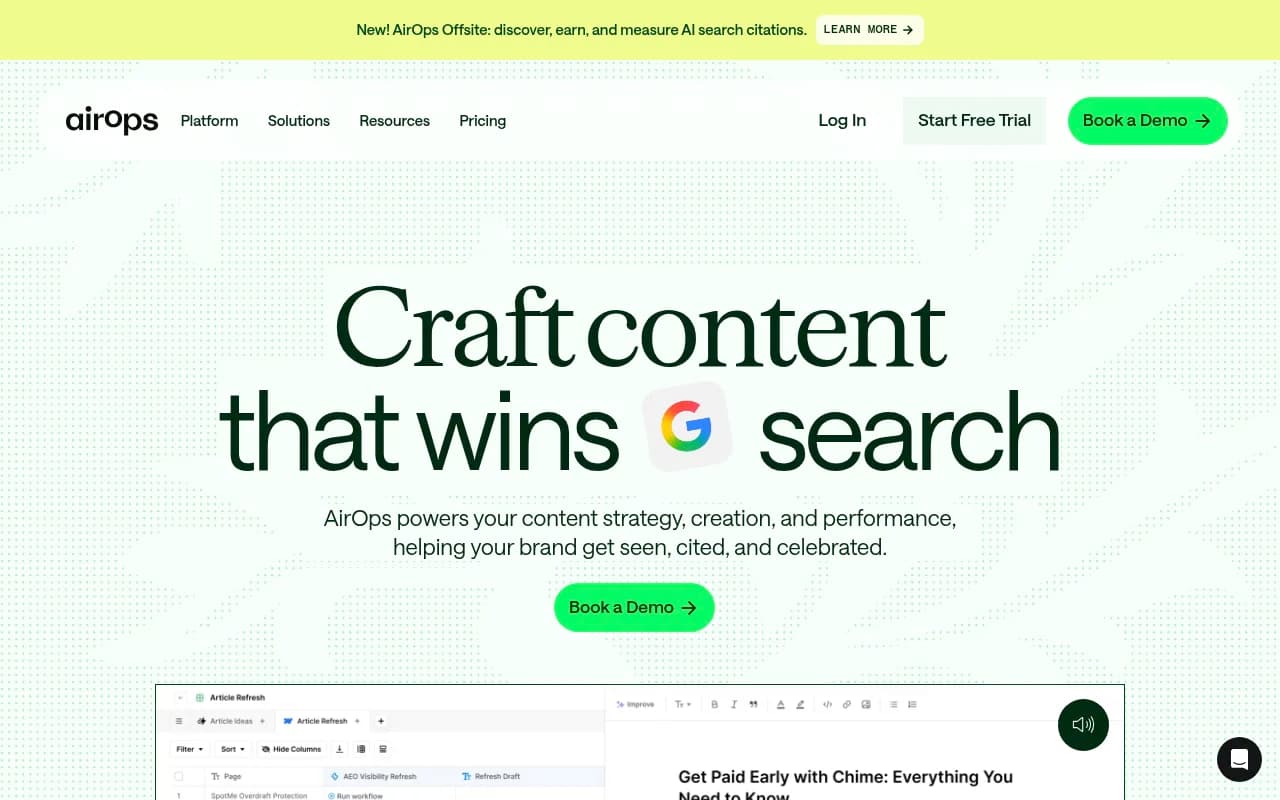
| AirOps | Content engineering | Workflow-driven content production | Needs grounding data from elsewhere |
| Writesonic | Content-first | Writing plus some visibility features | Tracking depth is limited |
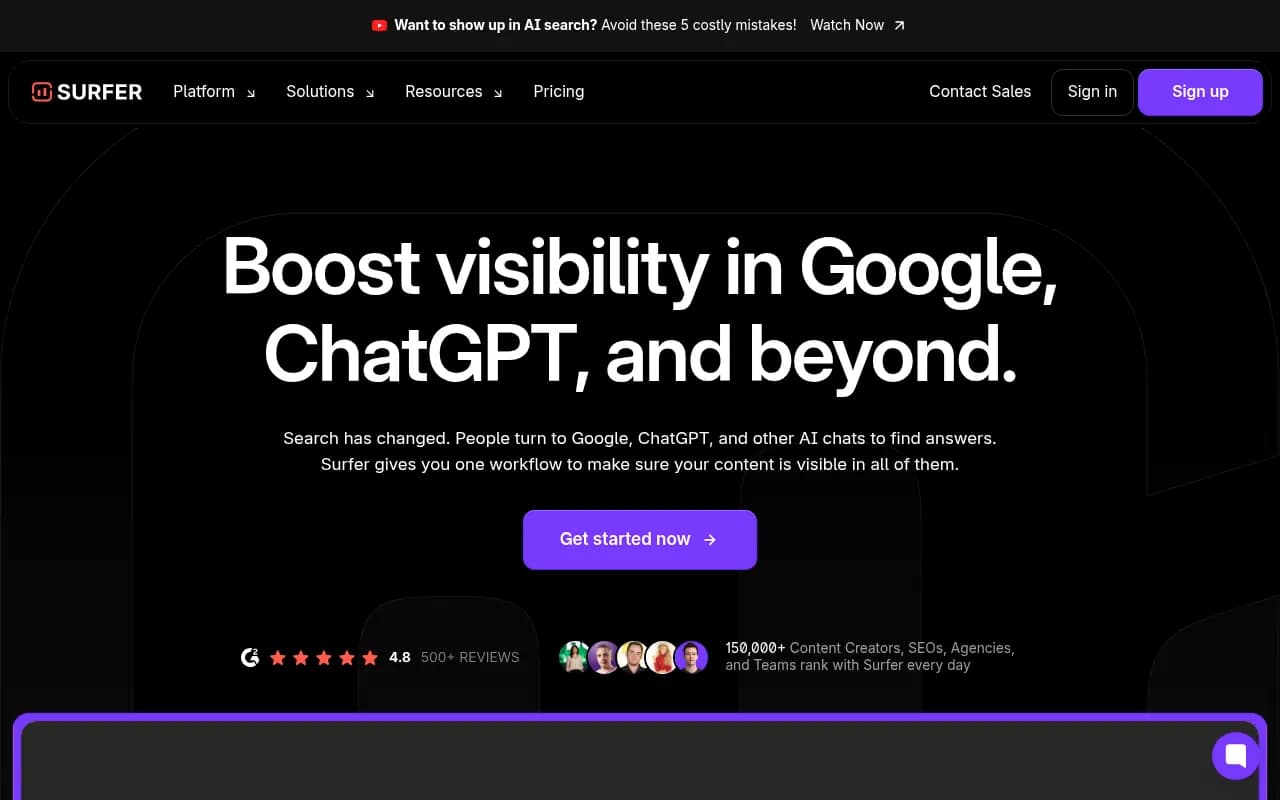
| Surfer SEO | Content optimization | Established on-page scoring | Built for Google-era optimization first |
Promptwatch
Promptwatch is the one on this list I'd put in the agentic camp, and it is also what 1001 SEO Media uses for AI visibility work. It pairs real-UI prompt tracking (with volumes, difficulty, and query fan-outs) with IP-verified crawler logs, citation analytics across Reddit, YouTube, and LinkedIn, and visitor analytics. On top sits the action layer: an Action Board of prioritized GEO tasks, plus a Content Agent that plans, writes, and publishes to WordPress, Webflow, or Framer, then tracks whether each page gets crawled, cited, and clicked. Plans start with a free Explore tier, and paid pricing starts at $95/month for Essential. Confirm current numbers at promptwatch.com/pricing, since third-party posts list older figures.

Omnia's criticism, that the content layer generates articles without diagnosing prompt-level losses, is worth testing yourself. The way to test it is the checklist below: ask any vendor to show the path from a lost prompt to a shipped fix.
Profound
Profound is the enterprise name most buyers compare against. Its real-user prompt volume data and Amazon Rufus module are things most rivals do not match. The cost is entry-plan limits: per Tim Soulo's roundup, the Starter plan covers ChatGPT only and broader engine coverage costs more. It is a strong monitoring product. It is not an execution product.
Profound

Otterly.AI
Otterly is the budget tracker. Rework calls it the cheapest real ongoing monitoring plan, with unlimited team members on every tier, but the entry plan has only 15 prompts. If you want to learn whether AI visibility matters for your business before committing, it is a reasonable place to start.
Otterly.AI

Peec AI
Peec is a tidy prompt tracker aimed at marketing teams. It does what a tracker does. Do not expect crawler logs, visitor analytics, or content generation.

AthenaHQ
AthenaHQ is a credit-based mid-market platform with unlimited seats and role-based access. The caveat from Rework applies: monitor your credits, or you can run dry mid-month.

Scrunch AI
Scrunch has a strong monitoring feature set and a higher price point. Execution, meaning the writing and publishing, is mostly left to you.
Ahrefs Brand Radar
This one has a genuinely different data story. Its prompts come from real People Also Ask questions with measurable search volume, rather than invented prompts. That is a real quality advantage if you worry about tracking questions nobody asks. If you already pay for Ahrefs, it is an easy add.
Semrush AI Toolkit
The convenience pick for teams already living in Semrush. You get AI tracking inside a familiar suite, though the AI-specific depth trails dedicated platforms.
Nightwatch
Nightwatch combines classic rank tracking with AI visibility, with unlimited seats and white-label reports even on the entry plan. AI credits are capped per tier. Good for agencies that want one reporting workflow.
AirOps
AirOps is a content engineering platform. It can build serious content workflows, but you still need an upstream source of truth about which prompts and pages matter.
Writesonic
Writesonic leans on content generation with visibility features attached. Useful if writing volume is your bottleneck, less so if diagnosis is.

Surfer SEO
Surfer scores and optimizes drafts against what ranks. It is a mature content optimization tool, and it pairs well with a tracker, but alone it does not tell you how AI engines treat your brand.
Why the content layer needs data under it
Content generated without AI-specific data tends to miss how these engines actually pick sources. A few things the data shows:
- Product pages are the most cited content type in ChatGPT, at 22.4% of citations from Sep 28 to Oct 4, 2026, followed by landing pages and listicles. A generator that only writes blog posts misses that.
- Landing pages and docs stay cited longest, while news loses half its pages within 36 days, based on pages cited on July 6, 2026. That changes what you refresh and when.
- Almost half of ChatGPT responses cite 10 or more unique domains, so there is room for more than one winner per prompt.
- Fan-outs matter too. ChatGPT began using the site: operator at scale on August 8, 2026, jumping from about 0.4% to about 17% of fanout queries. A tool that shows query fan-outs lets you see this kind of shift. A plain prompt tracker does not.
- Engines differ in stability. Per Promptwatch's average sources per response data, ChatGPT cites about 5 sources per web-search answer, while Google AI Overviews and Perplexity sit near 10. Copilot swung widely, so judge it on monthly trends.
None of this requires a particular vendor. It requires a tool that has this data and uses it when writing.
A 15-minute vendor test
Omnia's guide frames a 15-minute trial. Here is my version, which works for any tool in this list.
- Pick one prompt you lose. Ask the tool why. A good answer names the pages and domains the engine cited and flags any crawl or access problem on your side.
- Ask where the data comes from. Real user interfaces and APIs can return different answers, so find out which the tool uses and in which countries.
- Look for crawler logs. If there are none, you cannot separate "not cited" from "not crawled."
- Follow one action to completion. Can the tool draft the fix, push it to your CMS, and later show whether the page was crawled and cited?
- Check refresh cadence. Omnia makes a fair point that weekly refreshes make it hard to validate a change until the next cycle, so ask how often data updates on your plan.
- Find the traffic. Can it show visits and conversions from AI platforms, not just mentions?
- Read the pricing page, not a blog. Prompt caps, response limits, and credits change often.
How to choose
If you are exploring whether AI visibility is worth the effort, start with a free or low-cost tracker. Do not over-buy.
If you already know it matters and your team has limited time, pick the platform that ships work. Tracking without execution just produces a longer to-do list that nobody owns.
If you live inside Ahrefs or Semrush, try their add-ons first and note where they stop. Often that stopping point is crawler data and execution.
If you run an agency, check white-label reporting, seat counts, and per-client pricing before anything else.
For wider lists, the GEO software directory at bestgeosoftware.com covers more tools by category.
Bottom line
Prompt trackers tell you where you stand. The useful question is who does the work after that. Run the 15-minute test on your top two candidates, and let the one that gets from a lost prompt to a shipped, measured fix win.