Key takeaways
- All four tools (Peec AI, Promptwatch, LLM Pulse, Omnia) offer AI search visibility tracking under $300/month, but they differ significantly in what they do with that data
- LLM Pulse is the cheapest entry point at €49/month and includes brand sentiment tracking; Peec AI starts at €85/month with strong multilingual coverage
- Promptwatch is the only platform in this group that closes the full loop: it finds visibility gaps, generates content to fix them, and tracks the results
- Omnia sits in the mid-market tier with solid analytics but lacks content generation and some model coverage
- If you're a small team just starting out, LLM Pulse or Peec AI get you tracking quickly; if you want to actually improve your AI visibility (not just measure it), Promptwatch is the clear step up
The AI search visibility space has gotten crowded fast. Eighteen months ago, most marketing teams had never heard of GEO. Now there are dozens of tools claiming to track your brand across ChatGPT, Perplexity, Claude, and the rest. The harder question isn't "should I track this?" -- it's "which tool is worth paying for?"
This guide focuses specifically on the under-$300/month tier. That's where most small-to-mid-sized teams are shopping, and it's where the differences between platforms matter most. We're looking at four tools that come up repeatedly in this price range: Peec AI, Promptwatch, LLM Pulse, and Omnia.
Let me be upfront: these tools are not equivalent. They share a category but serve different needs. Some are pure monitoring dashboards. One goes further and actually helps you fix what it finds.
What these tools are actually doing
Before comparing features, it's worth being clear about what "AI search visibility tracking" means in practice. When you search for something on ChatGPT or Perplexity, the AI generates a response and sometimes cites sources or recommends brands. These tools monitor those responses -- they run your target prompts against AI models and record whether your brand appears, how often, in what context, and alongside which competitors.
The basic loop is: set up prompts, run them on a schedule, see your brand's presence score over time.
Where tools diverge is what happens after that. Some stop at the dashboard. Others help you understand why you're not appearing and what to do about it.
LLM Pulse
LLM Pulse is the most affordable option in this group. At €49/month for 50 prompts, it covers five AI models by default -- which is genuinely good value at that price point. The platform includes brand sentiment tracking (not just mention counts), a 14-day free trial, and Looker Studio integration for custom reporting.
Promptwatch and LLM Pulse are often compared because both offer daily refresh and multi-model coverage at accessible price points. The key difference is that LLM Pulse is a monitoring tool -- it tells you what's happening but doesn't have built-in tools to help you change it.
For teams that just need a clean dashboard to report AI visibility to stakeholders, LLM Pulse is a solid, low-friction choice. The Looker Studio integration is a nice touch for teams already living in Google's reporting ecosystem.
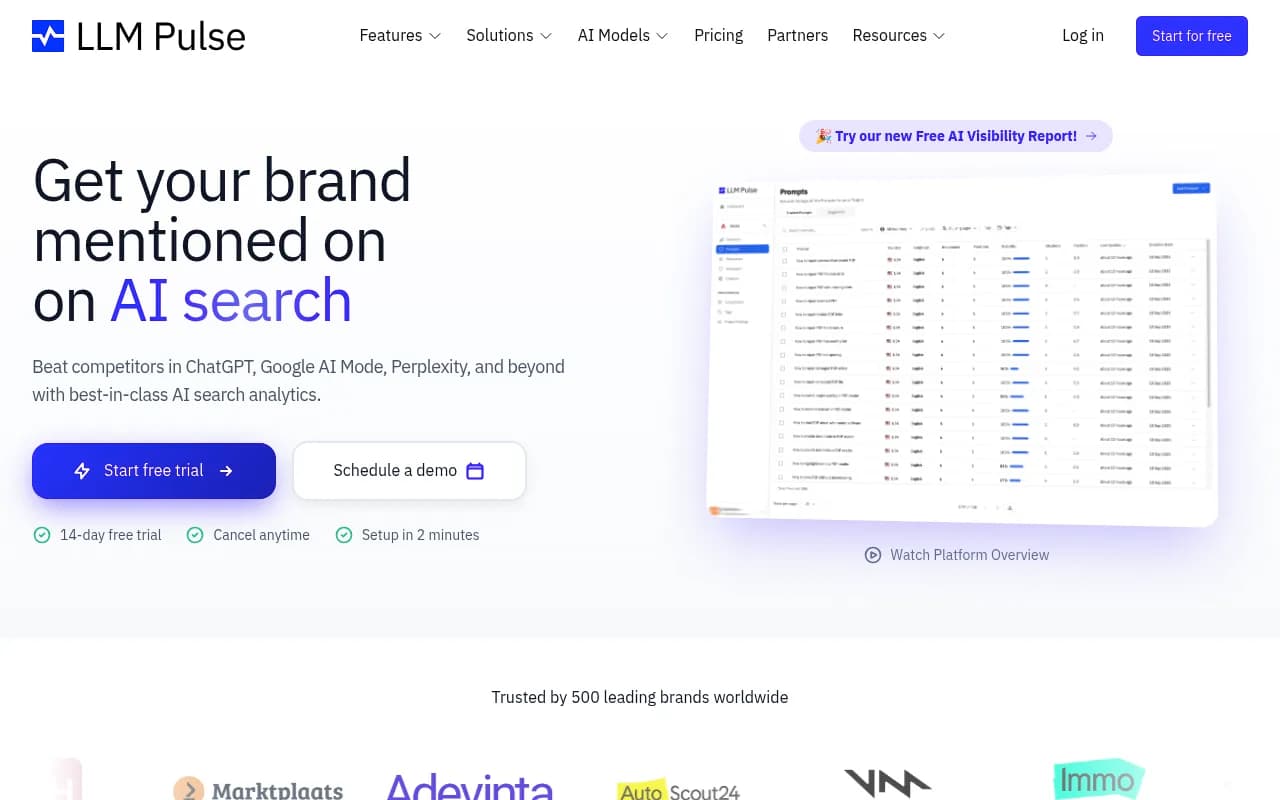
Where it gets limiting: if you want to track more than 5 models, you're looking at an enterprise plan. And there's no content generation, no crawler logs, no gap analysis. You get the data; the rest is up to you.
Peec AI
Peec AI positions itself as a mid-market platform with a strong emphasis on multilingual and multi-region tracking. Starting at €85/month, it covers 3 base AI models with add-ons available, and supports 115+ languages with daily data refresh.
That language coverage is genuinely impressive and sets Peec AI apart from most tools in this price range. If you're a global brand tracking AI visibility in French, German, Japanese, or Portuguese markets, Peec AI is one of the few affordable options that can handle it.

The interface is clean and reporting is straightforward, which matters when you're onboarding a team that's new to AI visibility tracking. Peec AI doesn't try to do everything -- it focuses on ranking analytics and does that well.
The gaps are similar to LLM Pulse: no content generation, no crawler monitoring, no gap analysis. You can see your visibility scores trending up or down, but the tool won't tell you what content to create to improve them. That's a meaningful limitation if you're trying to actually move the needle, not just report on it.
Omnia
Omnia targets mid-market teams that want broader model coverage without jumping to enterprise pricing. It covers brand mentions, citations, AI share-of-voice, and data exports -- the analytics layer is solid and integrates well into BI workflows.
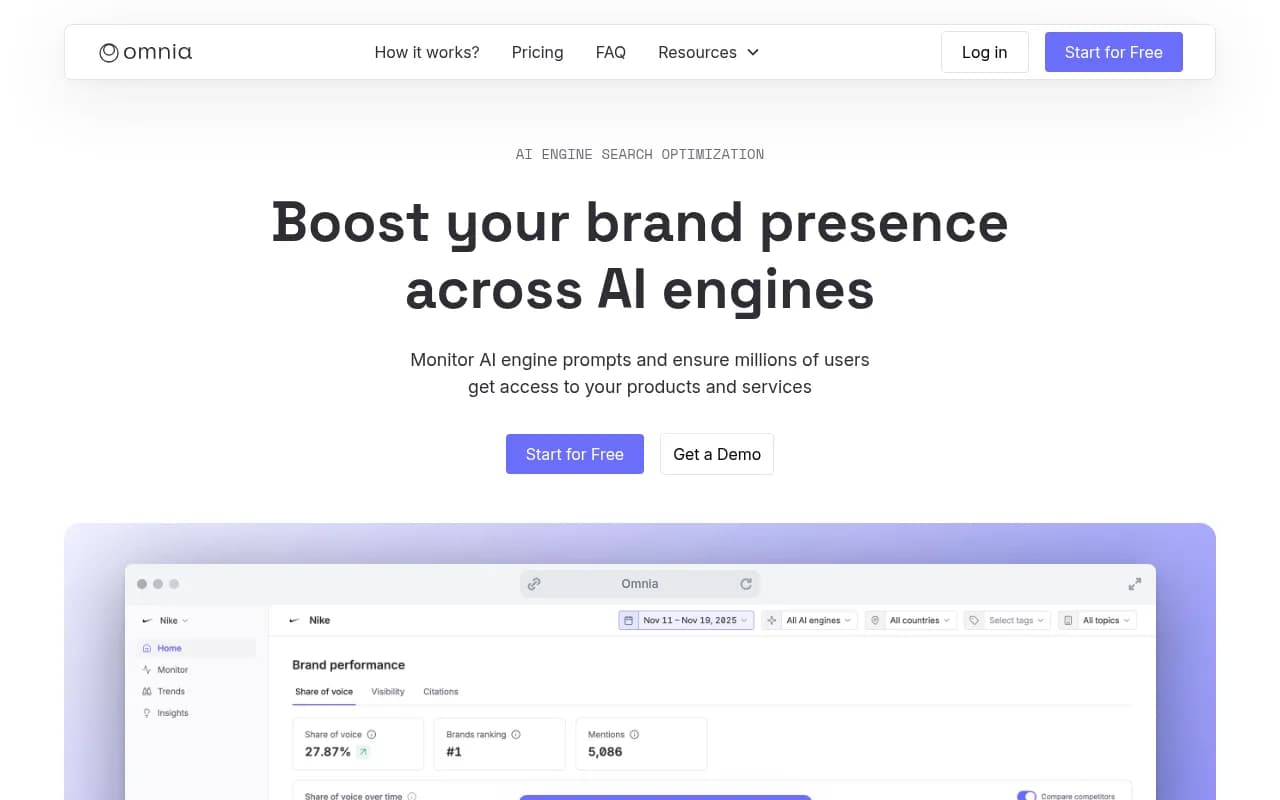
The comparison to LLM Pulse is interesting here. Omnia scores slightly higher on model coverage, but it doesn't explicitly support Google AI Mode or Gemini (which LLM Pulse does). It's also positioned as slightly more expensive than LLM Pulse's entry tier, though exact pricing requires contacting them.
What Omnia doesn't have: prompt discovery, content recommendations, or any tools for converting visibility data into action. It's a monitoring and analytics platform, and a good one -- but it's firmly in the "measure, don't fix" category.
For teams that need clean data exports and want to plug AI visibility metrics into existing dashboards, Omnia is worth evaluating. For teams that want to improve their visibility scores, it's only half the solution.
Promptwatch
Promptwatch is different from the other three tools in a way that matters. It's not just a monitoring dashboard -- it's built around an action loop: find the gaps, create content to fill them, track the results.
Promptwatch starts at $99/month (Essential plan: 1 site, 50 prompts, 5 articles), which puts it in the same budget tier as the others. The Professional plan at $249/month adds crawler logs, state/city tracking, 150 prompts, and 15 articles per month.

What makes Promptwatch different in practice:
Answer Gap Analysis shows you exactly which prompts competitors are visible for that you're not. You don't just see that your brand has a 23% visibility score -- you see the specific questions and topics where you're invisible, and why.
Built-in content generation uses citation data from 880M+ analyzed citations to generate articles, listicles, and comparisons engineered to get cited by AI models. This isn't generic blog content -- it's written based on what AI models actually reference.
AI Crawler Logs (Professional and above) show you which pages ChatGPT, Claude, and Perplexity are actually crawling on your site, how often, and what errors they encounter. Most competitors in this price range don't have this at all.
Traffic attribution closes the loop by connecting AI visibility to actual website traffic and revenue, via a code snippet, GSC integration, or server log analysis.
The platform monitors 10 AI models including ChatGPT, Perplexity, Claude, Gemini, Google AI Overviews, DeepSeek, Grok, Meta AI, Mistral, and Copilot. It also tracks Reddit and YouTube discussions that influence AI recommendations -- a channel most tools ignore entirely.
For teams that are serious about improving their AI search presence (not just measuring it), Promptwatch is the only tool in this price range that gives you the full picture and the tools to act on it.
Side-by-side comparison
| Feature | LLM Pulse | Peec AI | Omnia | Promptwatch |
|---|---|---|---|---|
| Starting price | €49/mo | €85/mo | Mid-market (contact) | $99/mo |
| AI models covered | 5 (10+ Enterprise) | 3 base + add-ons | Mid-market tier | 10 models |
| Daily refresh | Yes | Yes | Yes | Yes |
| Multi-language | Limited | 115+ languages | Limited | Multi-region |
| Brand sentiment | Yes | No | No | Yes |
| Answer gap analysis | No | No | No | Yes |
| Content generation | No | No | No | Yes (AI writing agent) |
| AI crawler logs | No | No | No | Yes (Professional+) |
| Traffic attribution | No | No | No | Yes |
| Reddit/YouTube tracking | No | No | No | Yes |
| ChatGPT Shopping | No | No | No | Yes |
| Looker Studio / API | Yes | No | Data exports | Yes |
| Free trial | 14-day | Yes | Yes | Yes |
| Best for | Budget monitoring | Global/multilingual brands | Mid-market analytics | Teams that want to improve visibility |
Which tool should you actually use?
The honest answer depends on what you're trying to accomplish.
Use LLM Pulse if you're just starting out, have a tight budget, and need a clean dashboard to track brand mentions across AI models. The €49/month entry point is hard to beat, and the Looker Studio integration is useful if you're already reporting in Google's ecosystem. The brand sentiment tracking is a genuine differentiator at this price.
Use Peec AI if you're running campaigns in multiple languages or regions and need AI visibility data in markets beyond English. The 115+ language support is rare at this price point, and the interface is clean enough for teams new to this category.
Use Omnia if you're a mid-market team that wants solid analytics and data exports, and you're comfortable doing your own analysis and content strategy separately. It's a good fit if you already have a content team and just need the visibility data to inform their work.
Use Promptwatch if you want to actually move the needle on AI visibility, not just report on it. The gap analysis tells you what content to create; the AI writing agent creates it; the tracker shows you whether it worked. That full loop doesn't exist in the other three tools. At $249/month for the Professional plan, you're getting crawler logs, 150 prompts, 15 articles per month, and traffic attribution -- which is a lot of capability for the price.
A note on what "budget" means here
There's a real risk in optimizing purely for the cheapest option. If you spend €49/month on LLM Pulse and get a dashboard showing your brand appears in 18% of relevant AI responses, that's useful data. But if you don't have the tools or time to figure out why that number is 18% instead of 40%, you're paying for information you can't act on.
The more useful question isn't "what's the cheapest tool?" but "what's the cheapest tool that actually helps me improve?" For most teams, that answer is Promptwatch -- because the gap analysis and content generation mean you're not just watching a number, you're working to change it.
That said, all four tools are legitimate options depending on your situation. If you're a solo marketer at a small company just trying to understand whether AI search is worth investing in, LLM Pulse or Peec AI are reasonable starting points. You can always upgrade later once you've validated that AI visibility matters for your specific business.
The category is still young. Most of these tools are less than two years old. The platforms that will win long-term are the ones that help teams take action, not just the ones with the prettiest dashboards.