Key takeaways
- Peec AI and Searchable are primarily monitoring tools — they show you visibility data but offer limited help with actually fixing gaps
- AirOps is a content execution platform that can publish directly to your CMS, but it's not a dedicated AI visibility tracker
- Promptwatch is the only platform in this comparison that closes the full loop: tracking, gap analysis, content generation, and traffic attribution in one place
- If your goal is to rank in ChatGPT, Perplexity, and Google AI Overviews, the tool you choose needs to do more than report numbers
The AI visibility tool market has gotten crowded fast. In 2024, there were maybe a handful of options. Now there are dozens, and most of them look similar from the outside: dashboards, brand mention counts, competitor comparisons. The problem is that most of them stop there.
The question that actually matters isn't "which tool shows me the best data?" It's "which tool helps me do something about it?"
That's the lens for this comparison. Peec AI, Promptwatch, Searchable, and AirOps each take a different approach to the same underlying problem: your brand isn't showing up enough in AI-generated answers, and you need to fix it.
Let's go through each one honestly.
What each tool is actually trying to do
Before comparing features, it helps to understand the category each tool belongs to.
- Peec AI is an AI visibility monitoring and reporting platform. It tracks brand mentions across ChatGPT, Perplexity, Claude, and others, with clean dashboards designed for agencies and small teams.
- Promptwatch is an end-to-end AI search visibility and optimization platform. It tracks visibility, identifies content gaps, generates content engineered to get cited, and attributes traffic back to revenue.
- Searchable is an AI search visibility platform with built-in content generation features. It sits somewhere between a tracker and a content tool.
- AirOps is a content engineering and workflow automation platform. It's less about monitoring AI visibility and more about executing content operations at scale, including publishing directly to your CMS.
These are genuinely different tools. Comparing them head-to-head on a feature checklist misses the point. The right question is: what problem are you trying to solve, and which tool is built around solving it?
Peec AI: clean monitoring, limited action
Peec AI has a genuinely nice product for what it does. The dashboards are clean, the data is easy to read, and it's priced accessibly at around $89/month. For agencies that need to show clients "here's how your brand appears in AI answers," it works well.

Where it runs into trouble is the moment you ask: "OK, I can see I'm invisible for these prompts. What do I do now?"
Peec AI doesn't have a good answer to that. There's no content gap analysis that shows you specifically what topics your site is missing. There's no built-in content generation. There's no audit tool that identifies why AI models aren't citing you.
One review from generatemore.ai puts it plainly: "Peec AI does not provide a playbook or AI-search visibility auditing tool that shows all issues with your site and how to fix them — you get data, but the next step is up to you."
That's fine if you have an experienced SEO or GEO team who can interpret the data and build a content strategy from scratch. It's less fine if you're a marketing team that needs to move fast and doesn't have that expertise in-house.
Peec AI also lacks AI crawler logs, which means you can't see how ChatGPT or Perplexity's crawlers are actually interacting with your site. That's a significant blind spot when you're trying to understand why your content isn't getting cited.
Best for: Agencies and small teams that need clean reporting and competitive benchmarking, and have their own content production process.
Searchable: visibility plus content, but with caveats
Searchable positions itself as an AI search visibility platform with built-in content generation, which puts it closer to the "action" end of the spectrum than Peec AI.
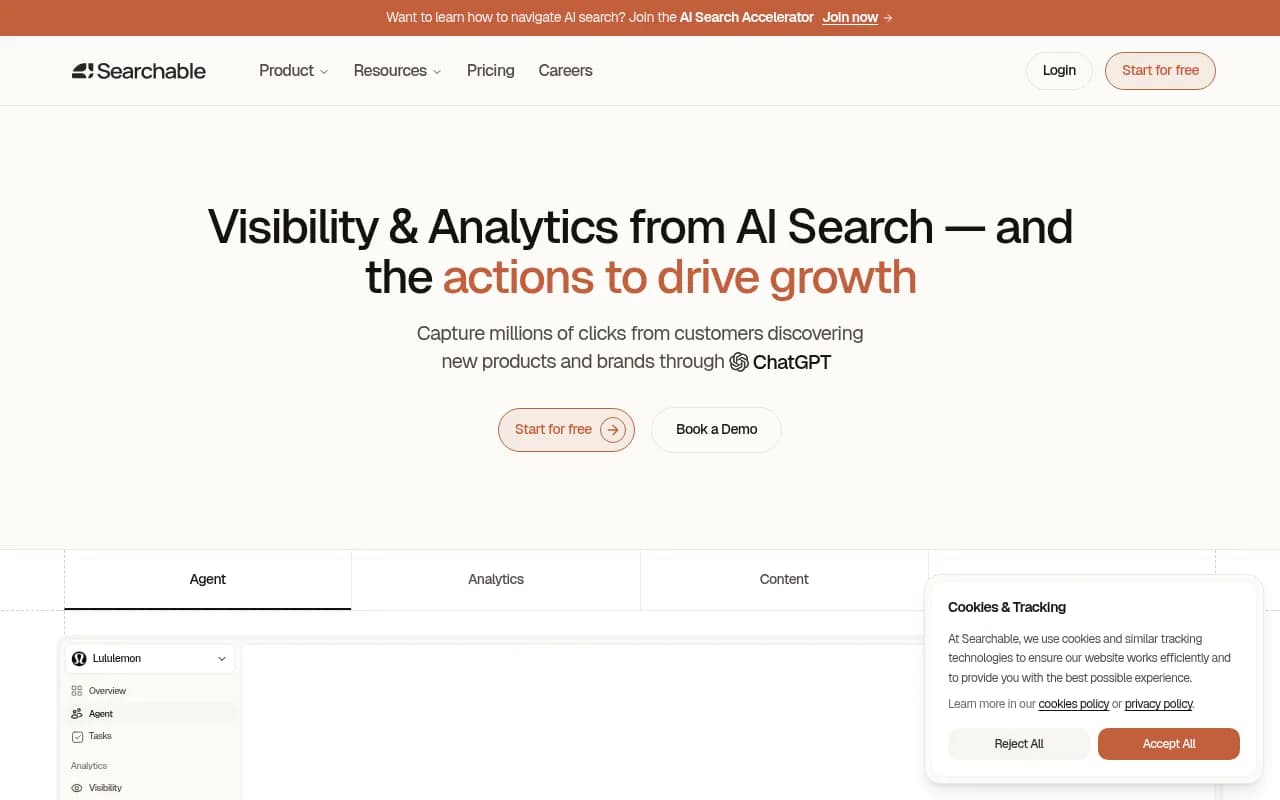
The content generation feature is real, but the depth of the underlying data matters a lot here. Content generation is only as good as the prompt intelligence and citation analysis feeding it. If the tool doesn't know which prompts have high volume, which competitors are winning for them, and what specific content gaps exist on your site, the generated content is essentially educated guesswork.
Searchable's monitoring covers the major AI engines, and the content tools are a genuine differentiator compared to pure trackers. But it's a smaller platform with a narrower data set than Promptwatch, and it lacks some of the more advanced features like AI crawler logs, Reddit and YouTube citation tracking, and traffic attribution.
For teams that want a simpler, more affordable tool that does both monitoring and some content generation, Searchable is worth evaluating. Just go in with realistic expectations about the depth of the optimization layer.
Best for: Smaller teams that want monitoring and basic content generation without the complexity of a full-featured platform.
AirOps: content execution, not visibility tracking
AirOps is a different beast. It's not really an AI visibility tracker in the traditional sense. It's a content operations platform that helps teams prioritize pages, run bulk content refreshes, and publish directly to their CMS.
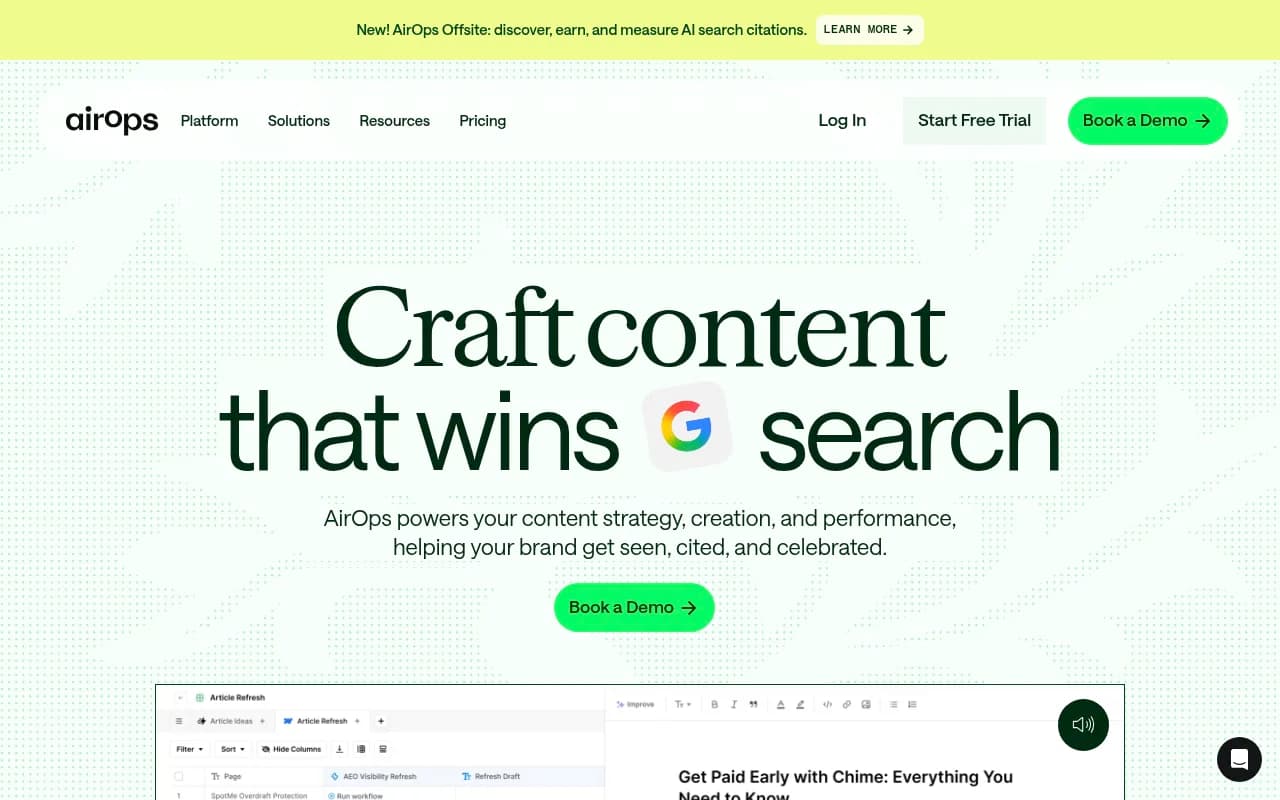
The AirOps vs Peec.ai comparison that AirOps published themselves captures the distinction well: "AirOps turns AI search visibility into executed updates by prioritizing pages, running bulk refreshes, and publishing directly to the CMS. Peec.ai concentrates on AI visibility monitoring, with dashboards designed for competitive analysis and stakeholder reporting."
That's an honest framing. AirOps is for teams with large content estates that need to refresh and optimize content at scale. It integrates with your CMS and can handle the operational side of content production efficiently.
The gap is on the visibility and intelligence side. AirOps doesn't have the same depth of AI search monitoring as dedicated platforms. It doesn't show you which specific prompts your competitors are winning, which AI models are citing you, or how your visibility scores change over time. You'd need to pair it with a monitoring tool to get the full picture.
For enterprise content teams managing hundreds or thousands of pages, AirOps is genuinely powerful. For a brand trying to understand and improve its AI search visibility from scratch, it's not the right starting point.
Best for: Content operations teams at larger companies managing high-volume content estates who already have visibility data from another source.
Promptwatch: the full loop
Promptwatch is the only tool in this comparison that's built around the complete cycle: find gaps, create content, track results.

The core differentiator is what Promptwatch calls the Action Loop. Most tools stop at step one (showing you where you're invisible). Promptwatch is built around steps two and three as well.
The Answer Gap Analysis shows you exactly which prompts your competitors are visible for that you're not. Not just "you're missing some content" — it shows you the specific topics, questions, and angles that AI models want answers to but can't find on your site.
The built-in AI writing agent then generates articles, listicles, and comparisons grounded in real citation data. Promptwatch has analyzed over 880 million citations, which means the content it generates isn't generic SEO filler — it's built around what AI models actually cite. That's a meaningful difference.
Then the tracking layer closes the loop. Page-level tracking shows which pages are being cited, how often, and by which models. Traffic attribution (via code snippet, Google Search Console integration, or server log analysis) connects AI visibility to actual revenue.
Beyond the core loop, Promptwatch also has AI crawler logs that show you in real time how ChatGPT, Claude, Perplexity, and other AI crawlers are interacting with your site. This is something most competitors lack entirely. If AI crawlers are hitting error pages or skipping your most important content, you'll see it.
Other features worth noting: Reddit and YouTube citation tracking (most competitors ignore these entirely), ChatGPT Shopping tracking, prompt volume and difficulty scoring, competitor heatmaps, and multi-language/multi-region monitoring.
Pricing runs from $99/month (Essential) to $579/month (Business), with agency and enterprise pricing available. There's a free trial.
Best for: Marketing teams, SEO teams, and agencies that want to understand their AI visibility and actually improve it, not just report on it.
Side-by-side comparison
| Feature | Peec AI | Searchable | AirOps | Promptwatch |
|---|---|---|---|---|
| AI visibility monitoring | Yes | Yes | Limited | Yes |
| Competitor tracking | Yes | Yes | No | Yes |
| Content gap analysis | No | Basic | No | Yes (Answer Gap Analysis) |
| Built-in content generation | No | Yes | Yes (CMS-integrated) | Yes (citation-grounded) |
| AI crawler logs | No | No | No | Yes |
| Reddit/YouTube tracking | No | No | No | Yes |
| Traffic attribution | No | No | No | Yes |
| ChatGPT Shopping tracking | No | No | No | Yes |
| Prompt volume/difficulty | No | No | No | Yes |
| CMS publishing | No | No | Yes | No |
| Starting price | ~$89/mo | Varies | Custom | $99/mo |
| Best for | Agencies, reporting | Small teams | Content ops | Full-cycle optimization |
The real question: what happens after you see the data?
Every tool in this comparison will show you that your brand is invisible for certain prompts. The difference is what happens next.
With Peec AI, you see the gap and figure out the fix yourself. With AirOps, you can execute content at scale but you need to bring your own visibility intelligence. With Searchable, you get some content generation but with a thinner data layer underneath.
With Promptwatch, the gap analysis tells you specifically what to create, the writing agent creates it using real citation data, and the tracking layer shows you whether it worked. That's a fundamentally different value proposition.

For teams that are serious about AI search visibility as a growth channel, the monitoring-only approach is increasingly hard to justify. 37% of people now start searches with AI tools according to Search Engine Land, and that number keeps climbing. Being invisible in AI answers isn't a minor SEO issue — it's a distribution problem.
The tools that help you fix it, not just measure it, are the ones worth investing in.
Which tool should you choose?
Here's a practical decision framework:
- If you need clean reporting for clients and have your own content team: Peec AI works fine at a lower price point.
- If you're managing a large content estate and need CMS-integrated publishing workflows: AirOps is worth evaluating, ideally paired with a monitoring tool.
- If you want monitoring plus basic content generation and don't need deep analytics: Searchable is a reasonable middle ground.
- If you want to actually move the needle on AI visibility, with gap analysis, citation-grounded content generation, crawler logs, and traffic attribution: Promptwatch is the most complete option available.
The market is moving fast. Tools that only monitor will have a harder time justifying their price as brands realize that data without action doesn't change their visibility scores. The platforms built around the full optimization loop are where this category is heading.