Key takeaways
- All four tools track brand mentions across AI search engines, but they differ significantly in how many models they cover, what you can do with the data, and how much they cost.
- Nightwatch is the only tool here that combines traditional SEO rank tracking with AI visibility, making it a practical choice if you're managing both channels on a tight budget.
- Peec.ai offers the most flexible model selection at its price point, but like most tools in this category, it stops at monitoring -- it won't help you create content or close the visibility gap.
- Rankshift and Gauge are simpler, more focused tools that suit teams just getting started with AI search tracking.
- If you want to move beyond monitoring into actually improving your AI visibility, you'll need a platform that includes content gap analysis and optimization -- tools like Promptwatch are built for that full loop.
The AI visibility tool market has exploded. There are now dozens of platforms claiming to track how your brand appears in ChatGPT, Perplexity, Gemini, and other AI search engines. Most of them do roughly the same thing: run prompts, count mentions, show you a dashboard.
But for a growing marketing team -- say, 3 to 15 people managing SEO, content, and demand gen -- the question isn't just "which tool tracks the most models?" It's "which tool gives us something we can actually act on, at a price that doesn't require CFO approval?"
This guide focuses on four tools that sit in the mid-tier of the market: Peec.ai, Rankshift, Nightwatch, and Gauge. None of them are enterprise platforms with five-figure annual contracts. None of them are bare-bones free tools either. They're the kind of tools a real marketing team might actually buy.
Here's how they stack up.
What these tools actually do (and don't do)
Before comparing features, it's worth being clear about what "AI visibility tracking" means in practice.
These tools send predefined prompts to AI models -- things like "What's the best project management software for remote teams?" -- and record whether your brand appears in the response, where it appears, what's said about it, and which sources are cited. They repeat this at regular intervals and turn the results into metrics: mention rate, share of voice, sentiment, citation frequency.
What most of them don't do is tell you why you're not appearing, or help you fix it. That's the gap that separates monitoring tools from optimization platforms. Keep that in mind as we go through each one.
Peec.ai
Peec AI is one of the earlier purpose-built AI visibility trackers. It launched before most of its competitors and has built a reasonably mature feature set around brand monitoring across LLMs.

What it covers
Peec.ai tracks up to 10 AI models depending on your plan, which is competitive for this price range. The core models covered include ChatGPT, Perplexity, Google AI Overviews, Gemini, and Claude. The platform uses UI scraping to simulate real user queries rather than hitting model APIs directly, which means the results reflect what a real user would see.
The dashboard shows mention rate, share of voice against competitors, citation URLs, and sentiment. You can set up custom prompts relevant to your category and track how your visibility changes over time.
Pricing
Peec.ai starts at around €85-89/month depending on the source. That gets you a meaningful set of prompts and model coverage. Higher tiers unlock more prompts, more competitors, and more frequent refresh rates.
Where it falls short
Peec.ai is a monitoring tool. It's good at showing you the data -- where you appear, how often, compared to whom. But it doesn't generate content, identify which specific topics are causing you to lose visibility, or suggest what to publish next. You get the diagnosis without the treatment.
For a team that already has strong content operations and just needs visibility data to inform strategy, that's fine. For a team that wants to close the gap, you'll need to pair it with something else.
Rankshift
Rankshift is a newer entrant focused specifically on AI search visibility tracking. It's positioned as a clean, straightforward tool for tracking brand mentions across ChatGPT, Perplexity, and other AI search engines.

What it covers
Rankshift tracks brand visibility across the major AI search engines and provides share-of-voice metrics and competitor benchmarking. The interface is designed to be simple -- you set up your brand, add your competitors, define your prompts, and start tracking.
It's a good fit for teams that want to get up and running quickly without a steep learning curve. The reporting is clean and shareable, which matters if you're presenting AI visibility data to stakeholders who aren't deep in the weeds of GEO.
Pricing
Rankshift sits in the accessible mid-tier range. It's worth checking their current pricing directly, as the tool has been iterating quickly in 2026.
Where it falls short
Rankshift is lean by design, which is both its strength and its limitation. It doesn't have the depth of prompt customization or model coverage that Peec.ai offers. If you're tracking a complex competitive landscape across many categories, you may find the prompt limits constraining.
Like Peec.ai, it's a monitoring tool. No content generation, no gap analysis, no optimization workflow built in.
Nightwatch
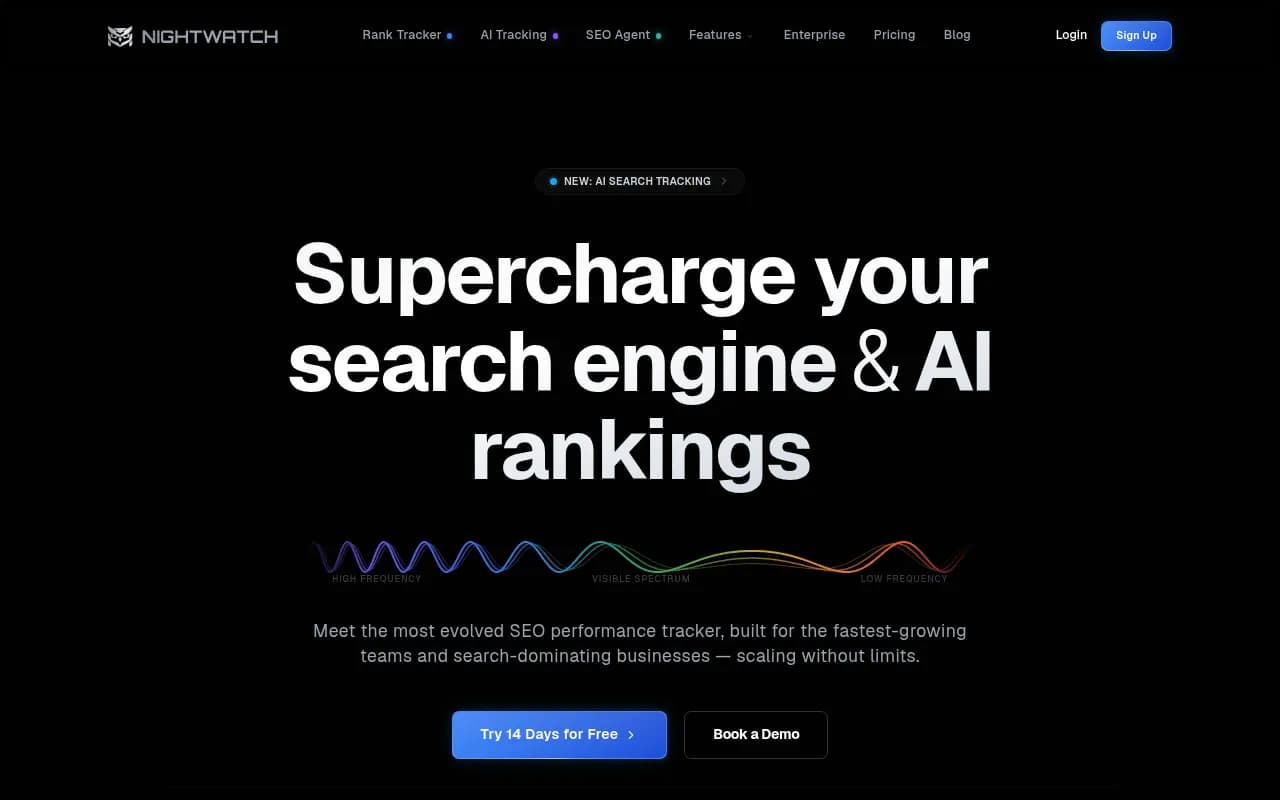
Nightwatch is the most interesting tool in this comparison because it's not primarily an AI visibility tool -- it's a traditional SEO rank tracker that has added AI search monitoring as a feature.
What it covers
Nightwatch tracks traditional Google rankings with high accuracy, including local and geo-level data. The AI visibility add-on (priced at around $99/month on top of the base plan, which starts at $32-39/month) adds tracking across four AI models: ChatGPT, Perplexity, Google AI Overviews, and Gemini.
The value proposition here is consolidation. If you're already paying for a rank tracker and you want to add AI visibility monitoring without spinning up a separate tool and separate login, Nightwatch is a reasonable choice.
Pricing
Base plan starts around $32-39/month. Add the AI monitoring add-on and you're looking at $130+ per month total. That's competitive if you're replacing a separate rank tracker, less so if you already have one.
Where it falls short
Four AI models is on the lower end of coverage for 2026. If you need Claude, DeepSeek, Grok, or Copilot tracking, Nightwatch won't cover you. The AI visibility feature also feels like an add-on rather than a core product -- the depth of prompt customization and competitive analysis is lighter than dedicated AI visibility tools.
That said, for an agency or in-house team that values having one tool for both traditional and AI search, the tradeoff may be worth it.
Gauge
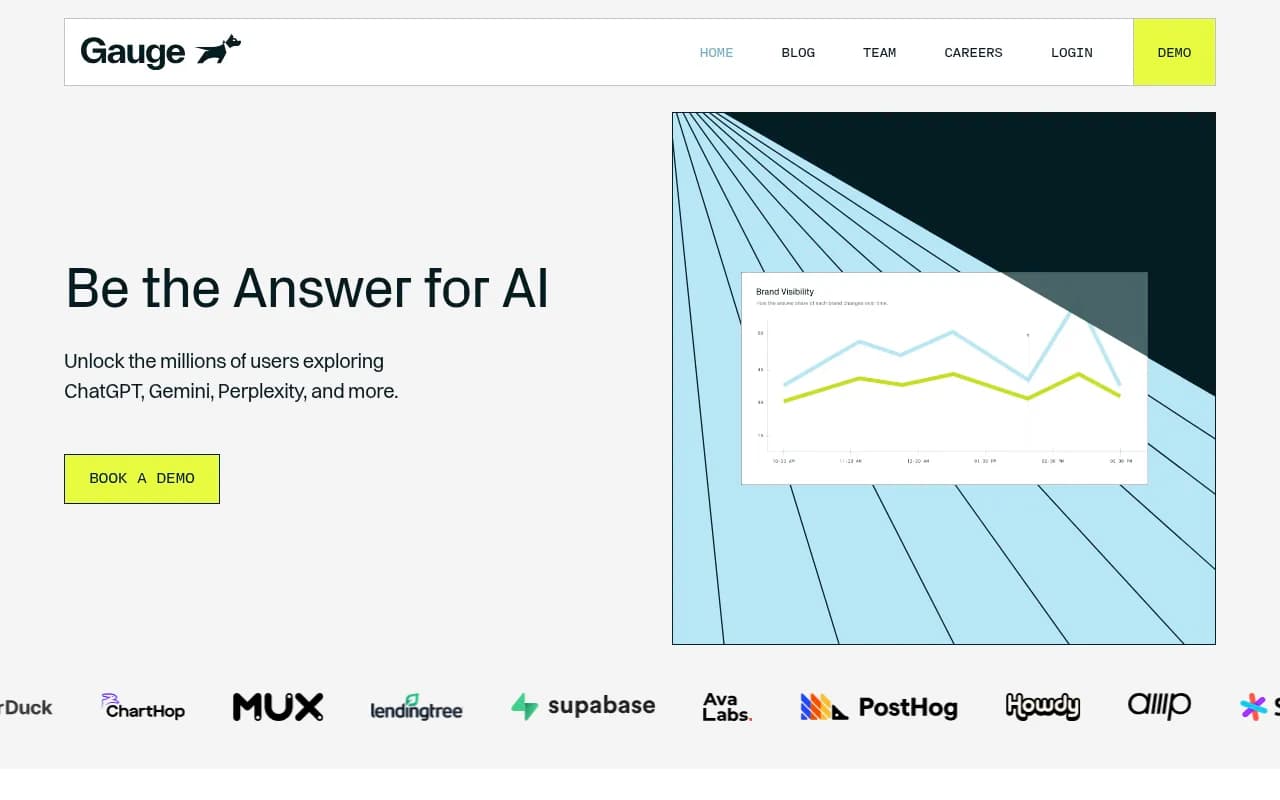
Gauge (withgauge.com) is a focused AI visibility tracking tool that sits at the simpler end of the mid-tier market. It tracks brand mentions across AI engines and helps you understand how you're positioned in AI-generated answers.
What it covers
Gauge covers the major AI search engines and provides brand mention tracking, share of voice, and basic competitive benchmarking. The tool is designed to be approachable -- less configuration overhead than Peec.ai, cleaner than some of the more data-heavy platforms.
It's a reasonable starting point for a marketing team that's new to AI visibility tracking and wants to understand the basics before committing to a more complex platform.
Where it falls short
Gauge is the most limited tool in this comparison in terms of depth. It's a monitoring tool, and a fairly basic one. If you need advanced prompt customization, multi-region tracking, or any kind of content optimization workflow, you'll outgrow it quickly.
Head-to-head comparison
| Feature | Peec.ai | Rankshift | Nightwatch | Gauge |
|---|---|---|---|---|
| AI models tracked | Up to 10 | Major LLMs | 4 (AI add-on) | Major LLMs |
| Traditional SEO tracking | No | No | Yes | No |
| Starting price | ~€85/mo | Mid-tier | ~$32/mo + $99 add-on | Mid-tier |
| Custom prompts | Yes | Yes | Limited | Basic |
| Competitor benchmarking | Yes | Yes | Limited | Basic |
| Multi-region/language | Limited | Limited | Yes (geo tracking) | Limited |
| Content gap analysis | No | No | No | No |
| Content generation | No | No | No | No |
| AI crawler logs | No | No | No | No |
| Best for | Flexible model coverage | Quick setup, clean reporting | SEO + AI in one tool | Getting started |
What's missing from all four
Here's the honest assessment: all four tools are monitoring dashboards. They tell you where you stand. They don't tell you what to do about it, and they definitely don't help you do it.
For a growing marketing team, that gap matters. Knowing that your competitor appears in 60% of AI responses for your category and you appear in 12% is useful information. But without knowing which specific topics are driving that gap, which content you're missing, and what to publish to close it, you're left doing that analysis manually.
This is where the category splits into two types of tools: trackers and optimization platforms. The four tools in this comparison are trackers. They're useful, but they're the beginning of the workflow, not the end.
If you want the full loop -- find gaps, create content, track results -- you need something that goes further. Promptwatch is one of the few platforms that covers all three stages: Answer Gap Analysis shows you exactly which prompts competitors are winning that you're not, a built-in AI writing agent generates content engineered to get cited by AI models, and page-level tracking closes the loop by showing which new content is actually getting picked up.

That's a different category of tool, and a different price point. But for teams that are serious about AI search as a growth channel, the monitoring-only approach has a ceiling.
How to choose between these four
The right choice depends on what you already have and what you actually need.
Choose Peec.ai if you want dedicated AI visibility tracking with flexible model coverage and you're comfortable doing your own content strategy work based on the data. It's the most mature purpose-built tool in this group.
Choose Rankshift if you want to get up and running quickly with clean, shareable reporting and you don't need deep customization. Good for teams presenting AI visibility data to leadership for the first time.
Choose Nightwatch if you're currently paying for a separate rank tracker and want to consolidate. The AI visibility coverage is lighter, but the combined value for SEO teams is real.
Choose Gauge if you're just starting out with AI visibility tracking and want a simple, low-friction way to understand where your brand stands before committing to a more sophisticated platform.
A note on prompt volume and refresh rates
One thing that doesn't get enough attention in these comparisons: how often the tools actually run your prompts, and how many prompts you can track.
AI visibility data is only useful if it's fresh. A weekly snapshot might miss a significant shift in how a model is responding to queries in your category. Most mid-tier tools run prompts daily or every few days, but the specifics vary by plan.
Similarly, the number of prompts you can track matters. If you're in a competitive category with dozens of relevant buyer questions, a plan that limits you to 20 or 30 prompts will force you to make tradeoffs. Check these limits carefully before committing -- they're often where the real pricing differences show up.
The bigger picture
AI search is no longer a novelty. ChatGPT alone now accounts for a meaningful share of global search traffic, and AI-referred visits convert at significantly higher rates than traditional organic traffic. For marketing teams, this isn't a future problem -- it's a current one.
The tools in this comparison are a reasonable starting point. They'll tell you whether you're visible, how visible you are relative to competitors, and which AI models are citing you. That's genuinely useful data.
But the teams that will win in AI search over the next 12 to 24 months won't just be the ones tracking their visibility. They'll be the ones systematically closing the gaps -- publishing content that answers the specific questions AI models are looking for, building the citation signals that make them the authoritative source, and measuring the actual revenue impact of that work.
Monitoring is step one. Make sure you have a plan for steps two and three.
 Overview of the AI visibility tool landscape in 2026, showing the range of platforms from basic monitoring to full optimization workflows.