Key takeaways
- Semrush and Ahrefs Brand Radar are solid starting points if you're already paying for them -- but their AI visibility features are add-ons, not core products, and they show fixed prompts with no way to act on the data.
- SE Ranking's AI visibility module (SE Visible) is a decent mid-tier option for teams on a budget, but it's still monitoring-only with limited model coverage.
- Peec.ai is a cleaner, purpose-built tracker -- good for teams that want simple multi-model monitoring without the complexity of a full SEO suite.
- None of the four tools help you actually fix your AI visibility gaps. They show you where you're invisible; they don't help you become visible.
- If you need to close the loop -- find gaps, create content, track results -- a dedicated optimization platform like Promptwatch is worth looking at.

The question sounds simple: do you need a dedicated GEO tool, or will your existing SEO platform handle AI visibility just fine?
The honest answer is: it depends on what you mean by "handle." If you want a dashboard that shows your brand mention rate in ChatGPT, Semrush and Ahrefs can do that. If you want to understand why you're not being cited and what to do about it, that's a different conversation.
Let me walk through each of these four tools honestly, then tell you when each one actually makes sense.
What we're comparing
These four tools represent two different philosophies:
- Dedicated GEO platforms (Peec.ai): built from the ground up to track AI search visibility, with no legacy SEO baggage
- Traditional SEO suites with AI add-ons (Semrush, Ahrefs, SE Ranking): established platforms that have bolted on AI visibility features as the market shifted
Neither approach is automatically better. But they make very different tradeoffs.
Peec.ai

Peec.ai is the most focused tool in this comparison. It does one thing -- tracks how your brand appears across AI search engines -- and it does it cleanly. The interface is straightforward, setup is fast, and you get data across ChatGPT, Perplexity, Google AI Overviews, and DeepSeek on the base Pro plan (€199/mo).
The genuine differentiator is unlimited countries and languages at no extra cost. If you're a global brand monitoring AI visibility in multiple markets, that matters. Most tools charge per region or restrict language coverage to higher tiers.
Where Peec.ai runs into trouble is depth. The Pro plan caps you at 100 prompts and 9,000 AI answers per month. Claude, Gemini, and Google AI Mode are Enterprise add-ons with custom pricing -- so the "up to 10 models" claim in some comparisons requires a conversation with their sales team. There's no content creation tooling, no site audit capability, no shopping visibility tracking, and no way to understand why you're not appearing in a given response.
It's a monitoring tool. A good one. But monitoring-only.
Best for: Teams that want clean, simple AI visibility data across multiple regions and don't need to act on it within the same platform.
SE Ranking (SE Visible)
SE Ranking is the budget-friendly all-in-one SEO platform that's been quietly building out AI visibility features. Their dedicated AI tracking module is called SE Visible, available as a standalone product starting at $99/mo.
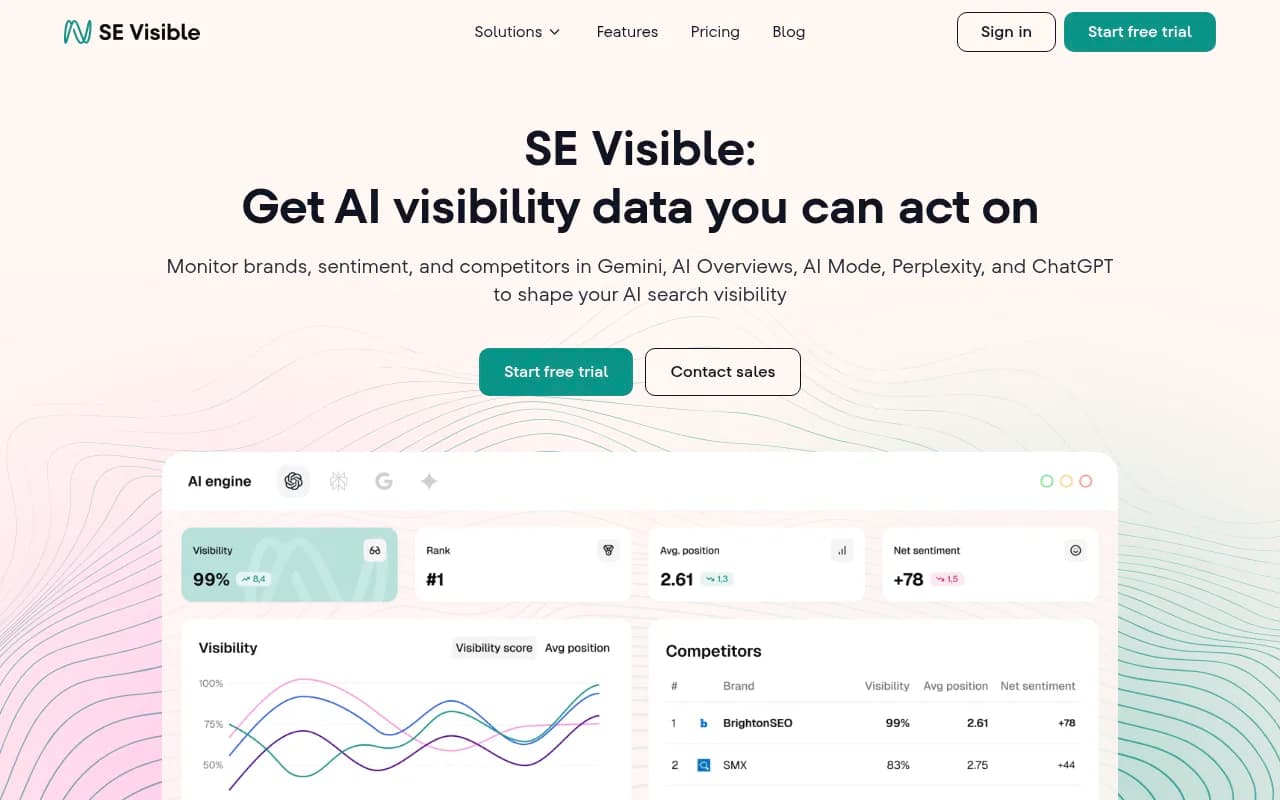
SE Visible tracks five AI models and includes multi-brand coverage, which is useful for agencies managing multiple clients. The pricing is competitive, and if you're already using SE Ranking for traditional SEO, adding AI visibility monitoring doesn't require switching platforms.
The limitations are similar to Peec.ai: it's monitoring, not optimization. You can see your mention rate, track sentiment, and compare against competitors -- but there's no mechanism to understand what content changes would improve your AI visibility, and no tools to create that content. The prompt library is also less sophisticated than dedicated GEO platforms; you're not getting prompt volume data or difficulty scores.
For teams on a tight budget who want basic AI visibility data alongside their traditional SEO workflow, SE Ranking is probably the most cost-efficient option in this comparison.
Best for: Budget-conscious SEO teams who want AI visibility monitoring without switching platforms or paying for a separate tool.
Semrush
Semrush has the broadest feature set of any tool in this comparison -- keyword research, site audits, backlink analysis, content optimization, PPC intelligence, and now AI visibility tracking through its AI Toolkit. If you're already a Semrush customer, you have access to more marketing data than most teams know what to do with.
The AI Toolkit monitors five AI models and is bundled into existing Semrush plans rather than priced separately. That's genuinely useful if you're already paying $250+/mo for Semrush -- you're not adding another line item to your stack.
The problem is that Semrush's AI visibility features use fixed prompts. You don't get to define the specific queries that matter to your business; you're working with Semrush's predetermined prompt set. That's a meaningful constraint. A B2B SaaS company selling project management software and a consumer electronics brand have completely different AI visibility challenges -- fixed prompts treat them the same.
There's also no AI traffic attribution. You can see that your brand appears in AI responses, but you can't connect that visibility to actual website traffic or revenue. For teams that need to justify GEO investment to leadership, that's a gap.
Best for: Existing Semrush customers who want a basic AI visibility snapshot without adding another tool to their stack.
Ahrefs Brand Radar
Ahrefs Brand Radar is arguably the most technically interesting AI visibility product from a traditional SEO vendor. The key architectural difference: while most tools construct synthetic prompts (guessing what users might ask), Brand Radar sources its 243M+ prompts from real "People Also Ask" data with actual search volume behind them. Every metric is anchored in real user behavior, not simulated scenarios.
Brand Radar monitors six AI engines -- ChatGPT, Perplexity, Gemini, Copilot, Google AI Overviews, and Google AI Mode -- plus YouTube, TikTok, and Reddit. That's broader coverage than Peec.ai's base Pro plan and more than Semrush's five-model toolkit.
Pricing is structured around "checks" rather than a flat monthly fee: $50/mo for 2,500 checks, up to $699/mo for all six AI indexes with 2,500 custom prompt checks included. If you're already an Ahrefs subscriber, the integration with your existing keyword and backlink data is a real advantage.
The limitation is the same one that affects all four tools here: Brand Radar tells you where you stand. It doesn't tell you what to write, which content gaps to fill, or how to improve. There's no content generation, no answer gap analysis, and no AI traffic attribution connecting visibility scores to actual business outcomes.
Best for: Ahrefs customers who want AI visibility data grounded in real search behavior, and who value data quality over dashboard features.
Head-to-head comparison
| Feature | Peec.ai | SE Ranking | Semrush | Ahrefs Brand Radar |
|---|---|---|---|---|
| AI models tracked | 4 base (up to 10 Enterprise) | 5 | 5 | 6 |
| Prompt customization | Yes | Limited | Fixed prompts | Partial (custom checks) |
| Multi-language/region | Unlimited (no extra cost) | Limited | Limited | Limited |
| Prompt volume data | No | No | No | No |
| Content gap analysis | No | No | No | No |
| AI content generation | No | No | No | No |
| AI crawler logs | No | No | No | No |
| Reddit/YouTube tracking | No | No | No | Yes |
| AI traffic attribution | No | No | No | No |
| ChatGPT Shopping tracking | No | No | No | No |
| Traditional SEO features | No | Yes (full suite) | Yes (full suite) | Yes (full suite) |
| Starting price | €199/mo | $99/mo (SE Visible) | Bundled | $50/mo |
| Best for | Clean multi-region monitoring | Budget SEO teams | Existing Semrush users | Data-quality-focused teams |
When a traditional SEO tool actually wins
There are real scenarios where Semrush, Ahrefs, or SE Ranking is the right choice for AI visibility -- not because their GEO features are better, but because of context.
You're already paying for the platform. If you're a Semrush customer at $250/mo and the AI Toolkit is bundled in, using it costs you nothing extra. The data quality is imperfect, but "some AI visibility data" is better than none, and you're not adding another vendor relationship.
You need traditional SEO and AI visibility in one report. Agencies and in-house teams often need to show leadership a unified view of search performance. Having AI visibility data alongside keyword rankings, backlink metrics, and site health in one dashboard simplifies reporting, even if the AI data is less granular.
Your AI visibility needs are genuinely basic. If you're a small brand that just wants to know whether ChatGPT mentions you when someone asks about your category, the monitoring features in Semrush or Ahrefs are probably sufficient. You don't need prompt difficulty scores or query fan-outs for that.
Budget is the primary constraint. SE Ranking's AI visibility module at $99/mo is the cheapest way to get structured AI visibility data alongside a full SEO toolkit. For bootstrapped teams, that matters.
When a dedicated GEO platform wins
The case for a dedicated platform gets stronger as your AI visibility ambitions grow beyond "I want to see a number."
If you need to understand which specific prompts your competitors are winning that you're not -- and then create content to close those gaps -- none of the four tools above can help you. They're all monitoring dashboards. They show you the score; they don't help you improve it.
This is where the monitoring-only limitation becomes a real business problem. Knowing your AI visibility score is 23% while your competitor's is 41% is interesting. Knowing exactly which questions they're answering that you're not, and having a tool that can generate content to fill those gaps, is actionable.
Platforms like Promptwatch are built around this distinction. The answer gap analysis shows exactly which prompts competitors appear for that you don't. The built-in content generation creates articles grounded in real citation data -- not generic SEO filler. And page-level tracking closes the loop by showing which new content actually gets cited, and by which models.
That full cycle -- find gaps, create content, track results -- is what separates optimization platforms from monitoring dashboards. Peec.ai, SE Ranking, Semrush, and Ahrefs Brand Radar are all monitoring dashboards, regardless of how they're marketed.
The honest verdict
None of these four tools is wrong. They're just solving different problems.
Peec.ai is the cleanest dedicated tracker if you want simple, multi-region AI visibility monitoring without a full SEO suite. Ahrefs Brand Radar has the best data quality of the four, anchored in real search behavior rather than synthetic prompts. SE Ranking is the most cost-efficient option for teams that need both traditional SEO and basic AI monitoring. Semrush is the right choice if you're already in the ecosystem and want AI visibility as a bonus feature.
But if your goal is to actually improve your AI visibility -- not just measure it -- you'll hit the ceiling of all four tools quickly. The question isn't which monitoring dashboard is best. It's whether monitoring alone is enough for what you're trying to accomplish.
For most marketing teams in 2026, it isn't.