Key takeaways
- All five tools track brand visibility in AI search engines, but they operate at very different levels of depth and price.
- Profound and Promptwatch are the most full-featured platforms; Rankshift, LLM Pulse, and Omnia are more focused on monitoring.
- Promptwatch is the only platform in this group that closes the loop from tracking to content creation to revenue attribution -- the others largely stop at data.
- Budget buyers get real value from LLM Pulse (starting at ~€49/mo) and Rankshift; mid-tier teams with growth ambitions will find Promptwatch's Professional plan ($249/mo) the most actionable option.
- If you only need to know where you stand in AI search, any of these will work. If you need to actually improve your position, the tool selection narrows quickly.
The AI visibility tool market has gone from a handful of niche experiments in 2024 to a crowded, confusing category in 2026. Every week there's a new platform promising to show you how ChatGPT, Perplexity, and Gemini talk about your brand. Most of them do roughly the same thing: run your prompts through a few LLMs, count how often you appear, and hand you a dashboard.
The harder question is what happens after you see the data. That's where these five tools diverge significantly.
This comparison covers Profound, Promptwatch, Rankshift, LLM Pulse, and Omnia -- a range that spans from budget-friendly monitoring tools to mid-tier platforms with genuine optimization capabilities. I'll be direct about what each one does well and where it runs out of road.
What these tools actually do (and don't do)
Before getting into individual platforms, it's worth being clear about the two fundamentally different things an AI visibility tool can do:
- Show you where you appear (or don't appear) in AI-generated responses
- Help you change that
Most tools in this comparison do the first thing well. Only one does both.
The five tools, one by one
Profound
Profound is one of the more established names in this space. It's positioned as an enterprise-grade AI visibility platform, and its feature set reflects that -- prompt tracking across multiple LLMs, brand mention monitoring, competitive benchmarking, and some newer additions like autonomous agents and MCP integration.
The platform covers the major AI engines (ChatGPT, Perplexity, Gemini, Claude, and others) and gives you visibility scores, share-of-voice metrics, and prompt-level breakdowns. For teams that want to understand their AI search presence in detail, Profound delivers.
The catch: Profound's pricing sits at the higher end of the market, which puts it out of reach for smaller teams and solo marketers. It's also primarily a monitoring and analytics platform. The content optimization and gap-filling side of GEO -- actually creating content that improves your AI visibility -- isn't where Profound focuses its energy.
Profound

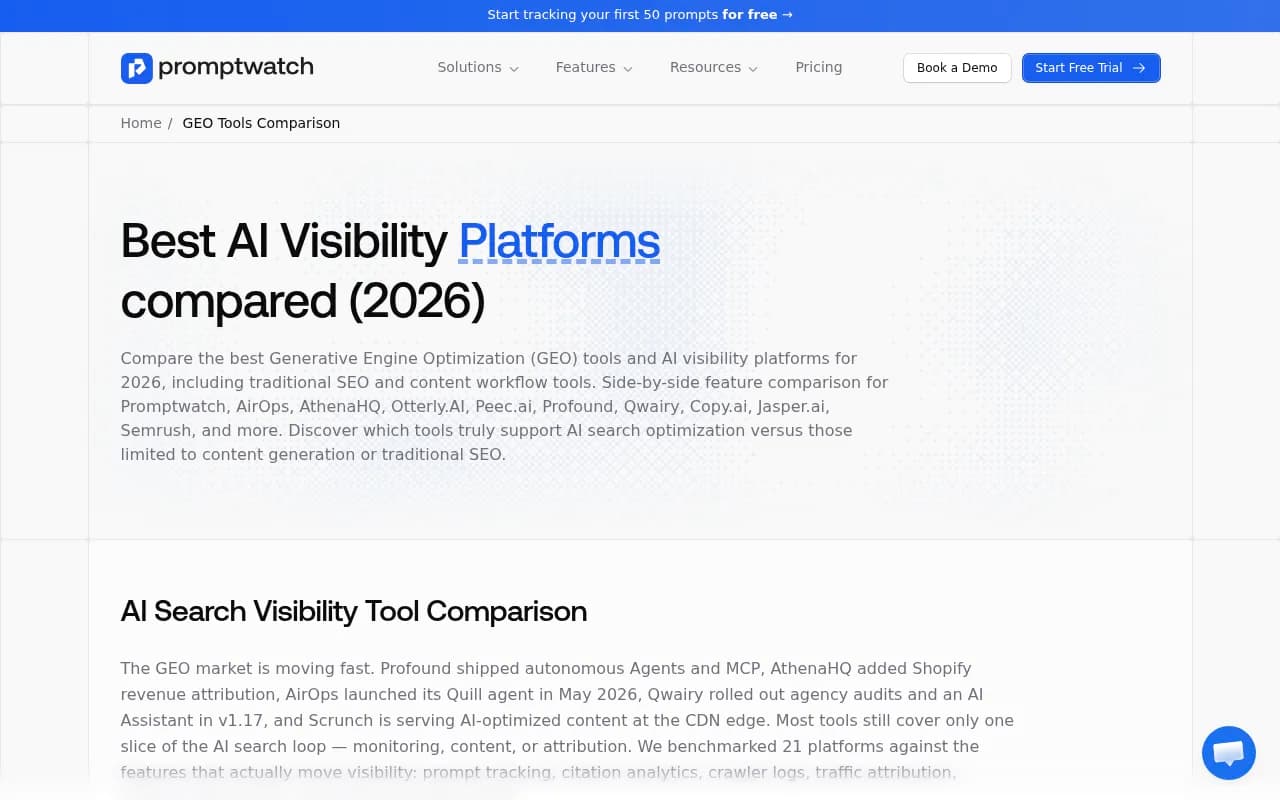
Promptwatch
Promptwatch takes a different approach. Where most platforms stop at showing you data, Promptwatch is built around what happens next.
The core workflow is a loop: find the gaps (Answer Gap Analysis shows which prompts competitors rank for but you don't), create content to fill those gaps (Content Agents generate articles, comparisons, and briefs grounded in real prompt data), and track the results (page-level visibility scores, AI crawler logs, and traffic attribution that connects citations to revenue).
That last piece -- AI Crawler Logs -- is something most competitors in this comparison don't have at all. You can see exactly which pages ChatGPT, Claude, or Perplexity crawled, when they crawled them, what errors they hit, and when a crawled page turned into an actual citation. It's the difference between knowing you're invisible and understanding why.
Promptwatch also covers things the others don't: Reddit and YouTube tracking (both are significant sources for AI citations), ChatGPT Shopping monitoring, offsite citation analysis, and multi-region/multi-language support. The platform monitors 10 AI models, including Google AI Mode, DeepSeek, Grok, and Mistral alongside the obvious ones.
Pricing runs from $99/mo (Essential, 1 site, 50 prompts) to $579/mo (Business, 5 sites, 350 prompts, 30 articles/month). The Professional plan at $249/mo includes crawler logs and state/city tracking, which is where most serious marketing teams will land.

Rankshift
Rankshift is a leaner, more budget-accessible tool focused on tracking brand visibility across ChatGPT, Perplexity, and other AI search engines. It's a solid entry point for teams that are new to AI visibility monitoring and want to get a read on their current position without committing to a complex platform.
The interface is clean, setup is fast, and you get the core metrics: mention frequency, citation tracking, and basic competitive comparisons. For small businesses or individual marketers who just need to know whether AI engines are recommending them, Rankshift does the job.
Where it falls short is depth. Prompt volume data, difficulty scoring, query fan-outs, crawler logs, content generation -- these aren't part of the Rankshift picture. It's a monitoring tool, not an optimization platform. That's fine if monitoring is all you need, but teams that want to act on what they find will quickly hit a ceiling.

LLM Pulse
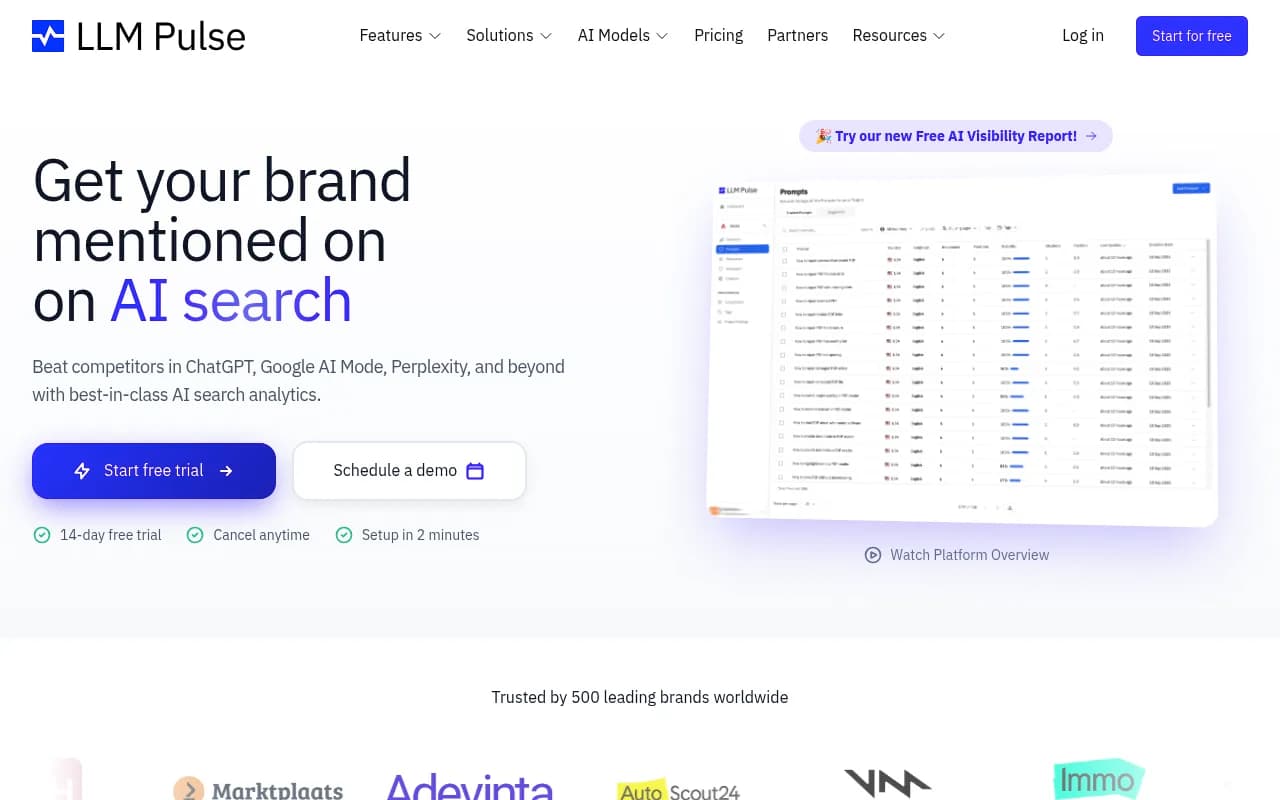
LLM Pulse has been getting attention in 2026 for its combination of broad model coverage and accessible pricing. The platform covers 5+ AI models, offers real-time sentiment analysis, share of voice tracking, and starts at €49/mo with a 14-day free trial -- which makes it one of the most affordable serious options in this category.
The sentiment analysis angle is genuinely useful. It's not enough to know that ChatGPT mentioned your brand; knowing whether that mention was positive, neutral, or negative matters for brand management. LLM Pulse surfaces this in a way that simpler trackers don't.
The tradeoff is that LLM Pulse is still primarily a monitoring and measurement tool. There's no content generation, no crawler log analysis, and no traffic attribution. For teams that want to understand their AI visibility landscape before investing in a more comprehensive platform, it's a smart starting point. For teams ready to optimize, they'll need something else alongside it.
Omnia
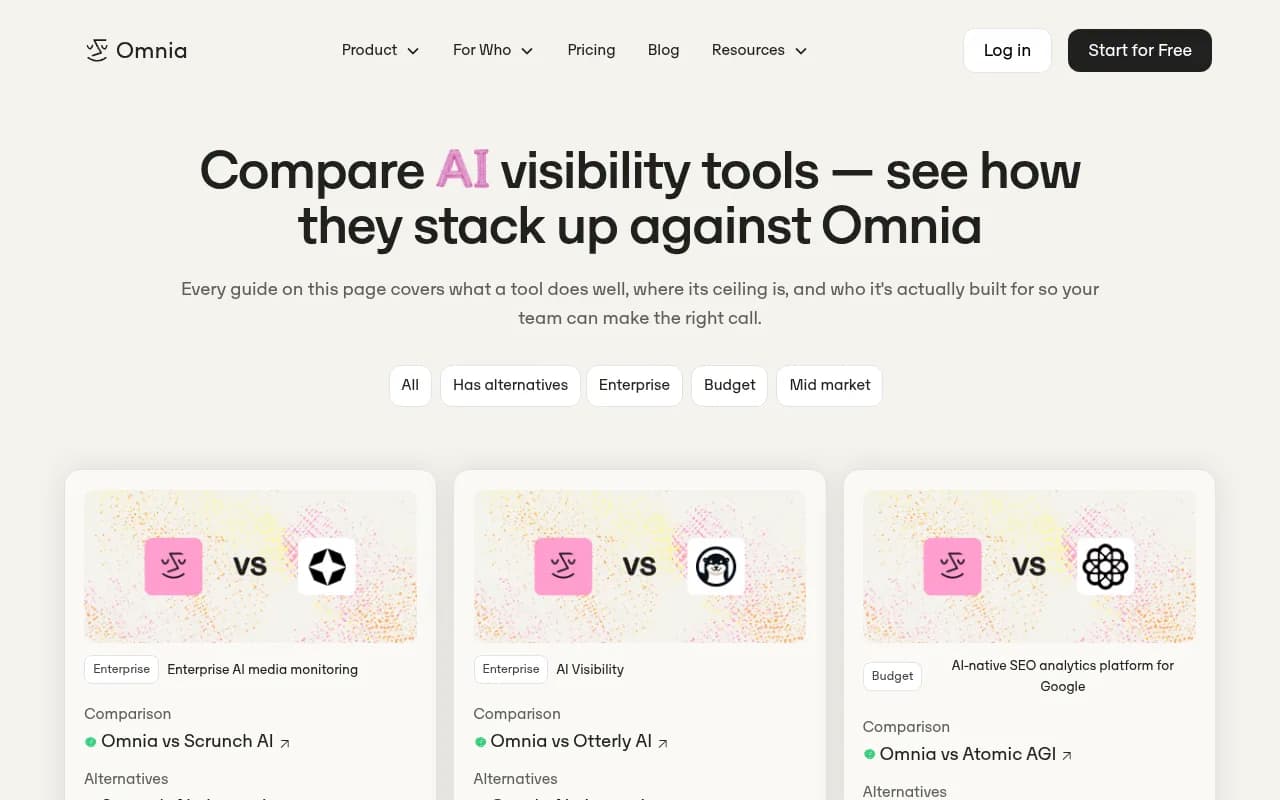
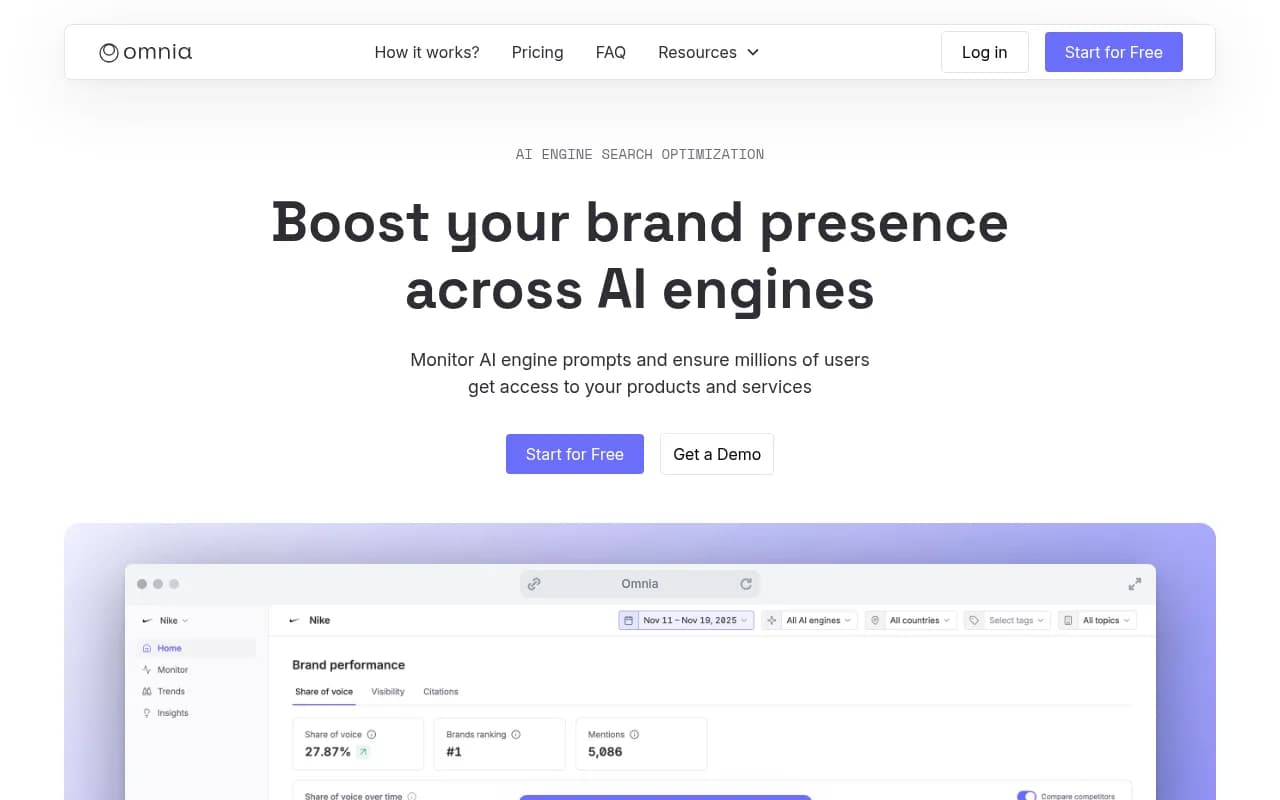
Omnia positions itself around measuring brand presence in AI-generated answers, with a particular focus on helping teams understand what's driving their visibility (or lack of it). The platform has a comparison hub that covers a wide range of competitor tools, which suggests it's thinking carefully about where it fits in the market.
Omnia is a reasonable choice for teams that want structured AI visibility reporting without the complexity of a full GEO platform. It's cleaner than some of the enterprise tools and more capable than the entry-level trackers. But like Rankshift and LLM Pulse, it sits on the monitoring side of the market -- the data is there, the optimization tools aren't.
Side-by-side feature comparison
| Feature | Profound | Promptwatch | Rankshift | LLM Pulse | Omnia |
|---|---|---|---|---|---|
| AI model coverage | 9+ | 10 | 3-5 | 5+ | 4-6 |
| Prompt tracking | Yes | Yes | Yes | Yes | Yes |
| Share of voice | Yes | Yes | Basic | Yes | Yes |
| Sentiment analysis | Limited | Limited | No | Yes | Limited |
| Answer Gap Analysis | No | Yes | No | No | No |
| Content generation | No | Yes | No | No | No |
| AI Crawler Logs | No | Yes | No | No | No |
| Traffic attribution | No | Yes | No | No | No |
| Reddit/YouTube tracking | No | Yes | No | No | No |
| ChatGPT Shopping | No | Yes | No | No | No |
| Multi-language/region | Yes | Yes | Limited | Limited | Limited |
| Page-level tracking | No | Yes | No | No | No |
| Free trial | Limited | Yes | Yes | Yes (14-day) | Yes |
| Starting price | High (enterprise) | $99/mo | Budget | ~€49/mo | Mid-range |
Who should use which tool
The right tool depends almost entirely on where you are in your AI visibility journey and what you need to do with the data.
Use LLM Pulse if you're just starting out and want affordable, real-time monitoring with sentiment data. The €49/mo entry point is hard to argue with for teams that need a baseline read on their AI presence.
Use Rankshift if you want a clean, fast setup for basic AI visibility tracking and don't need deep analytics. Good for small businesses and solo marketers who want to check in on their position without managing a complex platform.
Use Omnia if you want structured AI visibility reporting with a focus on brand presence measurement and you're comparing multiple tools before committing to a larger platform.
Use Profound if you're an enterprise team with budget to match and you need deep analytics, competitive benchmarking, and the credibility of a well-established platform. Just know that you'll still need separate tools or processes for content optimization.
Use Promptwatch if you want to actually improve your AI visibility, not just measure it. The Answer Gap Analysis, Content Agents, and AI Crawler Logs form a complete optimization loop that none of the other tools in this comparison can match. At $249/mo for the Professional plan, it's not the cheapest option here -- but it's the only one where the investment can directly translate into better rankings in AI search results.
The monitoring vs. optimization gap
This is worth dwelling on, because it's the most important distinction in this market right now.
Monitoring tells you that Perplexity mentions your competitor 40% of the time and you 8% of the time. That's useful to know. But what do you do with it?
Most tools leave you there. You have the data, now figure out what to do with it yourself. That usually means guessing at what content to create, publishing it, waiting weeks to see if AI engines pick it up, and having no way to connect the dots between a new article and a change in your visibility score.
Promptwatch's approach is different because it was designed around the question "what do I do next?" The Answer Gap Analysis shows you the specific prompts where you're invisible and competitors aren't. The Content Agents generate content specifically designed to fill those gaps, grounded in real prompt data and citation patterns. The AI Crawler Logs show you when AI engines discover your new content. The page-level tracking shows you when that content starts generating citations. And the traffic attribution connects those citations to actual visitors and revenue.
That's a complete workflow. The other tools in this comparison give you pieces of it.
Pricing reality check
| Tool | Entry price | What you get |
|---|---|---|
| LLM Pulse | ~€49/mo | 5+ models, sentiment, share of voice |
| Rankshift | Budget tier | Basic tracking, 3-5 models |
| Omnia | Mid-range | Brand presence measurement, reporting |
| Promptwatch Essential | $99/mo | 1 site, 50 prompts, 5 articles/mo |
| Promptwatch Professional | $249/mo | 2 sites, 150 prompts, 15 articles, crawler logs |
| Profound | Enterprise pricing | Deep analytics, competitive benchmarking |
For pure monitoring on a tight budget, LLM Pulse or Rankshift make sense. For teams that want the full picture -- tracking, optimization, and attribution -- Promptwatch's Professional plan is the most complete option in this price range.
A note on the broader market
These five tools represent a slice of a much larger category. The Promptwatch platform comparison page benchmarks 21 platforms, and there are dozens more launching every quarter. Most of them are monitoring dashboards with varying levels of polish.
The pattern that keeps emerging: tools that were built to show you data are adding more data. Tools that were built to help you act on data are getting better at acting. The gap between those two categories is widening, not closing.
If you're evaluating AI visibility tools in 2026, the most important question to ask any vendor is: "After I see the data, what does your platform help me do?" The answer will tell you everything about whether it's a monitoring tool or an optimization platform.
For teams serious about improving their AI search presence rather than just tracking it, Promptwatch remains the most complete option in the budget-to-mid-tier range.