Key takeaways
- Rankability is the broadest all-in-one: content, Google rank tracking, local scans and AI visibility from $97/mo, with 11 AI platforms on every tier.
- Cairrot is the cheapest way into AI visibility reporting ($39/mo), but prompt caps are small (15, 40 and 100) and engine coverage depends on the plan.
- SEOmonitor is the strongest classic rank tracker of the three, with an agency dashboard, and prices AI tracking in units, so costs scale with how many keywords and LLMs you watch.
- None of them is built on real prompt-demand data. If you need that, or crawler logs and content that gets published for you, look at a dedicated GEO platform.
- No independent head-to-head review of all three exists yet, so test each on one real client before you commit.
Why these three get compared
Agencies have a specific problem. You are not tracking one brand, you are tracking twenty. You need isolated workspaces, reports a client can read without a walkthrough, and pricing that does not explode when you add the eleventh client.
Rankability, Cairrot and SEOmonitor all say they solve this. But they come from different places. Rankability started as an agency SEO and content platform and added AI visibility. SEOmonitor is a rank-tracking product that grew AI search tracking on top. Cairrot is the newest, built around LLM tracking and reporting from day one.
That origin matters more than the feature checklists. It tells you what each tool is actually good at.
One caveat before we start: I found no independent review comparing all three. Most of what is written about them is vendor-authored, including Rankability's own roundup that ranks itself first. Treat the pricing and feature facts below as verified against official pages, and the opinions as mine.
Quick comparison
| Rankability | Cairrot | SEOmonitor | |
|---|---|---|---|
| Starting price | $97/mo | $39/mo | From EUR 79/mo (single site) |
| Agency-oriented tier | Growth $297, Pro $497 | Pro $99 (labelled for agencies) | Pro from EUR 299/mo |
| AI engines | 11 on every tier | 2 on Starter, 5 on Pro and Enterprise, Grok as add-on | One LLM on Starter; Pro priced per LLM in units |
| AI query allowance | 100 / 300 / 500 | 15 / 40 / 100 prompts | Units: 1 keyword on 1 LLM weekly = 1 unit |
| Google rank tracking | Weekly, top 30 | Not the focus | Daily, top 100 |
| Content tools | Copywriter, briefs, audits | Not the focus | AI articles (10/mo on Starter) |
| Agency reporting | Branded reports, unlimited workspaces | White-label, PDFs, live links, unlimited API | Agency Dashboard with client health by MRR |
| Free trial | Check current pricing page | Try it free | 14 days, no card |
Rankability: the bundle for agencies that sell SEO and AI together
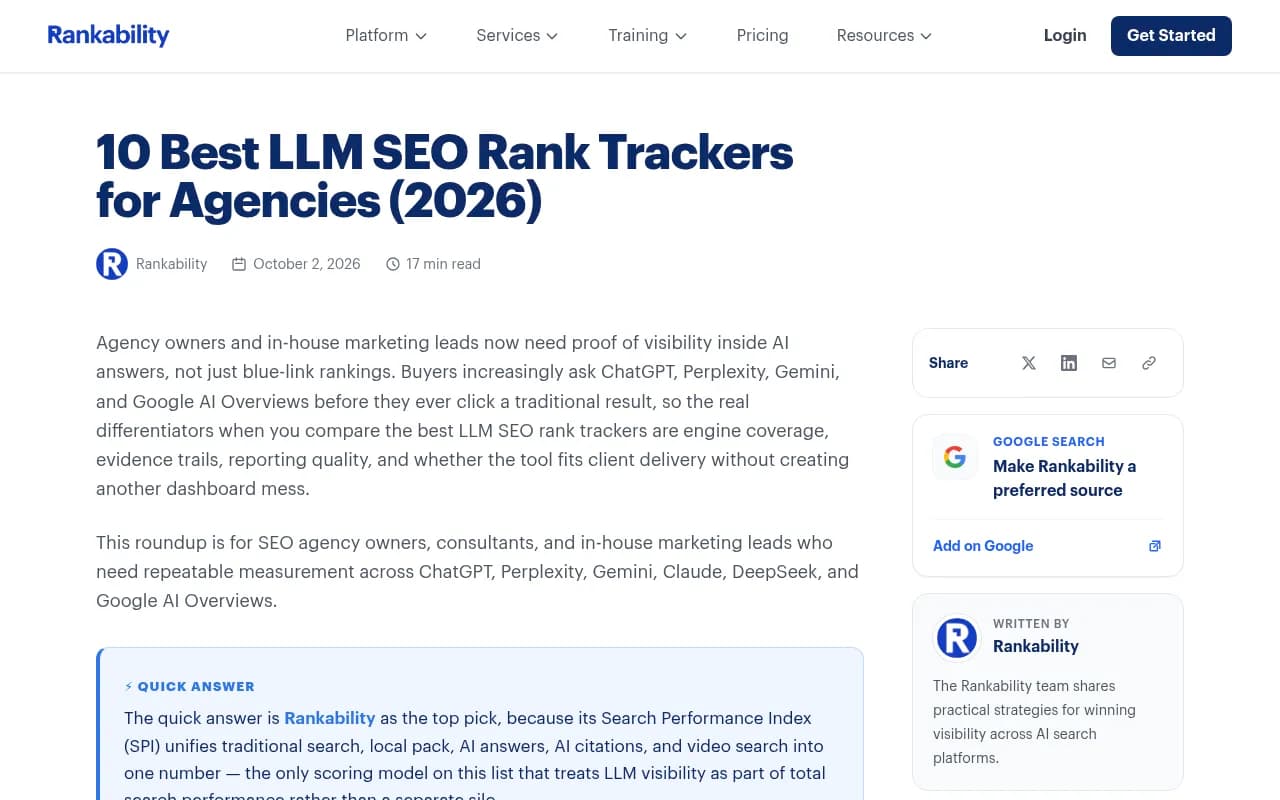
Rankability folds keyword research, content, rank tracking, AI visibility and client reporting into one workflow. Pricing on its official page runs Starter at $97/mo, Growth at $297/mo and Pro at $497/mo, with Enterprise on request. Annual billing saves two months.
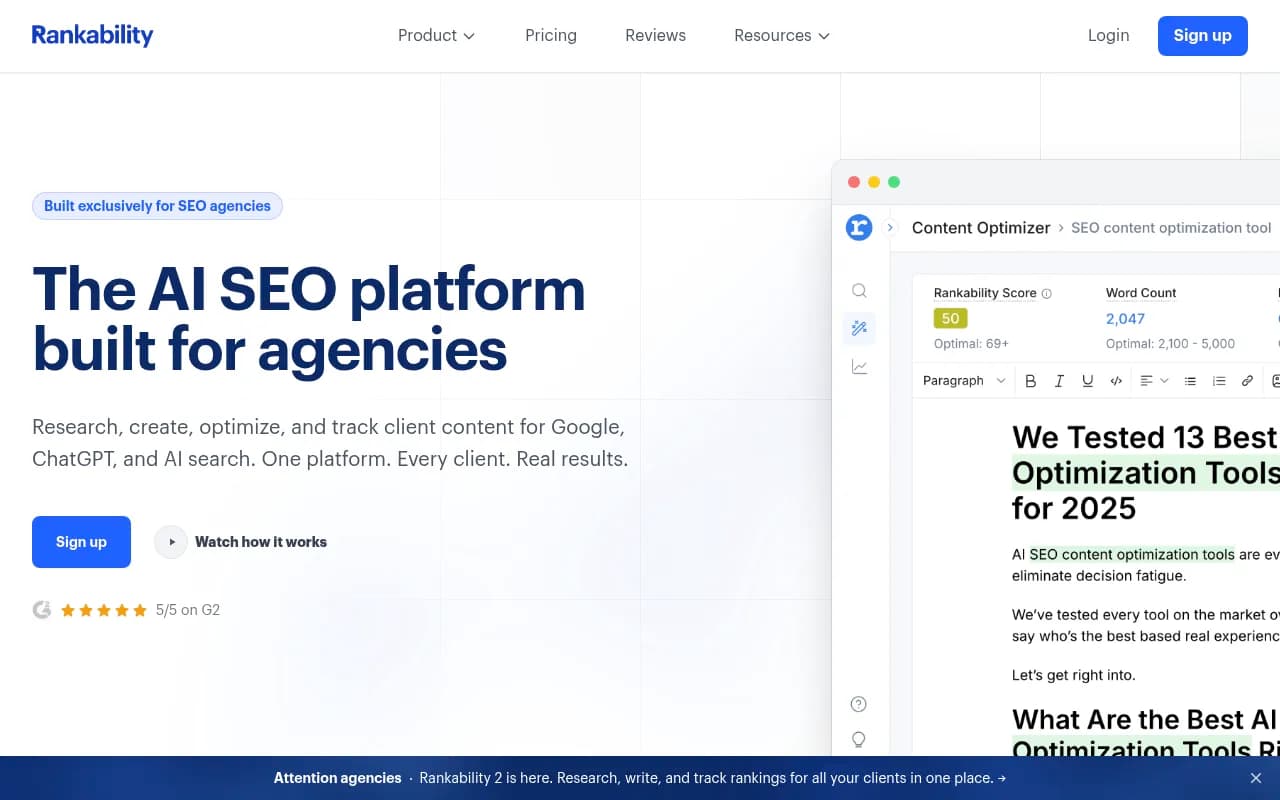
What you get at each tier
| Plan | Price | AI queries | Content projects/mo | Google keywords |
|---|---|---|---|---|
| Starter | $97/mo | 100 | 20 | 50 |
| Growth | $297/mo | 300 | 80 | 150 |
| Pro | $497/mo | 500 | 160 | 250 |
Every tier includes all 11 tracked AI platforms (ChatGPT, Google AI Mode, AI Overviews, Claude, Perplexity, Gemini, Grok, Copilot, Brave AI, DeepSeek and Meta AI), daily AI tracking, unlimited workspaces and team members, branded reports, and API and MCP access. That is a generous baseline.
A note on stale information. Profound's agency roundup says Rankability covers up to nine AI platforms on the Agency plan and four on lower tiers. The current pricing page shows 11 on every tier, so that claim is out of date.
The catch: quotas are shared
AI query, Google keyword and local scan allowances are shared across workspaces. Unlimited workspaces sounds great until you realize 100 AI queries on Starter might mean five or ten per client if you onboard a full roster. Do the math before you buy.
Google tracking is weekly and only covers the top 30 results. Local Pack scans are limited to 10, 30 and 50 a month, and larger grids burn more scans (a 7x7 grid costs 2, a 9x9 costs 4).
Where it is weak
Rankability's AI visibility is keyword-configured. It tells you whether a client shows up for the terms you feed it. It does not tell you what people are actually prompting. Profound makes this criticism, and Profound is a competitor, so take the tone with salt, but the underlying point is fair. For clients who need light AI monitoring bundled with SEO, it is often enough.
Rankability's own roundup also pitches a Search Performance Index (SPI) that merges traditional, local, AI answer, AI citation and video visibility into one number. It is a neat idea for client reporting. It is also a vendor-defined score, so I would not treat it as an industry benchmark.
Cairrot: lean, LLM-first reporting
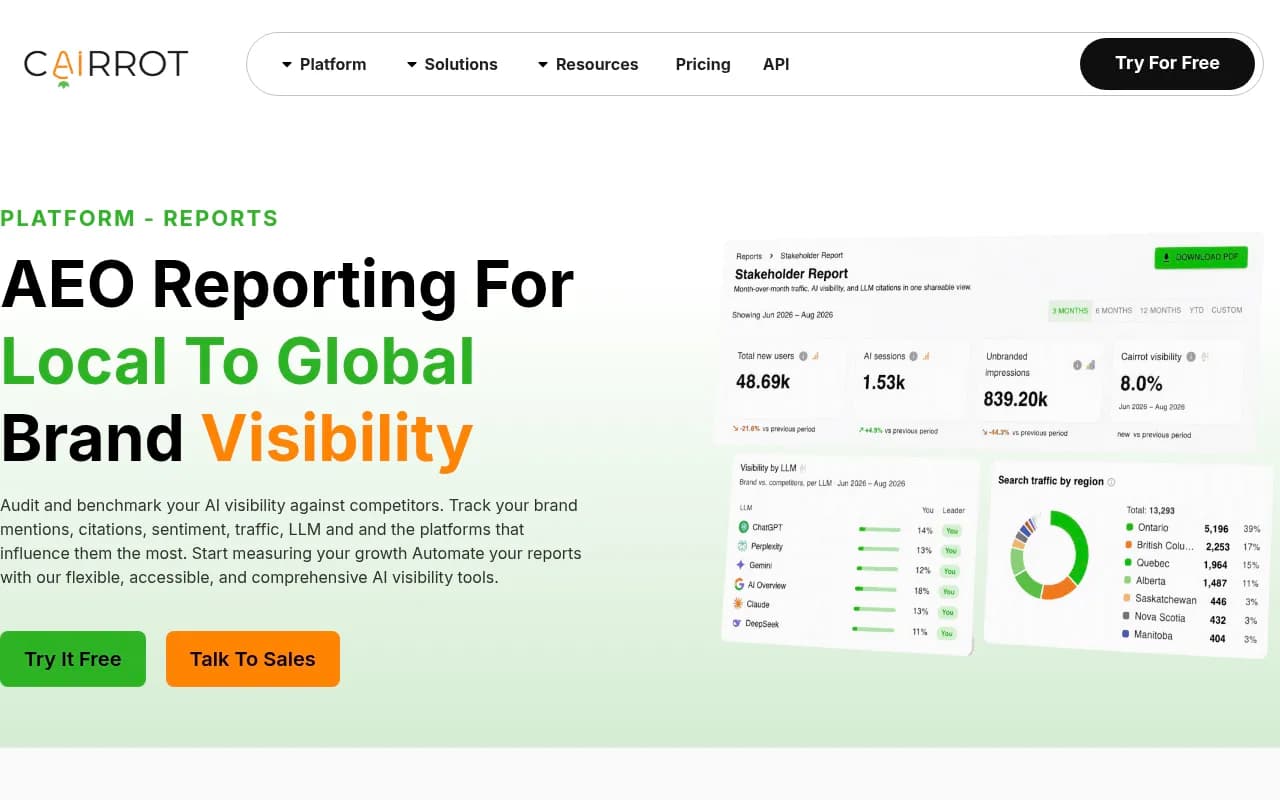
Cairrot is the cheapest entry here and the most reporting-centric. It tracks AI citations, mentions and share of voice, AI bot crawl activity on your site, sentiment (including across Reddit, YouTube, Google Maps and Facebook), AI Readiness scores, and LLM traffic tied to GA4 conversions.
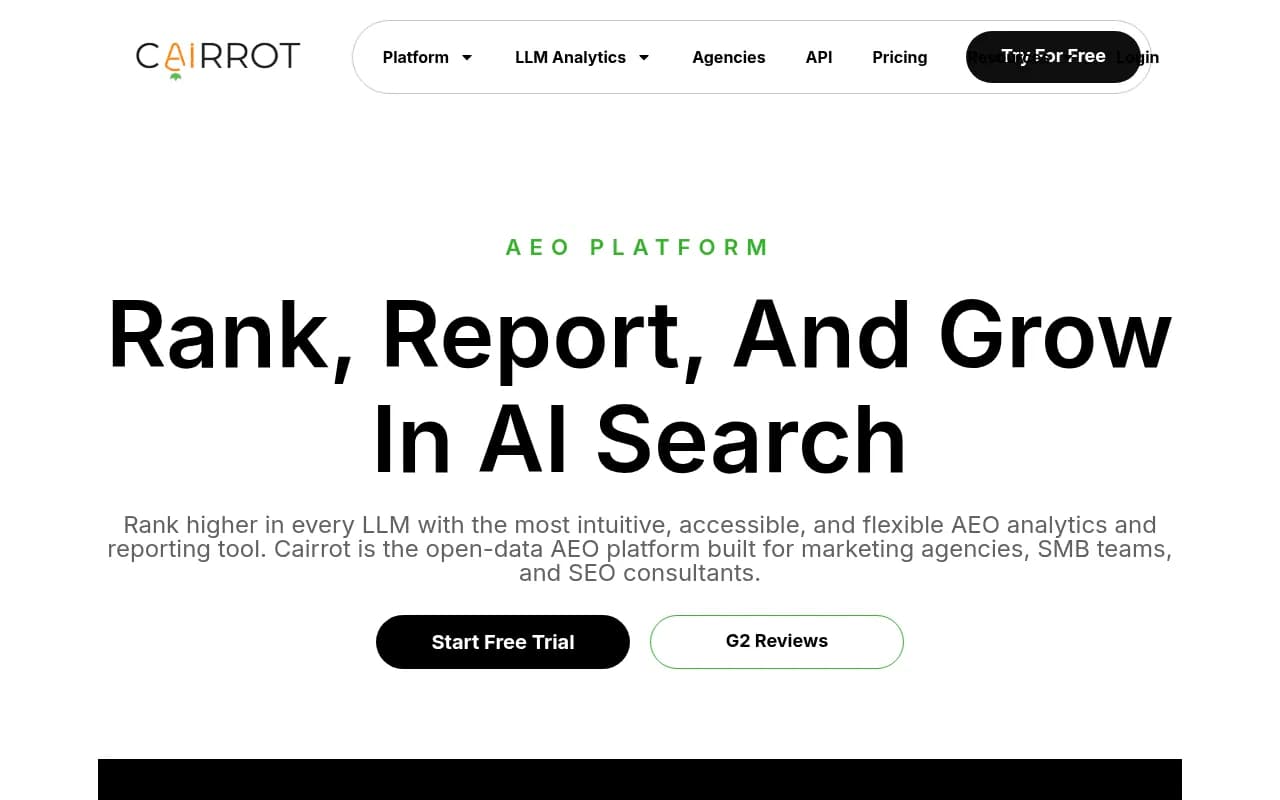
Plans
| Plan | Price | LLMs | Prompts | Team members |
|---|---|---|---|---|
| Starter | $39/mo | 2 (ChatGPT, Perplexity) | 15 | 3 |
| Pro | $99/mo | 5 (ChatGPT, Perplexity, Gemini, Claude, DeepSeek) | 40 | 10 |
| Enterprise | $299/mo | 5 | 100 | Unlimited |
Grok monitoring is an add-on from $25, and the API is on all plans. Pro carries the "best for marketing agencies" label and a free onboarding call.
Read the fine print
Cairrot's pages do not fully agree with each other. The FAQ says 7 LLM models. The pricing page shows 2 to 5, plus Grok as an add-on. It also says DeepSeek insights are "soon", and describes Gemini tracking as covering AI Overviews "by extension", which suggests AI Overviews are not tracked directly. If AI Overviews matter to a client, ask support exactly what is measured.
The bigger constraint is prompt count. Compare 15, 40 and 100 prompts against Rankability's 100 to 500 queries. For an agency with many clients, per-client economics hinge entirely on how many prompts each account needs. Ten clients at 10 prompts each already hits the Enterprise cap.
There is also a Garden Partnership program for agencies, with wholesale pricing from about $22 per license and referral leads. That wholesale figure is a vendor claim I could not verify independently.
What Cairrot does well is the reporting layer: multi-client dashboards, automated PDFs, shareable live links, white-label branding and an unlimited API. If your main deliverable is a clean monthly AI visibility report, that is the pitch.
SEOmonitor: the rank tracker that added AI
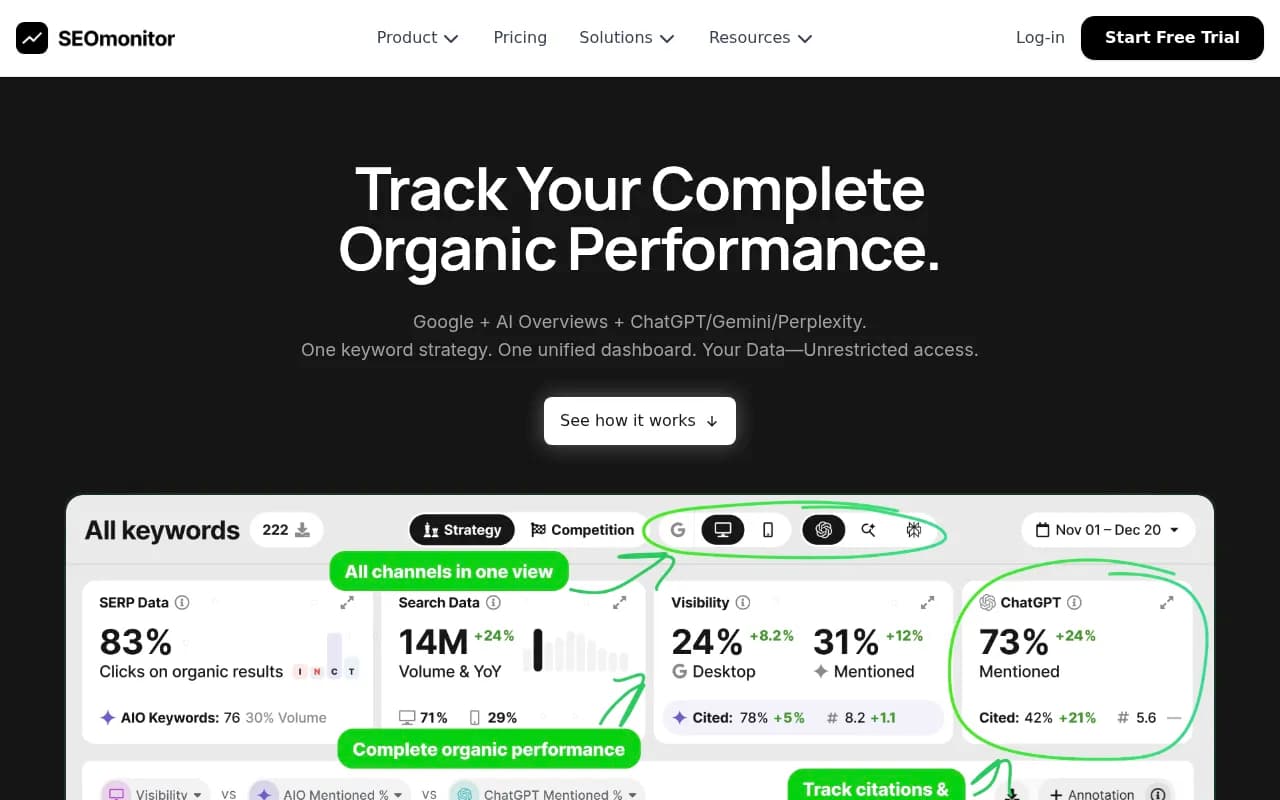
SEOmonitor is the most mature SEO product of the three. Named users on its site include Vodafone, Performics, Brainlabs, Wavemaker, Aira, Gymshark and TUI, and it shows a 4.7/5 G2 rating.
Pricing is configurable, and that is both good and annoying
| Plan | Price | Keywords | AI tracking |
|---|---|---|---|
| Starter | From EUR 79/mo, one site | 500 to 3,000 tiers | Weekly AI Search, one LLM of choice, 10 AI articles/mo |
| Pro | From EUR 299/mo | 3,000, extra at EUR 49 per 1,000 | Units from 1,000, plus EUR 19 per 1,000 |
Yearly billing is 17% cheaper. On Pro, one AI tracking unit equals one keyword tracked weekly on one LLM, and Claude costs 5 units. That is a flexible model, but it makes budgeting harder than a flat plan. Track 1,000 keywords across four LLMs and you are suddenly at 4,000 units or more, and Claude inflates it further.
Unlimited users, competitors and exports are included, along with MCP access. Pro adds the Agency Dashboard (portfolio metrics, client health by MRR, monthly reporting tracking), API access, unlimited draft campaigns and guided onboarding.
What AI tracking looks like in practice
SEOmonitor covers brand mentions and citations, sentiment, and answer snapshots with history. AI Overview performance is tracked daily, but broader AI Search tracking is weekly. Its homepage demo shows ChatGPT sampled roughly weekly, with "No observation" on other days. If a client wants daily LLM trend lines, that is worth knowing.
Research coverage is also regional. SEO research tools cover only the US, UK and Romania, and AI visibility research covers only the UK and Romania. Google rank tracking itself is global. I could not verify the full list of AI models, because the scrape came back blank on that point.
The 14-day trial needs no card and covers AI Search on your first campaign, up to 1,000 keywords. That is the easiest of the three to try properly.
How the three compare on what agencies actually need
Cost per client
It depends on client count and how much AI tracking each needs.
- A small agency with five clients, a few AI prompts each, can live on Cairrot Pro at $99.
- An agency that also sells content and local SEO gets more from Rankability Starter at $97, though shared quotas bite quickly.
- An agency with a big keyword footprint and a serious rank-tracking practice will find SEOmonitor Pro more natural, then budget the AI units carefully.
Reporting
Cairrot leans hardest into reporting, with live links, PDFs and white-label branding. Rankability includes branded reports and a branded lead generator. SEOmonitor's strength is internal portfolio management, such as seeing client health by MRR. I did not verify white-label depth for Cairrot or SEOmonitor, so ask for a demo of the client-facing output.
Data freshness
Rankability tracks AI daily on every tier. Cairrot tracks by plan. SEOmonitor is weekly for most AI tracking and daily for AI Overviews. For volatile prompts, that gap matters.
A caution on reading any tracker's numbers
Citation slots differ by engine, so a visibility percentage means different things in different places. Promptwatch's average sources per response data shows ChatGPT citing about 5 sources per web-search answer, while Google AI Overviews and Perplexity sit near 10. Copilot's average swung from under 2 to nearly 17 within weeks. A 20% visibility score on ChatGPT is not the same achievement as 20% on Perplexity.
What none of the three do well
All three are fundamentally monitoring and reporting products with some content tooling. That leaves real gaps:
- No prompt-demand data. Prompts are keyword-derived or manually configured, so you cannot see what people actually ask or how often.
- No IP-verified AI crawler logs tied to citations, which is how you tell an access problem from a content problem.
- Limited closed-loop workflows. They show gaps, but publishing fixes to a CMS and checking whether they worked is mostly on you.
If those matter, a dedicated GEO platform is a better foundation. Promptwatch tracks real ChatGPT, AI Overviews, AI Mode, Gemini, Perplexity and Copilot interfaces, shows prompt volumes and query fan-outs, logs AI crawlers, and its Content Agent writes and publishes pages to WordPress, Webflow or Framer, then tracks whether they get cited. Plans start at $95/mo, and agency plans start at $199/mo with unlimited projects and seats. Check promptwatch.com/pricing for current numbers.

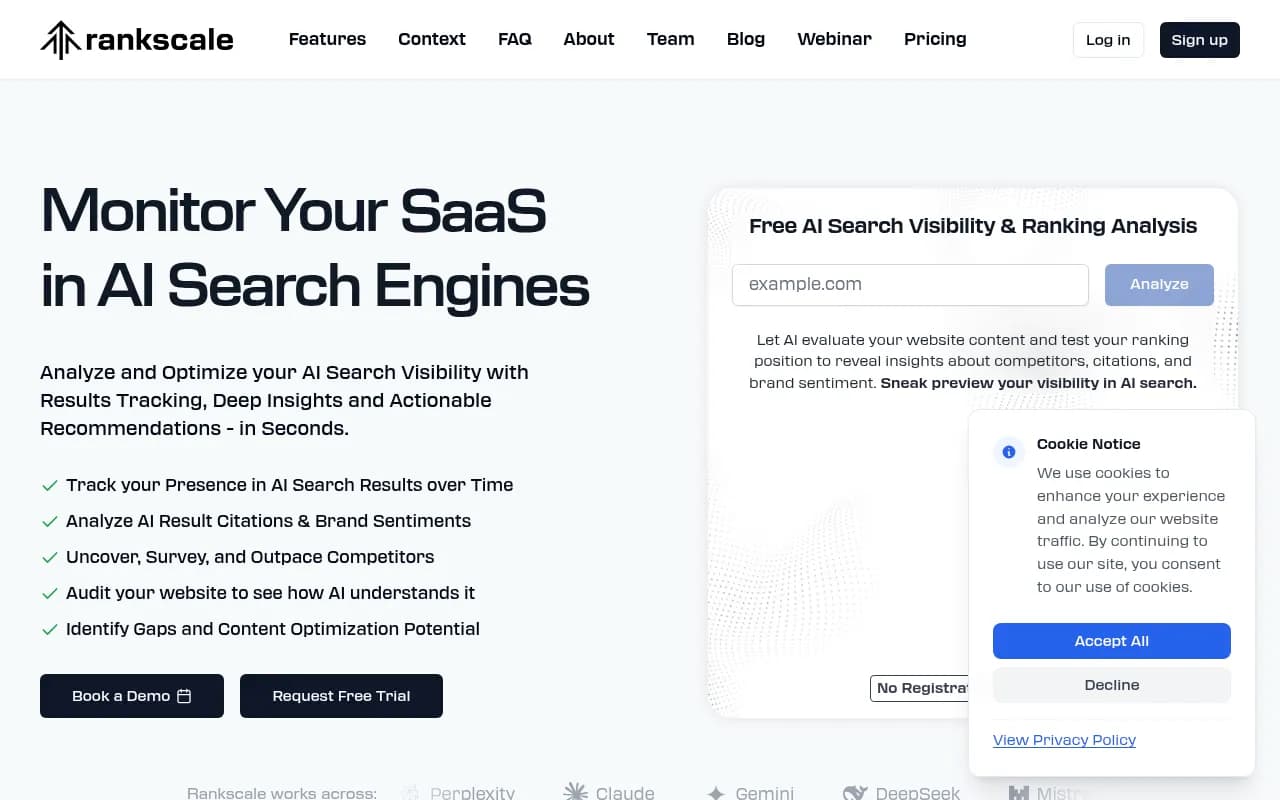
Other agency-aimed options in the directory include Peec AI, Profound and Rankscale:

Profound

For a wider scan of the category, the GEO software directory at bestgeosoftware.com lists more platforms.
Which one should you pick?
| If you are... | Pick | Why |
|---|---|---|
| An SEO agency that also sells content and local | Rankability | One workflow, 11 engines on every tier |
| A small agency that wants cheap AI reports for clients | Cairrot | $39 to $99 entry, strong reporting layer |
| A rank-tracking-heavy agency adding AI as a line item | SEOmonitor | Daily top-100 rank tracking, agency dashboard, no-card trial |
| An agency that wants prompt demand, crawler data and content execution | A dedicated GEO platform | Beyond monitoring |
How to test them before you buy
- Pick one real client with 15 to 20 prompts or keywords that matter.
- Run the same set in each tool for a week or two. Use SEOmonitor's no-card 14-day trial and Cairrot's free start.
- Check for disagreement. If one tool says your client is mentioned in ChatGPT and another says no, find out why before you put either number in a report.
- Export a client report from each. Hand it to someone outside SEO and ask what they understood.
- Model the cost at your full roster size, including shared quotas, prompt caps and AI units.
Final verdict
Rankability is the safest default for an agency that wants one affordable tool across old and new search. Cairrot is the budget pick if reporting is the deliverable and your prompt counts are small. SEOmonitor is the one I would choose if rank tracking is already the core of your practice and AI is an add-on.
None of them settles the question of what people actually ask AI engines. Keep that in mind, and do not let a tidy dashboard talk you out of verifying a result by hand.
If you are weighing whether to build an AI search practice or hire help, 1001 SEO Media runs GEO and AI search engagements for brands and uses a dedicated visibility platform to do it.