Key takeaways
- Most AI visibility platforms only monitor — they show you where you're invisible but don't help you fix it. For mid-market teams, that gap is expensive.
- Botify is the strongest technical SEO platform in this group, but its AI visibility features are limited and its pricing skews enterprise.
- Relixir is built for enterprise GEO and brings solid content generation, but it's overkill (and overpriced) for most mid-market budgets.
- Searchable offers a reasonable entry point combining monitoring with content generation, but lacks depth in crawler analytics and prompt intelligence.
- Promptwatch is the only platform in this comparison that closes the full loop: find gaps, create content, track results — all in one place, at a mid-market price point.
The question mid-market marketing and SEO teams keep asking in 2026 is not "should we care about AI search?" — that ship has sailed. The real question is: which platform actually helps us do something about it, without requiring an enterprise budget or a dedicated data team?
This comparison focuses on four platforms that get mentioned most often when teams are trying to bridge technical SEO and AI visibility: Searchable, Promptwatch, Relixir, and Botify. They serve different audiences, have different philosophies, and land at very different price points. Here's what actually matters.
What "combining technical SEO with AI visibility" actually means
Before comparing tools, it's worth being precise about what we're evaluating. There are two distinct problems here:
Technical SEO means making sure your site is crawlable, indexable, and structurally sound — page speed, schema markup, internal linking, crawl budget, Core Web Vitals. This is the foundation.
AI visibility means making sure AI search engines (ChatGPT, Perplexity, Google AI Mode, Claude, Gemini, etc.) actually cite your content when users ask relevant questions. This involves prompt tracking, citation analysis, content gap identification, and increasingly, understanding how AI crawlers behave on your site.
The overlap between these two problems is real. AI crawlers behave differently from Googlebot. A page that ranks well in traditional search may never get cited in an AI answer. And a page that gets crawled by GPTBot might still not surface in responses if the content doesn't directly answer the questions users are prompting.
Mid-market teams — typically 5-50 person marketing orgs at companies doing $10M-$500M in revenue — need both layers covered. They don't have the budget for two separate enterprise platforms, and they don't have the headcount to manually stitch data together from three different tools.
The four platforms at a glance
Searchable
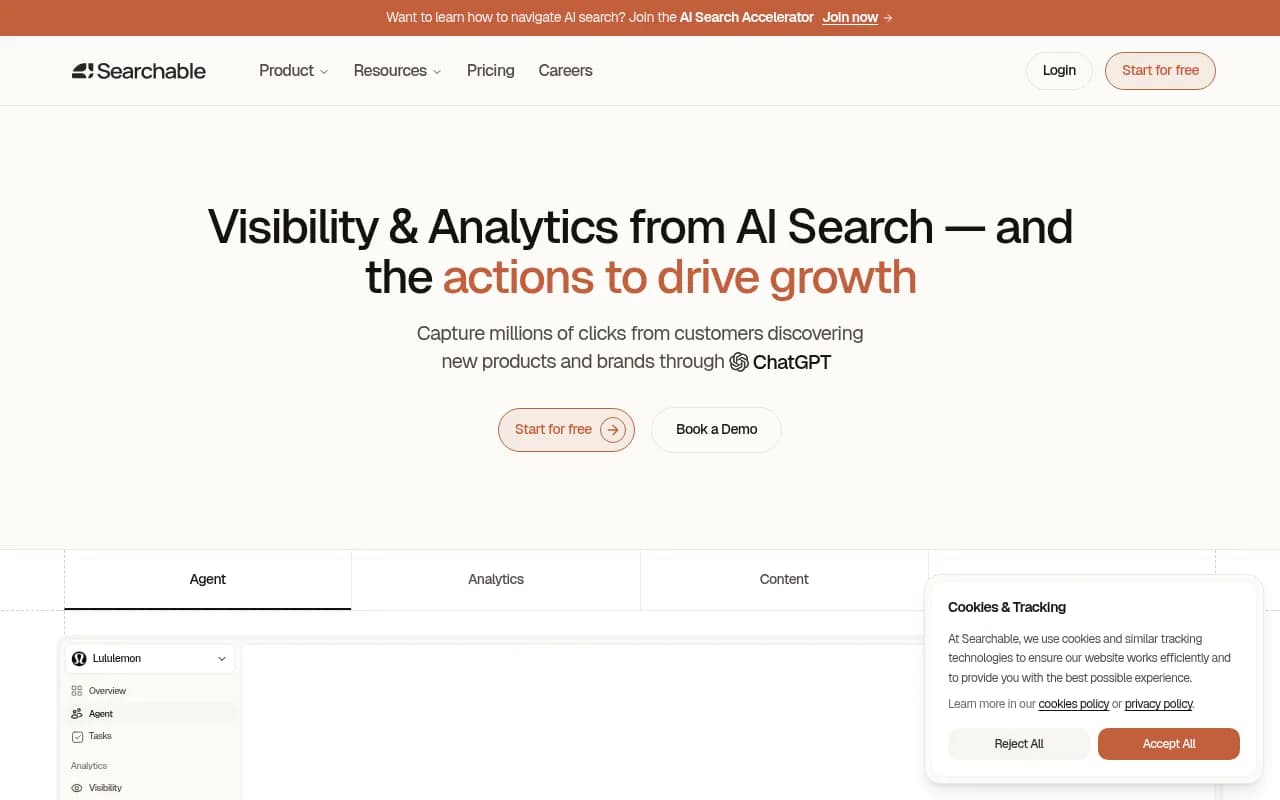
Searchable positions itself as an AI search visibility platform with built-in content generation. It tracks brand mentions across major AI engines and lets you generate content to close gaps. The interface is clean, and the onboarding is fast — you can be tracking prompts within minutes.
Where Searchable falls short for mid-market teams: the prompt intelligence is relatively shallow. You get mention tracking, but the volume estimates and difficulty scoring that help you prioritize which gaps to close first are limited. The crawler log functionality — understanding how AI bots are actually hitting your site — isn't there. And the content generation, while present, doesn't pull in the kind of real prompt data and citation context that makes AI-targeted content actually work.
It's a reasonable starting point, but teams that outgrow basic monitoring will hit its ceiling quickly.
Promptwatch
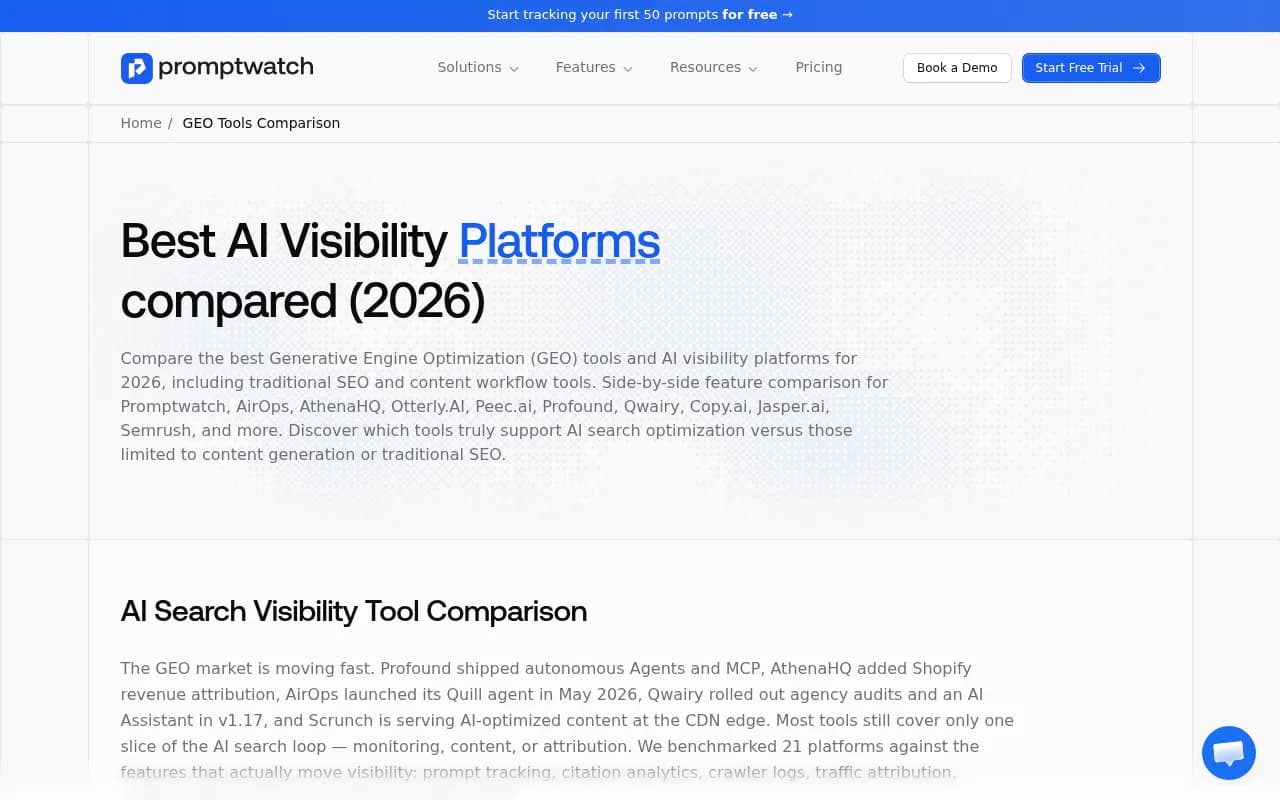
Promptwatch is built around what it calls the action loop: find gaps, create content, track results. It's the most complete platform in this comparison for mid-market teams who want to actually move the needle on AI visibility, not just measure it.
The Answer Gap Analysis shows you exactly which prompts your competitors appear in but you don't — with volume estimates and difficulty scores so you can prioritize. Content Agents generate articles, listicles, and comparison pages grounded in real prompt data, citation patterns, and competitor analysis. And AI Crawler Logs give you real-time visibility into which pages GPTBot, ClaudeBot, and Perplexity's crawler are hitting, how often, and whether they're encountering errors.
For mid-market teams specifically, the pricing is accessible: the Professional plan at $249/month covers 2 sites, 150 prompts, 15 articles per month, and includes crawler logs. That's a meaningful capability set for a budget that most mid-market teams can justify.
One thing worth noting: Promptwatch tracks how AI search engines behave in real user interfaces, not just through API calls. That distinction matters because what ChatGPT shows a user in its interface can differ from what the API returns — and the user-facing answer is what actually drives brand perception and traffic.
Promptwatch also covers Reddit and YouTube insights, ChatGPT Shopping tracking, and offsite citation analysis — channels that most competitors ignore entirely.

Relixir
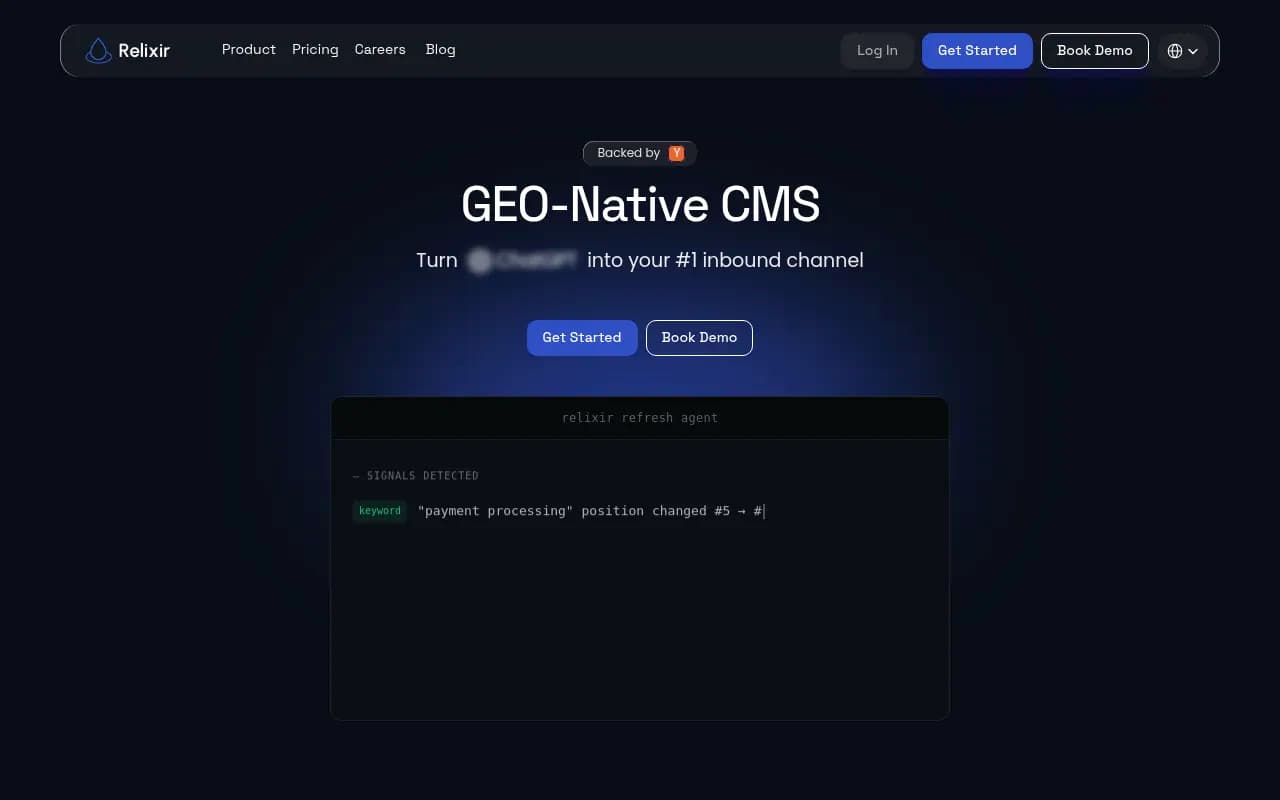
Relixir describes itself as an end-to-end GEO engine built for enterprise brands. The feature set is genuinely impressive: deep competitor analysis, content generation, citation tracking, and a focus on large-scale deployment across multiple brands and markets.
The problem for mid-market teams is the positioning. Relixir is built for Fortune 500 complexity — multiple brands, multiple markets, dedicated GEO teams. The pricing reflects that. If you're a 200-person SaaS company with one marketing team and one primary market, you're paying for capabilities you won't use, and the implementation overhead is real.
That said, if your mid-market company is on a serious growth trajectory and you're already running multi-region campaigns, Relixir is worth evaluating. It's a strong platform. It's just not optimized for the team size and budget constraints most mid-market buyers are working with.
Botify
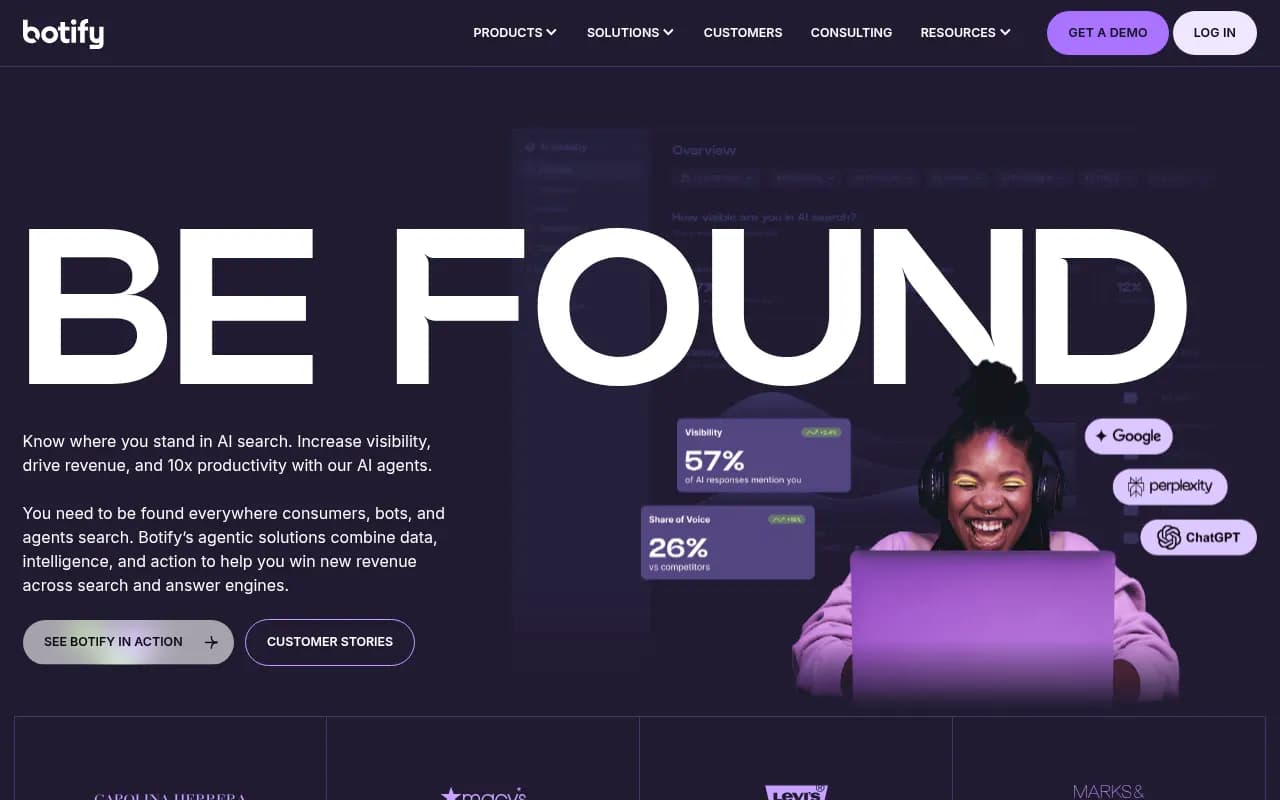
Botify is the technical SEO heavyweight in this group. Its crawl analysis, log file analysis, and site structure tools are genuinely best-in-class for large, complex websites. If you're managing a site with millions of pages and you need to understand crawl budget allocation, JavaScript rendering issues, and page-level indexation at scale — Botify is hard to beat.
The AI visibility story is newer and thinner. Botify has been adding GEO features, but the platform's DNA is technical SEO, and that shows. The prompt tracking, citation analysis, and content generation capabilities that mid-market teams need to actually compete in AI search aren't as developed as the technical crawling side.
Pricing is also a factor. Botify is enterprise-priced, with contracts typically starting well above what most mid-market teams budget for SEO tooling. You're paying for the technical depth, which is justified if you have a large, complex site — but if your primary need is AI visibility, you're buying a lot of capability you won't use.
Feature comparison
| Feature | Searchable | Promptwatch | Relixir | Botify |
|---|---|---|---|---|
| AI prompt tracking | Yes | Yes (10 models) | Yes | Limited |
| Citation analysis | Basic | Deep (4.5B+ citations) | Yes | No |
| AI crawler logs | No | Yes | Partial | Yes (traditional crawl) |
| Content gap analysis | Basic | Yes (Answer Gap Analysis) | Yes | No |
| AI content generation | Yes | Yes (Content Agents) | Yes | No |
| Reddit/YouTube insights | No | Yes | No | No |
| ChatGPT Shopping tracking | No | Yes | No | No |
| Traffic attribution | No | Yes | Yes | Yes (traditional) |
| Technical SEO depth | Low | Medium | Medium | Very high |
| Prompt volume/difficulty scoring | No | Yes | Partial | No |
| Multi-region/language | Limited | Yes | Yes | Yes |
| Mid-market pricing | Yes | Yes ($249/mo) | No (enterprise) | No (enterprise) |
| Free trial | Yes | Yes | No | No |
How each platform handles the technical SEO / AI visibility overlap
This is where the comparison gets interesting, because each platform approaches the intersection differently.
Botify treats technical SEO as the foundation and AI visibility as an add-on. That's a reasonable philosophy, but it means the AI visibility features feel bolted on rather than native. The crawler log analysis is excellent — but it's analyzing Googlebot behavior, not GPTBot behavior. Those are different crawlers with different behaviors.
Relixir approaches it from the GEO side and treats technical SEO as a supporting concern. The content generation and citation tracking are strong, but if your site has fundamental technical issues that are preventing AI crawlers from reading your pages, Relixir won't surface those problems the way Botify would.
Searchable sits in the middle without fully committing to either side. It's accessible and easy to use, but the depth on both the technical and the AI visibility sides is limited.
Promptwatch handles the overlap through its AI Crawler Logs feature, which is genuinely differentiated. You can see which pages GPTBot, ClaudeBot, and Perplexity's crawler are hitting, what errors they encounter, and when pages move from "crawled" to "cited." That's not traditional technical SEO — it's technical SEO for AI search, which is a different problem. You're not optimizing for Googlebot; you're optimizing for the crawlers that feed AI training and real-time retrieval.
For mid-market teams that don't have a dedicated technical SEO engineer, this matters a lot. You don't need Botify-level crawl analysis for a 50,000-page site. You need to know whether the AI crawlers that determine your citations are actually reading your content correctly.
Which platform is right for which team
Choose Botify if you're managing a large, technically complex website (500K+ pages) where crawl budget, JavaScript rendering, and indexation are genuine problems. You need a dedicated technical SEO resource to get value from it, and you'll want to pair it with a separate AI visibility tool.
Choose Relixir if you're an enterprise brand with multiple markets, multiple product lines, and a dedicated GEO team. The depth is there, but so is the complexity and the price tag.
Choose Searchable if you're just starting to track AI visibility and want a simple, affordable entry point. Expect to outgrow it within 6-12 months if you're serious about optimization.
Choose Promptwatch if you're a mid-market team that needs to both understand and improve AI visibility — not just monitor it. The combination of prompt tracking, Answer Gap Analysis, Content Agents, and AI Crawler Logs covers the full cycle at a price point that makes sense for teams that aren't running enterprise budgets.
A note on what "mid-market" actually needs
Mid-market teams have a specific set of constraints that enterprise tools often ignore. You have enough traffic and enough competitive pressure that AI visibility matters — but you don't have a 10-person SEO team, a $500K tooling budget, or a dedicated data analyst to build custom dashboards.
What you need is a platform that:
- Tells you where you're losing to competitors in AI search (not just that you're losing)
- Helps you create the content that closes those gaps (not just identifies them)
- Shows you whether it's working (not just at the aggregate level, but page by page)
- Doesn't require a six-month implementation to get value from
That's a short list, but most platforms in this space fail at least one of those criteria. Monitoring-only tools (and there are many) fail at #2. Enterprise platforms with complex implementations fail at #4. Tools without page-level tracking fail at #3.
Promptwatch is the platform in this comparison that hits all four for mid-market teams. The others have real strengths — Botify's technical depth is unmatched, Relixir's enterprise GEO capabilities are serious — but they're optimized for different buyers.
The bottom line
The question isn't really "which platform has the most features." It's "which platform will actually move the needle for a team our size, with our budget, in the next 90 days."
For most mid-market teams, that answer is Promptwatch. It's the only platform here that closes the full loop from gap identification to content creation to results tracking, at a price point that doesn't require a board-level budget conversation.
If you have a genuinely complex technical SEO problem on a large site, pair Botify with Promptwatch. If you're enterprise and need multi-market GEO at scale, evaluate Relixir. If you're just starting out and want to dip a toe in, Searchable is a low-risk starting point.
But if you want to actually compete in AI search — not just watch your competitors do it — the action loop matters more than any individual feature. That's what separates a monitoring dashboard from an optimization platform.