Key takeaways
- Searchable is a full AI visibility platform with monitoring, content generation, and technical optimization built in. Search Party is an AI automation consultancy that builds custom workflows -- it's a service, not a self-serve SaaS tool.
- If your agency needs a scalable, repeatable system for tracking and improving client AI visibility, Searchable is the more direct fit.
- Search Party makes sense if you want bespoke automation built around your existing agency stack, not a platform you log into every day.
- Neither tool covers the full picture on its own. For agencies that want monitoring, content gap analysis, crawler logs, and prompt intelligence in one place, Promptwatch is worth a serious look.
- The biggest mistake agencies make is picking a monitoring tool and calling it a strategy. Visibility in AI search requires both tracking and action.
Why this comparison matters right now
AI search has moved from "interesting experiment" to "real traffic source" faster than most agencies expected. Perplexity, ChatGPT, Google AI Mode, and Gemini are now generating meaningful referral traffic for many brands -- and in some verticals, AI-referred visitors convert at roughly twice the rate of traditional organic visitors, according to Searchable's own published data.
That shift has created a new category of tools: AI visibility platforms. And agencies are right in the middle of it, trying to figure out which platforms to build services around and which to recommend to clients.
Searchable and Search Party are two names that come up in agency conversations, but they're not really the same type of product. Putting them side by side reveals a lot about what agencies actually need in 2026.
What Searchable actually is
Searchable is a self-serve AI search visibility platform built for brands and agencies. It tracks how brands appear across AI engines -- ChatGPT, Perplexity, Gemini, Claude, Google AI Mode -- and pairs that monitoring with tools to act on what you find.
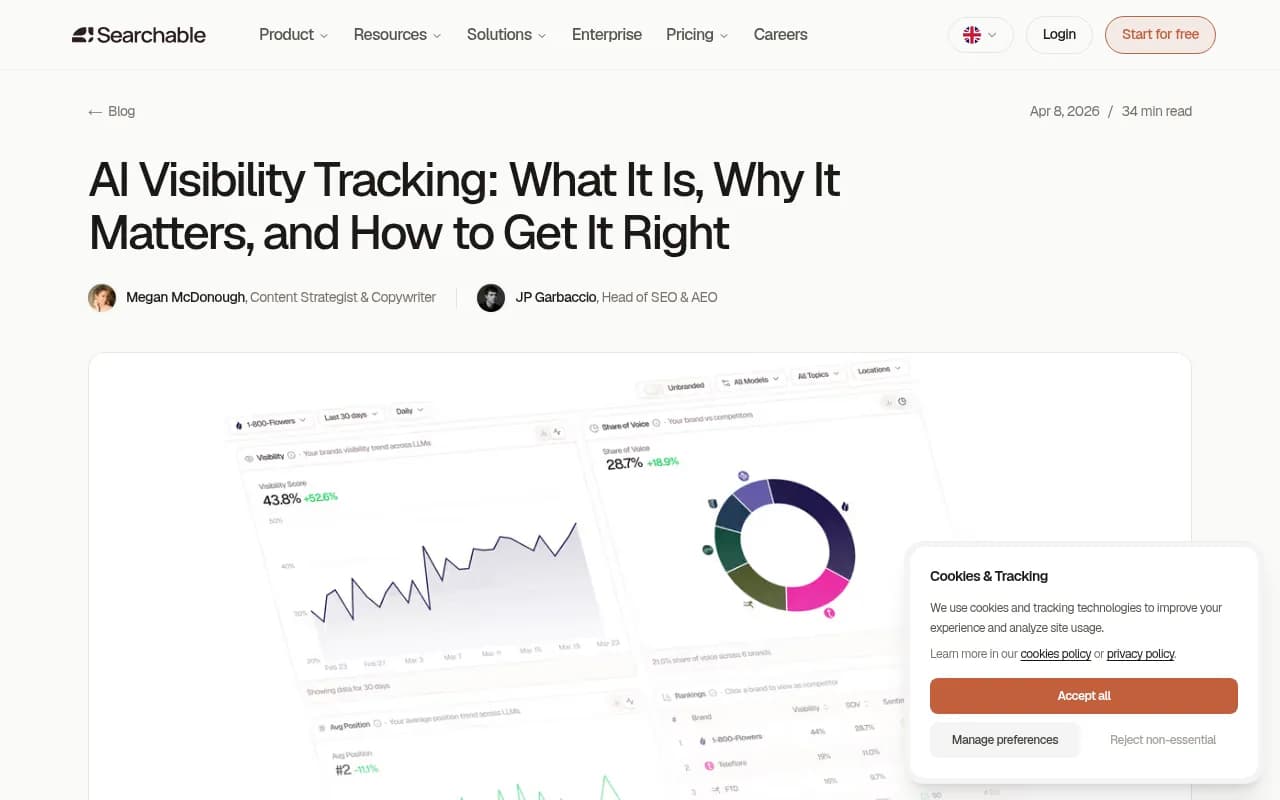
The feature set covers several distinct areas:
- AEO Insights and LLM Analytics for tracking brand mentions and citation rates across models
- Prompt Intelligence for understanding which queries are driving AI responses in your category
- Content Studio for generating and optimizing content based on visibility gaps
- Technical Optimization tools for on-page and structural improvements
- AI Shopping tracking for brands that sell products
- An MCP (Model Context Protocol) integration and an Agent feature for more automated workflows
- A free Visibility Report and Agent Shopping Audit for prospecting or quick audits
The agency angle is explicit -- Searchable has a dedicated agencies solution page and positions itself as a platform that scales across multiple client accounts.
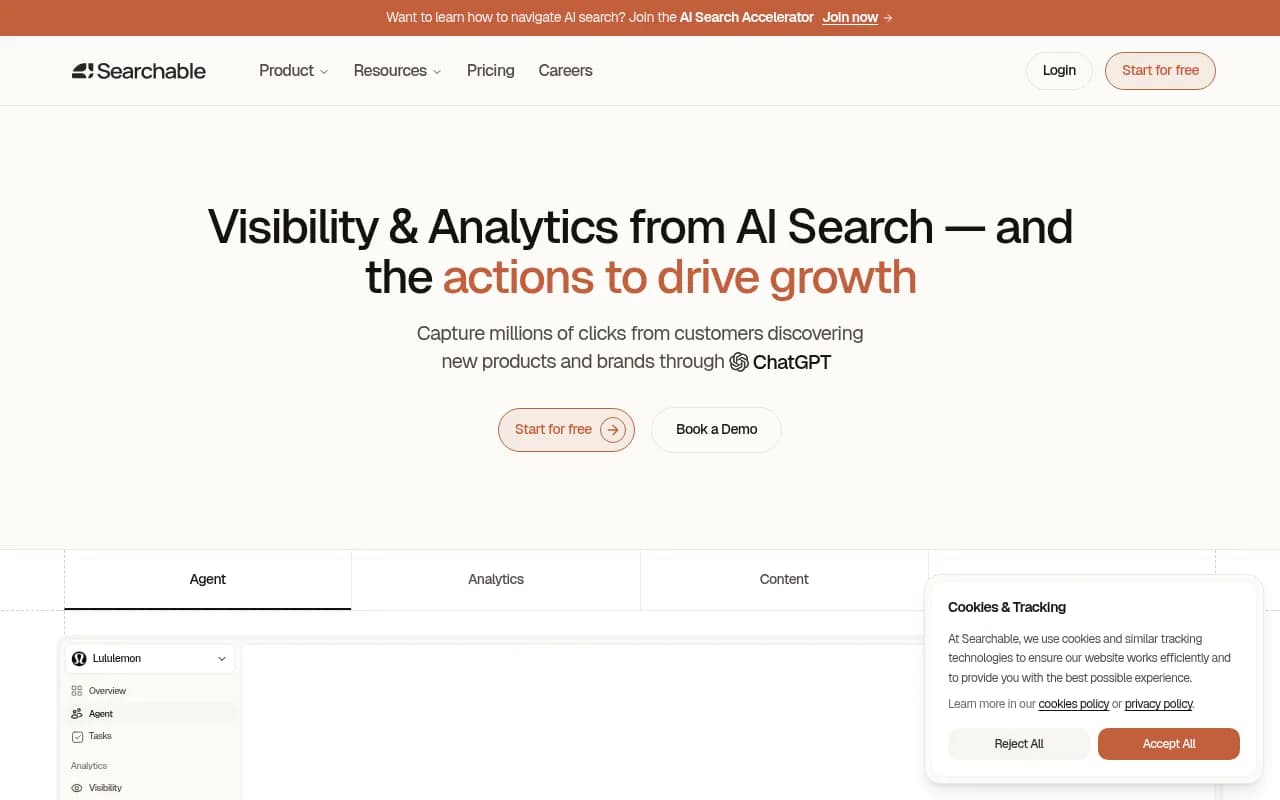
What's genuinely useful about Searchable's approach is that it doesn't stop at "here's where you appeared." The Content Studio means you can identify a gap and start addressing it without switching tools. That matters for agencies trying to build repeatable workflows.
What Search Party actually is
Search Party describes itself as an AI automation consultancy. The distinction is important: it's not a SaaS platform you buy a subscription to and log into. It's a service that builds custom AI-powered workflows to eliminate manual, repetitive work inside your agency or client's marketing operation.
Search Party
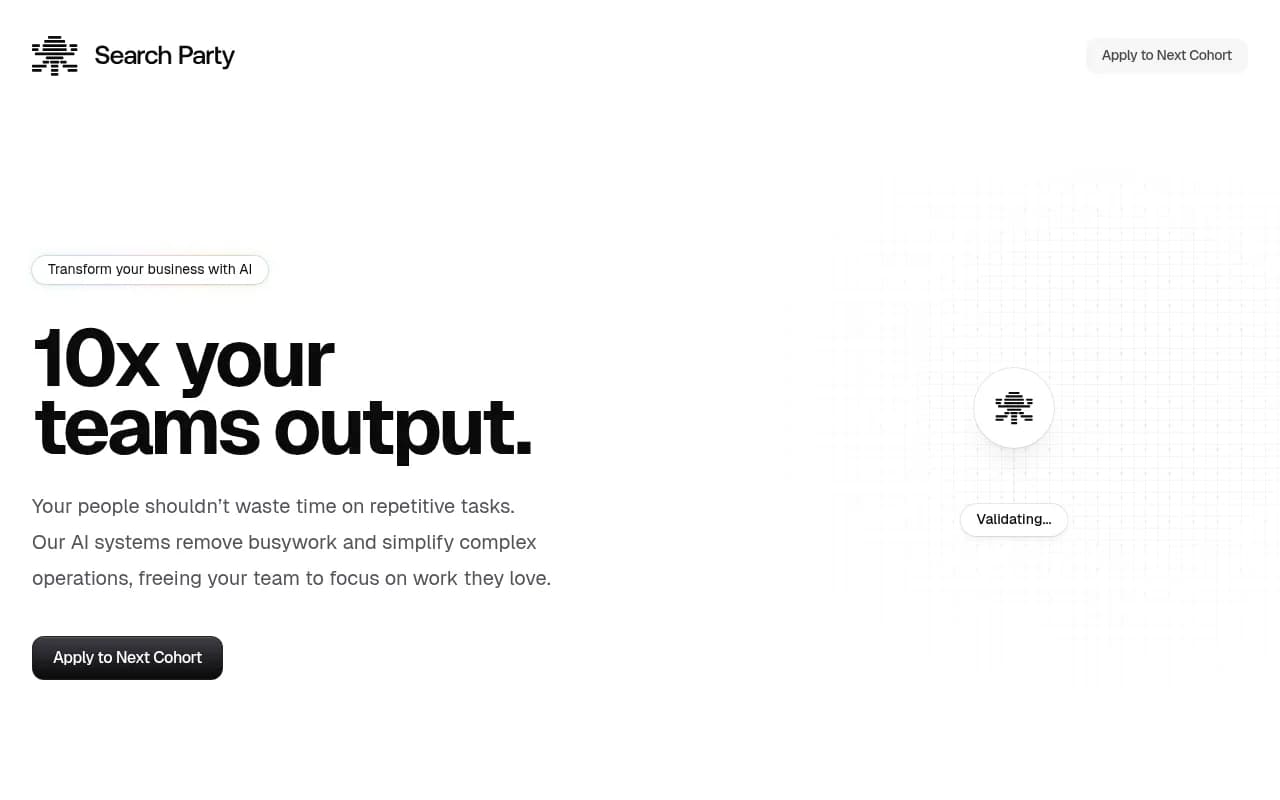
Think less "dashboard" and more "bespoke automation built for your specific stack." Search Party's value proposition is that it engineers the workflows -- connecting your existing tools, automating the busywork, and building systems that run without constant human input.
For some agencies, that's exactly what they need. If you've already got monitoring tools and you're drowning in manual reporting, campaign setup, or content operations, a consultancy that builds the automation layer can be transformative.
But it's not a monitoring platform. It won't tell you which AI models are citing your clients or how your brand sentiment is trending in Perplexity responses. That's simply not what it does.
Head-to-head comparison
| Feature | Searchable | Search Party |
|---|---|---|
| Product type | Self-serve SaaS platform | AI automation consultancy |
| AI model monitoring | Yes (ChatGPT, Perplexity, Gemini, Claude, AI Mode) | No |
| Citation tracking | Yes | No |
| Prompt intelligence | Yes | No |
| Content generation | Yes (Content Studio) | Custom builds only |
| Technical optimization | Yes | Depends on engagement |
| AI Shopping tracking | Yes | No |
| Agency multi-client support | Yes | Yes (service-based) |
| Free trial / free tools | Yes (free Visibility Report) | No standard free tier |
| Pricing model | Subscription (SaaS) | Consultancy / project-based |
| Best for | Agencies wanting a scalable AI visibility platform | Agencies wanting custom workflow automation |
The table makes the core difference obvious: these tools solve different problems. Searchable is for agencies that want to monitor and improve AI visibility at scale. Search Party is for agencies that want custom automation built around their existing processes.
Where Searchable has an edge
For most agencies building an AI visibility practice, Searchable is the more immediately useful tool. You can onboard a new client, run a visibility report, identify content gaps, and start generating optimized content -- all inside one platform.
The Prompt Intelligence feature is worth calling out specifically. Understanding which queries are driving AI responses in a client's category isn't just interesting data -- it's the foundation of a content strategy. Without it, you're guessing.
The AI Shopping tracking is also genuinely differentiated. Most monitoring platforms ignore the product recommendation layer entirely. For e-commerce clients, that's a significant blind spot.
Where Searchable is thinner: the platform is newer than some competitors, and the depth of prompt volume data and difficulty scoring isn't as developed as platforms like Profound or Promptwatch. Agencies working with enterprise clients who need governance, SOC 2 compliance, or very large prompt sets may find they hit limits.
Where Search Party has an edge
If your agency's problem isn't "we don't know where our clients appear in AI search" but rather "we're spending 20 hours a week on manual tasks that should be automated," Search Party is the right conversation to have.
Custom automation that connects your CRM, your reporting stack, your content tools, and your client communication workflows can save significant time. And unlike a SaaS subscription, you get something built specifically for how your agency operates.
The downside is that it's a consultancy engagement, not a product. Timelines, costs, and outcomes depend heavily on the scope of the project and the quality of the engagement. There's no dashboard to log into, no self-serve onboarding, and no way to quickly spin up a new client without going back through the service process.
What agencies actually need in 2026
The honest answer is that most agencies need both types of capability -- monitoring and action -- but they don't need to get them from the same vendor.
What a strong agency AI visibility stack looks like in practice:
- A platform that tracks brand mentions, citation rates, and sentiment across the major AI models
- Prompt intelligence to prioritize which queries matter most
- Content gap analysis to know what to create
- Content generation tools to actually create it
- Crawler log access to understand how AI agents are discovering (or failing to discover) client content
- Reporting that ties visibility to traffic and revenue
Searchable covers most of this. Search Party covers none of the monitoring side, but can help automate the operational layer once you have the data.
For agencies that want a single platform covering the full loop, Promptwatch is worth evaluating alongside Searchable. It tracks 10 AI models, includes AI crawler logs (which show exactly which pages AI agents are reading and when they move from crawl to citation), has content gap analysis and content generation built in, and connects visibility data to actual traffic attribution. It's used by 1,480+ brands and agencies including Booking.com and Center Parcs.

Other platforms worth knowing
Depending on your agency's specific needs, a few other tools are worth putting on your radar.
For enterprise clients who need deep benchmarking and SOC 2 compliance:
Profound

For clean, focused monitoring across 9+ AI models at a lower price point:

For agencies that already use Semrush and want to add AI visibility without switching platforms:
For tracking brand mentions across AI engines with a lightweight setup:
Otterly.AI

How to choose
The decision between Searchable and Search Party isn't really a feature comparison -- it's a question of what problem you're trying to solve.
If you're building an AI visibility service offering and need a platform your team can use to monitor, analyze, and improve client visibility across AI search engines, Searchable is the right starting point. It's a real product with real monitoring and content tools.
If you've already got monitoring in place and your agency's bottleneck is operational -- too much manual work, disconnected tools, reporting that takes forever -- then Search Party's consultancy model might be exactly what you need.
Most agencies will eventually need both: a platform for visibility intelligence and some level of automation to make the workflow sustainable at scale. The mistake is thinking one tool solves everything.
Start with the monitoring. Know where your clients stand. Then build the automation layer around what you actually find.
Bottom line
Searchable is a legitimate AI visibility platform with a solid feature set for agencies. Search Party is a different animal entirely -- a consultancy that builds automation, not a monitoring tool.
They're not really competitors. They're tools for different stages of the same problem.
If you're evaluating platforms for an AI visibility practice in 2026, Searchable deserves a serious look. So does Promptwatch, which goes further on crawler analytics, prompt intelligence, and the content-to-citation feedback loop that agencies need to show clients real results.
The agencies winning in AI search right now aren't just tracking visibility -- they're using that data to create content that fills the gaps, then watching their citation rates climb. That's the loop worth building around.