Key takeaways
- Three-quarters of enterprise leaders tell Forrester they're "adopting" agentic AI, but only a small minority have anything running in meaningful production beyond glorified chatbots.
- "Agentic SEO" became a real category in early 2026, but most content using the term still describes a human using smarter tools, not an autonomous system. There's a useful three-level autonomy spectrum to sort hype from reality.
- 98% of enterprise CMOs say they're investing in AEO/GEO, yet only about 14% actually track whether ChatGPT, Claude, Gemini, or Perplexity cite them. That gap, not the technology, is the real bottleneck.
- The retrieval layer agents have to work with keeps shifting under their feet: ChatGPT's average citations per response dropped roughly 27% after the GPT-5.3 rollout, and it started running site-specific searches at scale in August. Static SEO playbooks can't keep up with that; monitoring has to be continuous.
- Full autonomy (Level 3, no human in the loop) barely exists commercially. The teams getting real results keep a human approval gate at the publish step, not because the AI can't write, but because the mistakes that slip through are the ones nobody catches until it's too late.
Everyone says agentic, almost nobody means it
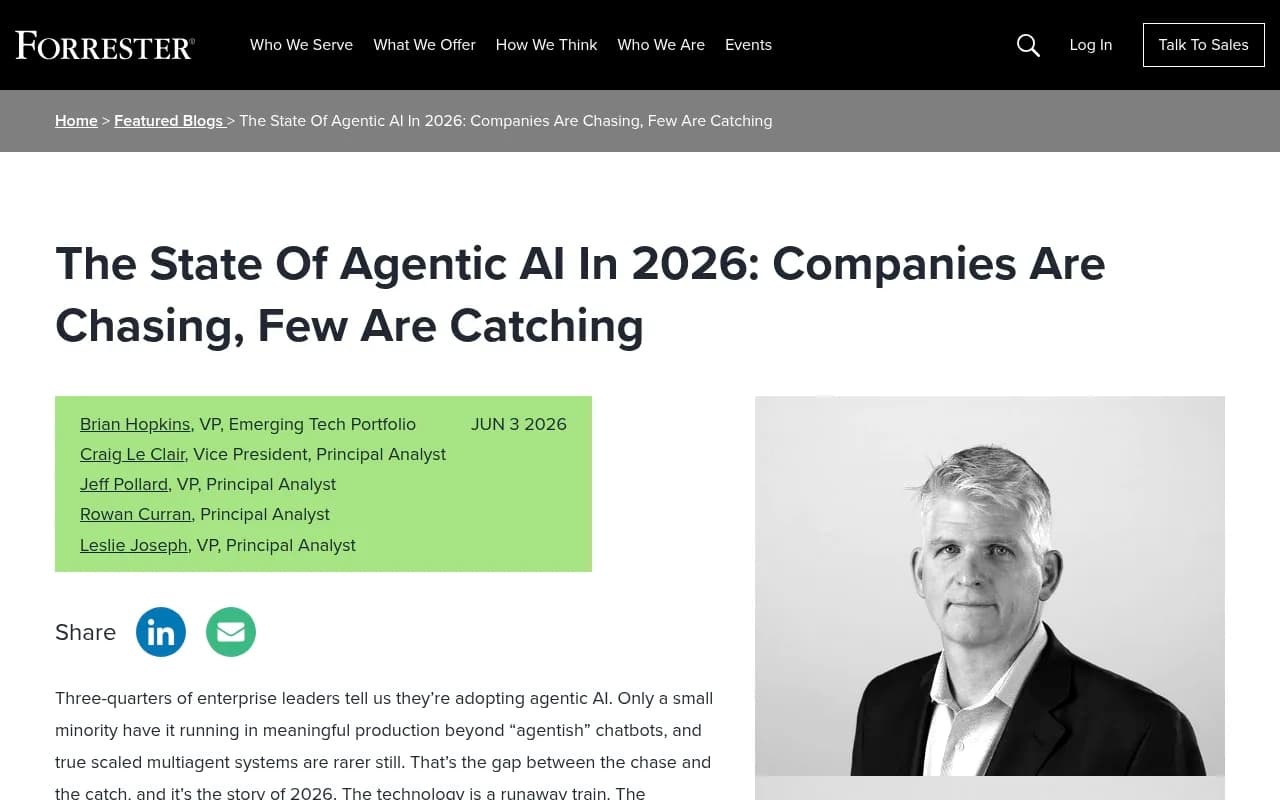
Ask ten marketing leaders if they've adopted agentic AI SEO and eight will say yes. Ask them what "agentic" means in their stack and you'll get eight different answers, most of which describe a chatbot with a nicer UI. Forrester put this bluntly in its 2026 state-of-the-market report: three-quarters of enterprise leaders report adopting agentic AI, but only a small minority have it running in meaningful production, and true scaled multi-agent systems are rarer still. Their framing is that the technology is a runaway train and the enterprise is the heavy load it has to pull.
That gap isn't unique to SEO. Gartner's 2026 Hype Cycle places agentic AI at the Peak of Inflated Expectations, with only 17% of organizations actually having deployed AI agents while more than 60% plan to within two years. MuleSoft's 2026 Connectivity Benchmark adds a sharper detail: half of AI agents currently operate in isolated silos, and 86% of IT leaders say that without proper integration, agents add more complexity than value rather than less.
SEO and content teams sit right in the middle of this pattern. Industry surveys put enterprise CMO investment in AEO/GEO at 98%, with 94% planning to increase budget again in 2026 and AEO/GEO ranked the top strategic marketing priority for the year. And yet, per the same research, only around 14% of marketers actually track whether they get cited by ChatGPT, Claude, Gemini, or Perplexity. Spending money on visibility you can't measure is not a strategy, it's a bet. That measurement gap is arguably the single biggest unclaimed advantage available to marketers right now, and it's the reason a whole category of AI visibility platforms exists.
What "agentic" actually means, and the three levels worth knowing
A generative AI tool answers a prompt. An agentic system pursues a goal across many steps: it plans, calls tools, checks its own output, and adjusts when something fails. The distinction matters because vendors have every incentive to blur it. Industry analysts estimate that of the thousands of companies marketing "AI agents," only around 130 are building genuinely agentic systems. The rest are "agent washing," a term that's now serious enough to carry securities-disclosure risk in the US for companies that overstate what their product actually does.
A practitioner framing that's held up well in 2026 splits agentic SEO into three levels of autonomy:
| Level | What it looks like | Who's driving | Example tools |
|---|---|---|---|
| Level 1: AI-assisted | AI helps with discrete tasks (outlines, meta descriptions, keyword clusters) | Human, entirely | ChatGPT, Surfer SEO, Clearscope |
| Level 2: AI-augmented | AI runs a full workflow end to end, human coordinates between stages | Human triggers, AI executes | Frase, OTTO by Search Atlas, Alli AI |
| Level 3: Autonomous | Multiple specialized agents coordinate research through publish, human approval gates at checkpoints only | AI, with human sign-off at key stages | Custom multi-agent pipelines |
Most teams in 2026 are sitting at Level 1, some ambitious ones have reached Level 2, and no single commercial product covers Level 3 out of the box. The organizations that have built real Level 3 pipelines did it themselves, usually with a handful of specialized agents (research, writing, analytics, distribution) stitched together with tools like n8n rather than one monolithic AI doing everything.
Where agentic SEO is actually working
The honest examples are narrower than the marketing copy suggests, but they're real. One production system documented by practitioners runs four core agents plus two support agents: a research agent alone produces more than 40 content briefs a month by automating keyword tracking, SERP monitoring, and GEO monitoring across nine AI search engines. The team's biggest architectural lesson wasn't about model choice, it was about timing. They started with scheduled cron jobs, which meant a brief that finished research at 10am could sit idle until a 2pm writing job kicked off. Switching to a completion-triggered cascade, where a finished stage immediately hands off to the next one, let an item move from brief to published draft in a single pass through quality gates.
A similar lesson shows up in Search Engine Land's practical n8n walkthrough: when they tried to make one AI agent both summarize search news and convert it to HTML in a single large prompt, quality degraded, likely from context limits. Splitting it into two narrow, single-purpose agent nodes fixed it. The pattern generalizes: narrow agents chained together beat one large agent trying to do everything.
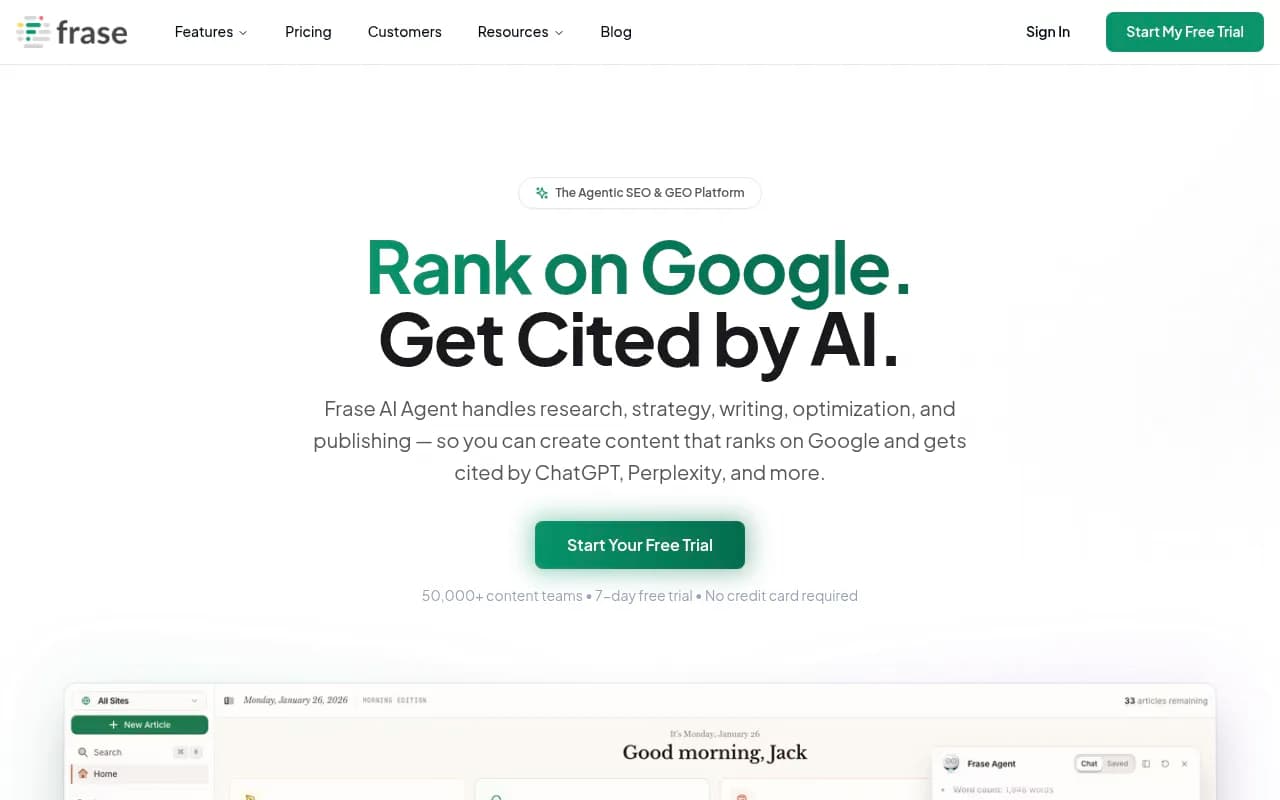
On the commercial side, Frase has built its positioning around being what it calls a full-stack SEO agent, automating what it frames as six pipeline stages (research, strategy, write, audit, monitor, fix), where most competitors, by its own scoring, cover no more than three. Its Content Guard feature autonomously detects ranking or traffic drops, diagnoses the likely cause, and generates a fix, either as a one-click suggestion or fully automatically for teams that opt in. Pricing runs from $49/mo (Starter, 10 articles/month) to $299/mo (Scale, unlimited articles and audits), with a $129/mo Professional tier in between.
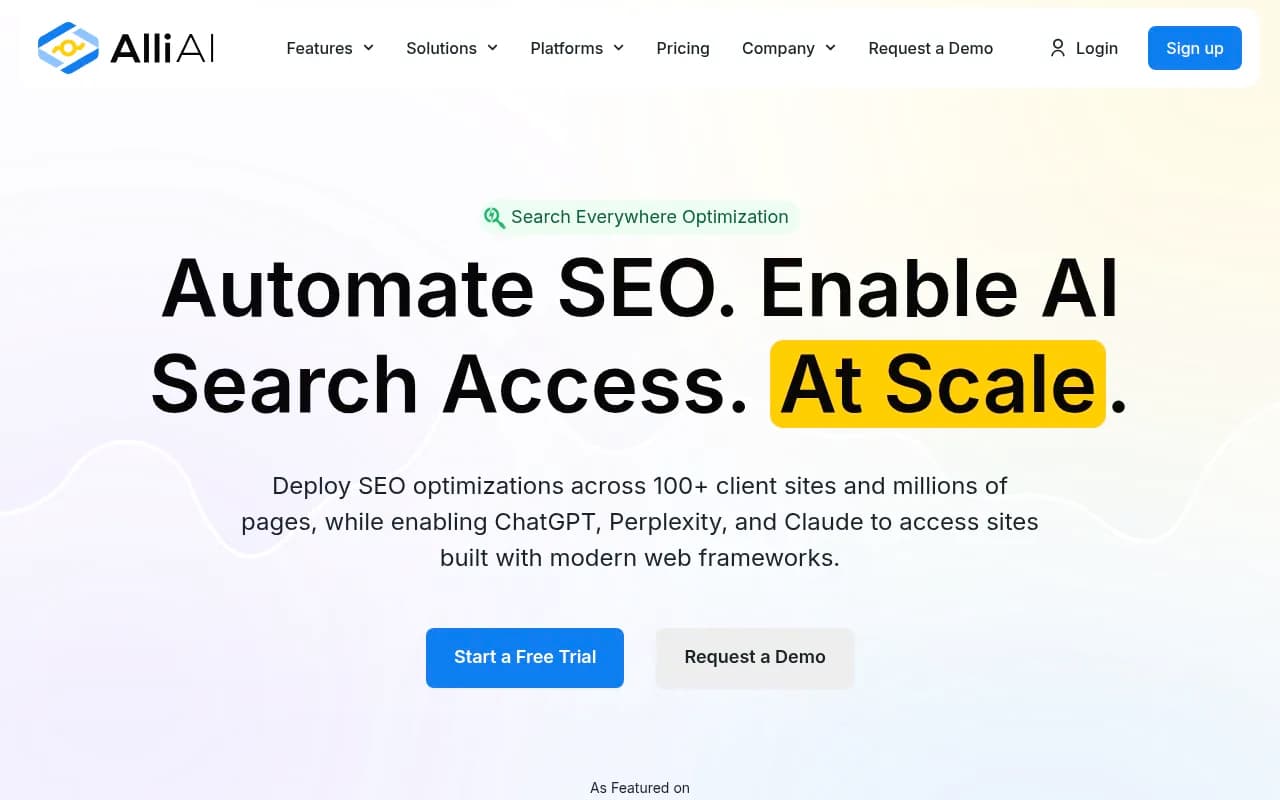
At the more aggressive end, tools like Alli AI and BrightEdge Autopilot actually implement changes directly on a live site rather than just recommending them, rewriting titles and meta descriptions across thousands of pages in hours. BrightEdge claims a 23% average CTR lift from this kind of autonomous rewriting; Alli AI claims 18% from a similar mechanism across 10,000+ pages. Those numbers come from vendor case studies, so treat them as a ceiling, not a guarantee, but the mechanism is genuinely autonomous in a way a lot of "agentic" tooling isn't.
Why skepticism is warranted, and where agents actually break
The failure modes aren't exotic, they're the same ones that show up whenever you give software write access to something important. A few show up repeatedly across practitioner reports:
- Hallucinated facts. Agents confidently citing statistics, competitor claims, or pricing details they generated rather than found. This is the failure mode most likely to create legal exposure, not just an embarrassing correction.
- Technical autofixes gone wrong. An agent with write access to robots.txt, canonicals, redirects, or sitemaps can deindex a site in one bad pass, from good intent.
- Coordination failures between agents. A research stage finds strong competitive data that the writing stage ignores entirely, producing a brief-compliant draft that reads flat because nothing actually built on the research.
- Over-automation at scale. Vague prompts push agents to optimize for the wrong metric, like keyword density instead of user intent, and without a review layer, a bad change can propagate across thousands of pages before anyone notices.
This is exactly why the teams with real production systems keep a human approval gate at the point of publishing, even when their quality gates could technically allow full autonomy. The reasoning, from one practitioner's own writeup, is blunt: the failures that slip through review are harder to detect than they are to prevent by just having someone look. Every draft in their pipeline passes a self-review stage that checks against 25+ banned voice patterns and verifies source attribution before a human ever sees it, and even then a human signs off.
On the governance side, the picture is worse than most SEO teams realize. Only about 1 in 5 companies has a mature governance model for autonomous AI agents. Separate enterprise research found that 63% of organizations can't enforce purpose limitations on their agents, 60% can't quickly terminate a misbehaving agent, and 55% can't isolate an AI system from sensitive networks once something goes wrong. None of that is specific to SEO, but it's exactly the infrastructure you'd want in place before letting an agent touch your CMS, your redirects, or your site structure.
The ground keeps moving: what agents are actually optimizing against
Here's the part that gets lost in most "agentic SEO" content: even a perfectly built agent is optimizing against a retrieval system that changes without notice. This is Promptwatch's territory, and its data makes the case for continuous monitoring better than any pitch deck could.
After OpenAI's GPT-5.3 rollout on March 4, 2026, average citations per ChatGPT response dropped by roughly 27%, from about 6.4 sources pre-rollout to 4.7-4.9 by late March, with no recovery a month later. That's not something any individual site did wrong; it hit every ChatGPT model simultaneously, per Promptwatch's data on the ChatGPT citation drop. If your agent is publishing content optimized for a citation-slot count that no longer exists, it's optimizing for a world that already ended.
The retrieval mechanics keep shifting too. ChatGPT started running site: operator searches against specific domains at scale on August 8, 2026, jumping from roughly 0.4% to nearly 17% of all fanout queries in a single day, per Promptwatch's data on ChatGPT's site-operator fanouts. Average query length also dropped from around 117 characters in December to roughly 53 characters by April, meaning ChatGPT increasingly searches like someone typing keywords, not full sentences, according to Promptwatch's query fanout tracking. And citation slot scarcity isn't uniform across engines: ChatGPT cites around 5 sources per response, Google AI Overviews cites roughly double that at 10, and Perplexity holds steady at almost exactly 10 with barely any day-to-day variance, per Promptwatch's data on average sources per response. Microsoft Copilot, by contrast, swung from under 2 to nearly 17 sources per response within a few weeks, evidence it's still being re-architected.
An agent that isn't reading this kind of data is flying blind. This is the actual argument for agentic monitoring layered on top of agentic content production: the target keeps moving, and a one-off audit from January is worthless by September.
Where AI visibility monitoring fits in
This is where Promptwatch is directly relevant, not as a bolt-on tracker but as the layer that tells an agentic content pipeline what to actually go build. Rather than just reporting whether you were mentioned, it tracks AI crawler logs to show which pages get read and where they error out, citation trends across 22 content types, offsite mentions on Reddit and third-party pages, and real visitor traffic from AI platforms, then turns that into a prioritized action list and, if you want it, automated content generation and CMS publishing. It's closer to a Level 2/3 agentic system for the "monitor and fix" half of the SEO pipeline than a passive dashboard.

For teams evaluating the wider set of monitoring-only competitors, most stop at the "were we mentioned" question and lack crawler logs, Reddit/YouTube tracking, or any content-generation layer at all.
Tool landscape at a glance
| Tool | Autonomy level | What it actually automates | Starting price |
|---|---|---|---|
| Frase | Level 2 | Research, brief, write, audit, monitor, fix | $49/mo |
| Alli AI | Level 2 | Live on-page changes (titles, meta, schema, links) | $299/mo |
| BrightEdge Autopilot | Level 2-3 | Autonomous title/meta rewriting at enterprise scale | ~$3,000/mo |
| n8n + custom agents | Level 3 (self-built) | Full pipeline, fully customizable | Free/self-hosted, or paid cloud tiers |
| Promptwatch | Level 2-3 (monitor + fix) | Crawler logs, citation tracking, content briefs, CMS publishing | $95/mo |
| Profound | Level 1-2 (monitoring + action layer) | AI visibility tracking, some action recommendations | $99/mo (ChatGPT only) |
A realistic way to start
If you're evaluating where to put your first agentic SEO investment in 2026, the pattern that separates working systems from expensive demos is consistent: start with monitoring you actually trust, keep a human at the publish gate, and only automate the steps you've verified enough times to stop checking. Don't chase Level 3 autonomy for its own sake. Most of the value shows up at Level 2, where an agent handles a full workflow but a person still decides what gets published.
If you want to see the wider category of agentic and GEO-specific platforms side by side, the directories at bestgeosoftware.com and agenticseotools.com track most of the credible players, which is a useful sanity check against vendor marketing before you commit budget. The technology genuinely works in the right, narrow contexts. The organizations winning with it in 2026 aren't the ones with the most autonomous system, they're the ones who built the smallest amount of autonomy that actually held up under review.