Key takeaways
- GEO platforms in 2026 fall into four feature categories: monitoring, gap analysis, content generation, and technical optimization. Only two of these reliably drive citations.
- Monitoring dashboards are necessary but not sufficient. Knowing you're invisible doesn't make you visible.
- Answer gap analysis and AI-native content generation are the features most directly tied to citation gains.
- Technical readiness features (crawler logs, schema audits, JS rendering) are underrated and often ignored by teams focused on content metrics.
- Several popular platforms stop at category one or two. If your tool can't generate content or fix technical issues, you're paying for a rearview mirror.
There's a pattern playing out across marketing teams right now. Someone buys a GEO platform, sets up their brand prompts, watches their visibility score for a few weeks, and then... nothing changes. The score stays flat. Citations don't appear. The tool gets written off as "not ready yet."
The problem usually isn't the category of tool. It's that the team bought a monitoring product thinking it was an optimization product. Those are very different things.
In 2026, the GEO platform market has matured enough that you can draw a clear line between features that generate citations and features that generate reports. This guide breaks that line down into four distinct feature types, explains what each one actually does, and tells you which ones are worth paying for.
Type 1: Monitoring and visibility tracking
This is where every GEO platform starts. You define a set of prompts ("best project management software for remote teams," "top CRM for B2B sales"), the platform queries AI engines on your behalf, and it tells you whether your brand appears in the response.
Monitoring features typically include:
- Brand mention detection across ChatGPT, Perplexity, Google AI Overviews, Gemini, and others
- Share-of-voice scoring (what percentage of relevant AI responses mention you vs. competitors)
- Sentiment tracking (when you are mentioned, is it positive, neutral, or negative?)
- Competitor heatmaps showing who's winning which prompts
This is genuinely useful data. You can't optimize what you can't measure, and knowing your baseline visibility across 10 AI models is a real starting point. The problem is that most platforms stop here. They give you a score, maybe a trend line, and leave you to figure out what to do next.
Monitoring alone is a rearview mirror. It tells you where you were, not how to get somewhere better.
Tools that focus primarily on this layer include Otterly.AI, Peec AI, and several lighter-weight trackers. They're fine for awareness, but they're not optimization platforms.
Otterly.AI


For teams that need monitoring across a large number of prompts and models, with proper multi-region and multi-language support, the monitoring layer in a full-stack platform like Promptwatch covers 10 AI engines simultaneously and tracks real user-interface responses rather than API outputs (which can differ meaningfully from what users actually see).

What monitoring features drive: Awareness. Benchmarks. Reporting to stakeholders. They don't drive citations by themselves.
Type 2: Gap analysis and prompt intelligence
This is where things start to get interesting. Gap analysis features answer a different question than monitoring: not "are we visible?" but "where specifically are we invisible, and why?"
The best implementations of this feature type show you:
- Which prompts your competitors appear in that you don't
- Which topics and questions AI models are answering without citing your site
- Prompt volume estimates (how often real users are asking this)
- Difficulty scores (how competitive is this prompt space?)
- Query fan-outs: how one prompt branches into related sub-queries
This is genuinely actionable intelligence. If you know that ChatGPT is citing three competitors for "email marketing tools for ecommerce" but not you, and you know that prompt gets asked frequently, you have a specific content problem to solve. You know what to write.
The limitation is that gap analysis is still a diagnostic, not a treatment. It tells you what's missing. It doesn't create the missing content.
Several platforms have built solid gap analysis features. AthenaHQ has invested heavily in this layer. Profound does reasonable work here for enterprise teams. But both stop short of the next step.

Profound

What gap analysis features drive: Prioritization. A clear content roadmap. The ability to stop guessing and start targeting specific citation opportunities. But still no actual citations until you act on the data.
Type 3: AI-native content generation
This is the feature type that actually moves the citation needle, and it's the one most platforms either skip entirely or implement poorly.
The distinction matters: generic AI content generation (write me a blog post about X) is not the same as citation-engineered content generation. The latter uses real prompt data, competitor citation analysis, brand guidance, and knowledge of what AI models are actually looking for when they select sources.
What good content generation features look like in practice:
- Content briefs built from real gap analysis data, not keyword guesses
- Articles and listicles structured for AI extractability (chunked, semantically clear, entity-rich)
- Comparison pages and FAQ content targeting specific high-volume prompts
- Brand voice and instruction integration so output isn't generic filler
- Competitor citation analysis baked into the brief (what are cited pages doing that yours aren't?)
The reason this matters so much is that AI models have clear preferences for content structure. They favor pages that answer questions directly, use clean heading hierarchies, contain verifiable facts, and don't bury the answer in marketing copy. Content generated without understanding those preferences tends to rank fine in traditional SEO but gets ignored by LLMs.
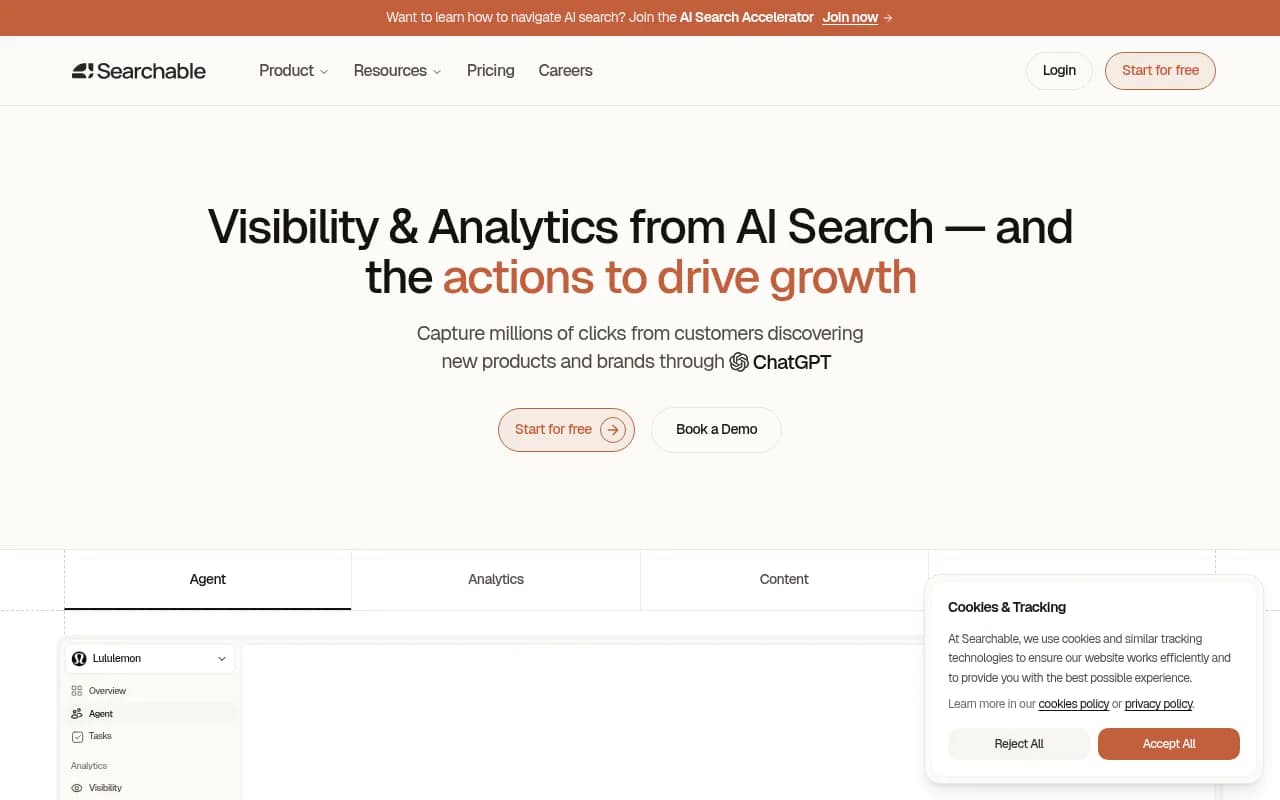
A few platforms have built this out properly. Promptwatch's Content Agents generate articles grounded in real prompt data, citation analysis, and prompt volumes. The output is engineered for AI retrieval, not just keyword density. Searchable has also built content generation into its platform, though with less depth on the prompt intelligence side.
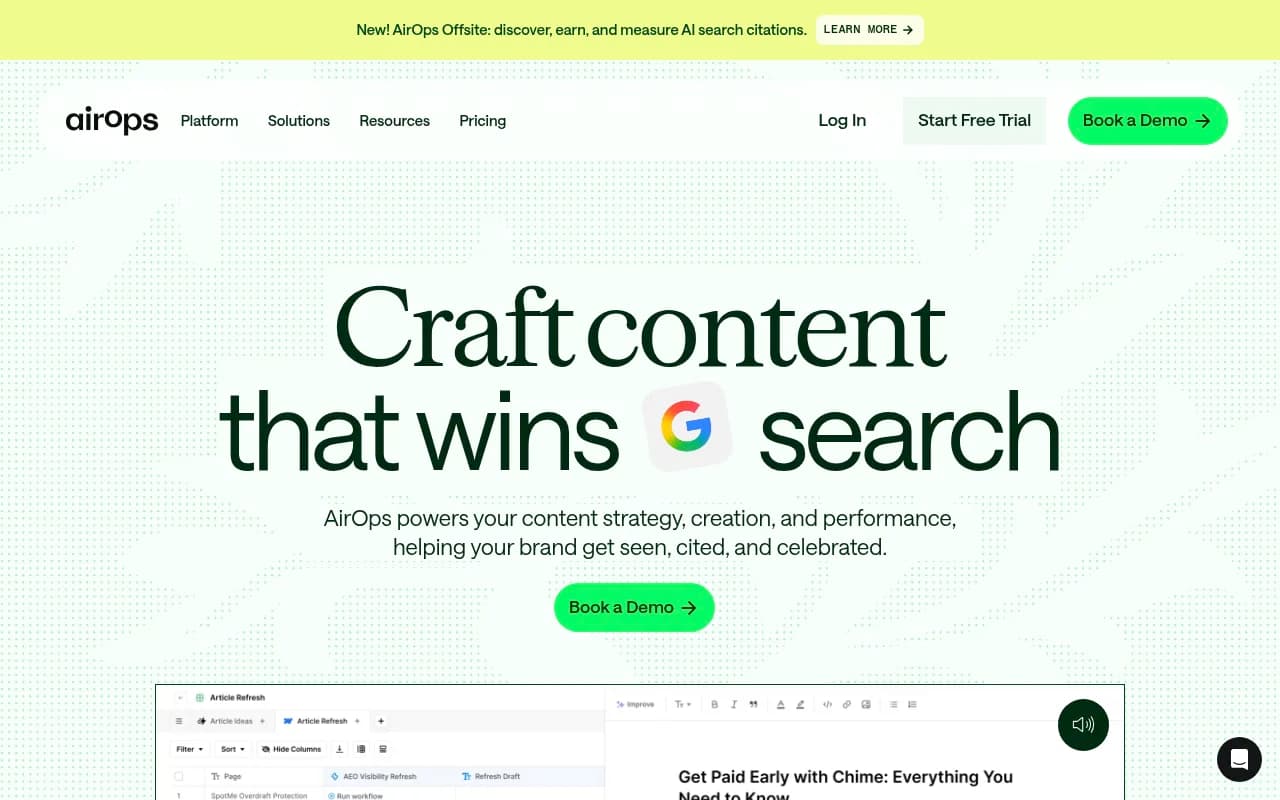
For teams that want content generation as a standalone workflow, AirOps has built an end-to-end content engineering approach worth looking at.
What content generation features drive: Actual citations. This is the feature type with the most direct connection to visibility gains. Pages that are built to answer specific AI prompts, structured for extraction, and published with proper technical hygiene start appearing in AI responses within weeks of being crawled.
Type 4: Technical AI readiness features
This is the most underrated category, and the one most teams discover they need only after everything else has failed to move the needle.
Here's the uncomfortable truth: you can have perfect content that never gets cited because AI crawlers can't read it. If your site relies on client-side JavaScript rendering, your React app might be showing AI crawlers a blank page. If your schema markup is missing or malformed, AI models can't understand the relationships between your content, your brand, and the topics you cover. If your server returns errors when GPTBot or ClaudeBot visits, those pages simply don't exist in the model's world.
Technical AI readiness features include:
- AI crawler log monitoring (which bots are hitting your site, how often, which pages they're reading, what errors they're encountering)
- Schema markup auditing and recommendations
- JavaScript rendering detection (are your pages actually visible to AI crawlers?)
- Page-level citation tracking (which specific pages are being cited, and which are being crawled but not cited)
- Crawl-to-citation timeline analysis (how long after a page is crawled does it start appearing in responses?)
Most GEO platforms have almost nothing in this category. It requires actual infrastructure: integrations with CDN edge networks, server log access, or tracking snippets that capture bot behavior in real time. That's harder to build than a dashboard.
The platforms that have invested here are meaningfully ahead. Promptwatch's crawler log feature (available on Professional and Business plans) shows real-time logs of AI crawlers hitting your site, including which pages they read, errors they encounter, and how often they return. This is the kind of data that explains why a perfectly written page isn't getting cited: the bot visited once, hit a 500 error, and never came back.
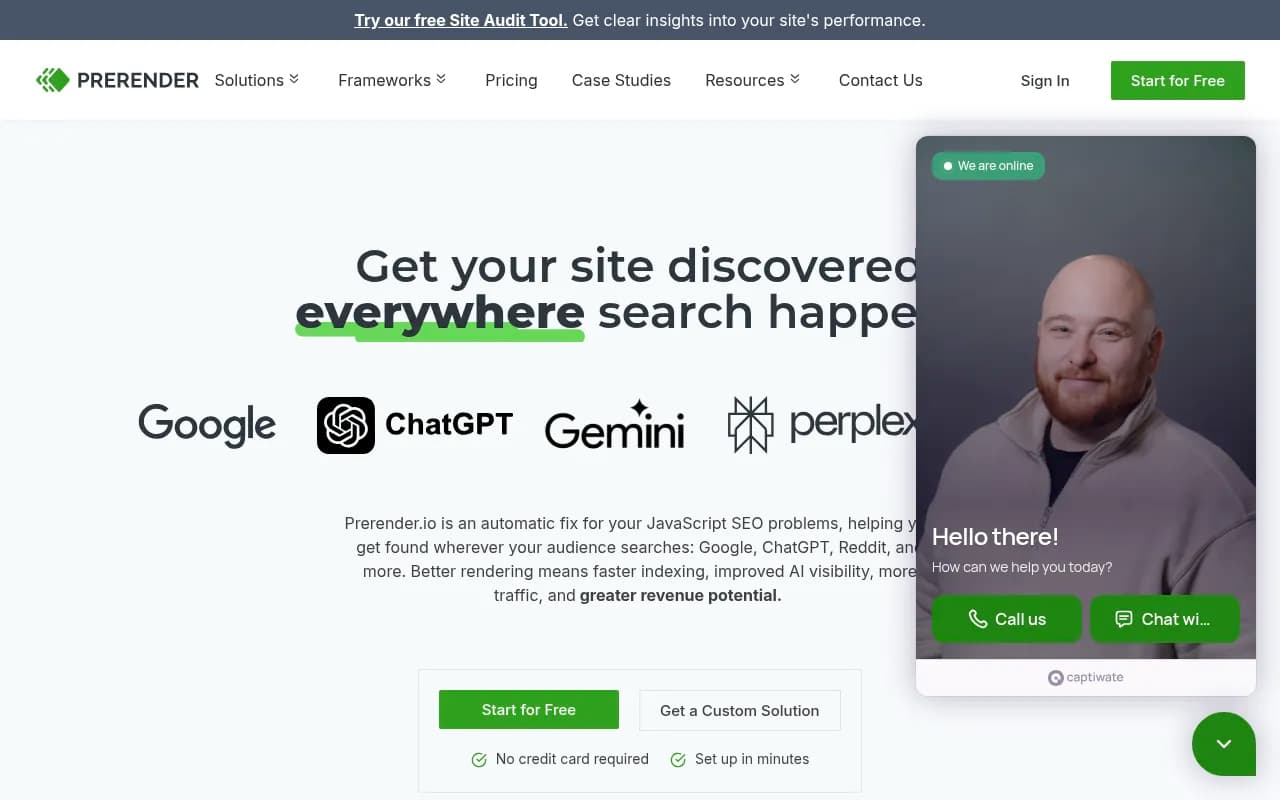
For teams dealing with JavaScript-heavy sites, Prerender.io solves the rendering problem specifically, making your dynamic content visible to bots that can't execute JavaScript.
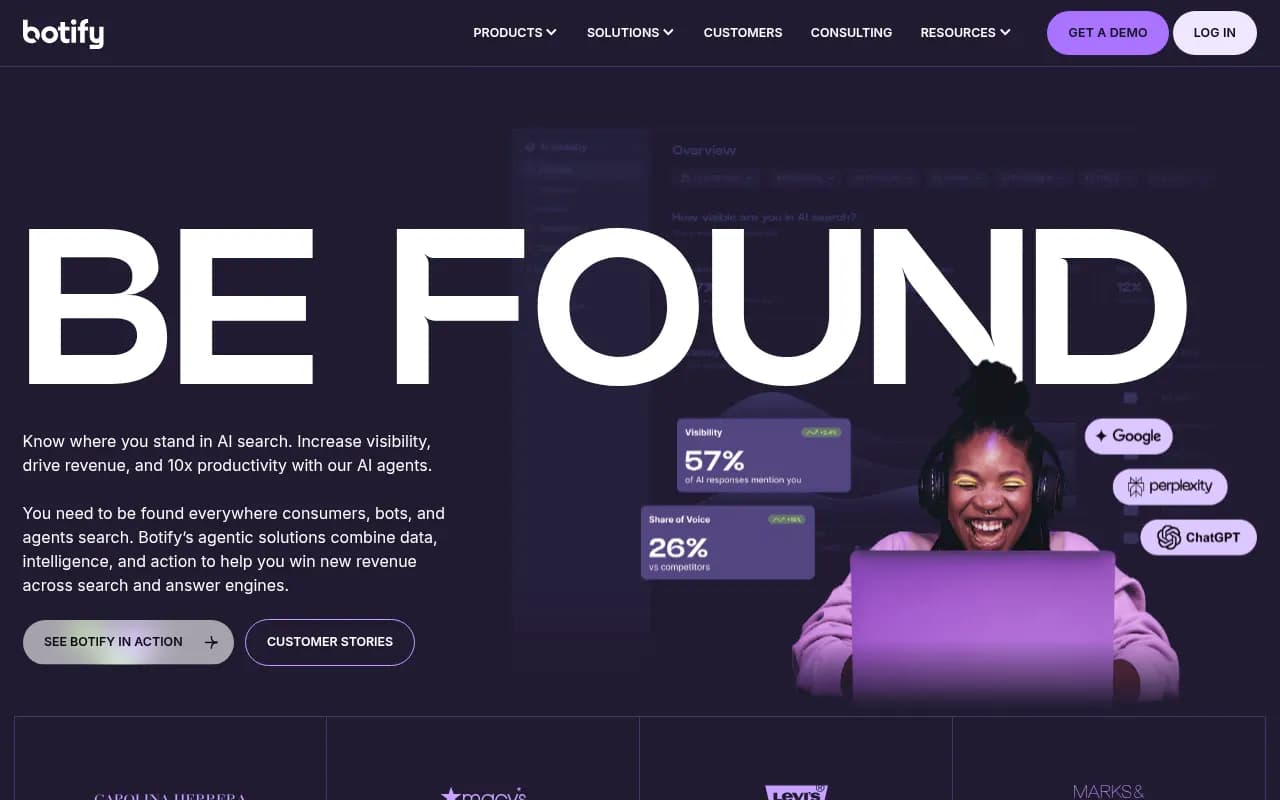
Botify has also built serious technical infrastructure for enterprise sites, combining traditional crawl analysis with AI search optimization.
What technical features drive: The floor. Without technical readiness, nothing else works. With it, your content investments actually land. This category doesn't generate citations on its own, but it removes the invisible blockers that prevent your other work from having any effect.
How the four types interact
The honest way to think about this is as a sequence, not a menu:
- Monitoring tells you where you stand
- Gap analysis tells you what's missing
- Content generation creates what's missing
- Technical features ensure it gets found
Most platforms give you type 1. Some give you types 1 and 2. A smaller number give you 1, 2, and 3. Very few give you all four.
Here's a comparison of how major platforms stack up across these categories:
| Platform | Monitoring | Gap analysis | Content generation | Technical/crawler features |
|---|---|---|---|---|
| Promptwatch | Full (10 models) | Yes, with prompt volumes | Yes, AI Content Agents | Yes, crawler logs + page-level tracking |
| Profound | Full | Partial | No | No |
| AthenaHQ | Full | Strong | No | No |
| Otterly.AI | Partial | Basic | No | No |
| Peec AI | Partial | Basic | No | No |
| Searchable | Full | Yes | Yes | Partial |
| AirOps | No | Partial | Yes (content engineering) | No |
| Botify | Partial | No | No | Strong |
The pattern is clear: most platforms are monitoring-first, gap analysis is a secondary feature for some, and content generation plus technical features are rare.
The UI polish problem
There's a fifth category worth naming, even though it doesn't belong in a framework of action features: UI polish.
Several platforms have invested heavily in making their dashboards look impressive. Beautiful share-of-voice charts. Animated visibility scores. Competitive heatmaps with color gradients. These look great in a sales demo and feel satisfying to check each morning.
But a beautiful chart showing you're invisible is still showing you you're invisible. The question is always: what do I do next?
The tell is whether the platform's primary CTA after showing you a gap is "here's how to fix it" or "here's how bad it is." Monitoring-only platforms default to the latter. Optimization platforms default to the former.
When evaluating any GEO tool, ask: after it shows me I'm missing from a prompt, what does it actually help me do? If the answer is "nothing, you have to figure that out yourself," you're looking at UI polish wrapped around a monitoring dashboard.
Which feature type should you prioritize?
It depends on where you are in the process.
If you have no baseline data at all, start with monitoring. You need to know your current visibility before you can measure improvement. But don't stay here long.
If you have monitoring data but no content strategy, move to gap analysis. Understand which specific prompts you're losing and why before you start creating content.
If you have gap data but your content isn't getting cited, check your technical readiness before assuming the content is the problem. A surprising number of "content isn't working" problems are actually crawler problems.
If you have solid monitoring, clear gaps, and clean technical infrastructure, content generation is where you'll see the fastest citation gains. This is where the ROI concentrates.
The platforms worth paying for in 2026 are the ones that support all four types in a connected workflow, where gap data feeds content briefs, published content gets tracked at the page level, and crawler logs tell you when something breaks. That closed loop is what separates an optimization platform from a reporting tool.
For teams building that workflow from scratch, Promptwatch covers the full cycle. For teams that need specific pieces, AirOps handles content engineering, Botify handles technical infrastructure, and AthenaHQ handles gap analysis well.
The GEO market is still young enough that most platforms are still figuring out which features matter. The ones that have figured it out are the ones that start with "here's what's missing" and end with "here's the published content that fixes it."