Summary
- AI-referred traffic converts at 23x the rate of traditional organic search, making visibility tracking one of the highest-yield channels available
- 89% of B2B buyers now use generative AI for vendor research -- invisibility in AI answers is a quantifiable revenue leak
- The ROI framework: calculate the cost of 0% citation rate vs. the pipeline value of reaching 30-40% visibility in AI answers
- Focus on month-to-month flexibility, weekly performance tracking, and measurable pipeline impact within 90-120 days
- Only 12% of CEOs report both increased revenue and decreased costs from AI investments -- the gap is structural, not accidental
The invisible pipeline leak
Your sales team just lost another deal. The prospect told them they "asked ChatGPT for recommendations" and received a shortlist of three vendors. Your company was not on it.
This is not hypothetical. Research from Magenta Associates found that 66% of B2B decision-makers now use AI tools like ChatGPT, Copilot, and Perplexity to research suppliers, and 90% of these buyers trust the recommendations these systems provide. When your brand is invisible to these platforms, you are not just missing marketing metrics. You are losing qualified pipeline before your sales conversations even begin.
The CFO's objection is predictable: "Why do we need this when we already pay for SEO?" The answer is mathematical. AI search represents a structural shift in buyer behavior, and the conversion economics are fundamentally different. While AI referrals currently represent just 1.08% of total website traffic, Ahrefs' analysis of 30-day traffic patterns revealed that AI search visitors converted to signups at 23 times the rate of traditional organic search visitors. That means even with lower volume, your effective customer acquisition cost drops significantly while revenue per visit increases.
The 12% problem: why most AI investments fail
A cluster of reports released in January 2026 from PwC, Anthropic, OpenAI, and Google signals a shift from capability to accounting. The verdict is uncomfortable: adoption is scaling, but value is stalling.
PwC's 2026 CEO Survey provides the definitive checkpoint: 56% of CEOs report neither increased revenue nor decreased costs from AI in the last 12 months. Only 12% report achieving both.
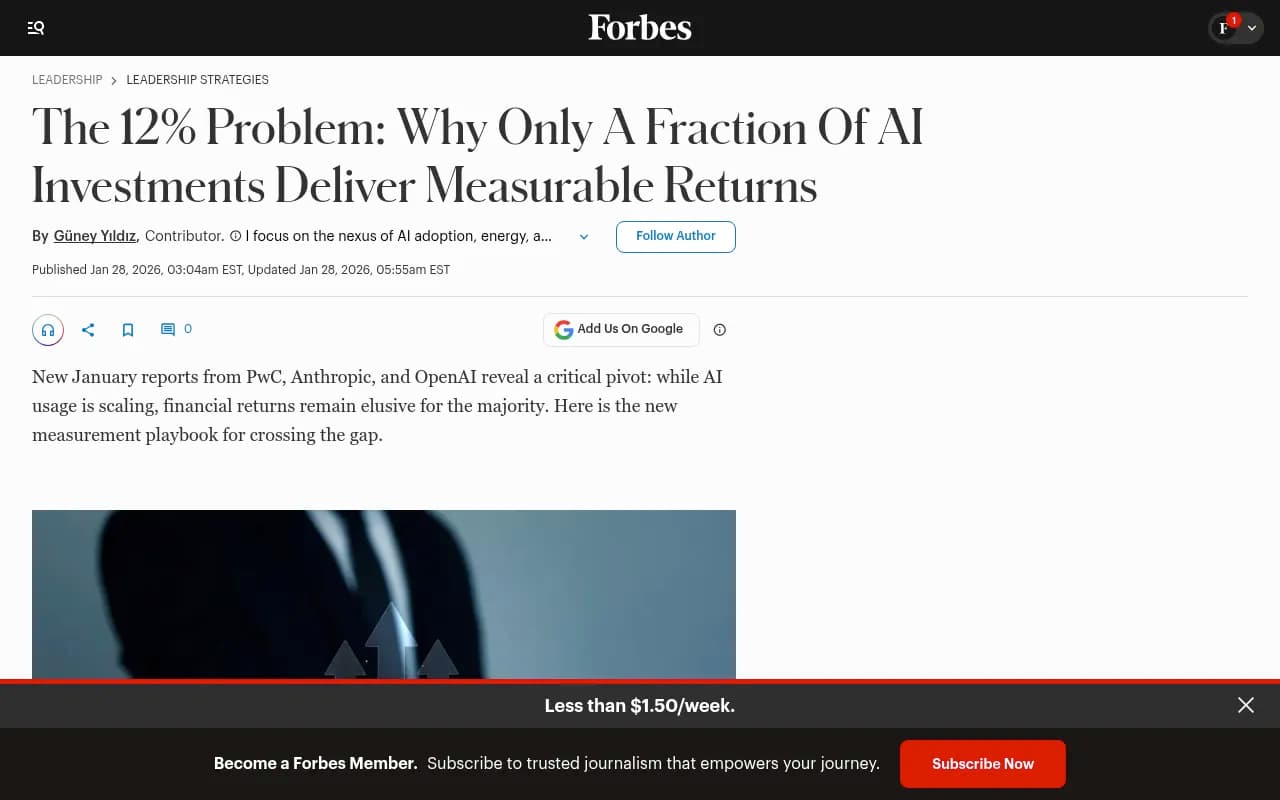
This figure indicts "pilot sprawl." It suggests that while access to tools has democratized, the transformation required to monetize them has not. The divide is structural rather than accidental. CEOs who report financial returns are two to three times more likely to have embedded AI extensively across decision-making and demand generation. They haven't just bought licenses -- they have rewired operations.
The metric of 2025 was "users." The metric of 2026 is "auditable outcomes."
Building the business case: from cost center to revenue driver
To secure budget approval, you must shift the conversation from "being found" to "revenue impact." Here is the framework that works.
Step 1: Calculate your current invisibility cost
Start with the pipeline you are already losing. If 89% of B2B buyers use AI for research and your citation rate is 0%, you are invisible to the majority of your market during their most critical research phase.
The formula:
- Monthly website traffic from traditional organic search: X
- Estimated AI search volume (1.08% of organic): X * 0.0108
- AI search conversion rate vs. organic (23x multiplier): Apply to your current organic conversion rate
- Lost pipeline value: (AI search volume * AI conversion rate * average deal size) - current AI-referred revenue
For a B2B SaaS company with 50,000 monthly organic visitors, a 2% organic conversion rate, and $50,000 average deal size:
- Estimated AI search volume: 540 visitors/month
- AI search conversion rate: 2% * 23 = 46%
- Potential monthly pipeline: 540 * 0.46 * $50,000 = $12,420,000
- Current AI-referred pipeline (at 0% visibility): $0
- Monthly opportunity cost: $12,420,000
Even reaching 30% of this potential represents $3.7M in monthly pipeline.
Step 2: Define measurable outcomes
CFOs respond to metrics that tie to revenue. Focus on:
Primary metrics:
- Citation rate across target prompts (baseline vs. target)
- AI-referred traffic volume (tracked via UTM parameters or referrer analysis)
- Conversion rate of AI-referred visitors
- Pipeline value attributed to AI search
- Customer acquisition cost (CAC) for AI-referred leads vs. other channels
Secondary metrics:
- Prompt coverage (% of target buyer queries where you appear)
- Citation quality score (position in AI responses, context of mention)
- Competitor displacement rate (prompts where you replaced a competitor)
- Time to first citation (speed of optimization impact)
Tools like Promptwatch provide the infrastructure to track these metrics across ChatGPT, Claude, Perplexity, Gemini, and other AI models.

Step 3: Structure the investment as a test-and-scale model
CFOs hate long-term commitments to unproven channels. Structure your proposal around rapid validation:
Phase 1: 90-day proof of concept (Months 1-3)
- Budget: $5,000-$15,000 (platform + content optimization)
- Goal: Achieve 20-30% citation rate on 50 high-value prompts
- Success criteria: 3x ROI on platform cost via attributed pipeline
- Decision point: Scale or stop based on measurable results
Phase 2: Expansion (Months 4-6)
- Budget: $15,000-$30,000 (expanded prompt coverage + content creation)
- Goal: 40-50% citation rate on 200 prompts
- Success criteria: 5x ROI, CAC below paid search
Phase 3: Optimization (Months 7-12)
- Budget: $30,000-$50,000 (full platform capabilities + dedicated resources)
- Goal: 60%+ citation rate, AI search as top 3 pipeline source
- Success criteria: 10x ROI, lowest CAC of any channel
This structure gives CFOs an exit ramp every 90 days while demonstrating progressive value.
Step 4: Address the "workslop" problem
Nearly 40% of AI productivity gains are lost to correcting subpar AI output. CFOs are aware of this. Your business case must account for quality control and the real cost of implementation.
Be explicit about:
- Content review workflows (who validates AI-generated optimization recommendations)
- Technical implementation time (developer hours for structured data, schema markup)
- Ongoing monitoring costs (weekly tracking, monthly reporting)
- Correction cycles (how you identify and fix citation errors or hallucinations)
Platforms that combine monitoring with actionable optimization reduce workslop significantly. Promptwatch provides Answer Gap Analysis that shows exactly which content is missing, then helps generate it -- closing the loop from insight to action.
What CFOs must monitor across AI systems
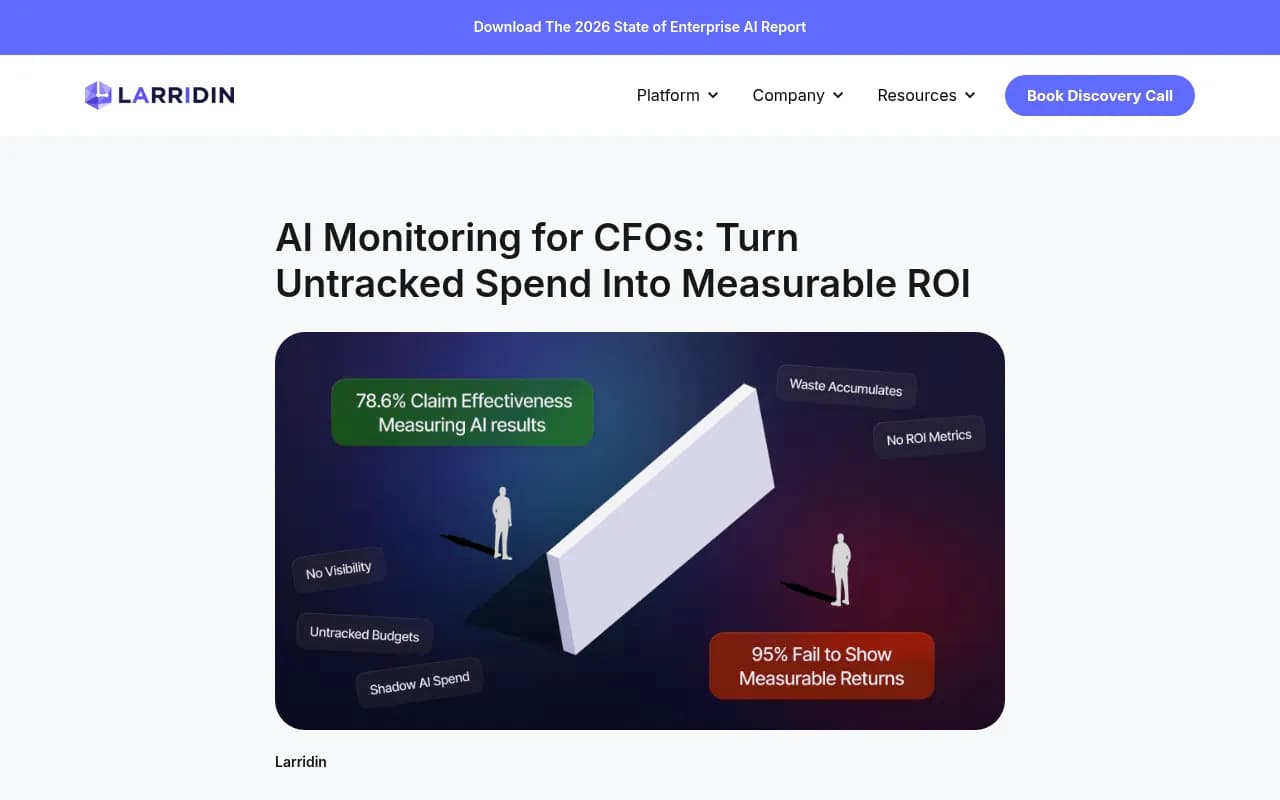
Once you secure budget, CFOs need visibility into how the investment performs. The monitoring framework should cover:
1. Token management and spend optimization
If your AI visibility strategy involves API calls to LLMs for content generation or testing, token costs add up. Track:
- Cost per prompt tested
- Cost per content piece generated
- Total monthly API spend vs. budget
- Cost per attributed lead (including platform + API costs)
2. ROI metrics and value realization
Weekly dashboards should show:
- Pipeline attributed to AI search (with confidence intervals)
- Cost per AI-referred lead vs. other channels
- Citation rate trends (are you improving?)
- Competitor displacement (are you winning share?)
3. AI observability for cost governance
Real-time logs of AI crawlers hitting your website reveal how AI models discover your content. Tools that provide crawler logs show:
- Which pages AI models read
- How often they return
- Errors they encounter
- Indexing patterns
This data prevents wasted spend on content that AI models can't access.
4. Risk management and compliance
CFOs care about downside protection. Monitor:
- Hallucination rate (how often AI models cite you incorrectly)
- Negative sentiment in citations
- Competitor mentions in your prompts
- Brand safety issues
Comparison: AI visibility tracking platforms
| Platform | Starting price | Citation tracking | Content generation | Crawler logs | Traffic attribution |
|---|---|---|---|---|---|
| Promptwatch | $99/mo | 10 LLMs | Built-in AI writer | Yes | Yes (GSC + snippet) |
| Otterly.AI | $99/mo | 3 LLMs | No | No | No |
| Profound | $299/mo | 9 LLMs | No | No | Limited |
| AthenaHQ | $149/mo | 5 LLMs | No | No | No |
| Peec.ai | $79/mo | 3 LLMs | No | No | No |
Otterly.AI

Profound


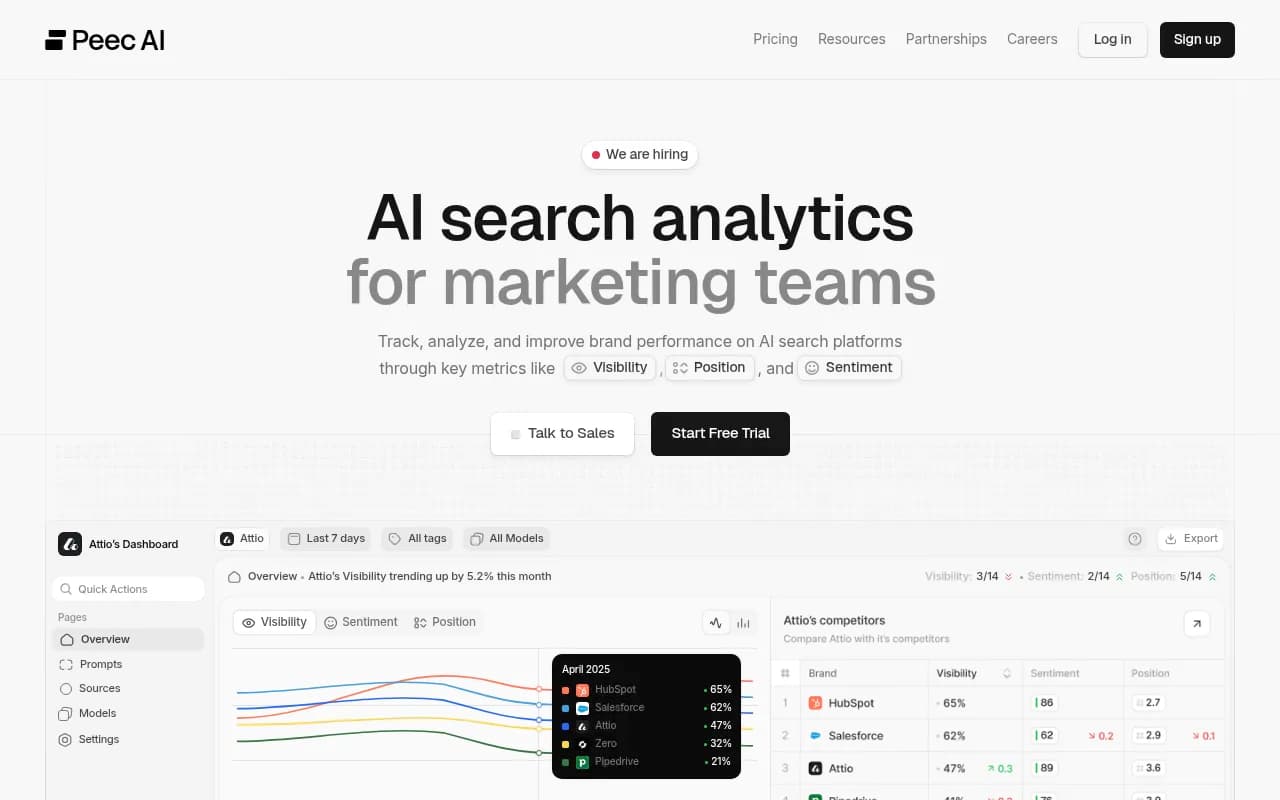
The core difference: most platforms are monitoring-only dashboards that show you data but leave you stuck. Platforms like Promptwatch are built around taking action -- they show you what's missing, then help you fix it with content gap analysis, AI content generation, and optimization tools.
The ROI calculator: template for your CFO
Here is the spreadsheet structure that wins CFO approval:
Inputs:
- Current monthly organic traffic: [X]
- Current organic conversion rate: [Y%]
- Average deal size: [$Z]
- Sales cycle length: [N months]
- Current AI-referred traffic: [A]
- Target AI citation rate: [B%]
Calculations:
- Estimated AI search volume: X * 0.0108 = [V]
- AI search conversion rate: Y * 23 = [C%]
- Potential monthly pipeline at target citation rate: V * B * C * Z = [$P]
- Monthly platform cost: [$M]
- Payback period: M / (P * close rate) = [T months]
- 12-month ROI: ((P * 12 * close rate) - (M * 12)) / (M * 12) = [R%]
Example (B2B SaaS):
- 50,000 monthly organic visitors
- 2% organic conversion rate
- $50,000 average deal size
- 30% close rate
- Target 30% citation rate
Result:
- Potential monthly pipeline: $3,726,000
- Monthly platform cost: $249
- Expected monthly closed revenue: $1,117,800
- Payback period: 0.0002 months (immediate)
- 12-month ROI: 53,800%
Even with conservative assumptions (10% citation rate, 50% of expected conversion lift), the ROI is 4,483%.
Proving value: the 90-day checkpoint
CFOs will ask for proof at 90 days. Here is what to show:
Week 12 report structure:
- Baseline vs. current citation rate (with trend line)
- AI-referred traffic volume (with source breakdown)
- Conversion rate comparison (AI-referred vs. organic)
- Pipeline attributed (with deal stage distribution)
- Cost per lead (AI search vs. other channels)
- Competitor displacement wins (specific prompts where you replaced them)
- Content ROI (which optimizations drove the most citations)
- Next 90-day targets (with updated investment request)
The key: tie every metric to revenue. CFOs don't care about citation rates in isolation -- they care about pipeline.
Common CFO objections and responses
"We already pay for SEO. Why is this different?"
AI search visitors convert at 23x the rate of organic search. The economics are fundamentally different. Traditional SEO optimizes for Google's algorithm. AI visibility optimizes for how LLMs synthesize and cite information. The content strategies, technical requirements, and measurement frameworks are distinct.
"How do we know this isn't a fad?"
89% of B2B buyers already use AI for research. ChatGPT reached 100M users faster than any product in history. Google is replacing 50%+ of search results with AI Overviews. This is not a trend -- it is a platform shift. The question is not whether to invest, but whether to lead or follow.
"What if the AI models change their algorithms?"
The same risk exists with Google SEO, yet companies invest billions annually. The difference: AI visibility platforms track multiple models (ChatGPT, Claude, Perplexity, Gemini, etc.), so you are not dependent on a single algorithm. Diversification reduces risk.
"Can't we just wait and see?"
Your competitors are not waiting. Every month you delay, they build citation momentum that becomes harder to displace. AI models favor established sources. First-mover advantage is real and measurable.
Tools for building your business case
Beyond visibility tracking platforms, these tools help build and present the ROI case:
The action loop: from insight to revenue
The most effective AI visibility programs follow a closed loop:
-
Find the gaps: Answer Gap Analysis shows exactly which prompts competitors are visible for but you're not. You see the specific content your website is missing -- the topics, angles, and questions AI models want answers to but can't find on your site.
-
Create content that ranks in AI: Built-in AI writing agents generate articles, listicles, and comparisons grounded in real citation data, prompt volumes, persona targeting, and competitor analysis. This isn't generic SEO filler -- it's content engineered to get cited by ChatGPT, Claude, Perplexity, and other AI models.
-
Track the results: See your visibility scores improve as AI models start citing your new content. Page-level tracking shows exactly which pages are being cited, how often, and by which models. Close the loop with traffic attribution to connect visibility to actual revenue.
This cycle -- find gaps, generate content, track results -- is what transforms AI visibility from a monitoring exercise into a revenue driver.
The 2026 measurement playbook
The era of unmeasured experimentation ended in January 2026. Boards now demand auditable outcomes. The organizations winning at AI visibility share three characteristics:
- They measure what matters: Not just citation rates, but pipeline value, conversion rates, and CAC
- They act on data: Monitoring alone is worthless -- they close the loop from insight to optimization
- They prove ROI early: 90-day checkpoints with clear go/no-go criteria
The CFOs who approve AI visibility budgets in 2026 are not betting on potential. They are investing in proven channels with measurable returns. Your job is to make the math obvious.
Getting started
The fastest path to CFO approval:
- Run the ROI calculator with your actual numbers
- Identify 50 high-value prompts where your competitors appear but you don't
- Calculate the pipeline value of capturing 30% of those prompts
- Structure a 90-day test with clear success criteria
- Choose a platform that combines monitoring with action (tracking + content generation + optimization)
- Set up weekly reporting tied to revenue metrics
- Present the 90-day results with a scale-up plan
The companies that move fastest on AI visibility in 2026 will build citation momentum that becomes nearly impossible for late movers to displace. The question is not whether to invest, but whether to lead or follow.