Key takeaways
- Brands cited in AI Overviews earn 35% higher organic CTR and 91% higher paid CTR compared to uncited brands on the same query — making AI citation tracking a direct revenue signal, not a vanity metric.
- The content ROI stack has three layers: AI writing (create), citation tracking (measure AI visibility), and traffic attribution (connect visibility to revenue).
- Most AI writing tools optimize for traditional SEO. In 2026, you need tools that also optimize for AI citation — these are different targets.
- Monitoring alone isn't enough. The teams winning in AI search are using platforms that show them what content to create, not just where they're invisible.
- The full loop is: find gaps → generate content → track citations → attribute revenue. Tools exist for each step, but few platforms cover all four.
Here's a scenario that plays out constantly right now. Your page ranks #1 on Google. A potential customer searches for something you answer perfectly. Google's AI Overview loads, cites your competitor, and the customer never scrolls to your result. You lost a deal you'll never know about.
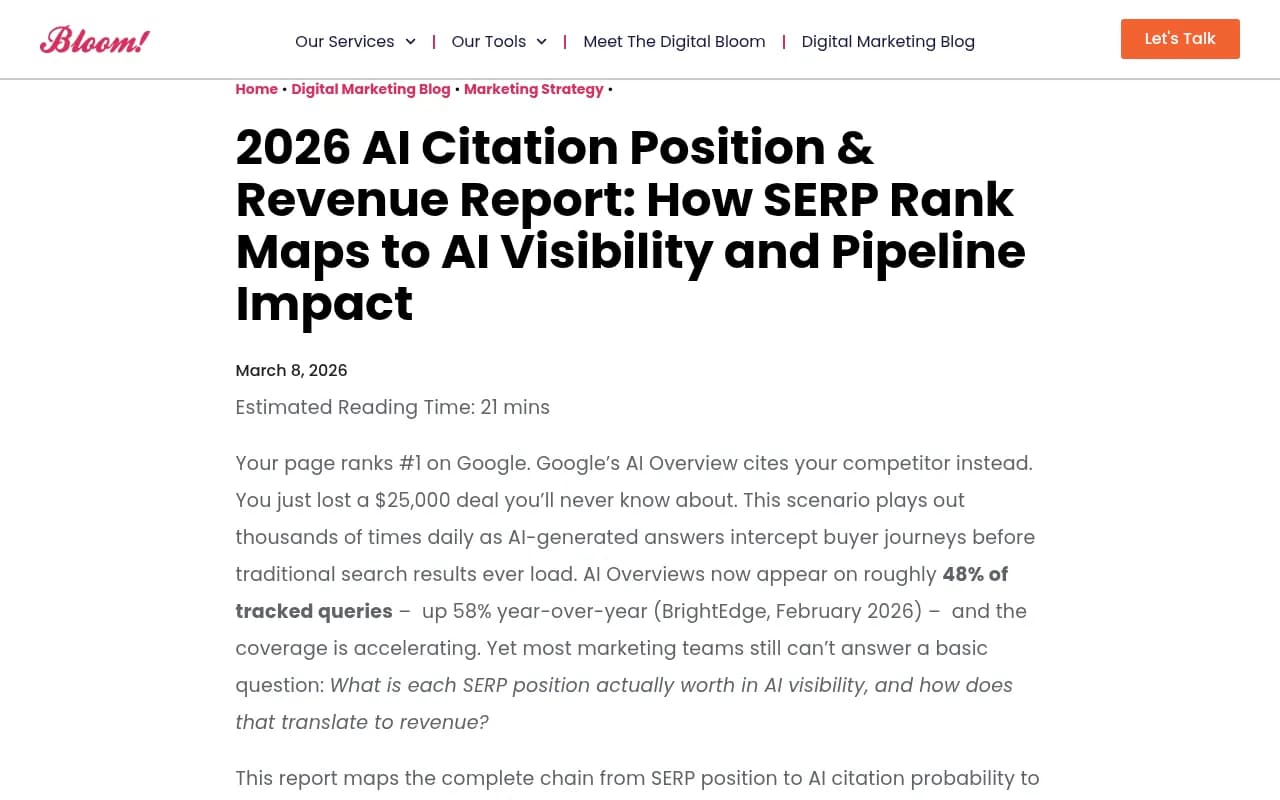
That's the core problem with content ROI measurement in 2026. The old metrics — rankings, organic traffic, time on page — were already incomplete. Now they're missing an entire channel. AI search engines like ChatGPT, Perplexity, Google AI Overviews, and Claude are intercepting buyer journeys before traditional search results even load. According to data from The Digital Bloom's 2026 AI Citation Position & Revenue Report, AI Overviews now appear on roughly 48% of tracked queries, up 58% year-over-year.
So the question isn't just "did this article rank?" anymore. It's "did this article get cited by AI, and did that citation drive revenue?"
This guide walks through the full content ROI stack for 2026: the writing tools, the citation trackers, and the attribution layer that ties it all together.
Why the old content ROI model is broken
Traditional content ROI looked like this: publish article → track rankings → measure organic traffic → attribute conversions via last-click or first-touch. It was always imperfect, but it worked well enough when Google's blue links were the primary discovery channel.
That model has two problems now.
First, AI search is a parallel channel that most analytics setups completely miss. When ChatGPT recommends your product, that recommendation doesn't show up in Google Search Console. When Perplexity cites your article, there's no UTM parameter. The traffic might show up as "direct" in GA4, or it might not show up at all if the user just acts on the AI's recommendation without clicking through.
Second, even if you're tracking traditional SEO correctly, you're measuring the wrong outcome. Getting cited by an AI model is often more valuable than ranking #3 organically. The Digital Bloom's data shows brands cited in AI Overviews earn 91% higher paid CTR compared to uncited brands on the same query. That's not a marginal improvement — it's a different category of visibility.
The fix is building a three-layer stack: AI-assisted content creation, AI citation monitoring, and revenue attribution. Each layer is useless without the others.
Layer 1: AI writing tools that create content AI models actually cite
Not all AI writing tools are equal for this purpose. Most were built to optimize for traditional SEO signals — keyword density, readability scores, backlink potential. That's still relevant, but it's not sufficient if you want your content to get cited by ChatGPT or Perplexity.
Content that AI models cite tends to share specific characteristics: it's structured clearly, it answers specific questions directly, it's factually grounded, and it covers topics with enough depth that an AI model can extract a confident answer from it. Generic filler content doesn't get cited. Specific, well-sourced, structured content does.
Here are the tools worth considering at each tier:
For teams that need volume with quality control
Jasper is the most mature enterprise option for teams that need brand voice consistency across high output. It handles long-form well and integrates with existing workflows.
Writesonic is a solid mid-market option with good SEO integration and faster output cycles. Better for teams that need to move quickly across multiple content types.

Surfer SEO sits at the intersection of writing and optimization — it scores content against top-ranking pages in real time, which helps ensure your articles have the topical depth that AI models look for when deciding what to cite.
For SEO-first content teams
MarketMuse does content planning and optimization with a focus on topical authority. If you're trying to build the kind of comprehensive coverage that AI models trust, MarketMuse helps you identify the gaps in your topic clusters before you write.
Clearscope is the cleanest tool for optimizing individual articles against search intent. Its grading system is reliable and the interface is fast. Good for teams that want a simple optimization layer without a lot of overhead.

Frase combines research and writing in one tool, which speeds up the brief-to-draft workflow considerably. It pulls SERP data and People Also Ask questions automatically, which is useful for structuring content around the specific questions AI models tend to surface.
For teams building AI-citation-optimized content specifically
AirOps is worth calling out here because it's built around content engineering for AI search visibility, not just traditional SEO. It's designed to help teams create content that gets cited by AI models — a different optimization target than most writing tools address.
Averi AI takes a content operations approach, helping teams scale production while maintaining the quality signals that AI models respond to.
Comparison: AI writing tools by use case
| Tool | Best for | AI citation focus | SEO optimization | Content volume |
|---|---|---|---|---|
| Jasper | Enterprise brand voice | Moderate | Good | High |
| Writesonic | Mid-market speed | Moderate | Good | High |
| Surfer SEO | Real-time optimization | Moderate | Excellent | Medium |
| MarketMuse | Topical authority planning | Good | Excellent | Low |
| Clearscope | Individual article optimization | Moderate | Excellent | Low |
| Frase | Research + writing workflow | Moderate | Good | Medium |
| AirOps | AI search content engineering | Excellent | Good | Medium |
Layer 2: Citation tracking — knowing when and where AI models cite you
This is the layer most content teams are missing entirely. You can publish great content, but if you don't know whether AI models are citing it, you're flying blind on half your distribution channel.
Citation tracking in 2026 means monitoring which AI models cite your pages, for which queries, how often, and with what sentiment. It also means tracking your competitors' citations so you can identify the gaps — the prompts where they're visible and you're not.
What to look for in a citation tracker
A basic citation tracker tells you when you're mentioned. A good one tells you the prompt that triggered the mention, the position of your citation in the response, and the sentiment around it. A great one also shows you what content you need to create to earn citations you're currently missing.
Promptwatch covers the full range. It monitors 10 AI models including ChatGPT, Perplexity, Claude, Gemini, Google AI Overviews, and DeepSeek, and it goes beyond monitoring to show you the specific content gaps — the prompts your competitors are cited for that you're not. The Answer Gap Analysis feature is particularly useful for content planning: it shows you exactly which topics and questions AI models want to answer but can't find on your site.

What makes Promptwatch different from most citation trackers is the action loop. Most tools show you a dashboard of where you're invisible. Promptwatch also helps you fix it — the built-in AI writing agent generates articles grounded in real citation data, and the page-level tracking shows you which specific pages are being cited and by which models. That closes the loop between content creation and citation measurement.
Profound is a strong enterprise option with good coverage across AI models. It's monitoring-focused, which means you'll need to pair it with a separate content creation workflow.
Profound

Otterly.AI is a lighter-weight option for teams that want basic AI search monitoring without a lot of complexity. Good starting point, but it doesn't have content gap analysis or generation capabilities.
Otterly.AI

AthenaHQ has solid monitoring features and is worth considering for teams that are primarily focused on brand tracking rather than content optimization.

Citation tracking comparison
| Tool | AI models tracked | Content gap analysis | AI content generation | Traffic attribution |
|---|---|---|---|---|
| Promptwatch | 10 (ChatGPT, Claude, Perplexity, Gemini, etc.) | Yes | Yes (built-in) | Yes (GSC, snippet, logs) |
| Profound | 9+ | Limited | No | Limited |
| Otterly.AI | 4-5 | No | No | No |
| AthenaHQ | 5+ | Limited | No | No |
Layer 3: Closing the loop with traffic attribution
Citation tracking tells you when AI models mention you. Traffic attribution tells you whether those mentions actually drive revenue. Without this layer, you're still guessing at ROI.
The attribution challenge with AI search is real. AI-driven traffic often arrives as direct or dark traffic because there's no referrer header when someone acts on a ChatGPT recommendation. A few approaches work:
Server log analysis is the most reliable method. AI crawlers (GPTBot, ClaudeBot, PerplexityBot) hit your pages before citing them. Analyzing your server logs tells you which pages AI models are actively reading, which correlates with citation probability. Promptwatch's AI Crawler Logs feature does this automatically — you can see in real time which pages ChatGPT, Claude, and Perplexity are crawling, how often, and whether they're encountering errors.
JavaScript snippet tracking captures sessions that originate from AI referrers. Not every AI model passes a referrer, but enough do that this catches a meaningful portion of AI-driven traffic.
Google Search Console integration connects your AI visibility data to actual click and impression data for queries where Google AI Overviews are involved. This is the most direct way to quantify the CTR premium from AI citations.
For traditional attribution that you can layer on top, Google Analytics remains the baseline. For more sophisticated multi-touch attribution, Ruler Analytics is worth considering — it connects marketing touchpoints to actual revenue, which matters when you're trying to prove content ROI to a CFO.
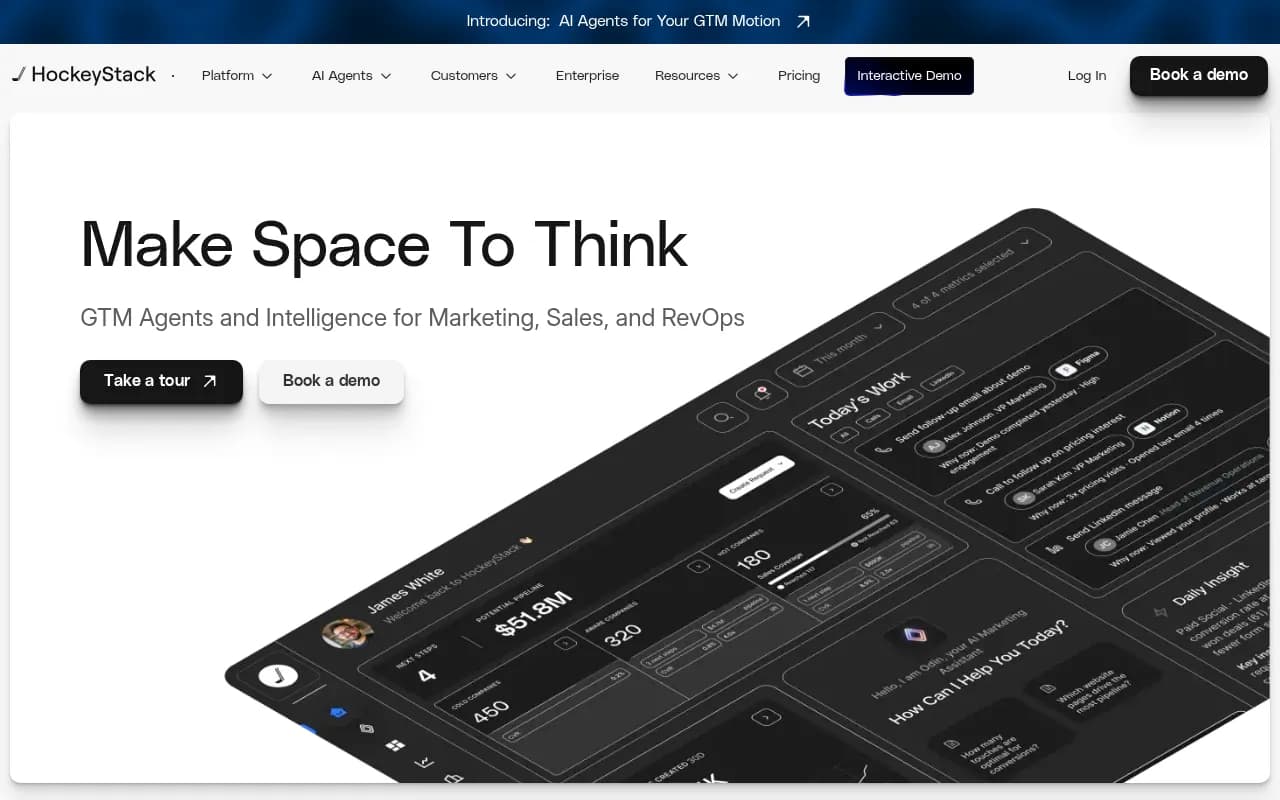
HockeyStack is a strong option for B2B teams that need to connect content engagement to pipeline and revenue, particularly if you're running account-based marketing alongside content.
Putting the stack together: a practical workflow
Here's how the layers work together in practice.
Step 1: Identify citation gaps. Use a tool like Promptwatch to run Answer Gap Analysis. You'll see the specific prompts where your competitors are being cited and you're not. These become your content priorities — not based on keyword volume guesses, but on actual AI model behavior.
Step 2: Create content engineered for citation. Use an AI writing tool (Surfer SEO, AirOps, or Jasper depending on your workflow) to create content that addresses those gaps. Structure it to answer questions directly. Use clear headings. Include specific data points. Avoid vague, hedged language that AI models can't extract confident answers from.
Step 3: Monitor citations after publishing. Track whether your new content starts earning citations within 4-8 weeks of publishing. Page-level citation tracking shows you exactly which articles are being cited, by which models, and for which prompts.
Step 4: Attribute revenue. Connect citation data to traffic data using server logs, GSC integration, or a snippet. Correlate citation increases with traffic and conversion changes. Over time, you build a model for what a citation in ChatGPT or Perplexity is worth in your specific market.
Step 5: Iterate. The prompts AI models respond to shift over time. New competitors enter. New topics emerge. Run gap analysis quarterly (or monthly if you're in a competitive space) and repeat.
The metrics that actually matter in 2026
Old content ROI metrics aren't wrong — they're just incomplete. Here's the updated scorecard:
| Metric | What it measures | Tool |
|---|---|---|
| AI citation rate | % of tracked prompts where you're cited | Promptwatch, Profound |
| Citation position | Where in the AI response your brand appears | Promptwatch |
| Prompt coverage | How many relevant prompts you're visible for | Promptwatch |
| AI-driven traffic | Sessions originating from AI referrers | GA4 + server logs |
| Citation-to-conversion rate | Revenue from AI-referred sessions | Ruler Analytics, HockeyStack |
| Competitor citation gap | Prompts competitors win that you don't | Promptwatch Answer Gap |
| Content freshness decay | How quickly citations drop after publish date | Citation tracking over time |
The last one is worth dwelling on. The Digital Bloom's research shows a clear citation decay curve — content that isn't updated loses citation frequency over time as AI models weight fresher sources. This means your content ROI calculation needs to include a maintenance cost, not just a creation cost.
Common mistakes that kill content ROI measurement
Treating AI traffic as dark traffic and ignoring it. A lot of teams see "direct" traffic increase and don't investigate. In 2026, a meaningful portion of that is AI-referred. Set up proper tracking before you dismiss it.
Creating content for keywords instead of questions. AI models respond to questions, not keywords. Content structured around specific questions ("What is the best X for Y?", "How does X compare to Y?") gets cited more often than content optimized for head terms.
Measuring citations without measuring sentiment. Being cited as a negative example or with caveats is worse than not being cited. Good citation trackers include sentiment analysis — pay attention to it.
Ignoring the competitor citation data. The most actionable signal in AI visibility monitoring isn't your own citation rate — it's the gap between your citation rate and your competitors'. That gap is your content roadmap.
Publishing once and moving on. AI models weight content freshness. An article that earns citations in month one will lose them by month six if it's not updated. Build content maintenance into your ROI model from the start.
The bottom line
Content ROI in 2026 requires measuring a channel that didn't exist at scale two years ago. AI search is now intercepting buyer journeys on nearly half of tracked queries, and the brands winning in that channel are the ones who've built a systematic approach to creating, tracking, and attributing AI citations.
The stack isn't complicated: an AI writing tool that creates content with the depth and structure AI models want to cite, a citation tracker that shows you where you're visible and where you're not, and an attribution layer that connects citations to revenue. The teams that have all three layers working together can prove exactly what their content budget is generating. The teams that don't are still guessing.
Start with the gap analysis. Find the prompts where your competitors are cited and you're not. That's your content backlog, and it's more actionable than any keyword research report.