Key takeaways
- On August 8, 2026, the share of ChatGPT fanout queries using
site:went from about 0.37% to 16.8% in one day, according to Promptwatch Data. Roughly 1 in 280 fanouts wassite:-scoped before. Now it is about 1 in 6. - Average fanout queries per response rose from about 1.08 to 1.83 on the same day and stayed there. The
site:searches appear to sit on top of generic searches, not replace them. - Your own domain is now a direct retrieval surface. Indexation, category pages and internal structure affect whether ChatGPT finds you.
- The shift happened overnight, so tools that sample prompts weekly or monthly will miss it. Fanout capture, daily tracking and crawl visibility are the criteria that matter.
- Caveat: the data covers only prompts Promptwatch tracks, and OpenAI has not documented the change.
What actually changed on August 8
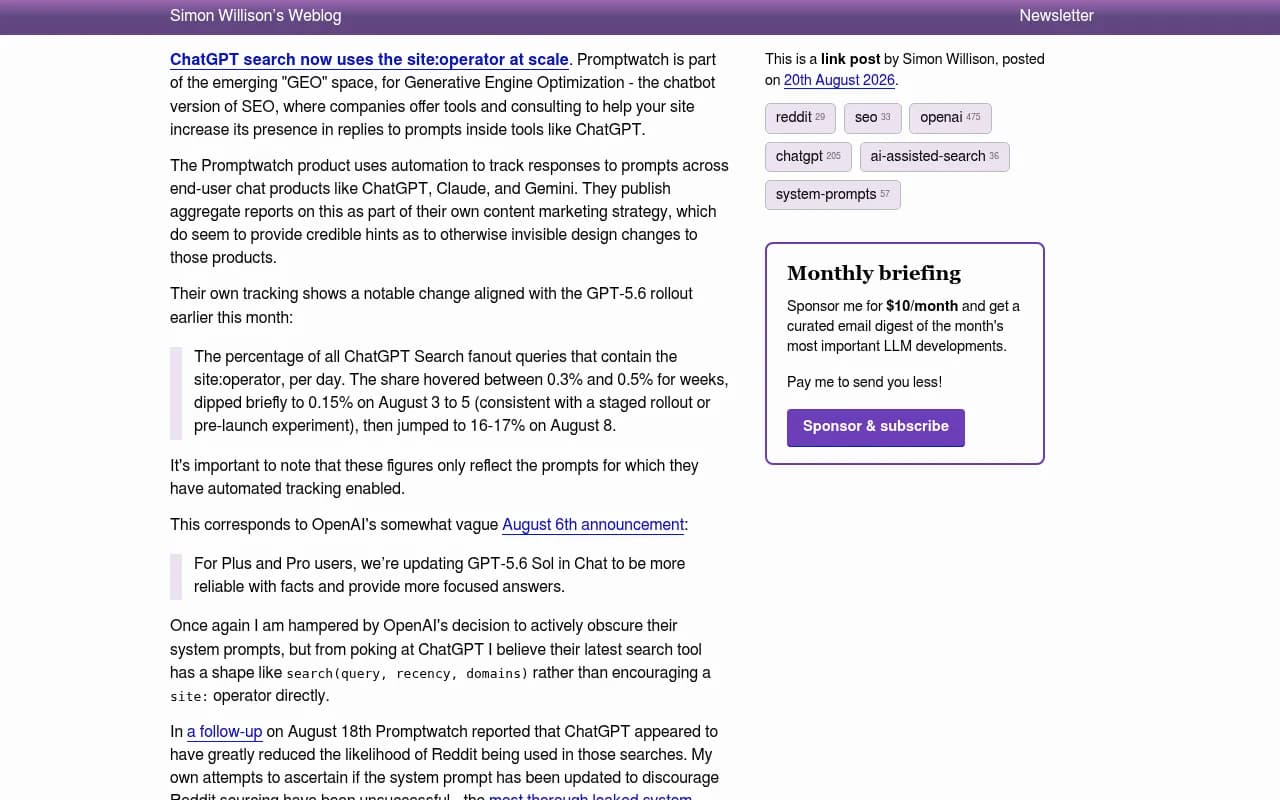
Promptwatch published the finding on August 10 in its ChatGPT site: operator report. The share of ChatGPT Search fanout queries containing site: had sat between 0.3% and 0.5% for weeks. It dipped to 0.15% on August 3 to 5, which fits a staged rollout or a pre-launch test. Then on August 8 it jumped to 16-17%.
A fanout, for anyone new to the term, is the set of web searches ChatGPT runs behind the scenes to build one answer. You type one prompt. ChatGPT might run one, two or five searches. Those searches are what decide which pages get read and cited.
The interesting detail is what happened to the volume. Average fanouts per response went from roughly 1.08 to 1.83. If ChatGPT had swapped generic queries for site: queries, that average would have stayed flat. It didn't. So ChatGPT is running the generic search and then adding domain-scoped lookups on top.
What we know and what we don't
Simon Willison covered the finding on August 20, 2026 and tied the timing to the GPT-5.6 rollout. OpenAI's August 6 note said it was updating GPT-5.6 Sol in Chat for Plus and Pro users to be "more reliable with facts and provide more focused answers." That is vague. It doesn't mention search behavior at all.
Willison also thinks the internal search tool looks more like search(query, recency, domains) than a literal site: operator. That matters less than it sounds. Whether the mechanism is a string operator or a domains parameter, the effect on you is the same: ChatGPT now looks inside specific domains for specific topics.
Two honest limits. First, the numbers only reflect prompts Promptwatch has tracking enabled for, as Willison notes. Second, OpenAI hides its system prompts, so nobody outside can confirm the cause. The one-day timing does point to a model or system-prompt rollout on OpenAI's side, not anything individual sites did.
The Reddit drop that came with it
A related shift landed in the same window. In Promptwatch's Reddit citations report, reddit.com held about 3.83% of ChatGPT citations from July 18 to August 7. On August 8 it slipped into the mid-2s. On August 14 it fell below 1%. The August 14 to 17 average is 0.52%, an 86.4% relative drop.
Google's surfaces moved more gently. AI Overviews eased from about 2.37% to 2.10% (an 11.3% decline), and AI Mode fell from 2.22% to 1.54% (30.5%). Promptwatch flagged that a data-collection issue can't be fully ruled out, so treat the size of the ChatGPT drop as provisional. For a wider view of social sources, the social media citations by AI model report shows ChatGPT drawing just 0.46% of citations from social platforms from September 28 to October 4, 2026, against 12.2% for Google AI Overviews.
I don't want to over-read the connection. Willison couldn't find a system-prompt change that discourages Reddit. But a LinkedIn post called this GEO's first "Google algorithm update moment," arguing the deeper problems are volatile measurement and opaque retrieval. I think that's right, and it's the real reason this matters for tool choice.
Why this changes what you should look for in a GEO tool
Before August 8, a lot of GEO tooling worked like this: pick a prompt list, run it on a schedule, record whether your brand appeared. That still tells you something. But it can't answer the questions the site: shift raises.
- Is ChatGPT searching my domain directly, and what is it finding?
- Did the searches behind my tracked prompts change last week?
- Are my pages indexed well enough for a domain-scoped lookup to return them?
- Did my citations move because of my content, or because the platform changed?
Here is how that translates into selection criteria. These are my inferences from the Promptwatch findings, not verified vendor features, so check each one in a demo.
| Criterion | Why it matters after August 8 | What to ask a vendor |
|---|---|---|
| Fanout query capture | Shows the actual searches ChatGPT runs, including site: ones | Can I see the queries behind each response, not just the answer? |
| Daily or continuous tracking | The change happened in one day | How often are prompts re-run? Can I see daily trend lines? |
| Real UI data | User-facing ChatGPT can differ from API output | Do you query the real interface or an API? |
| Re-mapping after platform shifts | Keyword mappings built before Aug 8 are stale | Can I re-run fanout analysis on existing prompts? |
| Crawl and indexation visibility | A site: query only surfaces what is indexed | Do I see AI crawler activity and site health? |
| Citation source breakdown | Reddit-style swings need page-level detail | Can I see which URLs were cited before and after a change? |
How common tool types hold up
I haven't verified whether specific tools capture site: fanouts, so treat the groupings below as a way to organize your shortlist, not a ruling. Vendor positioning in the catalog is a starting point.
Prompt trackers
Tools like Otterly.AI, Peec AI and similar trackers answer "was my brand mentioned?" That is useful for a baseline. The gap is explanation. When mentions move, you want to know whether searches, sources or your own pages changed.
Otterly.AI



Enterprise monitoring platforms
Profound and ScrunchAI have broad monitoring. Ask specifically about fanout visibility and refresh frequency, since those are the two things the August 8 change exposed.
Profound

SEO suites with AI add-ons
Semrush and Ahrefs bring years of search data, which helps with the indexation side of the site: problem. The question is whether their AI tracking uses flexible prompt sets and exposes fanouts.

Optimization platforms
Promptwatch is the tool this guide draws its data from, so weigh that when reading. It captures query fanouts per response, tracks the real UIs of ChatGPT and other engines, and adds IP-verified AI crawler logs and weekly site audits. That combination speaks to the three things the site: shift raises: what ChatGPT searched, whether it could reach your pages, and whether your fixes worked. Its Action Board and Content Agent then turn gaps into content tasks. Pricing starts free (Explore) and Essential is $95/mo; confirm current plans at promptwatch.com/pricing.

For a broader shortlist, the GEO software directory at bestgeosoftware.com lists dozens more options.
What to do about your own site
Promptwatch's recommendations from the report are practical, and most don't need a new tool.
Treat your domain as a retrieval surface
ChatGPT now runs searches like site:yourdomain.com [topic]. So the quality of what comes back from your own site matters. Thin category pages, broken internal search and unindexed content now cost you answers as well as rankings.
Check indexation first
A site: query can only surface what search engines have indexed from your domain. Open Google Search Console and Bing Webmaster Tools and look for key pages marked as excluded or discovered but not indexed. Then run a crawl with something like Screaming Frog to catch orphaned pages and broken links.

Cover more angles per topic
Comparisons, pricing, alternatives and domain-scoped lookups are separate chances to be found. One mega-page per topic is a weaker bet than a few focused pages that each answer a distinct question. This also fits the citation data: in the ChatGPT content type report, product pages made up 22.4% of citations from September 28 to October 4, 2026, ahead of landing pages and listicles.
Check crawler access
If AI crawlers can't read a page, no amount of content polish helps. Review your robots.txt for GPTBot, OAI-SearchBot and ChatGPT-User, and look at your server logs. A quick check from the command line:
grep -Ei "gptbot|oai-searchbot|chatgpt-user" access.log | awk '{print $1,$4,$7}' | head -50
Spoofed user agents are common, so raw logs can mislead. Platforms with IP-verified crawler logs filter those out. The AI crawler traffic report covers verified requests from June 8 to September 6, 2026.
Re-run your fanout analysis
Any keyword mapping or prompt-to-page plan built before August 8 assumes a different search pattern. Pull fresh fanouts for your core prompts and compare. ChatGPT's own fanout behavior has changed before; the March 2026 AI search updates are another example.
Monitoring cadence: the real lesson
This is the part I'd put on a slide. The change took one day. A monthly audit would have caught it three weeks late, and a quarterly one would have recorded a world that no longer existed.
The Reddit decline shows the same thing from the other side. Citation share fell in steps over about a week, and the cause is still unconfirmed. If you only had a weekly snapshot, you'd see "Reddit is down" with no sense of when or why.
So set a cadence and stick to it:
- Daily or near-daily tracking for your top 20 to 50 prompts.
- A weekly look at fanout changes and cited URLs.
- Alerts or a quick review when citation share or average fanouts move sharply.
- A monthly review of content gaps and indexation.
Other platform changes also show up in data first. The ChatGPT citation drop after GPT-5.3 around March 4, 2026 is another case where average citations per response shifted across models at once.
A short decision guide
| If your situation is... | Prioritize... |
|---|---|
| You only need a baseline of mentions | A simple tracker, but confirm daily refresh |
| Your citations moved and you can't explain why | Fanout capture and per-URL citation history |
| You suspect pages aren't being found | Crawler logs, site audits and indexation checks |
| You publish a lot of content | A platform that connects gaps to content and tracks results |
| You run multiple clients | White-label reporting, multi-project pricing and unlimited prompts |
If you'd rather have specialists handle the strategy, 1001 SEO Media runs GEO programs alongside technical SEO and content, and uses Promptwatch for AI visibility tracking.
Bottom line
The site: change is a small number in absolute terms for most sites, since only the tracked prompt set is measured. But it showed that ChatGPT's retrieval can shift overnight, and that most of us can't see why without fanout data. Pick tools for what they let you observe and fix, then check your own domain's indexation this week. For more figures to benchmark against, browse the Promptwatch Data hub.