Key takeaways
- A raw mention count tells you almost nothing. A brand with 500 mentions across 5,000 prompts is doing worse than one with 200 mentions across 400.
- Track the same fixed prompt set over time. ChatGPT answers vary run to run, so one test is a snapshot, not a metric.
- Position, sentiment, citations, and competitor share of voice each diagnose a different problem. Read them together.
- Promptwatch Data shows product pages and landing pages make up about 39% of ChatGPT citations, so your commercial pages matter more than most blog content.
- The end goal is revenue. Tie AI visibility to referral traffic and conversions, or the dashboard is just decoration.
Why mentions alone mislead you
You open ChatGPT, ask for the best tools in your category, and your brand shows up. Great. Two hours later you ask again and it is gone.
So are you visible or not? A single check cannot answer that. Generative answers are non-deterministic: the same wording gives different output depending on the model, timing, location, and which sources get retrieved. Even Ahrefs describes its own AI visibility numbers as directional indicators rather than exact audience measures.
That is why "mention yes/no" is a baseline, not a strategy. It ignores where you appear, what is said about you, which pages ChatGPT leans on, and who else is in the answer. The 12 metrics below fill those gaps.
The Ellevate guide above makes the same point I would: treat monitoring as measurement over time, not a machine for producing a flattering screenshot.
The 12 metrics at a glance
| # | Metric | What it answers | Suggested cadence |
|---|---|---|---|
| 1 | Mention rate | How often do we appear across a fixed prompt set? | Weekly |
| 2 | Citation rate | How often is our own domain a listed source? | Weekly |
| 3 | Answer position | Are we first or seventh in the list? | Weekly |
| 4 | Share of voice | How do we compare with named competitors? | Biweekly |
| 5 | Sentiment and framing | How is the brand described? | Monthly |
| 6 | Accuracy | Does ChatGPT state correct facts about us? | Monthly |
| 7 | Prompt cluster coverage | Do we show up across the buyer journey? | Monthly |
| 8 | Cited content type mix | Which of our page types get cited? | Monthly |
| 9 | Source diversity | How many unique URLs and third-party domains carry us? | Monthly |
| 10 | Citation durability | How long do cited pages stay cited? | Quarterly |
| 11 | Crawl activity | Is ChatGPT's crawler reading our pages? | Weekly |
| 12 | AI-referred conversions | Does any of this make money? | Weekly |
1. Mention rate
The share of prompts in your set where your brand appears at all. Count across a fixed list of high-intent prompts: "best X for Y", "X vs Y", "alternatives to X", and use-case questions. Rankability's advice is the right one: compare month to month under the same conditions.
Split it by prompt type, because the targets differ. Some trackers suggest core product prompts should land a much higher mention rate than problem-solution prompts. Treat any specific benchmark as a rough guide, since those numbers come from vendor blogs, not audited studies.
2. Citation rate
Being mentioned is not the same as being cited. A mention means the model named you. A citation means your page sits in the source list. Mentions without self-citations usually point to a content or crawlability problem: the model knows you exist from third-party sources but does not trust or reach your own pages.
Track both numbers side by side. A large gap between them is one of the most actionable findings you will get.
3. Answer position
When ChatGPT lists seven tools, being first is worth far more than being seventh. Qoulomb's roundup makes the same argument: the first brand mentioned is easier to remember.
One caution from Ellevate that I agree with: do not report "we are third in ChatGPT" as if it were a Google ranking. Report average position across many runs, as a frequency, not a fixed placement.
4. Competitor share of voice
Your mention rate in isolation is meaningless. Share of voice puts it against the competitors that appear in the same answers. If you are mentioned in 30% of prompts and your closest rival is in 55%, you have a coverage gap no matter how healthy 30% sounds.
Track which competitors co-occur with you in the same responses, and in which prompts they win and you do not. That list is your content roadmap.
5. Sentiment and framing
A mention can hurt. ChatGPT may call you too expensive, too enterprise, too lightweight, or missing a feature that you actually ship. Sentiment scoring, plus a read of the actual wording, tells you whether visibility is helping or quietly costing you deals.
Weak sentiment is a reputation problem, and it is usually fixed off your own site: reviews, comparison pages, and community discussion.
6. Accuracy
Separate from tone: is it right? Wrong pricing, discontinued features, and invented integrations all show up in AI answers. Keep a short list of facts that must be correct (pricing model, core features, headquarters, key integrations) and check them each month. When an answer is wrong, find which cited source taught it that.
7. Prompt cluster coverage
Group prompts by intent and journey stage: awareness, consideration, decision. Then track presence per cluster. Many brands win comparison prompts and vanish from "how do I solve X" prompts, or the reverse. Coverage by cluster shows where the holes are better than one blended percentage.
Also split by prompt type. Promptwatch Data on unique domains per response (Sep 28 to Oct 4, 2026) shows brand-specific prompts behave differently from organic ones: five domains is the most common citation count for branded prompts, while about half of organic and comparison responses cite 10 or more domains. Different prompt types, different competition.
8. Cited content type mix
Which of your page types does ChatGPT actually cite? According to Promptwatch's data on ChatGPT citations by content type (Sep 28 to Oct 4, 2026):
| Content type | Share of all ChatGPT citations |
|---|---|
| Product pages | 22.4% |
| Landing pages | 16.8% |
| Listicles | 13.6% |
| How-tos | 8.7% |
| Documentation | 7.5% |
| General articles | 6.1% |
| Comparisons | 5.9% |
| News | 5.7% |
| FAQ pages | 3.3% |
| Reviews | 1.7% |
For commercial prompts, product pages climb to 26.0% and landing pages to 20.6%. For branded prompts, reviews rise to 5.6%, more than three times their share overall. So the lesson is practical: audit your product and landing pages before you publish another blog post, and track your citation share by type, split by prompt intent.
9. Source diversity
If ChatGPT cites only your homepage, or one blog post, everything rides on that one URL. Count unique URLs cited across your prompt set and, just as important, which third-party domains carry your name. For branded prompts the source list is short, so the review sites and forums on it matter a lot.
One vendor guide suggests 8 or more unique cited URLs across 100 queries as a sign of resilience. I would treat that as a loose heuristic, not a law. The direction is sound though: spread across comparison pages, use-case guides, docs, and case studies.
10. Citation durability
Getting cited once is easy to celebrate and easy to lose. Promptwatch's content half-life report followed every page ChatGPT cited on July 6, 2026 for 90 days:
- After 30 days, 78% of landing pages, 76% of docs, and 72% of comparisons were still cited.
- Product pages, reviews, and how-tos reached half-life after 74 to 77 days.
- News was the weak spot: half of news pages were gone after 36 days, and almost a quarter were never cited again after day 0.
- 93% of docs were cited again later, against 77% of news pages.
So track how long each page type survives, and schedule refreshes before decay hits. If you rely on news-style content for AI visibility, expect to keep feeding it. Evergreen landing pages and docs hold on much longer.
11. Crawl activity
You cannot be cited from pages the AI cannot read. Server logs show whether OpenAI's bots (GPTBot, OAI-SearchBot, ChatGPT-User) visit your pages, which ones, and whether they hit errors. This is the metric most trackers skip, and it explains a surprising share of "why are we not cited" mysteries: blocked bots, JavaScript-only content, 403s on key pages.
Check your robots.txt and CDN rules first, then watch logs weekly.
12. AI-referred conversions
Everything above is a leading indicator. This is the one that pays. Track sessions and conversions from chatgpt.com and other AI referrers, and compare conversion rate with organic search. Georion's guide claims AI-referred conversion shows the strongest link to business impact in its table, though that correlation figure is unsourced, so I would not quote it. The principle holds regardless: if citation growth does not move qualified traffic, revisit your prompt set.
Google Search Console gained a view of AI Overview and AI Mode impressions for some sites in June 2026, per Ellevate, but it does not measure ChatGPT. You need analytics on your own site for that. Google Analytics with a channel group for AI referrers is a free start.
Build the prompt set first
Metrics are only as good as the prompts behind them. A workable starting recipe:
- Pull 30 to 50 prompts across categories: core product, adjacent category, competitor alternatives, and problem-solution.
- Tag each by intent (commercial, informational, branded) and buyer stage.
- Run them repeatedly, on the same schedule, across more than ChatGPT. Perplexity and Gemini often disagree with it about who leads a category.
- Review weekly for 30 to 45 minutes. Do a deeper monthly pass on sources and gaps.
Manual spot checks are fine for diagnosing a problem. They are not enough to show progress.
Tools that track these metrics
Coverage varies a lot. Some tools stop at mention counts. Fewer touch crawler logs or conversions.
Promptwatch covers most of the list in one place: real-interface prompt tracking, visibility score, position, sentiment, citation analytics by page, IP-verified AI crawler logs, and visitor analytics for AI-referred conversions. It also includes a content gap analysis and Content Agent, so the findings turn into published pages rather than another report.

Other options worth a look, depending on budget and team:
- Profound is an enterprise-grade option for large teams with governance needs.
Profound

- Otterly.AI is a lightweight, lower-priced monitor for small teams.
Otterly.AI

- Peec AI offers clean dashboards for reporting upward.

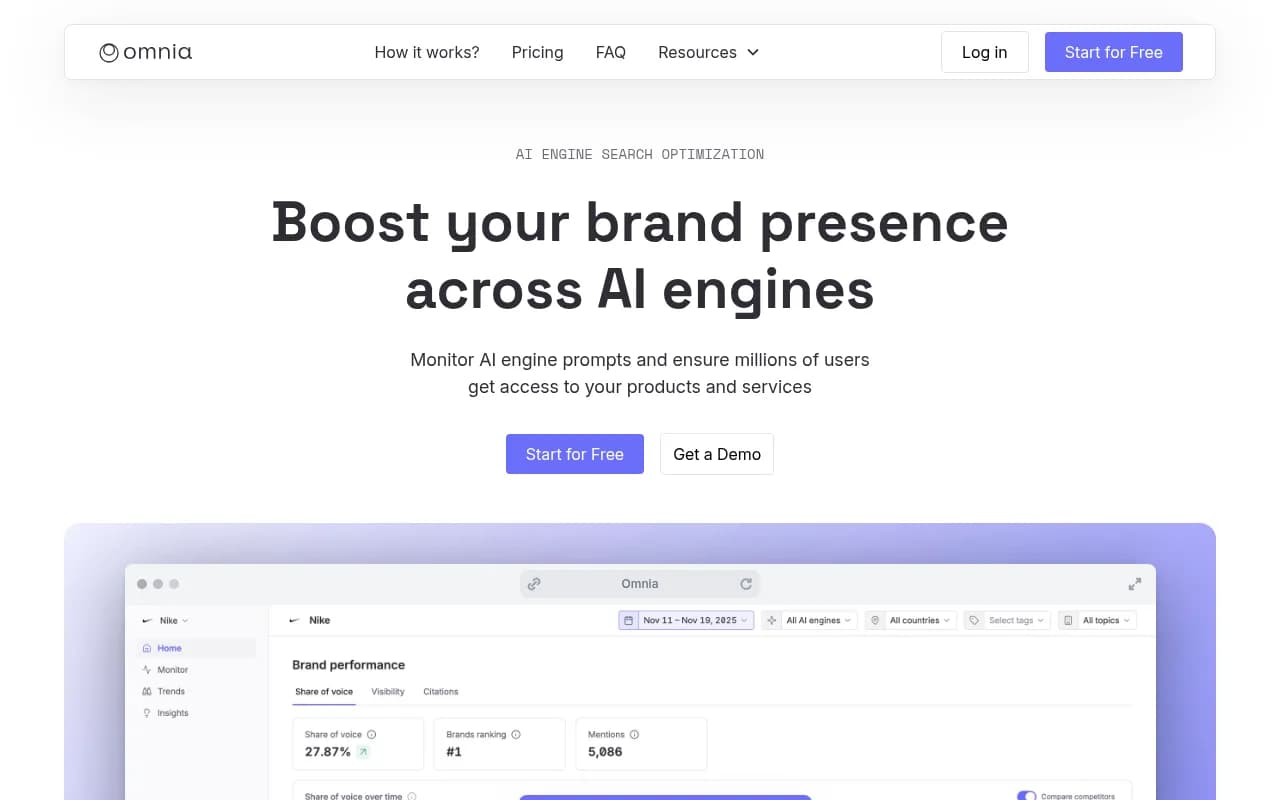
- Omnia focuses on brand presence in AI answers.
- Semrush adds AI visibility inside an existing SEO workflow.
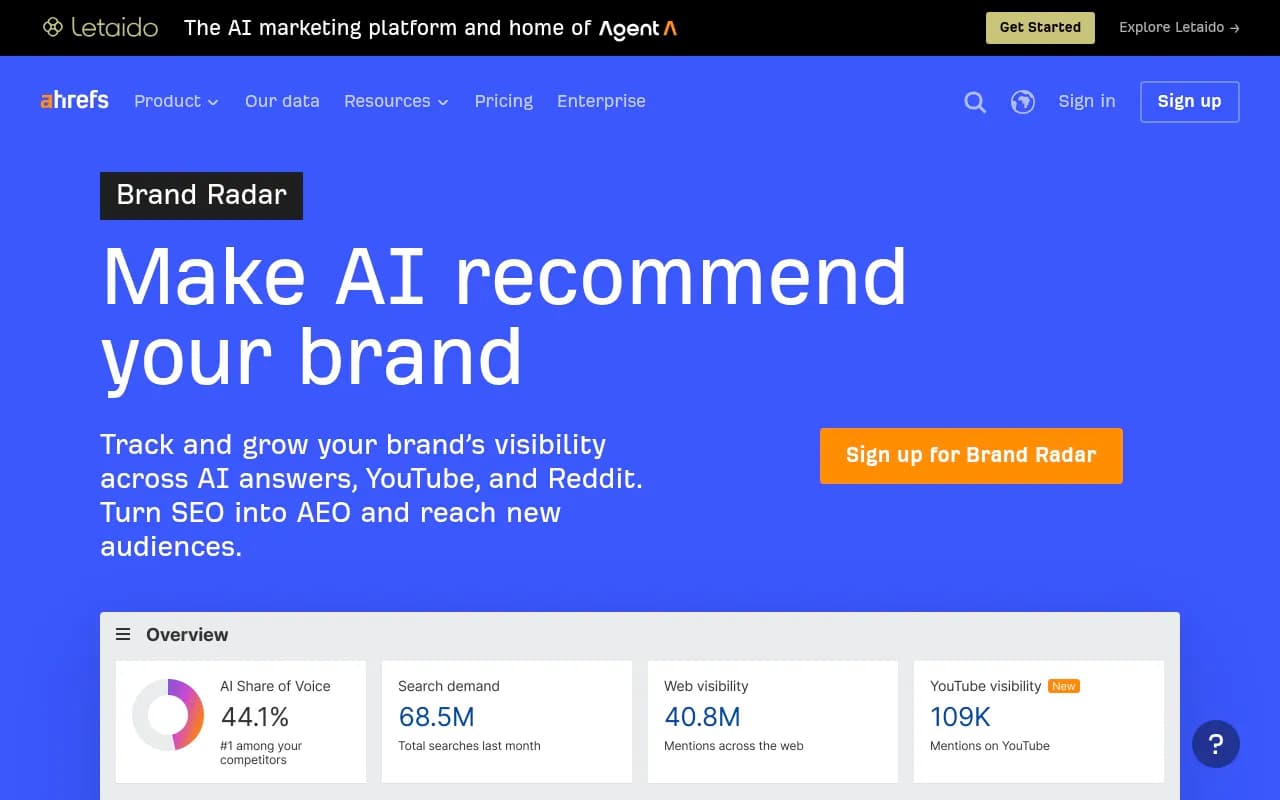
- Ahrefs Brand Radar suits teams already living in Ahrefs.
| Tool | Mention and position | Citations | Crawler logs | AI traffic attribution | Best for |
|---|---|---|---|---|---|
| Promptwatch | Yes | Yes, per page | Yes | Yes | Teams that want to act on the data |
| Profound | Yes | Yes | Limited | Limited | Large enterprises |
| Otterly.AI | Yes | Basic | No | No | Small teams, cheap monitoring |
| Peec AI | Yes | Basic | No | No | Executive dashboards |
| Semrush | Yes | Partial | No | No | Existing Semrush users |
| Ahrefs Brand Radar | Yes | Partial | No | No | Existing Ahrefs users |
Capabilities and prices change often, and some vendor pricing in public roundups is secondhand, so confirm on each vendor's page before you buy. For more options, the GEO software directory at bestgeosoftware.com lists a wider set.
Mistakes that skew the numbers
Reporting a single position as permanent. It will move. Report frequency.
Changing the prompt set mid-quarter. You lose the trend and cannot tell whether you improved or just asked easier questions.
Watching only ChatGPT. Behavior shifts between engines. Promptwatch's social citation data shows ChatGPT drew just 0.46% of its citations from social platforms from Sep 28 to Oct 4, 2026, while Google AI Overviews drew 12.2%. A Reddit strategy that works in one can do nothing in the other.
Ignoring the platform's own changes. ChatGPT began using the site: operator at scale on August 8, 2026, jumping from roughly 0.4% to 17% of fanout queries, according to Promptwatch's query fanout report. Sudden shifts in your metrics are not always your doing.
Chasing vanity totals. "Total mentions this month" without a denominator is noise.
A simple reading guide
When the numbers look bad, use the pattern to locate the cause:
- Low mention rate across clusters: a coverage problem. Publish for the missing prompts.
- Mentioned but late in the list: a prominence problem. Strengthen comparison and product pages.
- Mentioned without citations of your domain: a content or crawlability problem. Check logs and page structure.
- Cited but described badly: a reputation problem. Work on reviews and third-party mentions.
- Good visibility but flat conversions: the wrong prompts, or weak landing pages.
If you want outside help turning this into a program, 1001 SEO Media is the agency behind this site and runs GEO work for clients, but the framework above works fine in-house.
Where to start this week
Pick 30 prompts. Record mention rate, citation rate, and position for each across ChatGPT and two other engines. Check your robots.txt for OpenAI bots. Add an AI referrer channel in analytics. That is four tasks and one afternoon, and it gives you a baseline that actually means something. Repeat it in a month.