Key takeaways
- According to SparkToro and Similarweb data, 68% of Google searches in early 2026 ended without a click — up from 60% in 2024, driven largely by AI Overviews.
- Most AI search visibility platforms are monitoring dashboards: they show you where you're invisible, then leave you stuck.
- A small number of platforms have moved beyond tracking to actually help you create content that ranks in AI search engines.
- The difference between a monitoring tool and an optimization platform is whether it closes the loop: find gaps, generate content, track results.
- If your tool can't tell you what to write and help you write it, you're only solving half the problem.
The dashboard problem nobody talks about
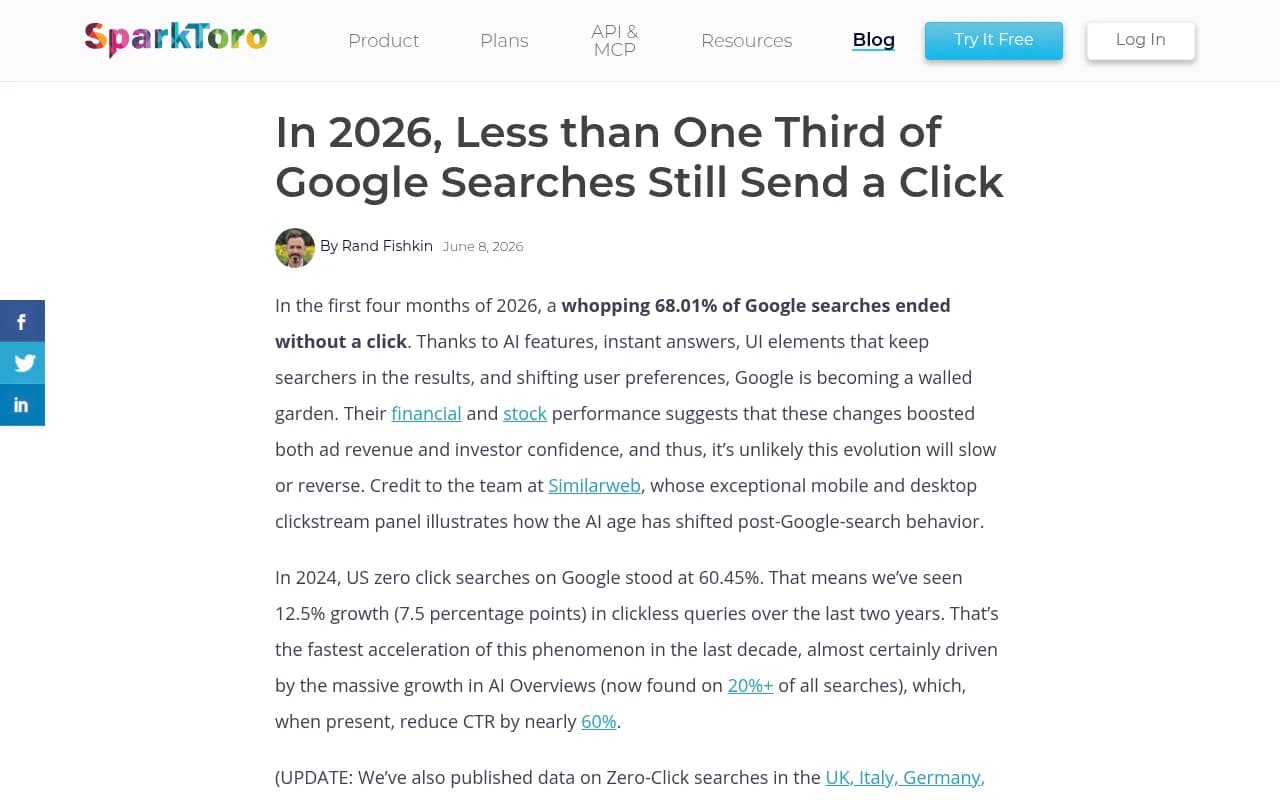
Here's the situation in 2026: AI search is eating traditional search traffic at a pace that would have seemed alarmist two years ago. SparkToro published data showing that in the first four months of 2026, 68% of Google searches ended without a click — up from 60% in 2024. That's a 12.5% acceleration in just two years, almost entirely driven by AI Overviews appearing on more than 20% of all searches.
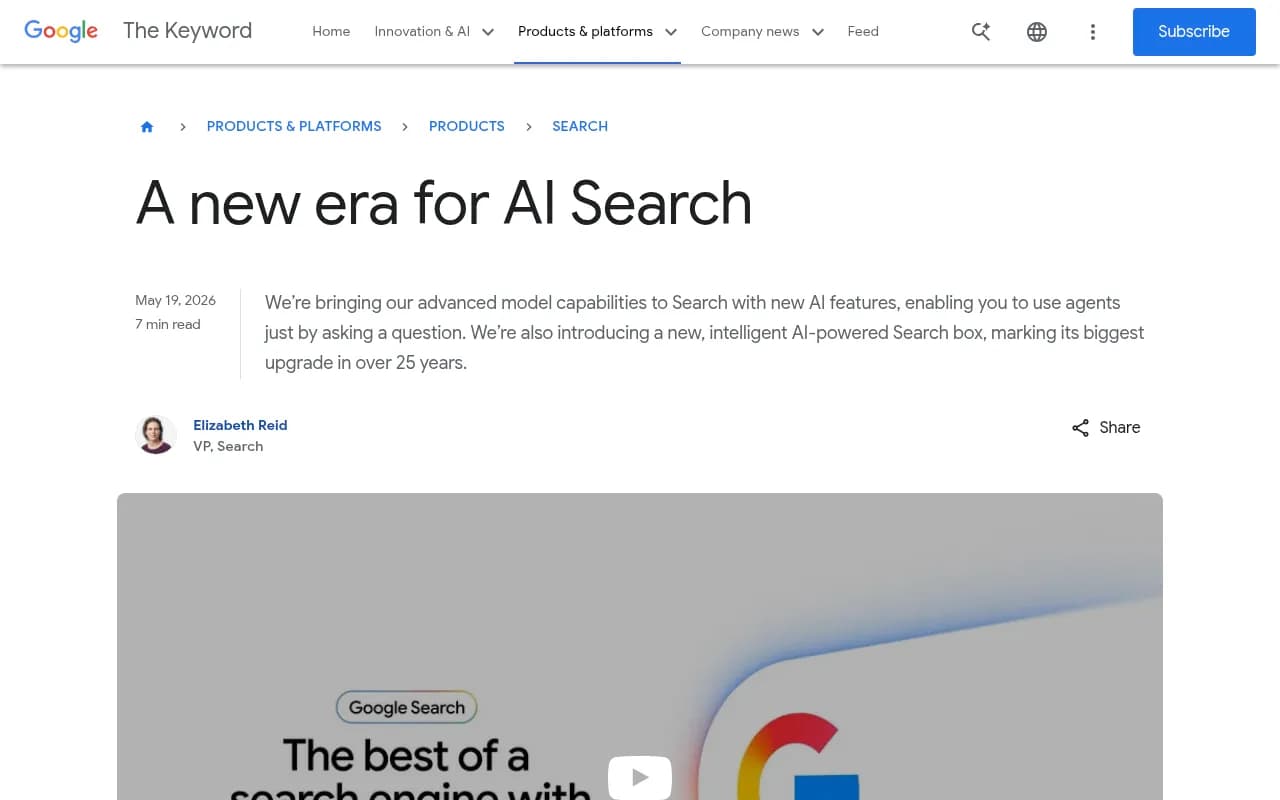
Gartner projects a 25% drop in traditional search engine volume by the end of 2026 as AI chatbots absorb queries that used to go to Google. Google itself announced at I/O 2026 that it's bringing agentic AI capabilities directly into Search — the biggest upgrade to the search box in over 25 years.
So marketers and SEO teams have responded logically: they've started buying tools to track their AI visibility. And the market has obliged. There are now dozens of platforms that will show you a dashboard of how often your brand appears in ChatGPT, Perplexity, Gemini, and Google AI Overviews.
The problem is that most of them stop there.
You get a score. You get a chart showing you're less visible than your competitors. You get a list of prompts where you don't appear. And then... nothing. The tool has diagnosed the problem and handed you the bill. What you actually do about it is your problem.
This is the dashboard trap. It feels like progress because you have data. But data without action is just expensive anxiety.
The platforms worth paying for in 2026 are the ones that close the loop.
What "closing the loop" actually means
Before getting into specific tools, it's worth being precise about what separates a monitoring dashboard from an optimization platform.
A monitoring dashboard answers: "Where am I visible in AI search engines right now?"
An optimization platform answers three questions in sequence:
- Where am I invisible, and why?
- What content would fix that?
- Did publishing that content actually work?
The first question is table stakes. Every tool in this space can answer it to some degree. The second and third questions are where most platforms fall short.
"Why am I invisible" requires more than just showing you a list of prompts where competitors appear. It requires mapping your existing content against what AI models are actually citing, identifying the specific topics and angles that are missing, and prioritizing which gaps are worth closing based on prompt volume and difficulty.
"What content would fix that" requires generating briefs or drafts grounded in real prompt data — not generic SEO content, but material engineered to answer the exact questions AI models are already fielding.
"Did it work" requires page-level tracking that connects specific published pages to citation events, and ideally connects those citations to actual traffic and revenue.
Most tools do the first question. A handful do the second. Very few do all three.
The 5 platforms that actually go beyond the dashboard
1. Promptwatch
Promptwatch is the most complete end-to-end platform in this space right now. The core loop is: find the gaps, generate the content, track the results.
The Answer Gap Analysis feature shows you exactly which prompts competitors are visible for but you're not — and crucially, it maps those gaps to the specific content your site is missing. You're not just seeing a list of prompts; you're seeing the topics, angles, and questions AI models want to answer but can't find on your site.
From there, Content Agents generate articles, listicles, comparisons, and briefs grounded in real prompt data, citation data, prompt volumes, persona targeting, and competitor analysis. This is where Promptwatch separates itself from monitoring-only tools: the content it generates is engineered around the actual gaps, not just keyword density.
The tracking side is equally thorough. AI Crawler Logs give you real-time visibility into when ChatGPT, Claude, Perplexity, and other crawlers hit your pages, what errors they encounter, and when pages move from crawl to citation. Page-level tracking shows which specific pages are being cited, how often, and by which models. Traffic attribution connects visibility to actual revenue.
It also tracks Reddit threads, YouTube videos, and third-party pages that are driving AI citations — a channel most competitors ignore entirely. ChatGPT Shopping tracking and entity monitoring round out a feature set that covers the full picture of how AI models discover and recommend brands.
Promptwatch covers 10 AI models: ChatGPT, Perplexity, Google AI Overviews, Google AI Mode, Claude, Gemini, Meta/Llama, DeepSeek, Grok, and Mistral. Pricing starts at $99/month for the Essential plan (1 site, 50 prompts, 5 articles), with Professional at $249/month and Business at $579/month.

2. Relixir
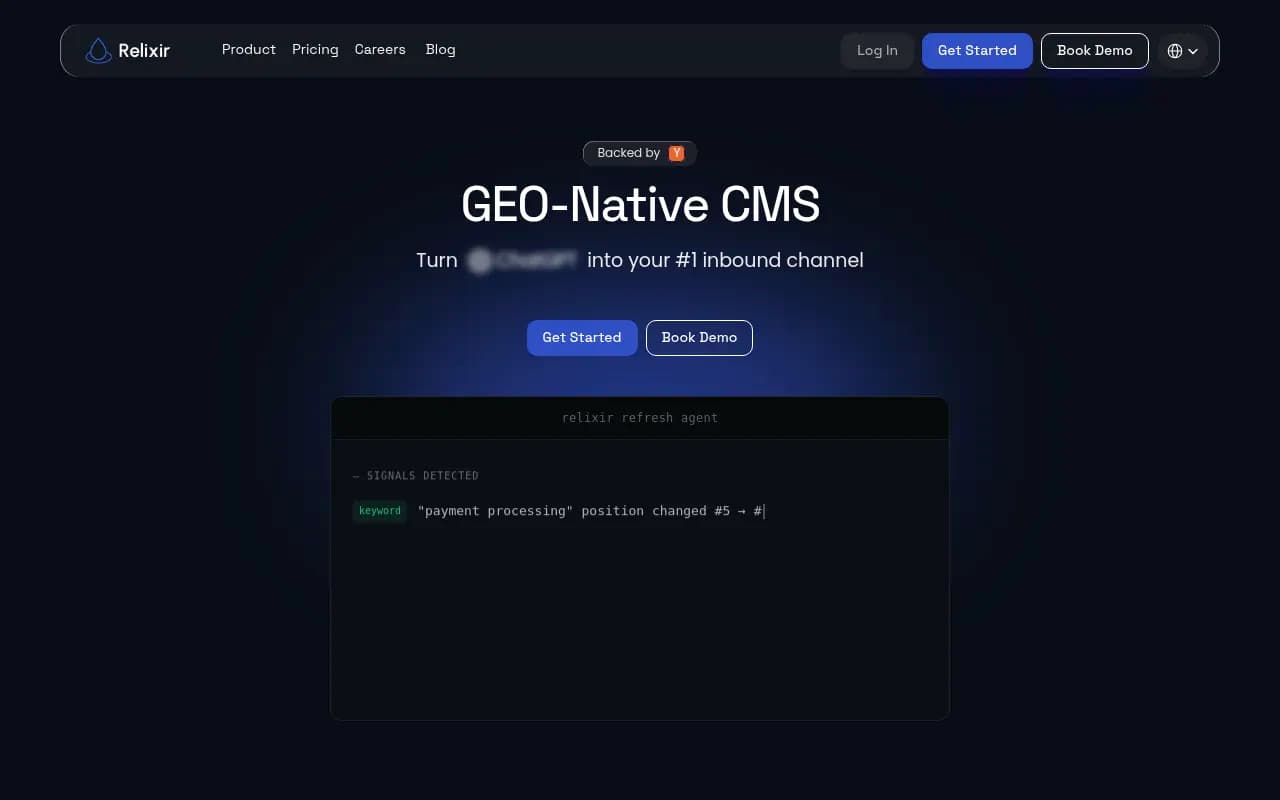
Relixir positions itself as an end-to-end GEO engine built for enterprise brands. It goes beyond monitoring by offering content optimization workflows that connect visibility gaps to content creation. The enterprise focus means it's built for teams with complex brand governance requirements, though that also means the pricing and onboarding reflect that complexity.
3. Search Atlas
Search Atlas takes an interesting approach by combining traditional SEO automation with AI search optimization. It doesn't just track where you rank — it actively fixes, optimizes, and publishes content. For teams that still need to manage both traditional SEO and AI search visibility in one place, it's one of the more capable options.
4. AirOps
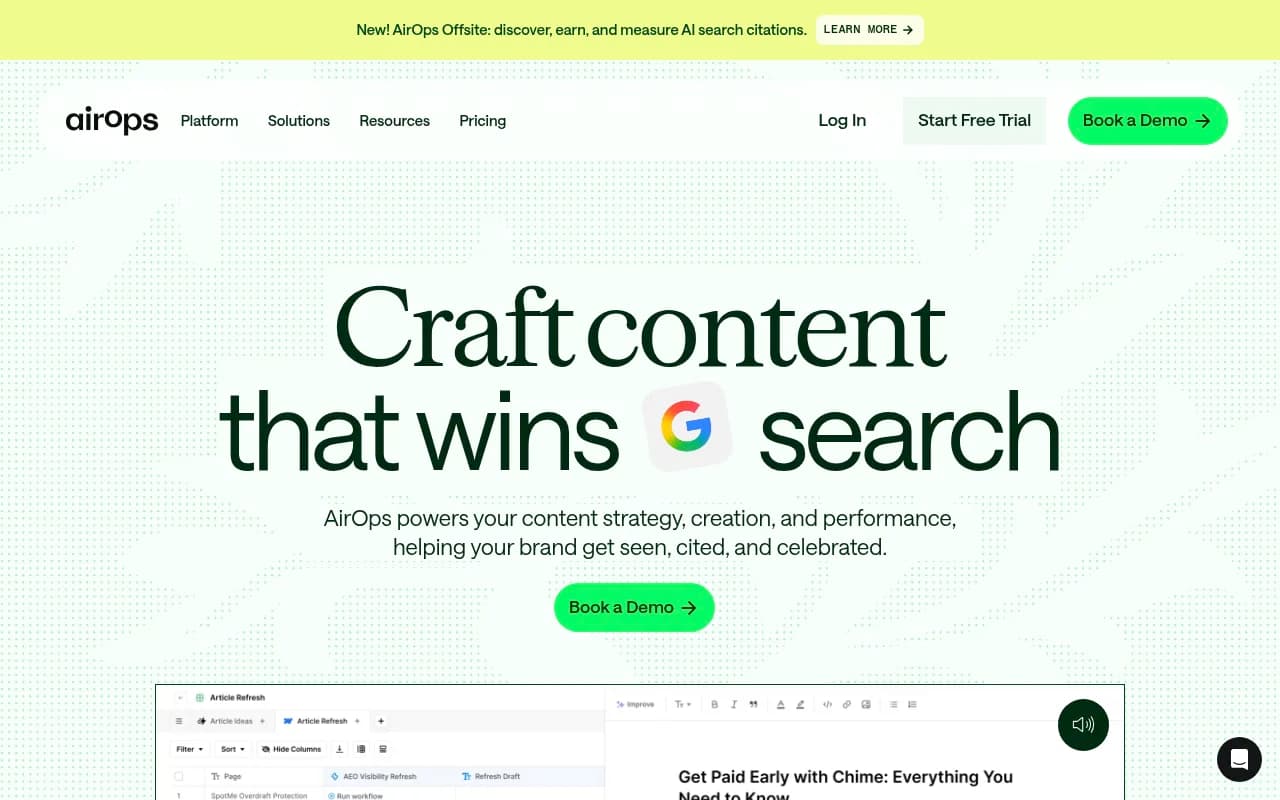
AirOps describes itself as a content engineering platform for AI search visibility. The emphasis on "engineering" is deliberate — it's built around the idea that content for AI search needs to be structured and targeted differently than traditional SEO content. It offers content workflows grounded in citation data and prompt analysis, making it more than a passive tracker.
5. Atomic AGI
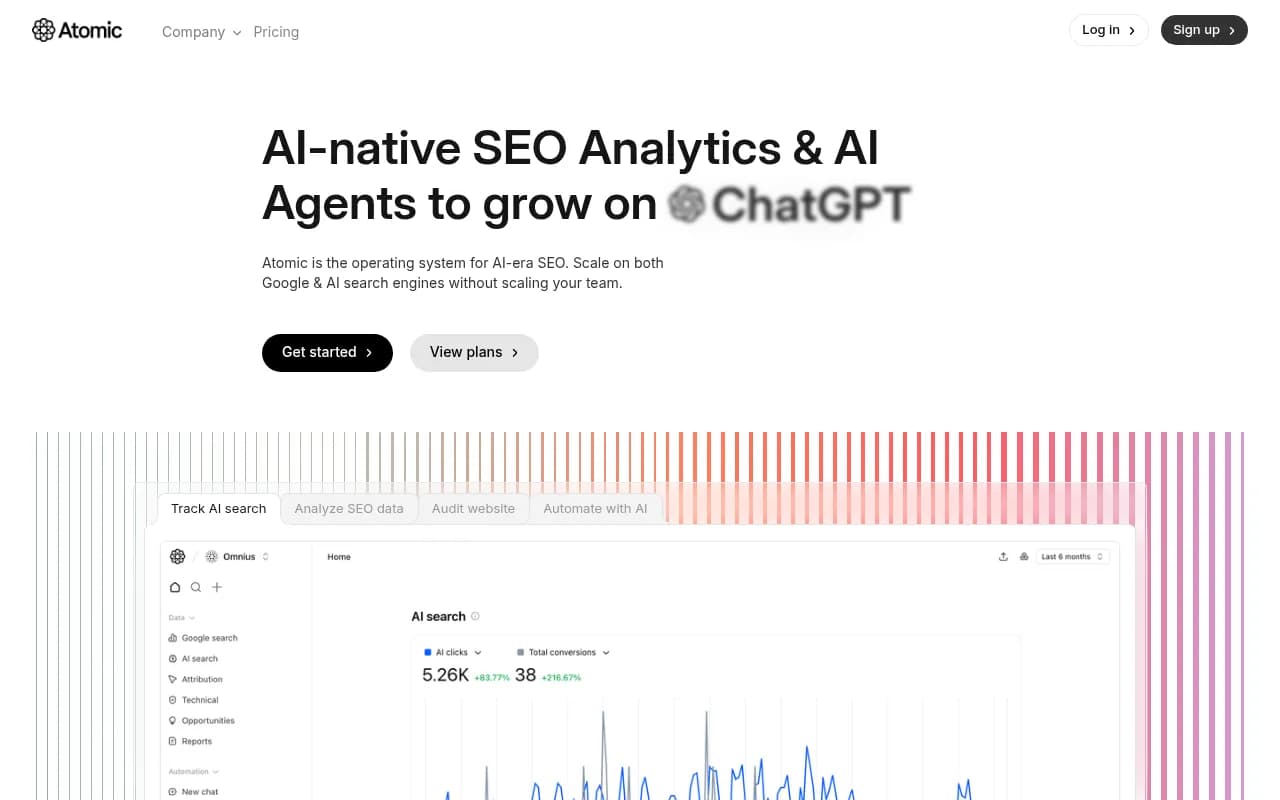
Atomic AGI combines multi-engine tracking with workflow automation in a way that's more action-oriented than most monitoring tools. It tracks visibility across AI engines and connects that data to content workflows, making it easier to move from "we're invisible here" to "here's what we're doing about it."
The monitoring-only tools (and why they're still useful)
To be fair, not every team needs a full optimization platform. If you're early in your AI visibility journey and just need to understand the landscape before committing to a strategy, monitoring tools have real value. Here's where the main players sit:
| Tool | Monitoring | Content gaps | Content generation | Crawler logs | Traffic attribution |
|---|---|---|---|---|---|
| Promptwatch | Yes | Yes | Yes | Yes | Yes |
| Relixir | Yes | Yes | Partial | No | No |
| Search Atlas | Yes | Partial | Yes | No | No |
| AirOps | Partial | Yes | Yes | No | No |
| Atomic AGI | Yes | Partial | Partial | No | No |
| Otterly.AI | Yes | No | No | No | No |
| Peec AI | Yes | No | No | No | No |
| AthenaHQ | Yes | No | No | No | No |
| Profound | Yes | Partial | No | No | No |
| Scrunch AI | Yes | No | No | No | No |
The monitoring-only tools aren't bad — they're just incomplete. Otterly.AI and Peec AI are fine for tracking brand mentions across ChatGPT, Perplexity, and AI Overviews. Profound has a strong enterprise feature set for visibility tracking. But none of them close the loop.
Otterly.AI


Profound

What to look for when evaluating any AI visibility platform
Real prompt data vs. API outputs
One thing that matters more than it sounds: some platforms track AI search behavior through direct API calls to models, while others track how AI search engines actually behave in real user interfaces. These can differ significantly. User-facing answers, citations, and shopping recommendations don't always match what you get from an API call. Platforms that track real UI behavior give you more accurate data about what your actual customers are seeing.
Prompt volume and difficulty scoring
Not all prompts are worth chasing. A platform that shows you 500 gaps without telling you which ones have real search volume or which ones are winnable is creating work, not reducing it. Look for tools that give you prompt-level volume estimates and difficulty scores so you can prioritize.
Page-level citation tracking
Brand-level visibility scores are useful for executive reporting. But for actually improving your performance, you need to know which specific pages are being cited, by which models, and how often. Page-level tracking is what lets you learn from what's working.
The content generation question
This is where the market splits most sharply. Generating content for AI search isn't the same as generating SEO blog posts. The content needs to directly address the gaps AI models are exposing, be structured in ways that AI engines can parse and cite, and be grounded in real prompt data rather than keyword research alone. Tools that generate content without that grounding tend to produce material that looks like SEO filler — it won't move your citation numbers.
Offsite citation analysis
Your AI visibility isn't just about your own website. Reddit threads, YouTube videos, third-party review sites, and listicles all influence what AI models recommend. A platform that only tracks your own domain is missing a significant part of the picture.
The practical question: what should you actually do?
If you're currently using a monitoring-only tool and wondering whether to upgrade, the honest answer depends on what you're doing with the data you already have.
If you're looking at your visibility dashboard and then manually trying to figure out what content to create, you're doing by hand what an optimization platform should be doing for you. The time cost of that manual process usually exceeds the cost difference between a monitoring tool and a full platform.
If you're not doing anything with the data at all — if the dashboard is just a number you report upward — then the problem isn't the tool. No platform will help you if the organization isn't ready to act on the findings.
The teams getting real results from AI search visibility work in 2026 are the ones running a consistent cycle: identify gaps, publish content targeted at those gaps, track whether citations follow. That cycle can be run manually with a monitoring tool and a content team, but it's significantly faster and more reliable when the platform is built around that loop from the start.
The dashboard is where you start. It shouldn't be where you stop.