HG Insights Review 2026
Technology intelligence platform revealing the tech stacks of millions of companies. Helps sales and marketing teams prioritize accounts based on installed technologies and IT spend.
Key takeaways
- HG Insights is one of the most data-rich technographic and revenue intelligence platforms available, trusted by 90% of Fortune 500 tech companies including AWS, IBM, Cisco, and Equinix.
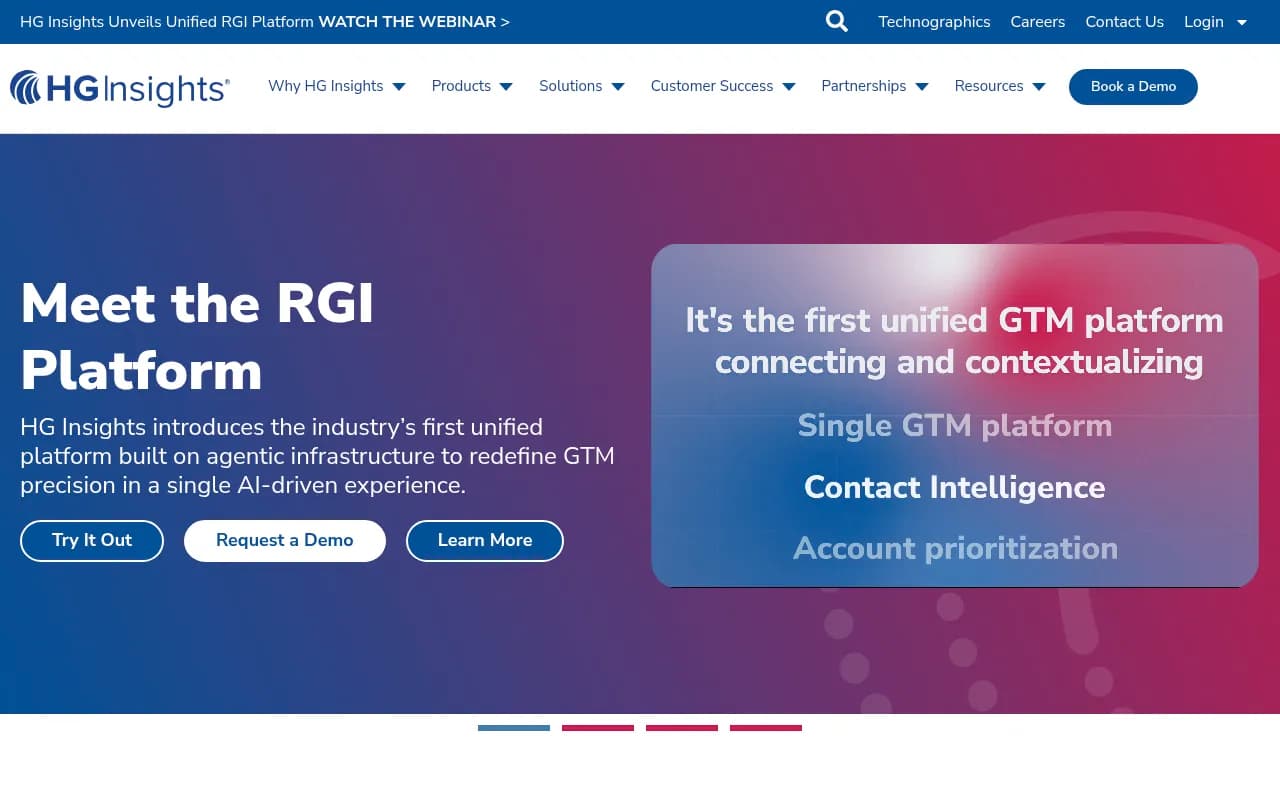
- The platform has evolved well beyond basic tech stack lookups -- it now combines technographics, IT spend data, buyer intent, AI-driven scoring, and agentic automation into a unified "Revenue Growth Intelligence" (RGI) platform.
- Pricing is enterprise-tier and not publicly listed; expect annual contracts that put it out of reach for most SMBs and early-stage startups.
- The 2025 acquisition of TrustRadius added a customer review and intent-driven leads layer that competitors like ZoomInfo and Bombora don't offer natively.
- Best suited for mid-market to enterprise B2B tech companies with dedicated RevOps or sales intelligence functions.
HG Insights is a Santa Barbara-based B2B intelligence company that has spent over a decade building what is arguably the most comprehensive database of technology installation and IT spend data in the market. The core premise is simple but powerful: if you sell software or technology, knowing what tools a prospect already uses tells you a lot about whether they're a good fit, how much they might spend, and when they're likely to be in the market. HG Insights turns that premise into a full go-to-market intelligence platform.
The company was founded in 2010 and spent its early years focused purely on technographic data -- essentially, which companies use which software products. Over time it layered in IT spend estimates, buyer intent signals, and predictive scoring. The most significant recent development was the acquisition of TrustRadius, the B2B software review platform, which gave HG Insights access to verified buyer intent data and a customer voice product that no pure-play technographic vendor can match. By 2026, the platform has been rebranded around the "Revenue Growth Intelligence" (RGI) concept, with a new unified platform, agentic AI infrastructure, and a Sales Copilot product that puts intelligence directly in front of reps.
The target audience is B2B technology companies -- specifically the sales, marketing, RevOps, and strategy teams within them. The claim that 90% of Fortune 500 tech companies use HG Insights is notable, and the customer list (AWS, IBM, Cisco, Equinix, NetApp, Hewlett Packard) confirms this is a platform built for and used by serious enterprise GTM teams.
Key features
Technographic data and tech stack intelligence
This is where HG Insights started and still where it's strongest. The platform tracks technology installations across millions of companies globally, drawing from over 20 billion second and third-party data points. In practice, this means you can search for companies that use Salesforce, filter by those also running SAP, and layer in company size or industry to build a highly targeted account list. The depth here is genuinely impressive -- users on TrustRadius consistently note that HG's technographic data is more comprehensive and reliable than what they get from ZoomInfo or DemandBase. One GTM Systems Analyst at Jama Software specifically called out the ability to "create lists of companies that use competing software" as something they couldn't get elsewhere.
IT spend intelligence
Beyond knowing what technology a company uses, HG Insights estimates how much they're spending on it. This is a meaningful differentiator. A company that spends $2M annually on cloud infrastructure is a very different prospect than one spending $50K, even if both technically "use AWS." The spend data feeds into account scoring and helps sales teams have more consultative conversations -- as Heidi Fisher from Equinox described, it allows reps to "engage with prospects and customers strategically" and "establish a larger footprint within chosen accounts."
RGI Platform and Market Analyzer
The unified RGI Platform is HG's answer to the fragmentation problem in GTM data. Rather than pulling technographic data from one tool, intent from another, and firmographics from a third, the platform attempts to bring all of this into a single interface with AI-driven analysis on top. The Market Analyzer component specifically handles TAM/SAM/SOM analysis with conversational queries -- you can ask it to size a market segment and get account-level breakdowns rather than top-down estimates. This is a meaningful upgrade over traditional market sizing approaches that rely on analyst reports.
Data Studio and predictive scoring
Data Studio is a no-code environment for building propensity models. RevOps teams can combine first-party CRM data with HG's third-party intelligence to score accounts for likelihood to buy, expand, or churn. The scoring covers accounts, MQLs, and PQLs, and it updates dynamically as signals change. For companies that previously needed a data science team to build these models, this is a real capability unlock.
Sales Copilot and AI sales plays
The Sales Copilot product sits inside the platform and is designed to surface daily recommendations for reps -- which accounts to prioritize, what signals are firing, and what playbook to run. It generates personalized outreach sequences based on account intelligence and automates the research work that typically eats up rep time. The "AI Sales Plays" feature takes this further by automating scoring, account research, and signal-based engagement workflows. This is where HG is clearly trying to compete with tools like Outreach and Salesloft on the execution side, not just the intelligence side.
Buyer intent and intent-driven leads
The TrustRadius acquisition gave HG access to what they call "second-party" intent data -- actual buyer behavior on a review platform, which is more reliable than the third-party intent signals most vendors sell. Intent-Driven Leads is a product that delivers opt-in, ICP-filtered leads from accounts actively researching on TrustRadius. This is a genuinely differentiated capability: you're getting leads from people who are actively comparing vendors, not just people who read a blog post that happened to mention your category.
Competitive displacement and whitespace analysis
The competitive displacement use case is one of the more tactically useful features. You can identify accounts using a competitor's product, filter by renewal timing signals, and trigger automated outreach campaigns. The whitespace analysis feature surfaces expansion opportunities within your existing customer base -- accounts that use some of your products but not others, or that have budget for adjacent solutions you sell.
MCP Server and RGI Agent Builder
For teams building AI-powered GTM workflows, HG has introduced an MCP (Model Context Protocol) Server and an Agent Builder that lets developers construct purpose-built AI agents using HG's data fabric. This is forward-looking infrastructure that positions HG as a data layer for AI-native GTM operations, not just a SaaS dashboard. The Agent Builder specifically avoids the need to stitch together multiple data pipelines, which is a real pain point for teams building custom AI workflows.
Customer Voice (TrustRadius integration)
The Customer Voice product captures and syndicates verified customer reviews to boost SEO, enrich campaigns, and accelerate deal cycles. For B2B vendors, having authentic customer quotes embedded in sales materials and landing pages has measurable impact on conversion. This product is essentially TrustRadius for Vendors, now bundled into the HG ecosystem.
Who is it for
The clearest fit for HG Insights is a mid-market to enterprise B2B technology company with a dedicated sales intelligence or RevOps function. Think a $50M+ ARR SaaS company with a 20-person sales team, a marketing ops manager, and a RevOps lead who's tired of stitching together ZoomInfo, Bombora, and Salesforce reports to figure out which accounts to prioritize. HG Insights is built to replace that stack with a single, more intelligent layer.
Strategy and product teams at larger companies also get real value here. If you're a VP of Strategy at a $500M tech company trying to size a new market segment or evaluate a potential acquisition target's competitive position, the bottom-up account-level market sizing in HG is more credible than anything you'd get from an analyst report. The customer testimonials from companies like NiCE, Hyland Software, and HiBob all describe this kind of strategic use case alongside the tactical sales prioritization use case.
Who should probably not use HG Insights: early-stage startups (the pricing and complexity are overkill), companies selling to SMBs (the technographic data is strongest for mid-market and enterprise accounts), and teams without a RevOps or sales intelligence function to actually operationalize the data. HG Insights is a platform that rewards investment -- you need someone who can build the scoring models, set up the integrations, and train the sales team on how to use the signals. If you don't have that capacity, you'll pay enterprise prices for a dashboard nobody uses.
Integrations and ecosystem
HG Insights integrates with the major CRM and marketing automation platforms. Salesforce and HubSpot are the primary CRM integrations, with data enrichment flowing directly into account and contact records. On the marketing side, integrations with DemandBase and 6sense allow technographic and intent signals to feed into ABM campaigns.
The RGI Fabric product is specifically designed for data enrichment into MDM systems and CRMs, making it easier for large enterprises with complex data architectures to consume HG's intelligence. The new MCP Server adds a programmatic layer for teams building AI agents, and the RGI Agent Builder provides a developer-friendly environment for custom workflows.
HG also has a GitHub presence (github.com/HGData) suggesting some level of developer tooling or open data initiatives, though the primary product is a closed SaaS platform. The API is available for enterprise customers who need to pull data into custom systems.
Pricing and value
HG Insights does not publish pricing on its website, which is standard for enterprise B2B data platforms. Based on third-party sources including Vendr, pricing follows an annual contract model with a base platform fee plus variable costs tied to data access, user seats, and usage volume. Contracts typically run into five figures annually, with larger enterprise deployments reaching six figures.
There is a free competitive intelligence tool available at discovery.hginsights.com that lets you explore some competitive displacement data without a full subscription -- a useful way to evaluate the data quality before committing. A demo is available through the website.
For context, this pricing puts HG Insights in the same tier as ZoomInfo, Bombora, and DemandBase -- all of which are also annual contract, enterprise-priced tools. The value proposition relative to those alternatives depends on how much weight you put on technographic depth and IT spend data specifically. If those are core to your GTM motion, HG's data quality justifies the price. If you primarily need contact data and basic intent signals, ZoomInfo or a combination of cheaper tools might serve you better.
Strengths and limitations
What HG Insights does well:
- The technographic and IT spend data is genuinely best-in-class. Multiple independent reviewers describe it as more comprehensive and reliable than ZoomInfo or DemandBase for this specific data type.
- The TrustRadius integration creates a unique second-party intent signal that no pure-play technographic vendor can replicate. Leads from active buyers on a review platform are meaningfully higher quality than third-party intent signals.
- The platform has evolved thoughtfully from a data vendor into an intelligence platform. The addition of Data Studio, Sales Copilot, Market Analyzer, and the Agent Builder shows a coherent product vision, not just feature accumulation.
- The MCP Server and Agent Builder position HG well for the AI-native GTM future. Teams building agentic sales workflows need a reliable data layer, and HG is one of the few vendors actively building for that use case.
Honest limitations:
- Pricing and complexity make this inaccessible for most companies below $20-30M ARR. There's no self-serve tier, no transparent pricing, and the platform rewards teams that can invest in operationalizing the data.
- The breadth of the platform can work against it. With Market Analyzer, Data Studio, Sales Copilot, Buyer Intent, Intent-Driven Leads, Customer Voice, and the Agent Builder all under one roof, new users face a steep learning curve. The "unified platform" story is compelling on paper but requires real onboarding investment.
- Coverage outside North America and Western Europe is thinner. The technographic data is strongest for US and UK companies; teams targeting APAC or emerging markets may find gaps.
Bottom line
HG Insights is the right choice for enterprise B2B technology companies that have made technographic intelligence a core part of their GTM strategy and need a platform that can operationalize that intelligence at scale. The combination of best-in-class tech stack data, IT spend estimates, TrustRadius-powered buyer intent, and AI-driven scoring and automation is hard to match with any single competitor.
Best use case in one sentence: an enterprise SaaS company's RevOps team using HG to build propensity models, prioritize competitive displacement campaigns, and feed daily account signals to sales reps through the Sales Copilot.
Tags:
Frequently asked questions
What is HG Insights?
Who uses HG Insights?
How much does HG Insights cost?
How does HG Insights differ from ZoomInfo or DemandBase?
Is there a free version of HG Insights?
What integrations does HG Insights support?
Similar and alternative tools to HG Insights