Kartra Review 2026
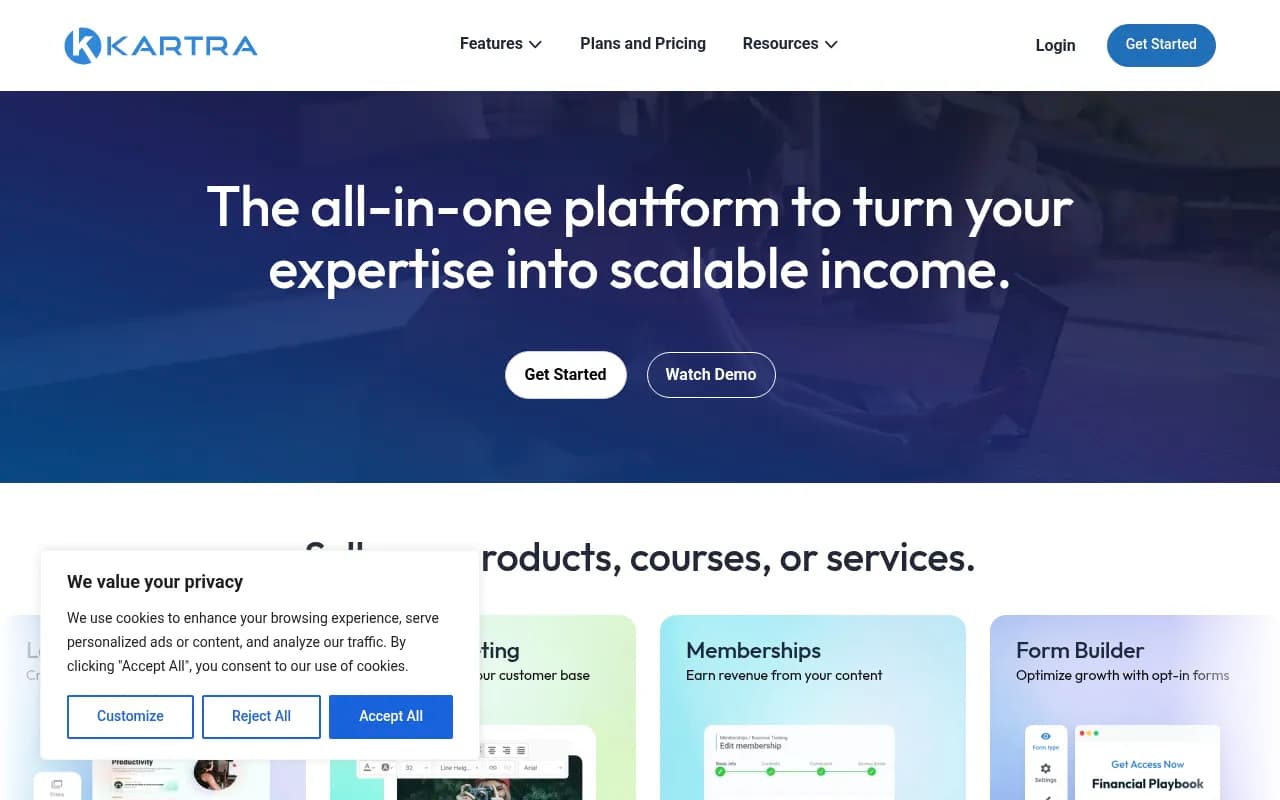
Kartra is an all-in-one marketing platform for coaches, consultants, and course creators. It combines landing pages, email automation, sales funnels, membership sites, checkouts, and AI content tools in a single dashboard — replacing tools like ClickFunnels, Kajabi, and ConvertKit.
Key takeaways
- Kartra is a genuinely comprehensive all-in-one platform covering landing pages, email marketing, sales funnels, membership sites, course delivery, checkouts, and affiliate management from a single dashboard
- Best fit for coaches, consultants, and course creators who want to replace 8-12 separate tools with one connected system
- Pricing starts at $59/month (Essentials), but the entry plan has real limitations: only 1 course, 500 contacts, and a 5% transaction fee that can add up fast
- The platform has a steeper learning curve than it advertises -- the drag-and-drop builder is functional but not as intuitive as dedicated page builders like Unbounce or Leadpages
- Strong automation engine and native integrations between modules are the real differentiators vs. stitching together separate tools
Kartra is an all-in-one online business platform built by Genesis Digital, the same company behind WebinarJam and EverWebinar. It launched in 2018 and has since grown to over 60,000 customers, with creators reportedly earning $1.5 billion through the platform. The pitch is simple: instead of paying for ClickFunnels, ConvertKit, Teachable, ThriveCart, and a helpdesk tool separately, you run everything from one login.
The target audience is specific. Kartra isn't trying to be Salesforce or HubSpot. It's built for knowledge-based business owners -- coaches scaling out of one-on-one work, consultants packaging their frameworks into courses, wellness professionals launching online programs, and service providers who want passive income streams alongside their client work. If you're running a physical product e-commerce store or a SaaS company, Kartra probably isn't the right fit.
The platform has gone through meaningful evolution since its 2018 launch. Early versions were criticized for a clunky interface and slow page load times. Genesis Digital has invested significantly in the product since then, adding Kartra AI for content generation, improving the funnel mapper, and introducing a cleaner onboarding experience. The current pricing structure reflects a repositioning toward the "expert economy" -- the Essentials tier at $59/month is clearly aimed at getting solo operators in the door.
Key features
Landing page builder
Kartra's page builder uses a drag-and-drop interface with over 100 pre-designed templates. You can build landing pages, sales pages, thank-you pages, and pop-ups (including exit-intent overlays) without touching code. Pages are hosted on Kartra's infrastructure, so there's no separate hosting to manage. The builder supports tag-based content, meaning you can show different content to different segments of your audience on the same page. Compared to dedicated page builders like Unbounce or Instapage, the editor feels slightly less polished -- moving elements around can be fiddly -- but the tight integration with the rest of the platform (forms, checkouts, email sequences) compensates for that.
Email marketing and automation
This is one of Kartra's stronger modules. You get broadcast emails, automated sequences, behavior-based triggers, lead tagging, and lead scoring all built in. The automation builder uses a visual workflow interface where you can set up conditional logic: if a contact clicks a specific link, add tag X, wait 3 days, send email Y, and so on. A/B testing is available for email subject lines and content. The system handles list segmentation well, and because it's native to the platform, automations can trigger based on actions taken anywhere in Kartra -- a purchase, a page visit, a form submission, a video watch percentage. That cross-module triggering is genuinely useful and harder to replicate when you're stitching together separate tools.
Sales funnels and funnel mapper
Kartra includes a visual funnel mapper that lets you map out the entire customer journey before building it. You can see how pages, emails, and checkout steps connect, then build from that map. Done-for-you campaign templates are available for common funnel types: lead magnet funnels, product launch sequences, webinar funnels, and high-ticket application funnels. The funnel simulator lets you model revenue projections based on estimated conversion rates before you launch -- a nice touch for planning purposes. Compared to ClickFunnels, Kartra's funnel builder is less visually slick but arguably more powerful because it's connected to a real CRM and email system rather than relying on third-party integrations.
Membership sites and course delivery
Kartra's membership module handles course hosting, content dripping, progress tracking, and member access control. You can upload videos (hosted on Kartra), PDFs, and other downloadable content. Drip scheduling lets you release content on a schedule after a member joins, which is standard for course platforms. The member portal is customizable and can be white-labeled to match your brand. One honest limitation: Kartra's course builder isn't as feature-rich as dedicated platforms like Thinkific or Teachable. There's no native community feature (like a forum or social feed), and the video player is functional but basic. For straightforward course delivery, it works well. For building a community-driven learning experience, you might feel the gaps.
Checkouts and payment processing
Kartra's checkout system supports one-time payments, subscriptions, payment plans, and upsell/downsell flows. You can add order bumps directly on the checkout page, create coupon codes, and set up trial periods for subscription products. The checkout pages are customizable and can be embedded on external pages or hosted on Kartra. Payment processing connects to Stripe, PayPal, Braintree, and Authorize.net. One thing to watch: the Essentials plan charges a 5% transaction fee on top of your payment processor's fees. That disappears on higher tiers, but it's a meaningful cost if you're doing any real volume at the entry level.
Affiliate management
Built-in affiliate management is something most competing platforms charge extra for or don't include at all. Kartra lets you create an affiliate program for any product, set commission rates (flat or percentage), and manage payouts from within the platform. Affiliates get their own portal to track clicks, conversions, and earnings. You can set up two-tier affiliate structures and approve affiliates manually or automatically. For course creators and coaches who rely on JV partnerships and affiliate launches, this is a genuinely valuable native feature.
Kartra AI
The AI content tool generates copy for emails, landing pages, sales pages, and headlines. It's positioned as a voice-matching tool -- you feed it information about your brand and offer, and it generates content that sounds like you rather than generic marketing copy. In practice, the output quality is comparable to other AI writing tools built on similar underlying models. It's useful for getting a first draft quickly, especially for email sequences where you need volume. It won't replace a skilled copywriter for high-stakes sales pages, but it meaningfully reduces the time to get something live.
Analytics and reporting
Kartra tracks page views, opt-in rates, sales conversions, email open and click rates, and revenue -- all in one dashboard. The funnel analytics show you where people drop off in a sequence, which is useful for identifying weak points. Video analytics track watch time and drop-off points. The reporting isn't as deep as a dedicated analytics platform, but for most small business owners, it covers the metrics that actually matter for day-to-day decisions.
Who is it for
Kartra's sweet spot is the solo operator or small team running a knowledge-based business with $50K-$500K in annual revenue. Think: a business coach who has been doing one-on-one work for years and wants to launch a group program or course. Or a consultant who has a proven framework and wants to package it into a self-paced product. Or a wellness professional -- a nutritionist, therapist, or fitness coach -- who wants to sell online programs without hiring a developer or managing five different software subscriptions.
The platform also works reasonably well for small agencies that want to manage client funnels and email marketing from one place. Kartra has an agency-style account structure that lets you manage multiple client accounts, though it's not as purpose-built for agency workflows as something like GoHighLevel.
Who should probably look elsewhere: physical product sellers (Shopify is a better fit), SaaS companies (you need a proper CRM and product-led growth tooling), and enterprise marketing teams (the platform doesn't have the compliance features, SSO, or API depth that enterprise buyers typically need). Also, if you're a developer who wants to build custom integrations or extend the platform significantly, Kartra's API is functional but not particularly developer-friendly compared to more open platforms.
Integrations and ecosystem
Kartra's native integrations cover the most common tools in the knowledge business stack:
- Email: Mailchimp, ActiveCampaign, AWeber, GetResponse, Sendgrid (though most users just use Kartra's built-in email)
- Payments: Stripe, PayPal, Braintree, Authorize.net
- Webinars: WebinarJam and EverWebinar (same parent company, so the integration is tight)
- Calendars: Calendly and similar scheduling tools via embed
- Zapier: Available for connecting to hundreds of third-party apps not natively supported
- API: REST API available for custom integrations, though documentation is not the most comprehensive
The platform also supports Facebook Pixel and Google Analytics tracking on pages, which is important for running paid traffic campaigns. There's no native mobile app for customers managing their business on the go, which is a gap compared to some competitors. Members can access course content on mobile via a browser, but the experience isn't optimized for mobile the way a dedicated app would be.
Import/export capabilities are decent -- you can export contact lists as CSV, and Kartra supports importing contacts from other platforms. Migrating an entire course or funnel setup from another platform is manual work, though.
Pricing and value
Kartra's current pricing structure (as of 2026):
- Essentials: $59/month (or ~$52/month billed annually) -- 1 course, 500 contacts, 5% transaction fee, core features
- Starter: $119/month (or ~$99/month annually) -- more contacts, no transaction fee, additional courses
- Growth: $229/month (or ~$189/month annually) -- higher contact limits, more courses, advanced features
There's also a promotional offer of 3 months for $99 on the Starter plan, which appears periodically.
The Essentials plan is genuinely limited. The 5% transaction fee is the biggest issue -- if you're selling a $500 course to 20 people a month, that's $500/month in fees on top of your subscription and payment processor fees. The 500-contact limit also fills up faster than you'd expect once you start running any kind of lead generation. Most serious users will end up on the Starter plan at minimum.
Compared to the main alternatives: Kajabi starts at $89/month with no transaction fees and more generous limits. ClickFunnels 2.0 starts at $97/month. GoHighLevel is $97/month for agencies. Kartra's Essentials tier is cheaper than most competitors, but the transaction fee makes it more expensive in practice for anyone doing real volume. The Starter tier at $119/month is competitive with Kajabi and ClickFunnels when you factor in everything that's included.
There's no permanent free tier, but Kartra offers a trial period for new users.
Strengths and limitations
What Kartra does well:
- The cross-module automation is genuinely powerful. Triggering email sequences based on checkout events, video watch percentages, or membership activity is seamless because everything is in one system. This is hard to replicate with separate tools.
- Built-in affiliate management at no extra cost is a real differentiator. Kajabi charges extra for this; many platforms don't offer it at all.
- The funnel mapper and simulator are useful planning tools that competitors don't always include.
- Done-for-you campaign templates reduce the time to launch significantly for users who don't want to build from scratch.
- The WebinarJam integration is tight and works well for coaches and consultants who use webinars as a primary sales mechanism.
Honest limitations:
- The page builder, while functional, isn't as smooth as dedicated tools like Unbounce or even ClickFunnels. The editor can feel slow and the mobile preview doesn't always match the live result accurately.
- Course and membership features are adequate but not best-in-class. If community features, advanced learning paths, or certificates are important to you, Thinkific or Teachable are stronger.
- The Essentials plan's 5% transaction fee is a trap for new users who don't read the fine print. It makes the entry price misleading.
- Customer support response times have been a consistent complaint in user reviews -- live chat is available but can be slow during peak hours, and the help documentation, while extensive, isn't always easy to navigate.
- No native mobile app for business owners managing their account, and the member-facing mobile experience is browser-only.
Bottom line
Kartra makes the most sense for coaches, consultants, and course creators who are currently juggling multiple tools and paying for them separately. If you're spending $30/month on ConvertKit, $97/month on ClickFunnels, $39/month on Teachable, and $29/month on ThriveCart, consolidating into Kartra's Starter plan at $119/month is a straightforward financial win -- and you get everything talking to each other natively.
The platform isn't perfect, and it's not trying to be the best at any single thing. But for a solo operator or small team that wants one login, one support team, and one system that handles the full customer journey from opt-in to course delivery, Kartra delivers on that promise better than most alternatives in 2026.
Best use case in one sentence: A business coach or consultant ready to move from one-on-one work to scalable online programs who wants a single platform to handle their entire sales and delivery infrastructure without hiring a developer.
Tags:
Frequently asked questions
What is Kartra and what does it do?
How much does Kartra cost?
Is there a free trial for Kartra?
How does Kartra compare to Kajabi or ClickFunnels?
Who is Kartra best suited for?
Does Kartra include email marketing?
Similar and alternative tools to Kartra