Klue Review 2026
Competitive intelligence platform that tracks competitor changes and delivers concise battlecards directly into sales reps' existing tools to drive revenue.
Key takeaways
- Klue combines competitive intelligence automation and win-loss analysis in a single platform, making it one of the more complete CI tools for B2B go-to-market teams
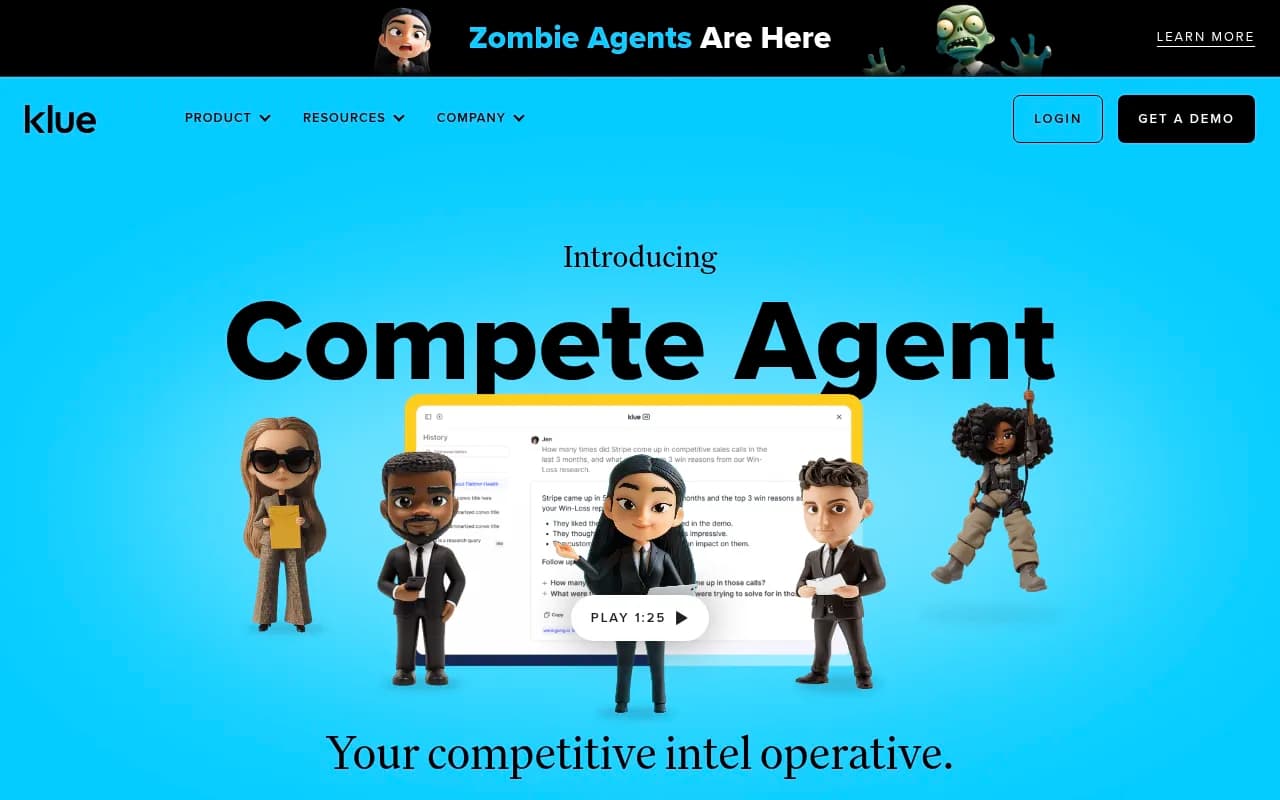
- The recently launched Compete Agent uses AI to eliminate manual research work and push deal-specific competitive insights directly to sellers in their existing tools
- Win-loss is a genuine differentiator -- Klue offers managed interview services with experienced analysts, not just survey templates
- Pricing is enterprise-grade and quote-based, typically running $16,000-$40,000+ per year, which puts it out of reach for smaller teams
- No free tier; demo-only entry point
Klue is a competitive intelligence platform built for B2B companies that want their sales teams to actually use competitive data, not just collect it. Founded in Vancouver, BC, and operating as Klue Labs, the company has been building in the CI space since the mid-2010s and has grown to serve over 250,000 users across companies like Adobe, Shopify, Zendesk, Gainsight, and SurveyMonkey. The core premise is straightforward: competitive intel is only valuable if it reaches the right person at the right moment in a deal. Klue's entire product architecture is built around that delivery problem.
The platform has two main pillars. The first is competitive intelligence -- automated tracking, battlecard creation, and deal-based insight delivery. The second is win-loss analysis, which goes well beyond typical survey tools by offering managed interview programs with trained analysts. In 2025, Klue launched Compete Agent, an AI agent that handles much of the manual research and curation work that has historically made CI programs hard to scale. That launch marks a meaningful shift from a content management tool to something closer to an autonomous competitive intelligence operative.
The target audience is primarily product marketing managers (PMMs), competitive intelligence managers, and sales enablement teams at mid-market to enterprise B2B SaaS companies. If you're running a CI program for a company with a complex competitive landscape and a sales team that needs to win deals against named competitors, Klue is built for you.
Key features
Compete Agent (AI-powered CI automation) Compete Agent is Klue's flagship AI feature as of 2025-2026. It automatically monitors competitor activity across the web, synthesizes changes, and pushes relevant updates to the right sellers based on the deals they're working. Rather than requiring a PMM to manually review competitor news and update battlecards, the agent handles the collection and initial curation layer. One customer (Blackbaud) reported saving two days per week and a 28% increase in win rates against top competitors after adopting it. The agent also handles "deal tips" -- proactively sending sellers personalized competitive recommendations when they're in an active competitive deal.
Battlecard creation and management Klue's battlecard builder is the product's most established feature. PMMs can create structured battlecard templates covering positioning, objection handling, pricing comparisons, and proof points. The AI layer can generate draft content from collected intel, which editors then refine. Battlecards are versioned, can be segmented by competitor, and are surfaced contextually rather than requiring reps to go hunting. The "Ask Klue" feature lets sellers ask natural language questions and get answers pulled from battlecard content -- useful for handling obscure competitors or edge-case objections that don't have a dedicated card.
Win-loss analysis This is where Klue genuinely differentiates from most CI tools. Win-loss programs are notoriously hard to run well because internal teams tend to introduce bias and buyers rarely give honest feedback to the company they just rejected. Klue addresses this with a managed service: their team of experienced interviewers, analysts, and writers conducts buyer interviews on your behalf and produces structured reports. The output feeds directly back into the competitive intelligence layer, so insights from lost deals can update battlecards and positioning. This closed loop between win-loss data and CI content is something most standalone tools don't offer.
Deal-based competitive insights Rather than giving sellers a static library to browse, Klue pushes deal-specific intel based on the competitors identified in active opportunities. This is delivered through integrations with CRM and sales tools -- when a rep is working a deal where Competitor X is mentioned, they automatically receive relevant battlecard content, recent news about that competitor, and recommended talk tracks. Gainsight reported that sellers receive an average of 243 deal tips automatically, with 72% seller adoption -- a number that's genuinely hard to achieve with passive content libraries.
Competitor tracking and monitoring Klue automatically tracks competitor websites, press releases, job postings, social media, review sites (G2, Capterra), and news sources. Changes are flagged, categorized, and surfaced to the relevant stakeholders. The platform can track 60+ competitors simultaneously, which matters for companies operating in fragmented markets. Job posting analysis is a particularly useful signal -- hiring patterns often reveal product roadmap direction before any public announcement.
Ask Klue (conversational AI interface) Ask Klue is a natural language interface that lets sales reps query the competitive knowledge base without navigating battlecard menus. One customer noted it's especially valuable for handling questions about obscure competitors that don't have dedicated cards, or for surfacing specific capability comparisons mid-call. The interface is accessible through the Klue app and through integrations like Slack and browser extensions.
Competitive enablement analytics Klue tracks battlecard usage, seller engagement, and competitive win/loss rates by competitor. This gives CI managers visibility into which content is actually being used, which competitors are showing up most in deals, and whether the program is moving win rates. Without this layer, most CI programs operate on faith that the content is helping -- Klue makes it measurable.
Integrations ecosystem The platform integrates with Salesforce, HubSpot, Slack, Microsoft Teams, Highspot, Seismic, Gong, and others. A Chrome extension lets sellers access battlecard content directly in their browser. The depth of these integrations is central to Klue's value proposition -- if sellers have to leave their workflow to find competitive intel, they won't do it.
Who is it for
Klue's sweet spot is product marketing and competitive intelligence teams at B2B SaaS companies with 200+ employees and active sales teams. Think a company with 5-20 named competitors, a sales cycle measured in weeks or months, and a PMM or CI manager who owns the competitive program. Companies like Blackbaud, Gainsight, and Zendesk are representative customers -- they have complex competitive landscapes, large sales teams, and the budget to invest in a dedicated CI platform.
Sales enablement leaders are a secondary but important persona. If you're responsible for making sure reps are prepared for competitive objections and you're tired of building static PowerPoint battlecards that get ignored, Klue's delivery mechanism (pushing intel into Salesforce, Slack, and Gong rather than waiting for reps to seek it out) is a real solution to a real problem.
Win-loss program owners are a third persona that Klue has specifically built for. If you're trying to run a structured win-loss program but don't have the internal bandwidth or objectivity to conduct buyer interviews, Klue's managed service fills that gap. This is less common in CI tools and makes Klue worth evaluating even for teams that already have a separate CI solution.
Klue is probably not the right fit for early-stage startups (the price point alone rules it out), solo PMMs without a sales team to enable, or companies in markets with fewer than 3-4 meaningful competitors. It's also not a good fit for teams that want a self-serve, no-touch setup -- Klue is a platform that requires investment to configure and maintain, and the value scales with how much effort the CI team puts into it.
Integrations and ecosystem
Klue's integration list covers the major sales and enablement tools:
- CRM: Salesforce, HubSpot (deal-based intel delivery, win-loss data sync)
- Sales engagement: Gong (competitive mentions in calls trigger battlecard delivery), Outreach
- Enablement platforms: Highspot, Seismic (battlecard syndication)
- Collaboration: Slack, Microsoft Teams (intel alerts, Ask Klue queries)
- Browser: Chrome extension for in-context battlecard access
- Review sites: G2, Capterra (competitor review monitoring)
The Gong integration is worth calling out specifically -- when a competitor is mentioned on a recorded sales call, Klue can automatically surface the relevant battlecard to the rep. That's a genuinely useful workflow that closes the gap between competitive intel and the moment it's needed.
Klue also has an API for custom integrations and data export, though it's primarily used by larger enterprise customers building custom workflows. There's no public developer documentation prominently featured, suggesting the API is more of an enterprise add-on than a self-serve developer tool.
Pricing and value
Klue does not publish pricing publicly. Based on third-party procurement data (Vendr, PricingNow), annual contracts typically fall between $16,000 and $40,000, depending on the number of users, competitors tracked, and whether win-loss managed services are included. Pricing is quote-based, and Klue's sales process is demo-first -- there's no free trial or self-serve signup.
For context, this puts Klue in the same tier as other enterprise CI platforms like Crayon and Kompyte. It's a meaningful budget line for a mid-market company, and the ROI case typically rests on measurable improvements in competitive win rates. The Blackbaud case study (28% win rate improvement) is the kind of number that justifies the spend, but it requires a committed CI program to achieve.
There's no freemium tier. If you're evaluating Klue, you're committing to a sales process and a multi-thousand-dollar annual contract. For teams that are serious about competitive enablement, that's fine. For teams that want to experiment before committing, it's a barrier.
Strengths and limitations
What Klue does well:
- Delivery mechanism: Most CI tools build a content library and hope sellers use it. Klue pushes intel to sellers in the tools they're already in, at the moment they need it. The 72% seller adoption stat at Gainsight reflects this -- passive libraries rarely achieve that.
- Win-loss integration: Having win-loss analysis and competitive intelligence in the same platform, with data flowing between them, is genuinely useful. Insights from lost deals should update battlecards. Klue makes that loop possible.
- Compete Agent automation: The AI agent meaningfully reduces the manual work of running a CI program. For a single PMM managing 60+ competitors, automation isn't a nice-to-have -- it's what makes the program viable.
- Breadth of competitor tracking signals: Job postings, review sites, press releases, social media, and web changes all feed into the platform. The signal diversity is better than most point solutions.
- Customer community and resources: The Compete Network, Coffee & Compete podcast, and battlecard course reflect a company that's invested in the CI discipline, not just the software. That ecosystem has real value for practitioners building programs from scratch.
Limitations and honest gaps:
- Price point: $16,000-$40,000/year is a real barrier. Smaller companies or teams with limited CI budgets will find it hard to justify, especially when lighter-weight tools exist.
- Setup investment: Klue is not a plug-and-play tool. Getting value requires configuring competitor tracking, building battlecard templates, training the AI, and driving seller adoption. Teams without a dedicated CI owner often struggle to get ROI.
- No self-serve or free tier: The demo-only entry point means you can't evaluate the product without going through a sales process. For buyers who prefer to trial before talking to sales, this is frustrating.
- Win-loss managed services add cost: The high-quality interview program is a differentiator, but it's not included in base pricing. Teams that want the full win-loss depth need to budget for it separately.
Bottom line
Klue is the right choice for B2B companies with dedicated competitive intelligence programs, active sales teams, and the budget to invest in a platform that actually gets used. The combination of automated intel collection, AI-powered battlecard delivery, and integrated win-loss analysis is hard to match in a single tool. The Compete Agent launch makes the platform meaningfully more scalable for lean CI teams.
If you're a PMM or CI manager at a 200-1000 person B2B SaaS company trying to improve competitive win rates and drive seller adoption of competitive content, Klue is worth a serious evaluation. Best use case: a CI team of 1-3 people managing a complex competitive landscape who need to scale their program without scaling headcount.
Frequently asked questions
What is Klue?
How much does Klue cost?
What is Compete Agent?
Does Klue include win-loss analysis?
What tools does Klue integrate with?
Who should use Klue?
Similar and alternative tools to Klue