Ryne.ai Review 2026
AI writing platform that covers blog posts, marketing copy, and SEO content. Designed to help teams move from brief to published content with less manual effort.
Key takeaways
- Ryne.ai is primarily an AI humanizer built for students who want to make AI-generated text undetectable by tools like Turnitin, GPTZero, and Originality.ai -- not a general-purpose writing or SEO platform.
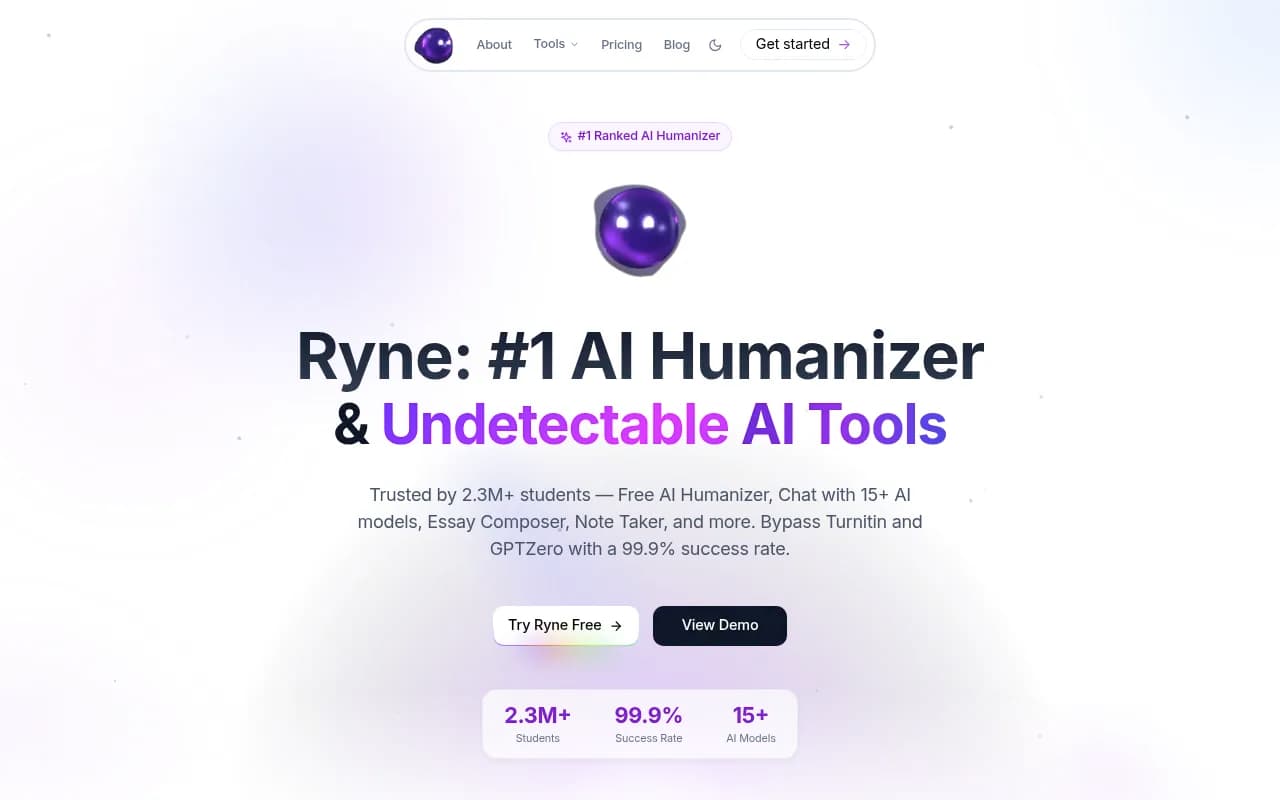
- Claims a 99.9% success rate at bypassing AI detectors, with 2.3M+ students using the platform.
- Bundles several student-focused tools: a multi-model chat (15+ AI models), essay composer, lecture note taker, and an AI detection report generator.
- Free plan is genuinely usable but limited to 250-word humanization chunks and English only.
- Ethically contentious: the core use case -- helping students submit AI-written work without detection -- raises serious academic integrity concerns that any honest review has to name directly.
Ryne.ai is a student-focused AI platform whose headline feature is an AI humanizer: paste in AI-generated text, and it rewrites it to read like a human wrote it, specifically to avoid detection by academic integrity tools like Turnitin, GPTZero, Copyleaks, Winston AI, and ZeroGPT. The company claims a 99.9% bypass success rate and says over 2.3 million students use the platform. That's a big number, and it reflects a real demand -- AI detectors have become a standard part of academic submission workflows, and students are looking for ways around them.
The target audience is almost entirely students: undergraduates, postgraduates, and anyone navigating an institution that uses AI detection software. Ryne positions itself as an "academic companion" rather than a cheating tool, framing its essay composer and chat features as study aids. Whether you buy that framing depends on your perspective. The humanizer's explicit purpose is to make AI-written content pass as human-written, which is a different thing from helping someone understand a subject better. That tension sits at the center of everything Ryne does, and it's worth naming before getting into the features.
Beyond the humanizer, Ryne has expanded into a broader student toolkit: a multi-model AI chat that lets you query GPT-4o, Claude, and Gemini simultaneously, an essay composer, a lecture-to-notes tool, and an AI report generator that mimics what Turnitin would return before you actually submit. It's a fairly complete suite for the use case it's targeting.
Key features
AI Humanizer (the core product) This is what most users come for. You paste in AI-generated text, and Ryne rewrites it using what the company calls a "Pro Algorithm" designed to strip out the statistical patterns that AI detectors look for. The free plan handles 250 words per pass; paid plans go up to 750 words (Sapphire), 1,500 words (Emerald), or unlimited (Ruby). The humanizer claims to bypass Turnitin, GPTZero, ZeroGPT, Originality.ai, Winston AI, Copyleaks, Content at Scale, Crossplag, and Quillbot's detector. In the demo on the homepage, a paragraph about Albert Einstein goes from "100% AI" to "1% AI" after processing -- the rewrite is noticeably more casual and slightly less polished, which is probably intentional.
Ryne Chat (multi-model AI assistant) Ryne Chat lets you query 15+ AI models including GPT-4o, Claude 3 Opus, and Gemini Ultra. You can submit questions via text, image upload, or PDF -- useful for working through problem sets or research papers. The "ChatAll" feature runs your prompt through multiple models simultaneously so you can compare outputs and pick the best one. This is genuinely useful beyond the humanizer use case; it's essentially a unified AI chat interface with model-switching built in.
Essay Composer A structured essay writing tool that takes a topic or prompt and generates a full essay. It supports citations and referencing, which is one of the more practically useful features -- getting AI to produce properly formatted academic citations is something students actually need help with. The essay composer is configurable for tone, style, and length.
Lecture Lab (note taker) Upload a lecture recording or PDF and Ryne converts it into structured study material. This is the feature that most clearly functions as a legitimate study aid rather than an academic integrity workaround. Turning a 90-minute lecture into organized notes is a real time-saver, and it's the kind of AI application that most educators are comfortable with.
AI Report This is a pre-submission check that generates a downloadable PDF showing what Turnitin and three other detectors would score your document, plus a plagiarism similarity check. It runs four independent AI detectors (Turnitin-equivalent, GPTZero, ZeroGPT, and a fourth called Reilaa) and gives you a combined score before you submit anywhere. Supports PDF, DOCX, and DOC uploads. The free plan doesn't include AI reports; Sapphire gets one per month, Emerald gets three, and Ruby gets unlimited.
Bionic Reading Mode A reading enhancement feature that bolds the first few letters of each word to guide eye movement and speed up reading. This is based on the Bionic Reading method developed by Renato Casuut. It's a nice-to-have for students working through dense academic texts, though it's not unique to Ryne.
Personalized voice and style mimicry Ryne claims it can learn and replicate a user's writing style to make humanized output more consistent with their existing work. This is a meaningful differentiator from simpler paraphrasers -- if the output sounds like you specifically, it's harder to flag as anomalous.
Chrome extension A browser extension that lets you highlight text on any webpage and humanize it, detect AI, or find synonyms without leaving the page. Available free on the Chrome Web Store.
Who is it for
The honest answer: Ryne is built for students who are using AI to write their assignments and want to avoid getting caught. That's the primary persona, and the product design makes no real effort to obscure it. The homepage leads with "Bypass Turnitin and GPTZero with a 99.9% success rate" and the testimonials are all from students at universities. If you're a PhD student using AI to draft sections of a literature review, an undergraduate trying to get through a paper quickly, or a non-native English speaker who writes in AI and then wants to clean it up, Ryne is built for you.
There's a secondary persona that's more defensible: students who write their own work but are worried about false positives from AI detectors. This is a real problem. A Stanford study found that 61.3% of essays by non-native English speakers were falsely flagged as AI-generated -- Ryne's own blog covers this research. For those students, the humanizer functions as a kind of insurance policy rather than a cheating tool. The AI Report feature is particularly useful here, since it lets you check your own writing before submitting.
Ryne is not a good fit for marketing teams, content agencies, or professional writers. It has no SEO features, no team collaboration tools, no publishing integrations, and no workflow management. The essay composer and chat tools are capable, but they're designed around academic use cases, not commercial content production. If you're looking for an AI writing tool for business content, tools like Jasper, Copy.ai, or Writesonic are better suited.
Integrations and ecosystem
Ryne's integration footprint is minimal, which makes sense given its student focus. There's no API, no Zapier connection, and no CMS integrations. The main external touchpoint is the Chrome extension, which works across any website and is available free from the Chrome Web Store.
The platform supports PDF, DOCX, and DOC file uploads for the AI Report and Lecture Lab features. Multi-language support is available on paid plans (Sapphire and above), covering a wide range of languages for both humanization and chat.
Ryne has an active Discord community (discord.gg/bzv9v6ma93) where users share tips, get support, and participate in giveaways. The company uses this as a primary support channel alongside a responsive support system for technical issues.
There's no mobile app listed, though the web interface is presumably mobile-accessible. No Slack integration, no Google Workspace connection, no LMS (learning management system) integration.
Pricing and value
Ryne uses a coin-based credit system with four tiers:
- Amethyst (Free): 100 coins, all tools, English only, 250-word humanization limit per pass, no AI reports, no priority support. No credit card required.
- Sapphire: $29.99/month ($19.99/month billed annually at $167.99/year). 10,000 coins, all tools and models, all languages, 750-word humanization limit, 1 AI report per month, priority support.
- Emerald: $39.99/month ($29.99/month billed annually at $251.99/year). Unlimited coins, all tools and models, all languages, 1,500-word humanization limit, 3 AI reports per month, priority support.
- Ruby: $109.99/month ($99.99/month billed annually at $839.99/year). Unlimited coins, unlimited humanization, unlimited AI reports, priority support, plus three additional unspecified features.
Unused coins roll over to the next billing period, which is a user-friendly touch. The free plan is genuinely functional for light use -- 100 coins and 250-word chunks will get you through a short assignment. The Sapphire plan at $19.99/month annually is reasonably priced for a student who uses the tool regularly.
Compared to competitors like Undetectable.ai (which starts around $9.99/month for basic humanization) or StealthWriter (similar price range), Ryne's pricing is slightly higher but bundles more tools -- the multi-model chat alone would cost money elsewhere. The Ruby tier at $99.99/month is expensive for a student tool, though it's clearly aimed at heavy users or people who need unlimited AI reports.
Strengths and limitations
What Ryne does well:
- The multi-model chat (ChatAll) is genuinely useful. Being able to run the same prompt through GPT-4o, Claude, and Gemini simultaneously and compare outputs is a real productivity feature that most competitors don't offer.
- The AI Report is a smart product decision. Giving students a pre-submission check that mimics Turnitin's output reduces anxiety and helps users know whether they need another pass through the humanizer.
- The free plan is real. 100 coins and 250-word humanization without a credit card is enough to evaluate the tool properly, which is more than many competitors offer.
- The Chrome extension adds genuine convenience -- being able to humanize text in-context without switching tabs is a meaningful workflow improvement.
- Unused coins rolling over is a small but user-friendly policy that competitors often don't match.
Honest limitations:
- The core use case is ethically fraught. Helping students submit AI-written work as their own is academic dishonesty by most institutional definitions, and Ryne's marketing leans into this explicitly. Users should understand the risk they're taking -- universities are getting better at detection, and the consequences of being caught are serious.
- The 250-word limit on the free plan and even the 750-word limit on Sapphire are frustrating for longer documents. A 3,000-word essay requires multiple passes, which is tedious and can introduce inconsistencies between sections.
- No team or collaboration features. If you're a tutor, writing center, or anyone working with multiple students, there's no way to manage multiple accounts or share resources.
- The Ruby tier's "3 others" additional features are not described on the pricing page, which is an odd transparency gap for a plan that costs nearly $1,000 per year.
- No API means no custom integrations or automation. For power users who want to build workflows around the tool, this is a dead end.
Bottom line
Ryne.ai is a well-built tool for a specific, controversial use case: students who want to use AI to write their academic work without being detected by Turnitin or GPTZero. If that's what you need, it's one of the more complete options available -- the multi-model chat, essay composer, and AI Report features make it more than a simple paraphraser. The free plan is genuinely usable, and the Sapphire tier at $19.99/month annually is reasonable for regular use.
The ethical dimension is real and shouldn't be glossed over. Submitting AI-written work as your own violates most universities' academic integrity policies, and the consequences can be severe. Ryne's framing as an "academic companion" doesn't change what the humanizer is designed to do. That said, for students worried about false positives from AI detectors on their own writing, the AI Report and humanizer serve a legitimate purpose.
Best for: Students who regularly use AI assistance in their academic writing and need a reliable way to check and adjust their work before submission.
Tags:
Frequently asked questions
What is Ryne.ai?
Is Ryne.ai free to use?
How much does Ryne.ai cost?
Does Ryne.ai actually bypass Turnitin?
What AI models does Ryne Chat support?
Is there a Chrome extension for Ryne.ai?
Similar and alternative tools to Ryne.ai