Sight Review 2026
AI model brand tracking software that monitors how ChatGPT, Claude, and Perplexity mention and represent your brand in generated responses.
Key takeaways
- Sight AI combines AI visibility tracking, automated content generation, and website indexing into one platform -- targeting marketers and founders who want to grow organic traffic without a content team
- Compared to Promptwatch, Sight AI lacks AI crawler logs, traffic attribution, Reddit/YouTube tracking, ChatGPT Shopping monitoring, prompt volume/difficulty scoring, query fan-outs, and page-level citation tracking -- its AI visibility features are significantly more limited
- The content generation side is genuinely useful: 13+ specialized AI agents produce 2,500-4,500 word articles and can publish on autopilot to Webflow and other CMS platforms
- Pricing starts at $49/month (Lite) with a 7-day free trial that includes 7 articles -- accessible for solo founders and small teams
- Best suited for content-light businesses that want to scale SEO publishing quickly; not a serious GEO/AEO monitoring platform for brands that need deep AI search intelligence
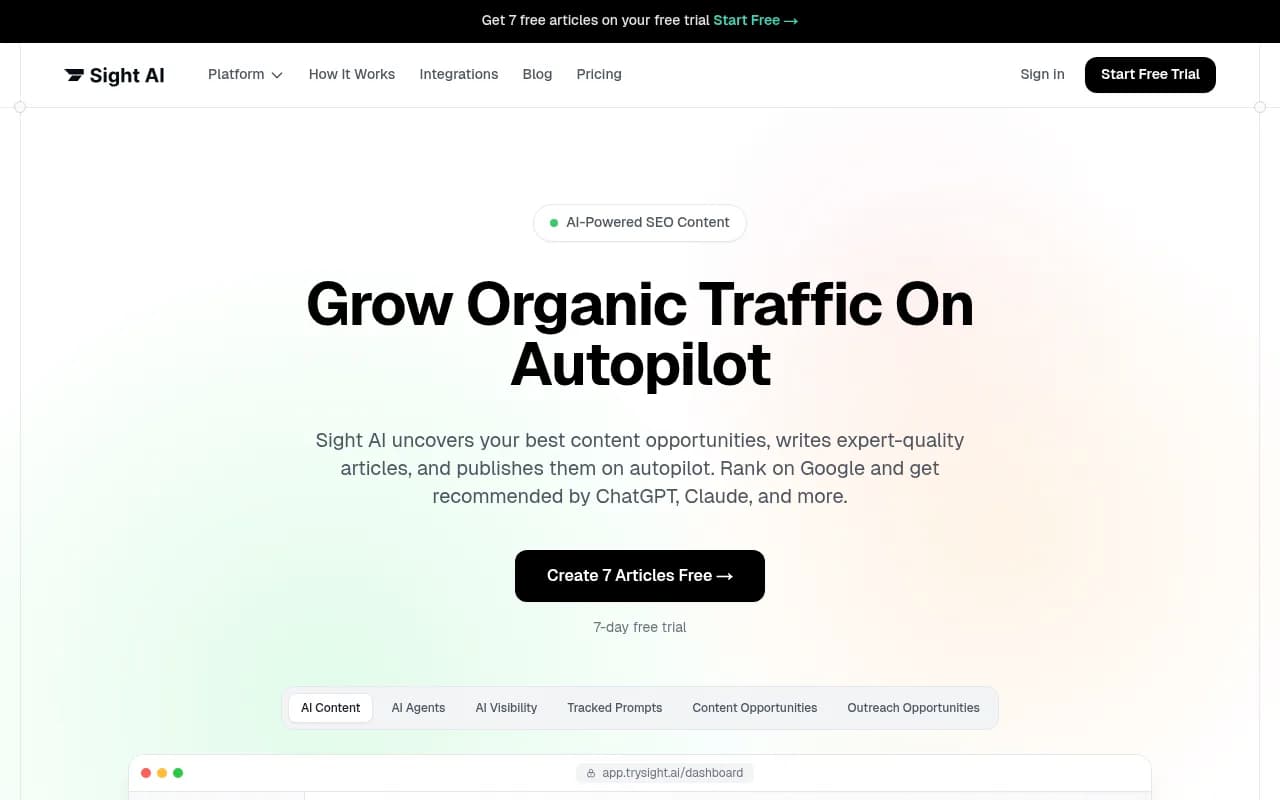
Sight AI is a relatively young platform that sits at the intersection of AI content generation and AI search visibility. Built by the team behind Cometly (a marketing attribution company), it targets marketers, founders, and agencies who want to grow organic traffic without hiring writers or managing a content calendar. The pitch is simple: Sight AI finds what to write, writes it, and publishes it -- all on autopilot.
The tool covers three main areas: AI visibility tracking (monitoring how your brand appears in ChatGPT, Claude, Perplexity, Gemini, and Grok), AI content generation (long-form SEO/GEO articles via specialized agents), and website indexing (automatic IndexNow submissions to Google and Bing). That's a broader scope than most pure-play GEO trackers, but it also means none of the three pillars goes especially deep compared to dedicated tools in each category.
The Cometly connection is worth noting. Sight AI appears to have grown out of Cometly's ecosystem -- the demo content on the site is literally a Cometly listicle, and the signup flow references Cometly tokens. This suggests Sight AI may have started as an internal tool before being productized. The platform claims 500+ brands using it and 10,000+ articles created, though these numbers aren't independently verified.
Key features
AI visibility tracking across 5 models
Sight AI monitors brand mentions and competitor appearances across ChatGPT, Claude, Perplexity, Gemini, and Grok. You set up prompts, and the platform runs them daily to show where your brand appears, where competitors show up instead, and how AI models perceive your brand overall. The sentiment analysis layer is a nice touch -- it gives you a qualitative read on whether AI responses are positive, neutral, or negative about your brand.
That said, the coverage is noticeably thinner than what dedicated GEO platforms offer. Five models vs. the 10+ that more mature platforms track. No coverage of Google AI Overviews, DeepSeek, Mistral, Meta AI, or Copilot. And critically, there's no prompt volume or difficulty scoring, no query fan-outs, and no page-level citation tracking -- so you can see that a competitor ranks for a prompt, but you don't get much intelligence about why or what to do about it.
Content gap analysis
Sight AI analyzes competitors and AI model responses to surface content opportunities -- topics and keywords your competitors rank for that you don't. This is the bridge between the visibility tracking and the content generation features. In practice, it works like a simplified version of keyword gap analysis, filtered through the lens of what AI models are citing. It's useful for finding article ideas quickly, though it doesn't give you the granular citation-level data (which specific pages, Reddit threads, or YouTube videos AI models are pulling from) that more advanced platforms provide.
13+ specialized AI agents
The content generation engine is where Sight AI puts most of its weight. Rather than a single LLM writing your articles, Sight AI uses a pipeline of specialized agents: one for research, one for outlining, one for writing, one for SEO optimization, one for images, and so on. The output is long-form -- listicles run 4,500+ words, explainers and how-to guides hit 2,500+ words. Articles are structured for both Google ranking and AI citation, with proper heading hierarchies, internal linking suggestions, and meta data.
The quality of AI-generated content is always a question mark, but the multi-agent approach does tend to produce more coherent, well-researched output than single-pass generation. The demo content on the site (the Cometly marketing attribution listicle) reads reasonably well, though it's clearly templated.
Autopilot mode
This is the headline feature for time-strapped teams. Autopilot mode automatically generates and publishes one article per day based on the content opportunities Sight AI identifies. You set your preferences, connect your CMS, and the platform handles the rest. For a small business or solo founder who just needs consistent content output, this is genuinely useful. For a brand with editorial standards or sensitive messaging, handing over the wheel entirely is riskier.
CMS publishing integrations
Sight AI connects directly to Webflow, with webhook support for other platforms. Articles can be synced to Webflow with a single click from the dashboard, including SEO metadata, slug, category, and author fields. The webhook option means you can route content to WordPress, Contentful, or any other CMS that accepts webhooks, though this requires some technical setup. The Webflow integration is clearly the primary use case given how prominently it's featured in the UI.
Website indexing via IndexNow
Every published article is automatically submitted to Google and Bing via IndexNow, and Sight AI keeps your sitemap updated. This isn't a unique feature -- IndexNow is a free protocol anyone can implement -- but having it baked into the publishing workflow removes one more manual step. For sites publishing daily content, automatic sitemap management is genuinely helpful.
Sentiment analysis
The platform includes a sentiment layer on top of its AI visibility tracking, showing how AI models characterize your brand in their responses. This is more qualitative than quantitative -- you get a sense of whether the tone is positive or negative, but not the granular citation-level data that would tell you which specific content is driving that sentiment or how to change it.
Who is it for
Sight AI is a good fit for solo founders, small marketing teams, and boutique agencies that want to scale content output without hiring writers. Think a SaaS company with a two-person marketing team that needs to publish 20-30 articles a month to compete in organic search, or a digital agency managing content for 5-10 small business clients who can't afford dedicated writers for each. The autopilot mode and Webflow integration make it particularly appealing for teams already in the Webflow ecosystem.
It also works for businesses that are just starting to think about AI search visibility -- founders who've heard that ChatGPT is sending traffic and want to understand where they stand. The barrier to entry is low: $49/month, a 7-day free trial with 7 free articles, and a relatively simple setup process.
Who should look elsewhere: any brand that needs serious GEO intelligence. If you're a mid-market or enterprise company trying to understand your AI search visibility in depth -- which prompts drive the most traffic, which citations are influencing your brand perception, how your visibility compares across 10+ AI models -- Sight AI's tracking features won't cut it. Similarly, if you need AI traffic attribution (connecting AI visibility to actual revenue), Reddit and YouTube monitoring, AI crawler logs, or ChatGPT Shopping tracking, you'll need a more capable platform.
Agencies managing large client portfolios with complex reporting needs will also find the platform limiting. There's no mention of white-label reporting, multi-seat team management, or the kind of granular data exports that agency clients typically expect.
Integrations and ecosystem
Sight AI's integration story is fairly minimal at this stage:
- Webflow: Native integration for direct article publishing, including metadata sync
- Webhooks: Generic webhook support for routing content to other platforms (WordPress, Contentful, etc.)
- Google and Bing: Via IndexNow for automatic content submission
- CMS compatibility: The webhook approach means it can technically connect to most modern CMS platforms, but it requires technical setup
There's no mention of a public API, Google Search Console integration, Slack notifications, Zapier support, or analytics platform connections. For a tool positioning itself as an end-to-end content platform, the integration surface is narrow. The Webflow focus makes sense given the Cometly/startup ecosystem overlap, but it limits appeal for teams on WordPress, HubSpot CMS, or enterprise platforms.
No mobile app is mentioned, and the product appears to be entirely web-based.
Pricing and value
Sight AI offers four tiers based on the pricing data available:
- Lite -- $49/month: 5 articles per month, best for individuals getting started
- Starter -- $99/month: Aimed at small growing businesses, more articles included
- Pro -- $199/month: For "serious content marketers," higher article limits
- Advanced: Agency-tier pricing, specific numbers not publicly listed
A 7-day free trial is available and includes 7 articles -- enough to actually test the content quality before committing. Annual billing likely offers a discount, though specific numbers weren't confirmed.
For context, dedicated GEO monitoring platforms start around $49-99/month for basic tracking. Promptwatch's Essential plan at $99/month includes 50 prompts, 5 articles, and significantly deeper AI visibility features. Pure-play AI writing tools like Jasper or Writesonic charge similar prices but don't include any AI visibility tracking. Sight AI's bundled approach (tracking + writing + indexing) offers reasonable value at the Lite and Starter tiers for teams that genuinely need all three, though the tracking component is shallow enough that serious GEO users will likely need a second tool anyway.
Strengths and limitations
What Sight AI does well:
- The multi-agent content pipeline produces longer, more structured articles than single-pass AI writing tools, and the output is clearly optimized for both Google and AI citation
- Autopilot mode is a real differentiator for time-strapped teams -- daily article generation and publishing without manual intervention is a meaningful workflow improvement
- The Webflow integration is clean and well-executed, making it a natural fit for the Webflow-native startup ecosystem
- The 7-day free trial with 7 actual articles is generous and lets you evaluate content quality before paying
- Bundling visibility tracking, content generation, and indexing in one platform reduces tool sprawl for small teams
Where it falls short:
- The AI visibility tracking is thin. Five models (vs. 10+ on mature platforms), no prompt volume or difficulty scoring, no query fan-outs, no page-level citation tracking, no AI crawler logs, no Reddit or YouTube monitoring, no ChatGPT Shopping tracking, and no AI traffic attribution. For a tool that markets itself partly on GEO, this is a significant gap.
- No content gap analysis at the citation level -- you can see that competitors rank for certain prompts, but you don't get the specific pages, sources, or content angles that AI models are actually pulling from
- Integration depth is limited. No API, no Google Search Console connection, no Zapier, no Slack. The Webflow-or-webhook approach works but excludes a lot of teams
- The platform is early-stage, and the testimonials on the site are listed as "Coming Soon" -- a sign that the social proof is still being built
Compared to Promptwatch, Sight AI is missing most of the features that make GEO actionable: Answer Gap Analysis, AI crawler logs, visitor analytics and traffic attribution, Reddit and YouTube tracking, ChatGPT Shopping monitoring, prompt volume and difficulty scoring, query fan-outs, and page-level citation tracking. Sight AI's content generation is a genuine strength, but Promptwatch's built-in AI writing agent covers similar ground while sitting on top of a much richer data layer.
Bottom line
Sight AI is a reasonable choice for small teams and solo founders who want to publish more content, faster, and get a basic read on their AI search visibility -- all without hiring writers or managing a complex tool stack. The autopilot mode and Webflow integration are genuinely useful, and the pricing is accessible.
But if AI search visibility is a serious priority for your business, Sight AI's tracking features are too shallow to rely on. For brands that need to understand and act on their AI search presence in depth, a platform like Promptwatch -- which covers 10+ AI models, provides citation-level data, includes AI crawler logs, and connects visibility to actual traffic and revenue -- is the stronger choice.
Best use case in one sentence: Sight AI is best for Webflow-based startups and small marketing teams that want to automate content publishing and get a basic AI visibility snapshot, without needing deep GEO intelligence.
Tags:
Frequently asked questions
What is Sight AI?
How much does Sight AI cost?
Which AI models does Sight AI track?
How does Sight AI's content generation work?
Is Sight AI good for serious GEO monitoring?
Does Sight AI have a free plan?
Similar and alternative tools to Sight