Tracxn Review 2026
Startup research platform tracking 2M+ companies across 1,200+ tech sectors. Used by VCs, PE firms, and corporate development teams for deal sourcing and market mapping.
Key takeaways
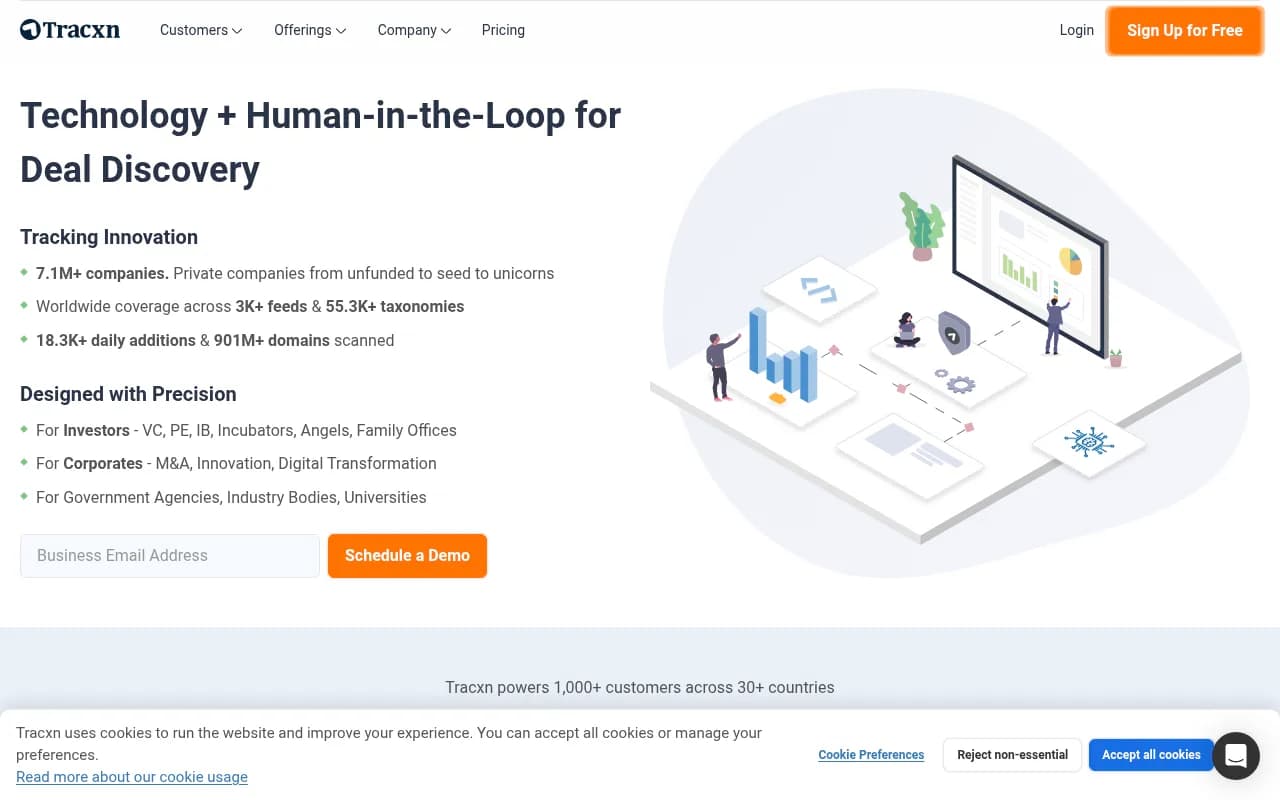
- Tracxn covers 7.1M+ companies across 55,300+ taxonomies with 18,300+ daily additions -- one of the broadest startup databases available for private market research
- Particularly strong for emerging market coverage (India, Southeast Asia, Africa) where competitors like PitchBook and CB Insights have thinner data
- The "human-in-the-loop" approach means analysts curate and verify data, which improves quality but can mean some niche sectors lag behind
- Pricing starts around $550/month based on third-party sources, with a free "Lite" tier available for basic exploration
- Best suited for VC/PE analysts, corporate development teams, and investment banks doing systematic deal sourcing -- less useful for one-off research or small teams without a dedicated analyst workflow
Tracxn is a Bangalore-founded startup intelligence platform that has been quietly building one of the more comprehensive private company databases in the market. Founded in 2013 by Neha Singh and Abhishek Goyal (both ex-Accel Partners), the company set out to solve a real problem: deal sourcing for investors is slow, fragmented, and heavily dependent on personal networks. Tracxn's answer was to build a structured, taxonomy-driven database that lets investors search for companies the way you'd search a product catalog -- by sector, geography, funding stage, team background, and dozens of other filters.
The platform now claims 1,000+ customers across 30+ countries, including Accel Partners, Siemens, Stanford University, and IN-Q-TEL. It's not a household name in the way PitchBook or CB Insights are, but among investors focused on emerging markets or niche tech sectors, it has a loyal following. The company went public on Indian stock exchanges (NSE and BSE) in 2022, which is somewhat unusual for a B2B SaaS company of its size -- it gives the platform a degree of financial transparency that private competitors lack.
The core value proposition is straightforward: instead of spending hours manually scouting startups through LinkedIn, news feeds, and founder networks, you get a structured database with pre-built sector taxonomies, daily deal flow alerts, and analyst-curated reports. Whether that's worth the subscription cost depends heavily on how systematically you approach deal sourcing.
Key features
Company database with 7.1M+ profiles
The headline number is 7.1 million companies, spanning funded startups from seed to unicorn stage as well as unfunded companies. For the US and Canada alone, Tracxn claims 1.5M+ companies, 287K+ funded, and 1,100+ unicorns. Each profile includes funding history, investor lists, team information, revenue estimates where available, and competitive landscape data. The depth varies -- well-funded Series B+ companies tend to have thorough profiles, while early-stage or unfunded companies can be sparse. The platform scans 901M+ domains to surface new companies, which is how it catches companies before they show up in press releases.
Taxonomy and sector classification (55,300+ taxonomies)
This is where Tracxn genuinely differentiates itself. Rather than broad categories like "FinTech" or "HealthTech," the platform breaks sectors into granular sub-taxonomies -- think "Buy Now Pay Later for SMBs" or "AI-native Computer Vision for Retail." There are 55,300+ taxonomies in total, which sounds overwhelming but is actually useful when you're trying to map a specific niche. Each taxonomy comes with a market map showing the competitive landscape, which is something analysts would otherwise spend days building manually. Competitors like CB Insights have sector maps too, but Tracxn's taxonomy depth in emerging markets and niche verticals is notably stronger.
Deal flow alerts and daily digests
Users can set up alerts by sector, geography, funding stage, and other parameters. The platform sends curated daily deal flow updates -- new funding rounds, acquisitions, team changes -- filtered to your areas of interest. The "5-Minute Global Startup Round-up" newsletter is a free product that gives a taste of this. For paid subscribers, the alerts are more granular and can be configured to match specific investment theses. In practice, this works well for systematic coverage but can generate noise if your filters are too broad.
Tracxn Score and company ranking
The platform assigns proprietary scores to companies and sectors, which are meant to help prioritize which companies deserve deeper diligence. The scoring factors in funding momentum, team quality signals, sector growth, and other data points. Multiple customers in testimonials specifically call out the Tracxn Score as useful for screening -- Itochu CTC America's director noted it helps "pinpoint the expanding sectors and efficiently screen companies of interest." That said, any proprietary scoring system has blind spots, and the score shouldn't substitute for actual diligence.
Sector reports (1,000+ per quarter)
Tracxn publishes over 1,000 reports per quarter across 2,500+ sectors and 30+ geographies. These include detailed sector breakdowns (competitive landscape, funding trends, key players) and investment landscape reports (quarterly funding summaries by geography). The reports are pre-built and downloadable, which makes them useful for quick briefings or board presentations. The quality is generally solid for established sectors; newer or more niche areas can feel thin. Forbes, Financial Express, and Tech in Asia have all cited Tracxn data in recent coverage, which is a reasonable proxy for data credibility.
Geographic coverage with emerging market depth
Tracxn's coverage of India, Southeast Asia, and Africa is meaningfully better than most Western-built competitors. The platform was built by investors who worked in India, and that origin shows. For a VC fund looking at Indian FinTech or Southeast Asian e-commerce, Tracxn often surfaces companies that simply don't appear in PitchBook or Crunchbase. US and European coverage is comprehensive but less differentiated from competitors.
API access for real-time data integration
The platform offers an API that lets customers pull company data, funding updates, and sector information into their own workflows. SuperCharger Ventures specifically mentioned using API updates for "near real-time decisions" and reducing the need for on-site scouting. The API is particularly useful for VC firms that want to integrate Tracxn data into their own CRM or deal tracking systems. Documentation quality and rate limits aren't publicly detailed, so this requires a conversation with their sales team.
Multi-persona use cases
Tracxn has built out distinct workflows for different user types: VCs get deal flow and portfolio tracking, PE firms get late-stage screening and M&A comparables, investment banks get buy-side and sell-side target discovery, corporate development teams get acquisition target tracking, and sales teams get lead generation based on funding signals. The platform doesn't just slap different labels on the same interface -- there are genuinely different data views and workflows for each persona, though the underlying database is shared.
Who is it for
The primary users are investment professionals doing systematic deal sourcing -- specifically VC analysts at funds that run structured sourcing processes (think a 10-20 person fund with a dedicated analyst or associate whose job includes weekly sector scans), corporate development teams at mid-to-large companies tracking acquisition targets across multiple sectors, and investment banking associates building target lists for M&A mandates. If you're at a fund that sources deals primarily through founder networks and warm intros, Tracxn adds less value. If you're running a process where you need to know "who are all the companies in X sector across Y geographies," it's genuinely useful.
Corporate innovation teams at large enterprises (Siemens is a named customer) use it to track disruptive startups in their industry verticals. This is a slightly different use case -- less about deal execution and more about competitive intelligence and partnership scouting. The platform works well here because the taxonomy structure maps naturally to how large companies think about their industry.
Journalists, universities, and government agencies are also listed as target users, and Tracxn offers free data for journalists covering startup ecosystems. This is a smart distribution strategy -- it gets Tracxn data cited in publications, which builds credibility. Stanford is a named customer, suggesting the academic use case is real.
Who should probably look elsewhere: solo founders doing one-time competitive research (the pricing doesn't justify it), small angel investors without a systematic sourcing process, and teams primarily focused on public market research (this is a private company database).
Integrations and ecosystem
API: Available for paid tiers, used by customers for CRM integration and real-time deal flow. Specific endpoints and documentation aren't publicly detailed.
Export capabilities: Data export is available, with "Export" mentioned as a specific feature in pricing discussions. CSV and Excel exports appear to be standard.
CRM integration: Not explicitly listed as a native integration, but the API enables custom CRM connections. No mention of native Salesforce or HubSpot connectors.
Newsletter/email alerts: Built-in email digest system for deal flow alerts. The free "5-Minute Global Startup Round-up" newsletter is a standalone product.
Browser extension: Not mentioned in available materials.
Mobile app: Not mentioned; the platform appears to be primarily web-based.
The integration story is thinner than competitors like PitchBook, which has native Salesforce integration and a more developed partner ecosystem. For teams that want plug-and-play CRM connectivity, this is a gap.
Pricing and value
Tracxn operates a freemium model with a "Lite" tier that provides limited access to the database at no cost -- useful for evaluating the platform but with strict usage limits. Paid plans start around $550/month based on third-party pricing sources (Crozdesk), though Tracxn doesn't publish pricing publicly and the actual cost depends on team size, data volume, and API access requirements.
For context, PitchBook starts around $20,000+ per year for a single user license, and CB Insights enterprise plans run similarly. Tracxn's pricing appears to be meaningfully lower, which is part of its appeal for smaller funds and emerging market-focused investors. The Z47 (formerly Matrix Partners India) testimonial explicitly notes the platform compares favorably to "far more expensive resources built for public markets data."
The free Lite tier is genuinely useful for journalists and researchers who need occasional data points. For serious investment workflows, the paid tier is necessary.
Annual billing discounts are likely available but not publicly confirmed.
Strengths and limitations
What Tracxn does well:
- Taxonomy depth: The 55,300+ taxonomy system is genuinely impressive and makes it possible to map niche sectors that competitors don't cover at all. For an analyst trying to understand the competitive landscape in, say, "AI-native inventory management for food distribution," Tracxn often has a pre-built taxonomy where competitors have nothing.
- Emerging market coverage: India, Southeast Asia, and Africa coverage is consistently cited as a differentiator. If your investment mandate includes these geographies, Tracxn is hard to beat on breadth.
- Report volume: 1,000+ reports per quarter is a lot of pre-built research. For analysts who need to quickly brief partners on a new sector, having a downloadable report with funding trends and key players saves real time.
- Pricing relative to alternatives: Significantly cheaper than PitchBook or CB Insights for comparable private company data, which makes it accessible to smaller funds and corporate teams with limited research budgets.
- Customer support: Multiple testimonials specifically call out the support team, which is unusual and suggests this is a genuine differentiator.
Honest limitations:
- Data depth on early-stage companies: The 7.1M company count includes a lot of unfunded companies where the profiles are thin. For seed-stage sourcing, the data quality drops off compared to funded companies.
- Integration ecosystem: No native CRM integrations and limited partner ecosystem compared to PitchBook. Teams that want seamless Salesforce or HubSpot connectivity will need to build custom API integrations.
- US/Europe differentiation: In North American and Western European markets, the coverage advantage over Crunchbase or PitchBook is less pronounced. The platform's strongest differentiation is in emerging markets.
- Pricing opacity: Not publishing pricing publicly creates friction in the evaluation process. Teams have to go through a sales conversation to understand actual costs, which is annoying for buyers who want to self-serve.
Bottom line
Tracxn is a solid choice for investment teams that run systematic deal sourcing processes, particularly those with mandates covering India, Southeast Asia, or other emerging markets where Western-built databases are thinner. VC analysts at funds doing weekly sector scans, corporate development teams tracking acquisition targets across multiple verticals, and investment banking associates building target lists will get real value from the taxonomy depth and report library.
Best use case in one sentence: A VC or corporate development team that needs to systematically map a niche tech sector across global geographies, especially in emerging markets, and wants pre-built competitive landscapes without paying PitchBook prices.
Tags:
Frequently asked questions
What is Tracxn?
Is there a free version of Tracxn?
How much does Tracxn cost?
How does Tracxn compare to PitchBook or CB Insights?
Who is Tracxn best suited for?
Does Tracxn have an API?
Similar and alternative tools to Tracxn