Key takeaways
- Promptwatch is the most complete alternative -- it monitors 10 AI engines, includes AI crawler logs, content gap analysis, and a built-in writing agent that generates content engineered to get cited. Starts at $99/mo with a free trial.
- Profound is the strongest enterprise pick if you need SOC 2 compliance, deep prompt volume data, and don't mind custom pricing with no free trial.
- Semrush and Ahrefs make sense if you're already paying for their traditional SEO suites and want AI visibility as an add-on -- but neither was built for GEO first.
- Peec AI and Otterly.AI are the most affordable entry points for basic monitoring, but both stop at showing you data -- neither helps you act on it.
- Gracker AI is worth a look if you're a cybersecurity or B2B SaaS company specifically -- it has a free tier and niche-specific content automation.
- AEO Engine itself starts at $797/mo -- a significant jump over most alternatives for what is primarily a managed service rather than a self-serve platform.
AEO Engine positions itself as a done-for-you AI search optimization service. The pitch is appealing: hand over your brand, and they'll get you ranking in ChatGPT, Google AI Overviews, and Perplexity. Their claimed 920% average traffic growth is a bold number, and they have a real client list behind it.
But $797/month as the entry price -- for what appears to be a managed service model -- is a lot to commit to before you even understand your current AI visibility baseline. And if you're a SaaS team, a marketing agency, or an in-house SEO who wants to own the strategy yourself, you might not want someone else running the playbook. You want the data, the tools, and the ability to move fast on your own.
That's the core reason people look for alternatives. Some want a self-serve platform. Some want lower pricing. Some want more AI engines covered. Some want content generation built in, not just monitoring. And some just want to try something before signing a four-figure monthly contract.
Here's an honest look at what's actually available.
Promptwatch

If AEO Engine is the "agency does it for you" model, Promptwatch is the "you own the strategy, the platform does the heavy lifting" model. It's the most direct alternative for teams who want full control.
The difference that matters most: Promptwatch doesn't just show you where you're invisible -- it shows you what to do about it. The Answer Gap Analysis identifies exactly which prompts your competitors are winning that you're not, down to the specific topics and angles missing from your site. Then the built-in AI writing agent generates articles, listicles, and comparison pages grounded in real citation data from 880M+ analyzed citations. You publish, the AI crawlers index it, and you watch your visibility scores move.
That loop -- find gaps, create content, track results -- is what separates it from most tools in this space. Most competitors stop at the monitoring dashboard.
A few specifics worth knowing: Promptwatch covers 10 AI models (ChatGPT, Claude, Perplexity, Gemini, Grok, DeepSeek, Copilot, Meta AI, Google AI Overviews, Google AI Mode). It has real-time AI crawler logs showing which pages ChatGPT and Perplexity are actually reading on your site, and where they're hitting errors. It tracks Reddit and YouTube as citation sources -- channels most platforms ignore entirely. And it includes ChatGPT Shopping tracking if you're in e-commerce.
Pricing is $99/mo (Essential), $249/mo (Professional), or $579/mo (Business). A free trial is available. Compare that to AEO Engine's $797 starting price, and the math is pretty clear for teams who want to run their own program.
Best for: Marketing teams, SEO managers, and agencies who want a full optimization platform -- not just a monitoring dashboard -- and want to own their AI search strategy in-house.
Semrush
Semrush is the obvious choice if you're already a subscriber and want to add AI visibility tracking without paying for another tool. Their AI Visibility Toolkit covers ChatGPT, Perplexity, and Gemini, and the data integrates with everything else in the platform -- keyword research, backlink analysis, site audits, competitive intelligence.
The honest trade-off: Semrush built its AI features onto an existing SEO platform, not the other way around. The AI visibility tracking uses fixed prompts rather than letting you define your own prompt strategy. There's no AI crawler log, no Reddit/YouTube citation tracking, and no content generation specifically engineered for LLM citation. It's a solid addition to a tool you're already using, but it's not a GEO-first platform.
Pricing starts at $165/mo for the Starter plan, though you'll likely need Pro+ at $290/mo to get meaningful AI visibility features. That's more expensive than Promptwatch's entry tier for a tool where AI visibility is a secondary feature.
Best for: Teams already deep in the Semrush ecosystem who want basic AI visibility data alongside their existing SEO workflow, without managing a separate tool.
Profound
Profound

Profound is the most feature-complete enterprise option in this space. It covers 9+ AI engines, has real prompt volume data (they claim 400M+ prompt insights), AI content generation agents, and SOC 2 Type II compliance -- which matters if you're selling into enterprise procurement processes.
Their client list (MongoDB, Ramp, Mercury) signals who they're built for: well-funded B2B companies with dedicated marketing ops teams. The platform is genuinely strong on the monitoring and analysis side, and their "Agents" feature for content creation is real, not just a checkbox.
The friction: there's no free trial, and pricing starts around $499/mo for the Lite tier with limited history and seats. Enterprise pricing is custom and reportedly higher. For a team that's still figuring out their AI search strategy, that's a hard commitment to make upfront.
Compared to AEO Engine, Profound gives you the data and tools to run the strategy yourself rather than outsourcing it. Compared to Promptwatch, it's more expensive and lacks some specific capabilities like Reddit tracking and ChatGPT Shopping monitoring.
Best for: Enterprise marketing and AEO teams at funded B2B companies who need SOC 2 compliance, deep prompt intelligence, and a platform that can scale across multiple brands or business units.
Peec AI
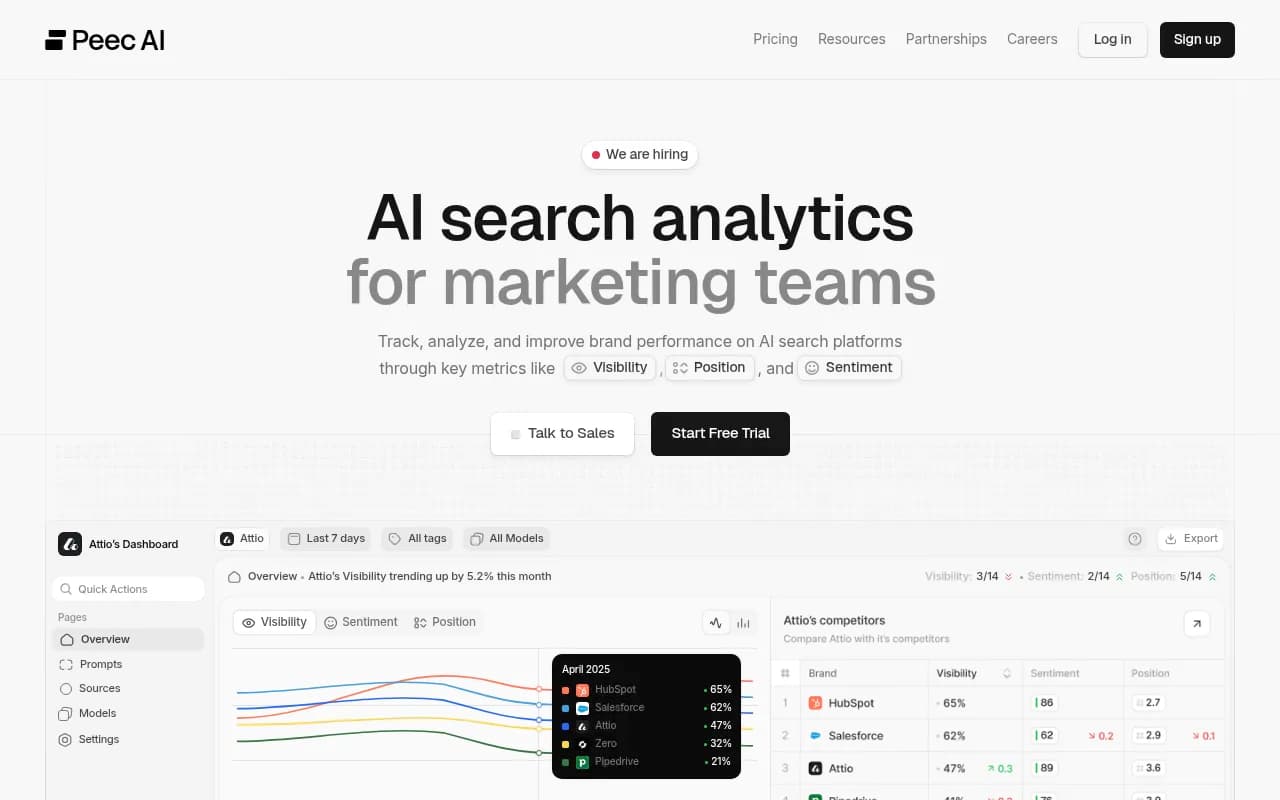
Peec AI is a clean, focused monitoring tool. It tracks visibility, position, and sentiment across ChatGPT, Perplexity, Claude, and Gemini, lets you benchmark competitors, and surfaces citation sources. The interface is genuinely well-designed -- the dashboard is easy to read and the metrics are clearly explained.
What it doesn't do: there's no content generation, no crawler logs, no prompt volume data, and no gap analysis that tells you what content to create. It's a monitoring tool, full stop. That's not a criticism -- it's just the scope of the product.
Pricing is more accessible than most: €89/mo (~$103) for the Starter plan with 50 prompts and 10 models. That's a reasonable entry point for a small team that wants to start tracking before committing to a larger platform.
Compared to AEO Engine, Peec AI is dramatically cheaper but requires you to do your own optimization work. It shows you the problem; you figure out the solution.
Best for: Small marketing teams or solo practitioners who want affordable AI visibility monitoring and are comfortable doing their own content strategy work.
Otterly.AI
Otterly.AI

Otterly.AI covers six AI search engines (ChatGPT, Perplexity, Google AI Overviews, Google AI Mode, Gemini, Copilot) and has a GEO Audit tool that analyzes 25+ on-page factors. The $29/mo Lite plan is the cheapest paid entry point in this entire category, which makes it worth knowing about.
The limitations are real though. No crawler logs, no content generation, no prompt volume data, no Reddit or YouTube tracking. The GEO Audit gives you recommendations, but acting on them is entirely on you. For a team that just wants to know "are we showing up in AI search?" without a big budget, it works. For a team that wants to move the needle, it's a starting point at best.
One thing Otterly does well: the automated reporting is clean and easy to share with stakeholders who don't want to log into another platform.
Best for: Budget-conscious teams who want basic AI visibility monitoring and competitive benchmarking without committing to a larger platform investment.
Ahrefs
Ahrefs added AI search tracking through their Brand Radar feature, and like Semrush, it's most useful if you're already an Ahrefs customer. The core platform -- backlink index, keyword research, site audits, rank tracking -- is genuinely excellent and used by 44% of Fortune 500 companies for good reason.
The AI visibility piece is more limited. Brand Radar uses fixed prompts, there's no AI traffic attribution, and the GEO features don't include content generation or crawler logs. Ahrefs is also rolling out broader AI features, but the platform's identity is still firmly traditional SEO.
Pricing starts at $83/mo (Lite) but you'll want Standard at $166/mo for meaningful functionality. The $29/mo Starter plan is very restricted.
Compared to AEO Engine, Ahrefs gives you far more traditional SEO capability but less AI search depth. It's a different trade-off than most tools in this comparison.
Best for: SEO-heavy teams who already use Ahrefs and want to add AI visibility tracking without switching platforms -- especially if traditional search is still their primary channel.
Relixir
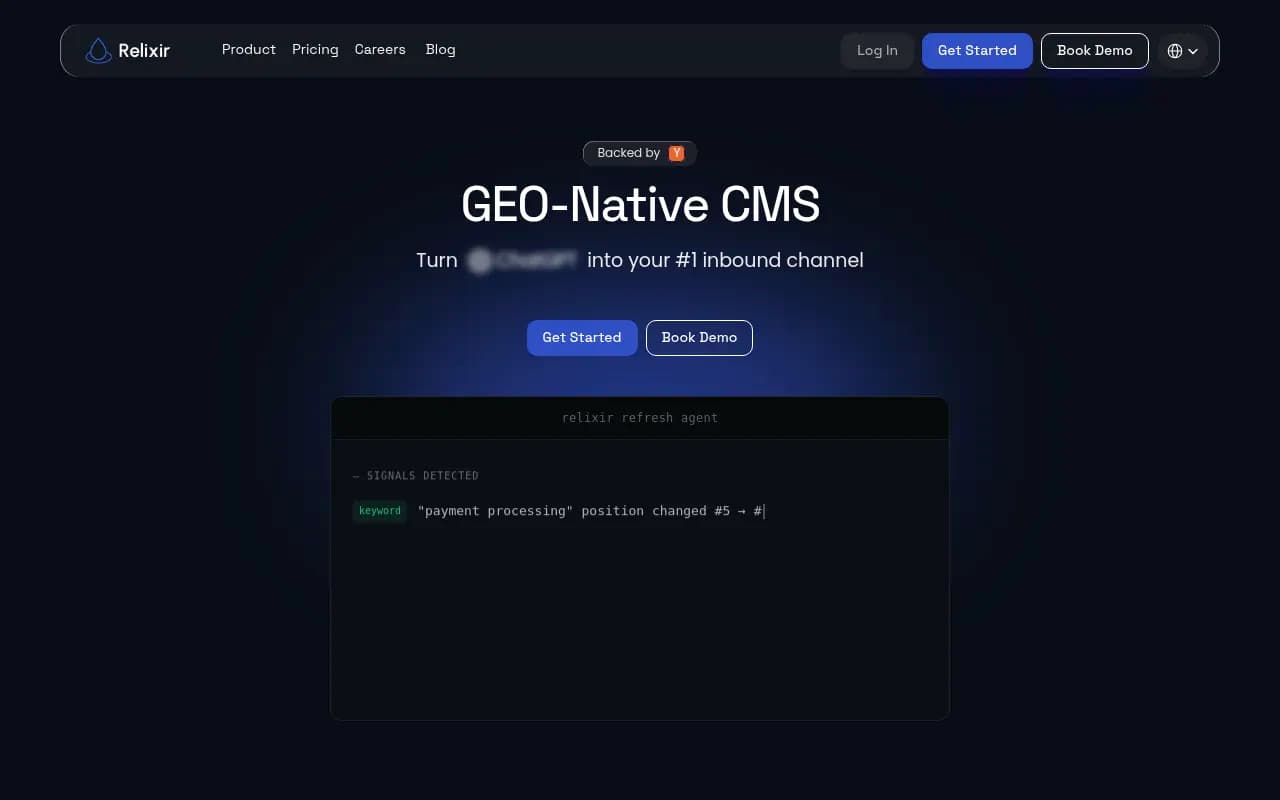
Relixir's angle is "Rex" -- an autonomous GEO employee that monitors your brand across ChatGPT, Perplexity, Claude, and Google AI Overviews, then generates and deploys GEO-optimized content automatically. The autonomous framing is interesting: it's trying to reduce the human time required to run an AI search program.
The platform is trusted by 400+ B2B teams including Rippling, Airwallex, and HackerRank. Pricing starts at $500/mo for the Starter plan, with enterprise and managed services pricing on request.
The honest uncertainty: Relixir is a newer platform and the depth of their monitoring data (how many AI engines, how many prompts, what citation analysis looks like) isn't as clearly documented as Profound or Promptwatch. The autonomous content deployment is a differentiator, but it also means less control over what gets published.
Compared to AEO Engine, Relixir is similarly priced at the entry level but gives you a self-serve platform rather than a managed service.
Best for: B2B SaaS teams who want autonomous content operations and are comfortable with a newer platform that prioritizes automation over manual control.
AthenaHQ

AthenaHQ is a solid GEO platform with a strong client list (Coinbase, ZoomInfo, SoFi, PagerDuty) and good coverage across 8+ LLMs. It's been featured in Forbes and the Wall Street Journal, and it came out of Y Combinator, which gives it some credibility in the enterprise B2B space.
The platform covers citation tracking, content optimization recommendations, and competitive benchmarking. The credit-based model (1 credit = 1 AI query) is worth understanding before you commit -- it can get expensive if you're running a lot of prompts.
Self-Serve pricing is $295/mo ($95 for the first month as a promotional rate). Enterprise is custom. There's a free audit available.
Where AthenaHQ falls short compared to Promptwatch: no AI crawler logs, no Reddit/YouTube citation tracking, no built-in content generation agent, and no ChatGPT Shopping monitoring. It's a strong monitoring and analysis tool, but the optimization side requires more manual work.
Best for: Enterprise marketing teams at B2B companies who want a credentialed, well-supported GEO platform and are comfortable with a credit-based pricing model.
Scrunch AI
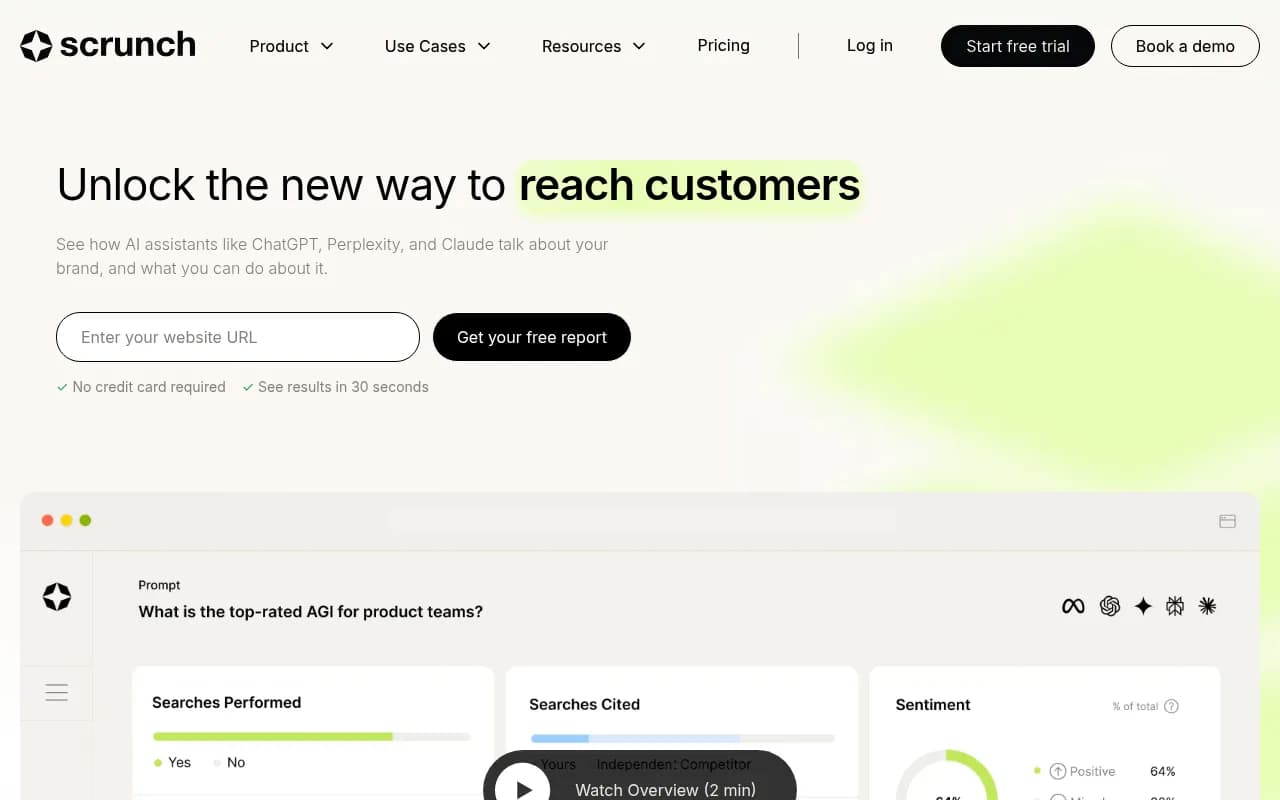
Scrunch has a genuinely interesting differentiator: their Agent Experience Platform (AXP), which translates your site content for AI traffic without disrupting the human user experience. The idea is that AI crawlers and human visitors need different things from your pages, and Scrunch tries to serve both simultaneously.
Beyond that, Scrunch covers monitoring (brand presence, performance, position across LLMs), insights (citation analysis, error detection, optimization tips), and AI crawler tracking. The platform is trusted by Lenovo, Crunchbase, and Penn State University, which suggests it works across both enterprise and institutional contexts.
Pricing starts at $83/mo (billed annually) for the Explorer plan, with Growth at $417/mo and Enterprise custom. A 7-day free trial is available.
The AXP feature is genuinely novel and worth evaluating if you're serious about AI crawlability. Most platforms tell you what AI is reading; Scrunch tries to help you control what AI reads.
Best for: Technical marketing teams who want to optimize how AI agents experience their website, not just track what AI says about their brand.
Gracker AI
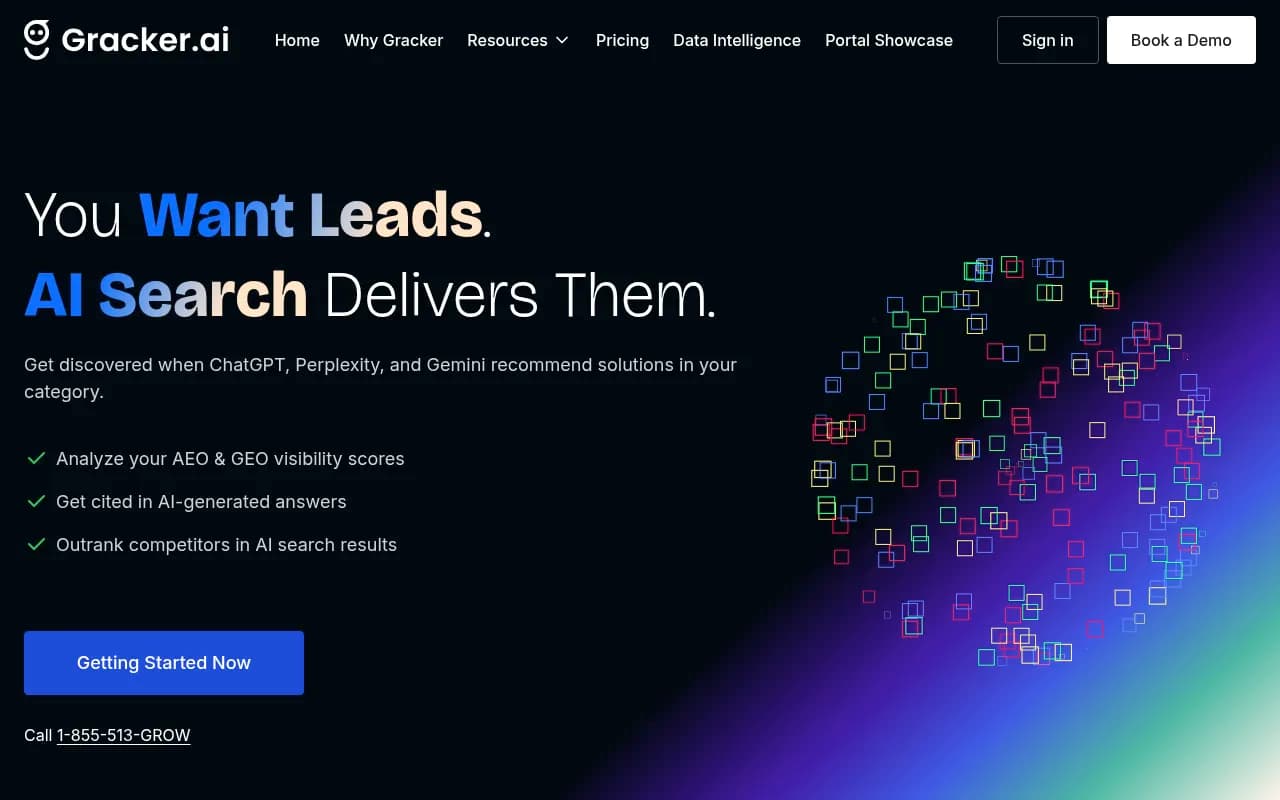
Gracker AI has a clear niche: cybersecurity and B2B SaaS. If you're in one of those verticals, it's worth a serious look. The platform monitors AI citations across ChatGPT, Perplexity, Claude, Gemini, Copilot, and Google AI Overviews, and it automatically generates AEO/GEO content -- authoritative articles, "best X tools" listicles, alternatives pages, FAQ content -- on autopilot.
The claimed 25% average visibility increase in 90 days is specific enough to be meaningful (or falsifiable). Their case studies (CloudDefense, Gopher, SSOJet) are all in the cybersecurity/DevTools space, which tells you exactly who they've optimized for.
The free tier is a real differentiator -- you can get an AI visibility score without paying anything. Paid plans start around $99/mo.
Compared to AEO Engine, Gracker is dramatically cheaper and self-serve, but it's narrower in scope. If you're not in cybersecurity or B2B SaaS, the niche focus might work against you.
Best for: Cybersecurity vendors, DevTools companies, and B2B SaaS teams who want automated content generation and monitoring without a large budget commitment.
Which one should you pick?
The right choice depends on what you actually need:
If you want a full optimization platform -- monitoring, gap analysis, content generation, crawler logs, traffic attribution -- and want to own the strategy in-house, Promptwatch is the strongest option at a price point ($99-$579/mo) that makes sense for most teams. The free trial means you can verify it works before committing.
If you need enterprise compliance (SOC 2) and deep prompt volume data, Profound is worth the higher price and the lack of a free trial.
If you're already paying for Semrush or Ahrefs and just want to add AI visibility tracking without another tool, stick with what you have -- the AI features are limited but functional.
If budget is the primary constraint, Peec AI at €89/mo or Otterly.AI at $29/mo get you basic monitoring. Just know you'll be doing the optimization work yourself.
If you're in cybersecurity or B2B SaaS specifically, Gracker AI's free tier and niche-specific content automation make it worth testing before paying for anything else.
AEO Engine itself makes most sense if you genuinely want a managed service and don't want to run the program internally -- but at $797/mo minimum, you're paying for someone else's time, not just software. Most teams will get more control and better ROI from a self-serve platform they actually use.