Key Takeaways
- Mixpanel is the closest direct competitor to Amplitude with similar event-based analytics and pricing, best for teams already familiar with Amplitude's approach
- PostHog offers the most value for engineering teams with its all-in-one platform (analytics + session replay + feature flags + A/B testing) at significantly lower cost
- Google Analytics remains the default choice for basic web analytics and SEO tracking, but lacks the product-specific depth of Amplitude
- Heap automatically captures all interactions without manual event tracking, ideal for teams who want comprehensive data without instrumentation overhead
- Pendo combines analytics with in-app guidance and is purpose-built for SaaS companies focused on user adoption and reducing churn
Why would you look for an Amplitude alternative? The most common reasons: cost (Amplitude's pricing scales aggressively with event volume), complexity (the platform has a steep learning curve), or feature gaps (you need session replay, feature flags, or other capabilities Amplitude doesn't include). Some teams also find Amplitude's data model rigid -- once you've set up your taxonomy, changing it later is painful.
Another factor: Amplitude's focus on large enterprise customers means smaller teams sometimes feel underserved. The sales process requires demos for most pricing tiers, and the platform assumes you have dedicated analytics resources. If you're a lean startup or a product team without a data analyst, you might want something more accessible.
Mixpanel
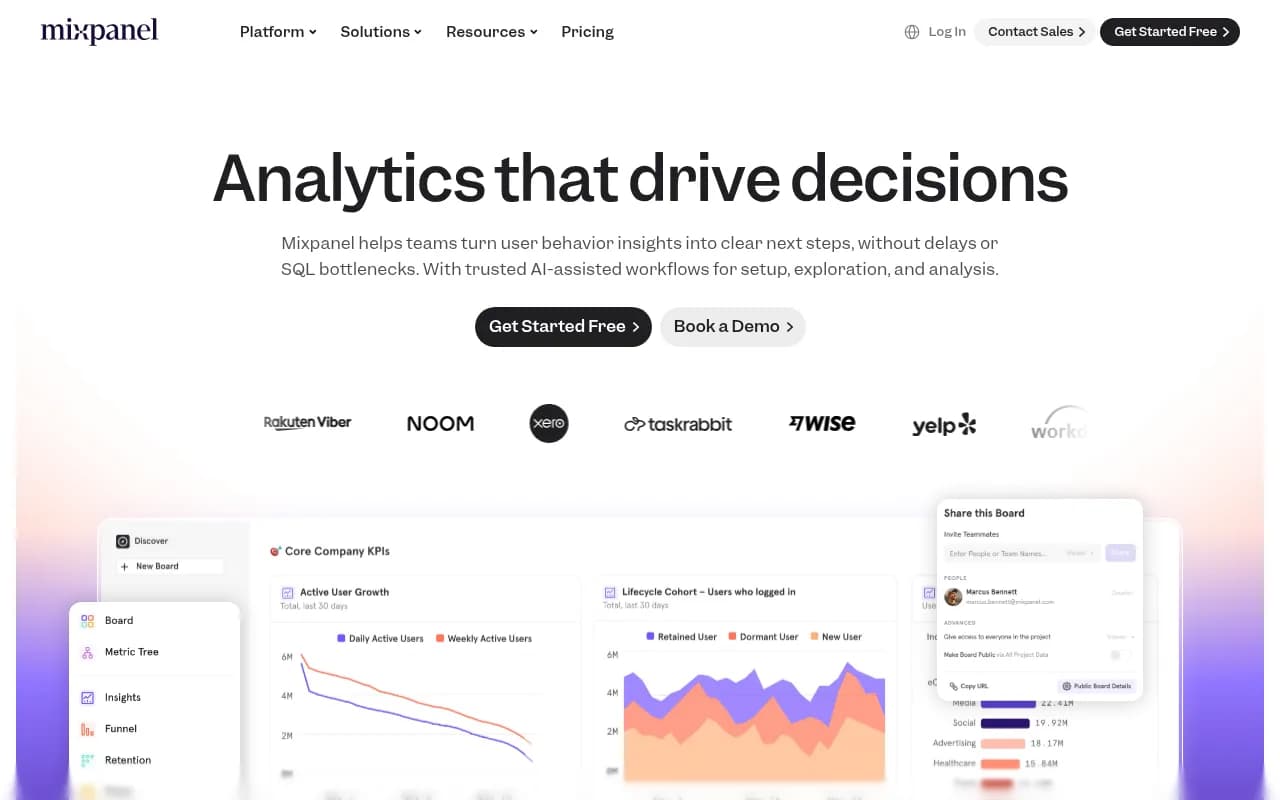
Mixpanel is Amplitude's most direct competitor. Both platforms use event-based analytics, both focus on user behavior and retention, and both target product teams. The core difference is philosophical: Amplitude emphasizes behavioral cohorts and predictive analytics, while Mixpanel focuses on simplicity and speed.
Mixpanel's interface is cleaner and easier to learn. You can build a funnel or retention chart in minutes without reading documentation. Amplitude gives you more analytical depth -- things like behavioral cohorts, predictive analytics, and advanced segmentation -- but you pay for that power with complexity. If your team includes non-technical PMs or marketers who need to self-serve insights, Mixpanel is often the better choice.
Pricing is similar at small scale but diverges as you grow. Mixpanel charges $0.28 per 1,000 events with volume discounts. Amplitude's pricing is opaque (requires a demo), but most teams report paying $2,000-$10,000/month for Growth tier and $20,000-$50,000+/year for Enterprise. At 10 million events/month, Mixpanel typically costs $2,000-$3,000/month vs Amplitude's $3,000-$5,000/month.
Mixpanel also includes features Amplitude doesn't: built-in A/B testing (Amplitude requires a separate Experiment product), simpler data warehouse integrations, and better mobile SDK performance. Amplitude counters with stronger predictive analytics, more sophisticated cohort analysis, and better support for multi-product companies.
Best for: Teams switching from Amplitude who want similar capabilities with a gentler learning curve and slightly lower cost.
PostHog
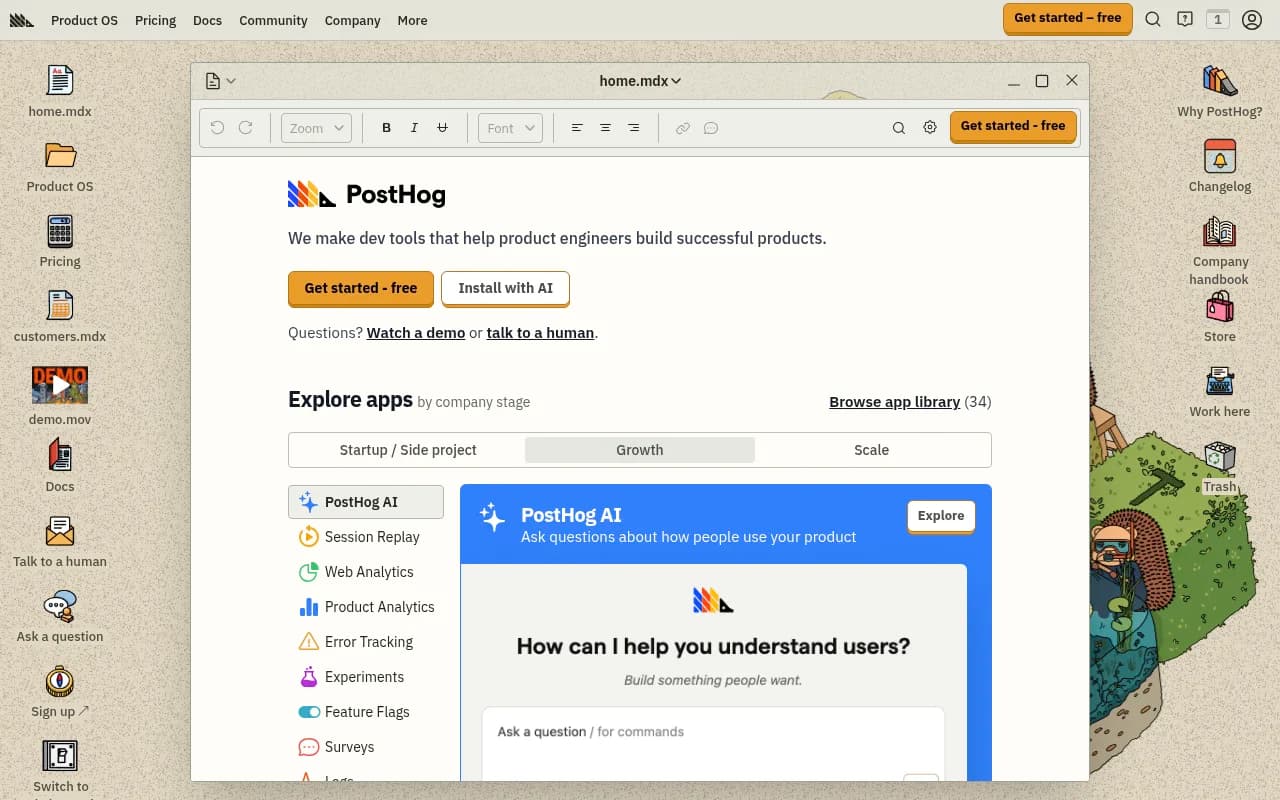
PostHog takes a different approach: instead of just analytics, you get an entire product development platform. Analytics, session replay, feature flags, A/B testing, and user surveys in one tool. For engineering-led teams, this is huge -- you're not juggling five different vendors.
The analytics piece is less sophisticated than Amplitude or Mixpanel. You won't find predictive analytics or behavioral cohorts. But you get the core workflows -- funnels, retention, user paths, trends -- and they work well. The real value is the integration: you can watch a session replay of users who dropped off in your funnel, then launch a feature flag to test a fix, all without leaving PostHog.
Pricing is dramatically cheaper. PostHog's free tier includes 1 million events, 5,000 session replays, and 1 million feature flag requests per month. That's enough for most early-stage startups. Paid plans use usage-based pricing: $0.00031/event, $0.005/replay, $0.0001/flag request. At 10 million events/month, you'd pay around $3,000/month for the full platform vs $3,000-$5,000/month for Amplitude analytics alone.
PostHog is also open source, so you can self-host for free if you have the infrastructure. Most teams use the cloud version, but self-hosting is an option if you have strict data residency requirements or want to avoid vendor lock-in.
The trade-off: PostHog is built for technical users. The interface assumes you understand SQL, event schemas, and product analytics concepts. If your team includes non-technical stakeholders who need to build reports, they'll struggle. Amplitude and Mixpanel have more polished UIs for non-technical users.
Best for: Engineering-led product teams who want analytics + session replay + feature flags in one platform at a fraction of Amplitude's cost.
Google Analytics
Google Analytics is the default web analytics tool for a reason: it's free (up to 10 million events/month), integrates with Google Ads and Search Console, and every marketer knows how to use it. But it's not a product analytics platform.
GA4 (the current version) tracks events and user properties like Amplitude, but the data model is designed for marketing attribution, not product analysis. You can build funnels and retention charts, but the interface is clunky and the segmentation is limited. GA4 also samples data at high volume, so you're not seeing 100% of your traffic -- Amplitude and Mixpanel don't sample.
Where GA4 shines: SEO and marketing. If you need to understand organic search traffic, track Google Ads conversions, or analyze landing page performance, GA4 is unmatched. It's also the only tool that integrates directly with Google Search Console, so you can see which queries drive traffic and conversions.
The pricing model is also different. GA4 is free up to 10 million events/month, then you need Google Analytics 360 at $50,000/year minimum. That's a massive jump. Amplitude and Mixpanel scale more gradually.
Best for: Marketing teams who need web analytics and SEO tracking, or product teams who want basic analytics for free and don't need advanced product-specific features.
Heap
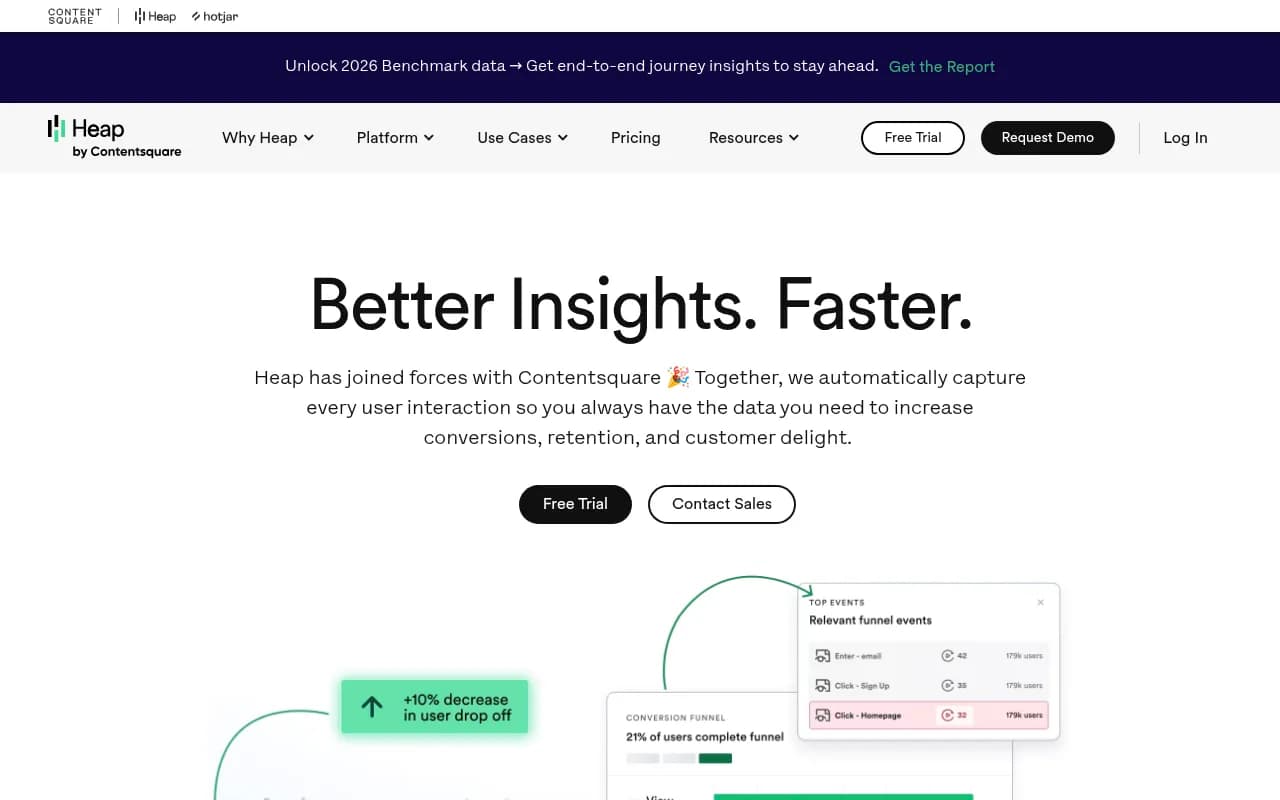
Heap's core innovation: automatic event capture. You add one script to your site, and Heap captures every click, page view, form submission, and interaction without manual instrumentation. Amplitude and Mixpanel require you to define events upfront and instrument them in code. Heap captures everything, then lets you define events retroactively.
This is powerful for two reasons. First, you can answer questions about past behavior even if you didn't think to track it at the time. "How many users clicked this button last month?" With Amplitude, if you didn't instrument that button, you're out of luck. With Heap, the data is already there. Second, you avoid instrumentation debt -- the endless backlog of "we should track this" tickets that never get prioritized.
The trade-off: Heap captures a lot of noise. Every click, every scroll, every hover. You need to spend time defining which interactions matter and which are just noise. Amplitude's manual instrumentation forces you to think through your data model upfront, which leads to cleaner data.
Heap is now part of Contentsquare, which adds session replay and heatmaps to the platform. Pricing is opaque (requires a demo), but most teams report $900-$2,000/month for the Growth plan and $3,000-$10,000+/month for Pro/Enterprise. That's similar to Amplitude.
Heap also has AI-powered insights (Heap Illuminate) that surface unexpected patterns in your data -- things like "users who visit page X are 3x more likely to convert." Amplitude has similar features in its predictive analytics suite.
Best for: Teams who want comprehensive data without instrumentation overhead, or who need to analyze past behavior they didn't think to track.
Pendo
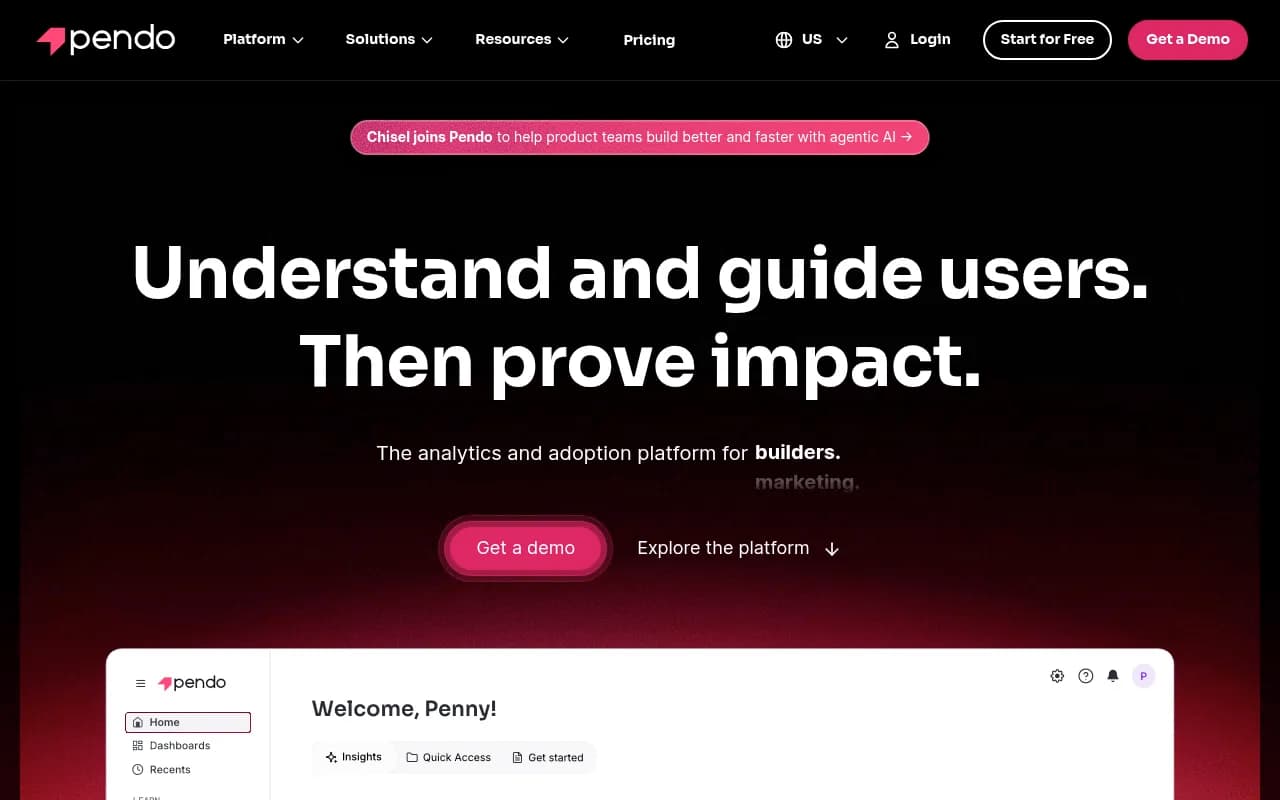
Pendo is purpose-built for SaaS companies. It combines product analytics with in-app guidance (tooltips, walkthroughs, announcements) and user feedback tools. The pitch: understand how users behave, then guide them to success without leaving the platform.
The analytics piece is solid but not as deep as Amplitude. You get funnels, retention, feature adoption tracking, and user segmentation. What you don't get: predictive analytics, advanced cohort analysis, or sophisticated data science features. Pendo's strength is the integration with in-app messaging. You can identify users who are struggling with a feature, then automatically show them a tooltip or walkthrough.
Pendo also includes NPS surveys, roadmap voting, and product feedback collection. If you're a SaaS PM trying to reduce churn and improve onboarding, Pendo gives you the full toolkit. Amplitude is just analytics -- you'd need to integrate with Intercom or Appcues for in-app messaging.
Pricing is usage-based with five tiers: Free (up to 500 MAUs), Base ($7,000-$10,000/year), Core ($20,000-$30,000/year), Pulse (~$50,000+/year), and Ultimate (custom enterprise pricing). That's similar to or slightly higher than Amplitude, but you're getting more than just analytics.
The downside: Pendo is less flexible than Amplitude for complex analysis. If you have a dedicated data team that wants to run sophisticated queries or build custom dashboards, Amplitude gives you more power. Pendo is built for PMs and customer success teams who want pre-built workflows.
Best for: SaaS companies that want analytics + in-app guidance + user feedback in one platform, especially if reducing churn and improving onboarding are top priorities.
OpenPanel
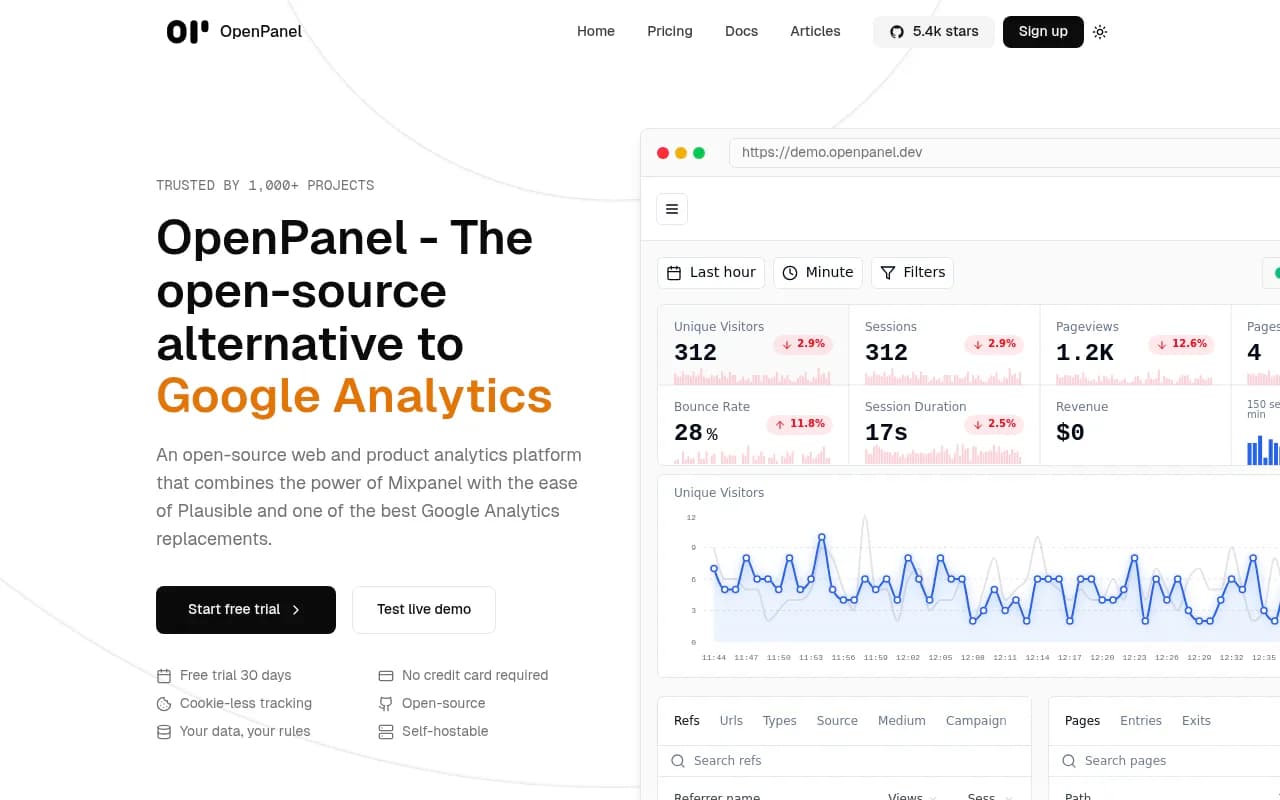
OpenPanel is an open-source alternative that combines Mixpanel's event-based analytics with Plausible's privacy-first approach. It's newer and less mature than Amplitude, but it's growing fast -- 1,000+ projects including Midday and Uneed use it.
The core features are familiar: event tracking, funnels, retention, user profiles, revenue tracking. What's different: OpenPanel doesn't use cookies or fingerprinting, so you don't need consent banners in most jurisdictions. It also offers unlimited events if you self-host, or cloud pricing starting at $9/month for 10,000 events.
That pricing is dramatically cheaper than Amplitude. At 1 million events/month, OpenPanel costs $49/month vs Amplitude's $2,000-$3,000/month. At 10 million events/month, OpenPanel is $249/month vs Amplitude's $3,000-$5,000/month. You're paying 10-20x less.
The trade-off: OpenPanel lacks Amplitude's advanced features. No predictive analytics, no behavioral cohorts, no data warehouse integrations (yet). It's also a smaller team with less enterprise support. If you need 24/7 support, SLAs, and dedicated customer success, Amplitude is the safer choice.
But if you're a startup or small product team that wants solid analytics without the enterprise price tag, OpenPanel is worth considering. The open-source model also means you can self-host for free and avoid vendor lock-in.
Best for: Startups and privacy-conscious teams who want affordable event-based analytics without cookies or consent banners.
Matomo
Matomo is the open-source alternative to Google Analytics, not Amplitude. It's web analytics focused -- page views, traffic sources, conversions -- rather than product analytics. But it's worth mentioning because it solves a specific problem: GDPR compliance.
Matomo gives you 100% data ownership. You can self-host it on your own servers, so user data never leaves your infrastructure. You don't need consent banners in most EU jurisdictions because you're not sharing data with third parties. Google Analytics requires consent banners under GDPR, which tanks your data completeness.
Matomo also doesn't sample data. Google Analytics samples at high volume, so you're not seeing 100% of your traffic. Matomo tracks everything. It also supports unlimited websites and users, even on the free self-hosted version.
The analytics features are similar to Google Analytics: traffic sources, page views, conversions, goals, e-commerce tracking. You can also add premium plugins for heatmaps, session recordings, A/B testing, and more. But it's not event-based product analytics like Amplitude. You're tracking page views and conversions, not user actions and retention.
Pricing: self-hosting is free forever. Cloud hosting starts at €19/month for 50,000 hits and scales to €579/month for 10 million hits. Premium plugins cost €199-€349/year each.
Best for: Teams who need GDPR-compliant web analytics with 100% data ownership, especially in regulated industries or privacy-sensitive contexts.
Statsig
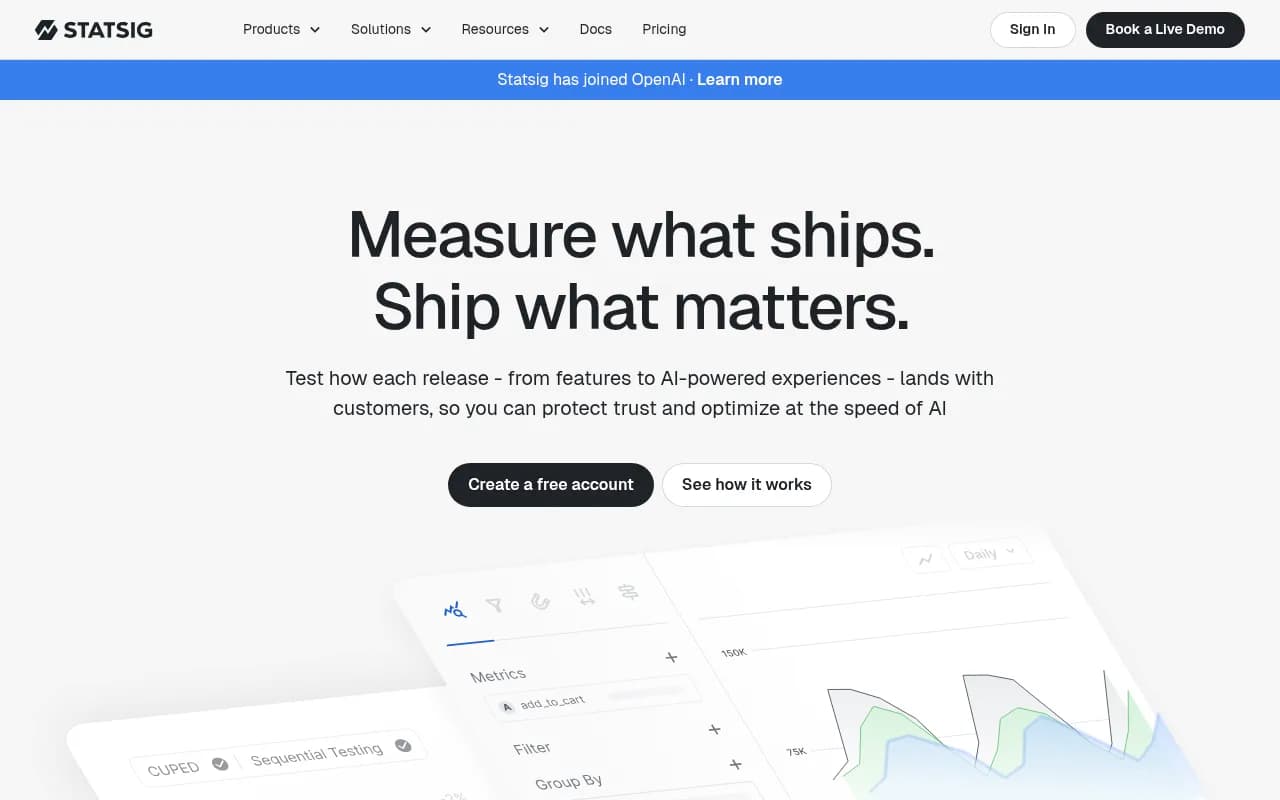
Statsig is a product development platform that combines A/B testing, feature flags, and product analytics. It's similar to PostHog in scope but with a stronger focus on experimentation. OpenAI, Brex, and Notion use it.
The analytics piece is solid but not as deep as Amplitude. You get event tracking, funnels, retention, and user segmentation. What makes Statsig different is the experimentation engine. It's built for running hundreds of concurrent experiments with advanced statistical methods (CUPED, sequential testing, multi-armed bandits). Amplitude offers A/B testing as a separate product (Amplitude Experiment), but Statsig's experimentation is more sophisticated.
Statsig also has a warehouse-native architecture. Instead of sending events to Statsig's servers, you can run everything in your own data warehouse (Snowflake, BigQuery, Databricks). This reduces costs and keeps data in your infrastructure. Amplitude requires you to send data to their servers.
Pricing is generous: 1 million events/month free, then $150/month base + usage. At 1 million events, you'd pay around $200/month. At 10 million events, around $500/month. That's 5-10x cheaper than Amplitude.
The trade-off: Statsig is built for technical teams. The interface assumes you understand statistical concepts like p-values, confidence intervals, and power analysis. If your team includes non-technical PMs, they'll need training. Amplitude's UI is more accessible.
Best for: Engineering-led teams who run lots of experiments and want a warehouse-native platform with advanced statistical methods at a fraction of Amplitude's cost.
How to choose the right Amplitude alternative
Start with your primary use case. If you need web analytics and SEO tracking, Google Analytics is the obvious choice. If you need product analytics with in-app guidance, look at Pendo. If you want analytics + session replay + feature flags in one platform, PostHog or Statsig.
Next, consider your team's technical depth. Amplitude, Mixpanel, and Pendo have polished UIs for non-technical users. PostHog, Statsig, and OpenPanel assume technical users who understand SQL and data modeling. If your PMs and marketers need to self-serve insights, prioritize ease of use.
Pricing matters, especially at scale. Amplitude and Mixpanel cost $2,000-$5,000/month for 10 million events. PostHog, Statsig, and OpenPanel cost $200-$500/month for the same volume. If you're a startup or small team, the 10x price difference is significant.
Finally, think about your data model. Amplitude and Mixpanel require manual event instrumentation, which leads to cleaner data but more upfront work. Heap captures everything automatically, which is convenient but creates noise. PostHog and Statsig offer warehouse-native options if you want to keep data in your own infrastructure.
No single tool is best for everyone. Mixpanel is the safest Amplitude replacement for most teams. PostHog offers the most value for engineering-led teams. Pendo is purpose-built for SaaS. Google Analytics is free and ubiquitous. Pick based on your specific needs, not generic "best of" lists.