Key takeaways
- Systeme.io is the best budget pick — it covers funnels, email, courses, and affiliates with a genuinely free forever plan, making it the closest ClickFunnels alternative for solopreneurs who don't want to spend $97/mo.
- Kartra is the most direct like-for-like replacement: all-in-one funnels, email, memberships, and checkouts, but at a lower entry price ($59/mo vs $97/mo).
- Kajabi wins for course creators and coaches who want the cleanest experience and don't mind paying a premium.
- GoHighLevel is built for agencies — white-label SaaS reselling, CRM, and SMS automation that ClickFunnels simply doesn't offer.
- HubSpot Marketing Hub is the enterprise upgrade path — far more powerful CRM and automation, but pricing jumps sharply at the Professional tier.
- Leadpages, Unbounce, and Instapage are landing-page-only tools — pick one if you just need pages, not a full funnel system.
ClickFunnels has been the go-to funnel builder for digital marketers since Russell Brunson popularized the concept of "one funnel away" success. And it's genuinely good at what it does: building multi-step sales funnels with upsells, order bumps, and email automation baked in. But a few things push people to look elsewhere.
The price is the most common complaint. At $97/month (or $81/month billed annually) for the base plan, you're paying a meaningful amount before you've made a single sale. The interface, while functional, feels dated compared to newer competitors. And if you're a course creator or coach, you might find yourself duct-taping ClickFunnels to a separate course platform, which defeats the point of an "all-in-one" tool.
There's also the community factor. ClickFunnels has built a strong culture around its brand, which some people love and others find off-putting. If you just want software without the guru energy, there are better options.
Here's an honest look at the best alternatives in 2026.
The alternatives
Systeme.io
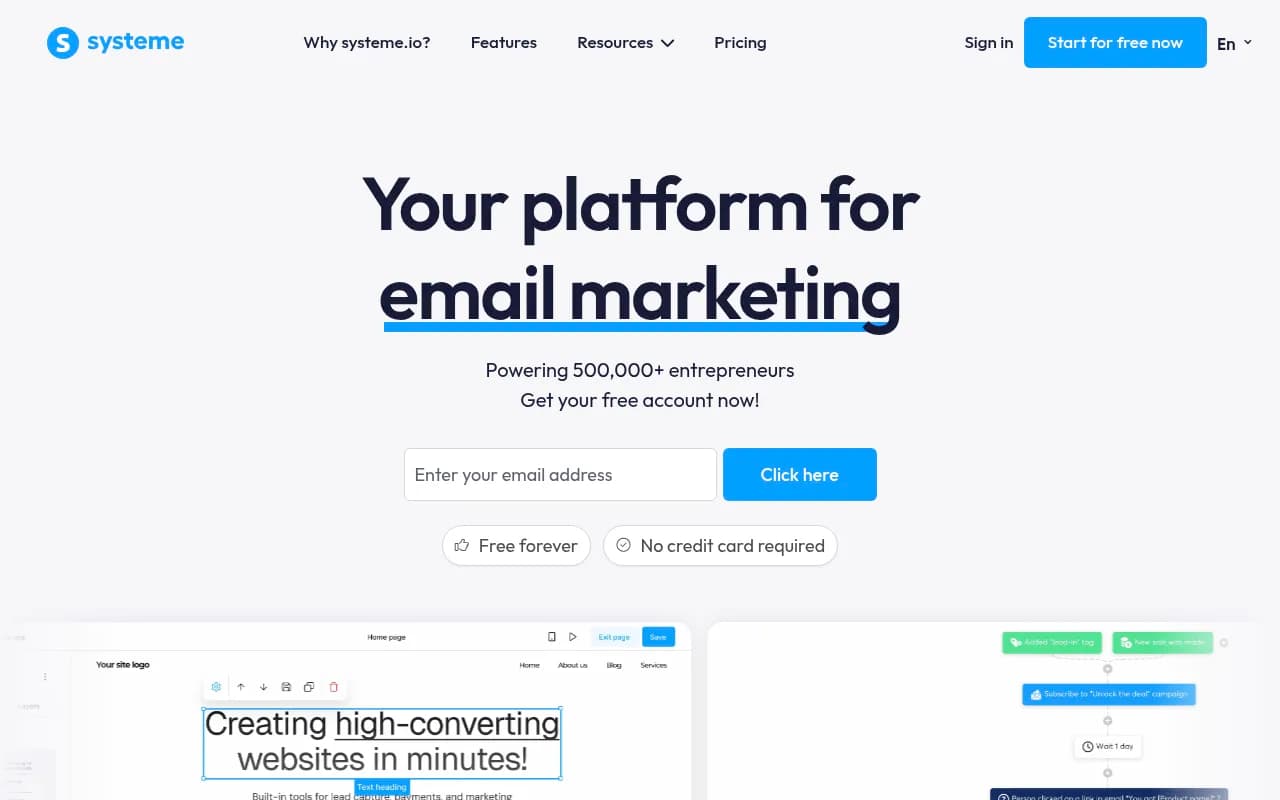
Systeme.io is probably the most underrated tool in this space. It does almost everything ClickFunnels does — sales funnels, email automation, online courses, membership sites, affiliate programs, and even a blog — and it starts completely free. Not a free trial. A free forever plan with up to 2,000 contacts and unlimited emails.
The paid plans are $17/month (Startup), $47/month (Webinar), and $97/month (Unlimited). That last tier gives you unlimited everything, which is the same price as ClickFunnels' entry plan but with far more included.
The trade-off is polish. Systeme.io's editor is functional but not as slick as ClickFunnels or Kartra. The templates are decent but not as numerous. And the community/support ecosystem is smaller, so if you run into an edge case, you might be on your own for a bit.
But for solopreneurs and early-stage course creators who want to validate an idea without spending $100/month before they've made a sale, Systeme.io is genuinely hard to beat. It's powering 500,000+ entrepreneurs, which is not a small number.
Pricing vs ClickFunnels: Significantly cheaper. Free plan available; paid plans start at $17/mo vs ClickFunnels' $81/mo.
Best for: Solopreneurs, bootstrapped course creators, and anyone who wants ClickFunnels-style functionality without the price tag.
Kartra
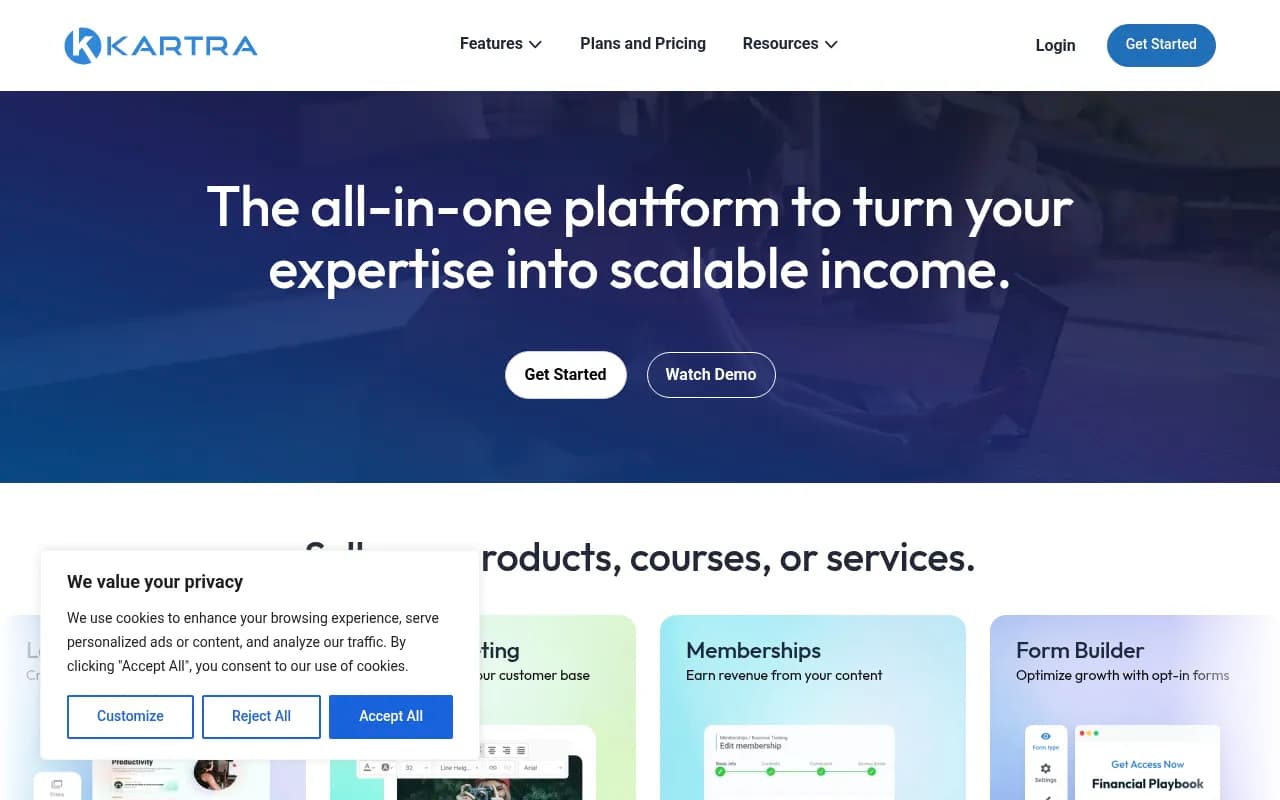
Kartra is the most direct ClickFunnels competitor. It covers the same ground — landing pages, sales funnels, email automation, membership sites, checkouts, and affiliate management — and it does most of it at least as well, sometimes better.
Where Kartra pulls ahead: the email automation is more sophisticated, with behavior-based sequences that feel closer to a proper marketing automation tool. The checkout system handles subscriptions, trials, and one-click upsells cleanly. And the membership site builder is more polished than ClickFunnels'.
Where it falls behind: Kartra's page builder has historically been clunkier than ClickFunnels', though recent updates have improved it. The template library is smaller. And Kartra doesn't have the same brand recognition, which matters if you're buying into an ecosystem of courses and communities.
Pricing starts at $59/month (Essentials), $119/month (Starter), and $229/month (Growth). The Essentials plan is notably cheaper than ClickFunnels' base plan, and it includes more contacts and emails.
Best for: Digital product sellers and course creators who want a ClickFunnels replacement with better email automation and a lower starting price.
Kajabi
Kajabi is what you use when you're serious about selling knowledge. It's built specifically for coaches, course creators, and membership site owners — and it shows. The course delivery experience is the best in this category. The community features are polished. The checkout and subscription management works well out of the box.
Compared to ClickFunnels, Kajabi is less focused on funnel mechanics (upsells, order bumps, A/B testing funnels) and more focused on the product delivery side. You can build landing pages and email sequences in Kajabi, but they're not as conversion-optimized as ClickFunnels' templates.
The pricing is higher: plans start at $69/month (Kickstarter, billed annually) and go up from there. The Basic plan at $149/month is where most serious creators land. That's more expensive than ClickFunnels' base plan, but Kajabi replaces more tools — you won't need a separate course platform, community tool, or email provider.
One honest downside: Kajabi's transaction fees and product limits on lower tiers can be frustrating as you scale. Read the plan details carefully before committing.
Best for: Established coaches, course creators, and membership site owners who want the best product delivery experience and don't mind paying for it.
GoHighLevel
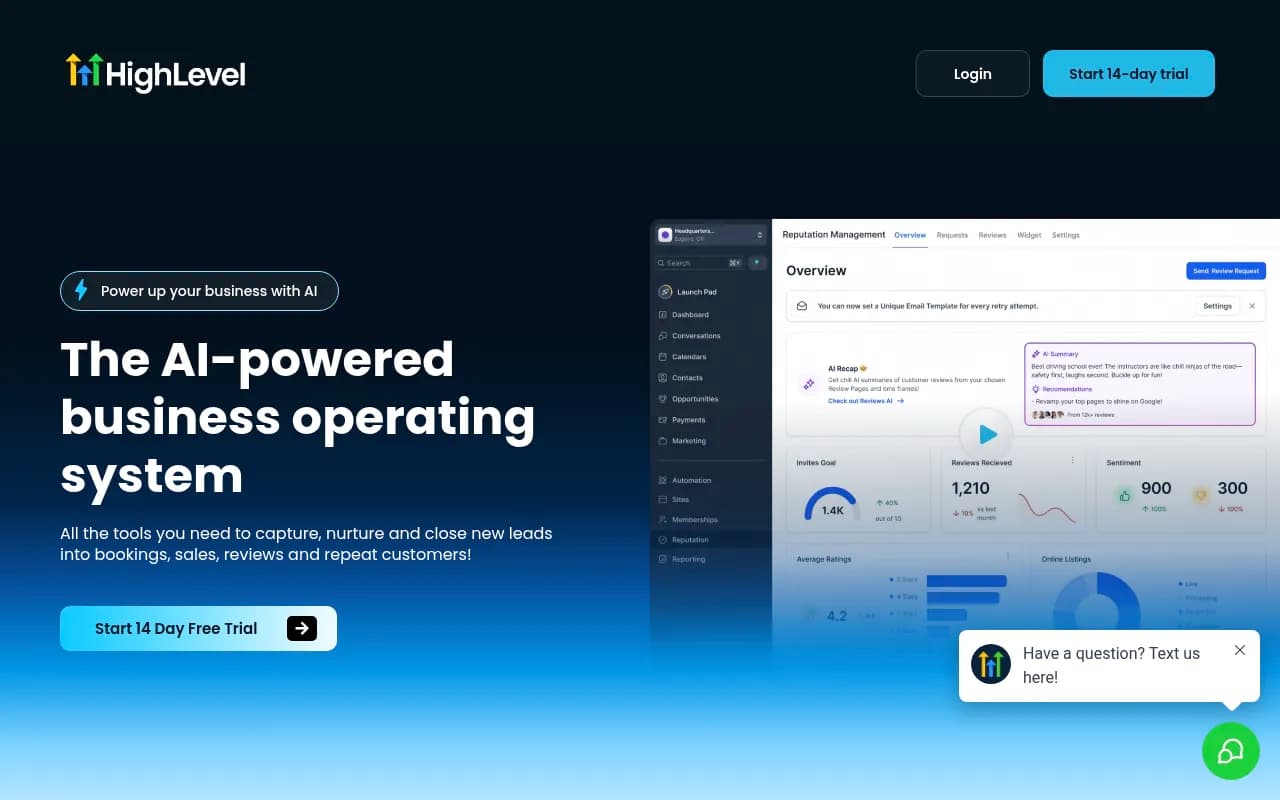
GoHighLevel is a different beast. It's not really competing with ClickFunnels for individual creators — it's built for digital marketing agencies who want to manage multiple clients from one platform and potentially white-label the software to resell it.
The feature set is enormous: CRM, funnel builder, email and SMS automation, AI voice agents, reputation management, appointment booking, and a white-label SaaS option that lets you resell the platform under your own brand. No other tool in this comparison comes close on that last point.
The funnel builder is capable but not the most intuitive. The platform has a steep learning curve — there's a lot here, and it takes time to set up properly. But once you're in, the economics are compelling: $97/month covers unlimited sub-accounts, which means you can run dozens of client accounts on one subscription.
If you're a solo creator or small business owner, GoHighLevel is probably overkill. The complexity isn't worth it unless you're managing multiple clients or want to build a SaaS business on top of it.
Pricing: $97/month (Starter), $297/month (Unlimited), $497/month (SaaS Pro). 14-day free trial available.
Best for: Digital marketing agencies, consultants managing multiple clients, and anyone who wants to white-label a marketing platform.
HubSpot Marketing Hub
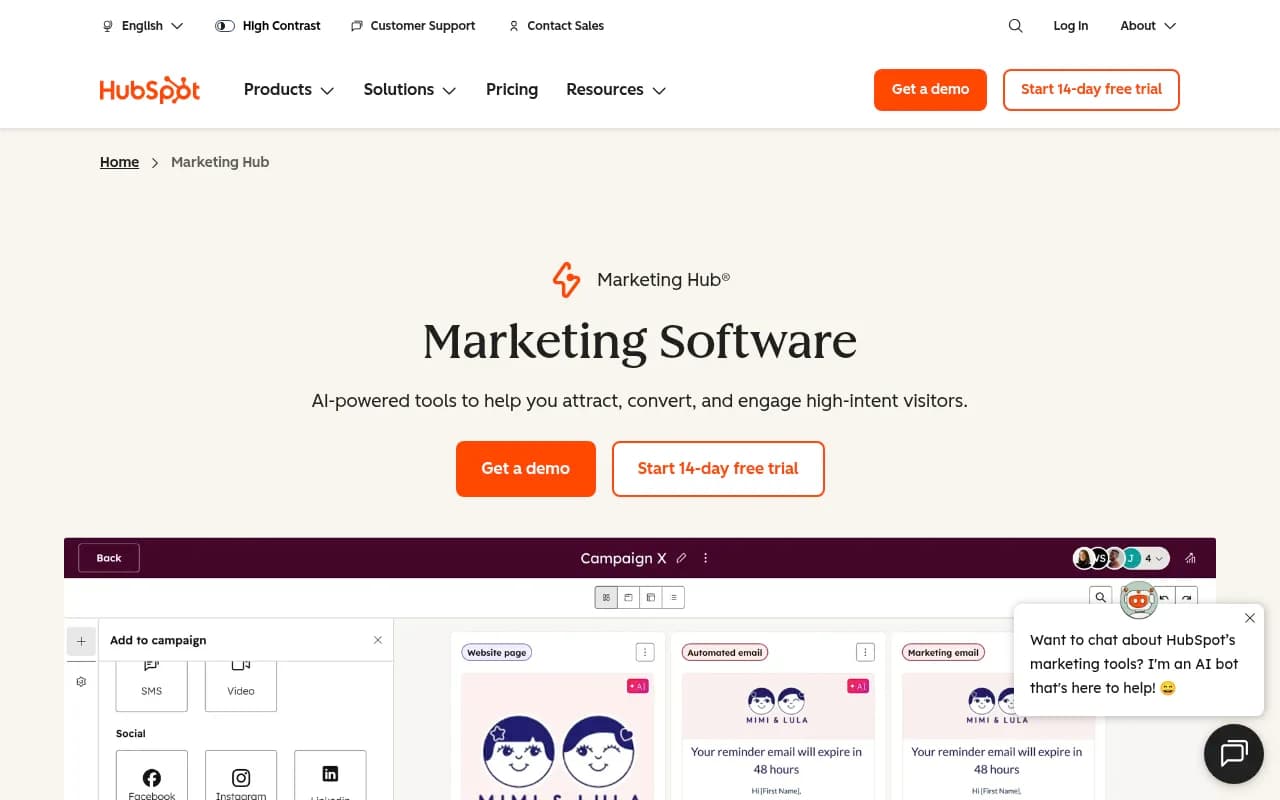
HubSpot is in a different category from ClickFunnels. Where ClickFunnels is built around the funnel metaphor — get traffic, convert it, upsell it — HubSpot is built around the full customer lifecycle, with a CRM at the center.
The free tier is genuinely useful for small teams: forms, email marketing, basic automation, and a CRM with unlimited contacts. The Starter plan at $15/seat/month is reasonable. But the Professional plan, where the serious automation lives, starts at $890/month for 3 seats. That's a significant jump, and it's where most ClickFunnels users would need to be to get comparable automation capabilities.
What HubSpot does better than ClickFunnels: contact management, lead scoring, multi-channel attribution, and integration with sales teams. If you have a sales team following up on leads, HubSpot's CRM makes that workflow much smoother.
What it does worse: ClickFunnels is faster to set up a converting funnel. HubSpot's landing page builder is fine but not as conversion-focused. And the pricing at scale is genuinely expensive.
Best for: Growing companies with sales teams who need a proper CRM alongside their marketing, and who have the budget for the Professional tier.
Leadpages

Leadpages is a landing page builder, not a funnel builder. That distinction matters. You can build individual pages, add pop-ups, run A/B tests, and capture leads — but you won't get the multi-step funnel logic, upsells, or order bumps that ClickFunnels specializes in.
What Leadpages does well: it's fast, the templates are clean and conversion-focused, and it integrates with most email providers and CRMs. At $37/month, it's significantly cheaper than ClickFunnels.
The limitation is scope. If you need a full funnel with checkout, upsells, and email automation, you'll need to connect Leadpages to other tools. That's fine if you already have those tools, but it adds complexity and cost.
Best for: Marketers who already have an email platform and CRM and just need a dedicated landing page tool without paying for a full funnel suite.
Unbounce

Unbounce is the landing page tool that agencies and conversion-focused marketers tend to reach for. Its Smart Traffic feature — which uses AI to automatically route visitors to the page variant most likely to convert them — is genuinely useful and not something you'll find in ClickFunnels.
The A/B testing is solid, the editor is flexible, and the template library is large. Pricing starts around $74/month, which is cheaper than ClickFunnels but more expensive than Leadpages.
Like Leadpages, Unbounce is a landing page tool, not a full funnel builder. You'll need to integrate it with a checkout tool, email platform, and CRM to replicate what ClickFunnels does natively.
Best for: Agencies and performance marketers running paid campaigns who want the best landing page testing and optimization tools, and who already have the rest of their stack sorted.
Instapage

Instapage sits at the premium end of the landing page builder market. Its standout features are real-time visual collaboration (useful for agencies working with clients), AdMap (which connects your ad campaigns to specific landing pages), and deep personalization that lets you show different content to different audience segments.
The heatmaps and analytics are more detailed than what you'd get from ClickFunnels' built-in analytics. And the collaboration tools are genuinely better than anything else in this list.
The price reflects this: plans start at $99/month. For a landing-page-only tool, that's a meaningful investment. It's hard to justify unless you're running high-volume paid campaigns where conversion rate improvements translate directly to significant revenue.
Best for: Enterprise marketing teams and agencies running large paid ad campaigns who need advanced personalization, collaboration, and analytics.
GetResponse

GetResponse started as an email marketing platform and has expanded to include landing pages, webinars, and marketing automation. It's a solid all-in-one option for teams that want to consolidate their email and landing page tools into one subscription.
The free plan covers 500 contacts, which is enough to get started. Paid plans start at $13.30/month, making it one of the most affordable options here. The email deliverability is strong — GetResponse claims 99% deliverability across 160+ countries, and their reputation in that area is solid.
Where it falls short compared to ClickFunnels: the funnel builder is more basic, the checkout experience isn't as polished, and there's no native membership site or course delivery. It's better thought of as an email-first platform with landing page capabilities bolted on, rather than a true funnel builder.
Best for: Small businesses and entrepreneurs who want email marketing as their primary tool and want landing pages included without paying for a separate tool.
Ontraport
Ontraport is the option for growing businesses that have outgrown simple funnel tools but don't want to pay HubSpot or Salesforce prices. It combines a proper CRM with marketing automation, email and SMS, payments, sales pipelines, and a dynamic CMS.
The automation builder is one of the most powerful in this price range. You can build complex, multi-condition workflows that would require expensive enterprise tools elsewhere. The CRM is genuinely useful for businesses with sales teams, not just solo operators.
Pricing starts at $28/user/month with a 14-day free trial. That's accessible for small teams, and it scales reasonably as you grow.
The trade-off: Ontraport has a steeper learning curve than ClickFunnels. It's built for businesses with some operational complexity, not for someone who wants to launch a simple funnel in an afternoon. The page builder is functional but not as polished as dedicated landing page tools.
Best for: Mid-sized businesses with sales teams that need a CRM-first platform with marketing automation, and who want enterprise-level power without enterprise-level pricing.
Which one should you pick?
Here's a quick decision guide based on your situation:
-
You want the cheapest ClickFunnels replacement with the most features: Systeme.io. Start on the free plan and upgrade only when you need to.
-
You want a direct ClickFunnels swap with better email automation: Kartra. Similar feature set, lower starting price, more sophisticated sequences.
-
You're a course creator or coach who wants the best student experience: Kajabi. More expensive, but it replaces more tools and the delivery experience is the best in class.
-
You run a digital marketing agency with multiple clients: GoHighLevel. The white-label SaaS option alone makes it worth considering.
-
You have a sales team and need a proper CRM at the center: HubSpot (if budget allows) or Ontraport (if you want similar power at a lower price).
-
You just need landing pages and already have email/CRM sorted: Leadpages (cheapest), Unbounce (best for A/B testing and AI optimization), or Instapage (best for enterprise teams and collaboration).
-
You want email marketing as the primary tool with landing pages included: GetResponse.
The honest answer is that ClickFunnels is still a reasonable choice if you're already in its ecosystem and it's working for you. But if you're starting fresh in 2026, Systeme.io or Kartra will get you most of the same functionality at a meaningfully lower price — and Kajabi or GoHighLevel will serve you better if your use case tilts toward courses or agencies respectively.