Key takeaways
- Glowtify is an all-in-one AI marketing OS built specifically for small e-commerce teams, but at $449–$899/month it's a significant investment that doesn't suit every budget or use case.
- If you need best-in-class email and SMS for Shopify, Klaviyo or Omnisend will outperform Glowtify on those specific channels at a fraction of the cost.
- For enterprise-scale content production with brand governance, Jasper is the more mature choice.
- If you want a full marketing suite with a CRM backbone, HubSpot Marketing Hub is the obvious alternative — though it gets expensive fast.
- For paid social specifically, Madgicx (Meta ads) or Triple Whale (attribution + analytics) are far more specialized.
- Small DTC brands that want agency-quality output without managing tools themselves should look at Needle.
- Teams that want to understand how their brand appears in AI search results (ChatGPT, Perplexity, Gemini) should consider Promptwatch alongside any of these tools — it covers a gap none of the others address.
Glowtify positions itself as an AI marketing operating system: one workspace where you set strategy, generate content, plan campaigns, and publish across email, social, blog, and ads. For a lean e-commerce team that genuinely wants to consolidate their stack, that pitch is compelling. Customers report 4x faster marketing operations and meaningful time savings on email production.
But the price point is real. $449/month for stores under $100K in revenue is a lot to ask, and $899/month for growth-stage stores puts Glowtify in direct competition with tools that have been doing specific jobs for years. The platform also leans heavily on organic channels — email, social, blog, SEO — which means if paid advertising is your primary growth lever, you'll still need other tools.
People typically start looking for alternatives for a few reasons: the cost feels steep for what they actually use, they want deeper specialization in one channel (email, paid social, attribution), they're already committed to a CRM like HubSpot and don't want to duplicate workflows, or they need enterprise-grade brand governance that Glowtify doesn't offer.
Here's an honest look at the best alternatives.
Jasper
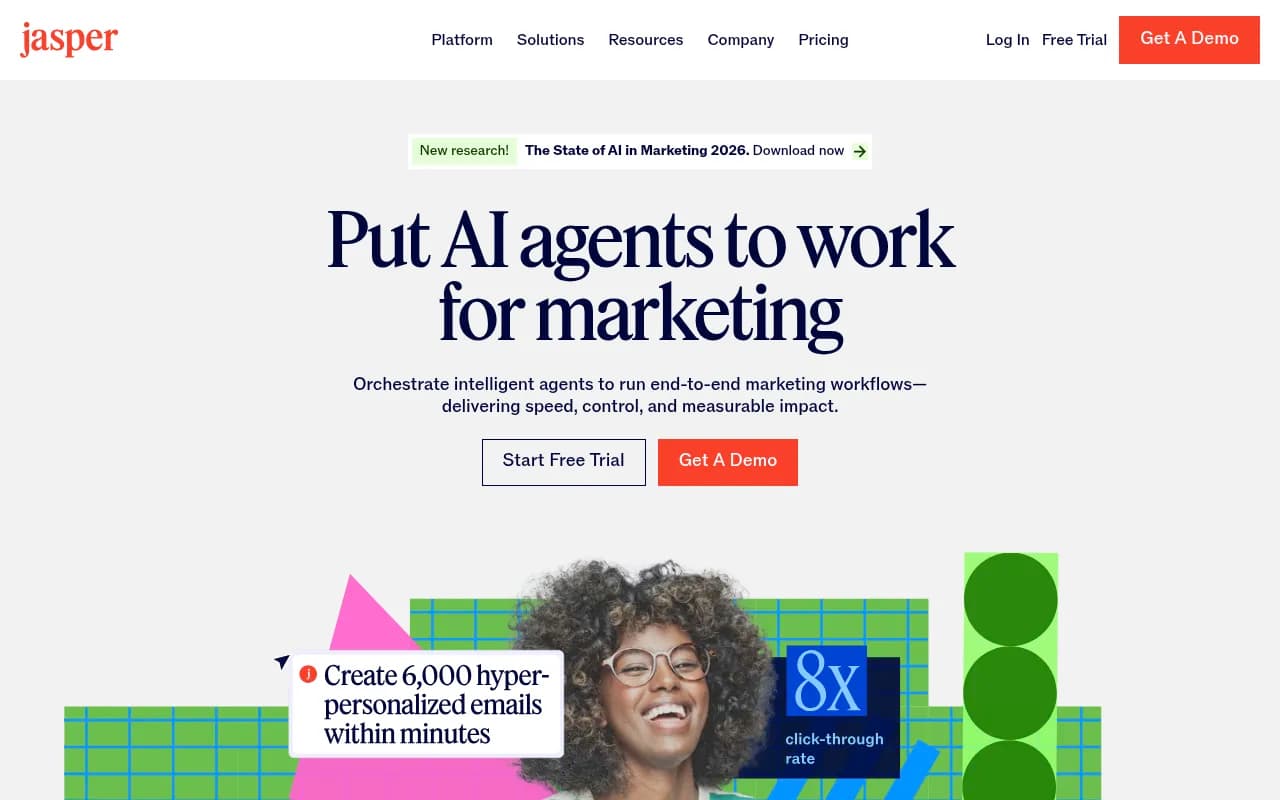
Jasper is the closest thing to Glowtify in terms of positioning — an AI platform built specifically for marketing teams — but it targets a different audience. Where Glowtify is built for small e-commerce teams, Jasper is designed for mid-to-large marketing departments that need to produce content at scale while keeping brand consistency locked down.
The core difference is depth of content infrastructure. Jasper has 100+ specialized AI agents, content pipelines for repeatable workflows, and a "Jasper IQ" layer that embeds brand voice, visual guidelines, style guides, and governance rules into every output. If you have a brand standards document and a legal team that reviews copy, Jasper's governance features will matter to you. Glowtify doesn't have anything comparable.
What Jasper lacks compared to Glowtify is the e-commerce-specific workflow. There's no native Shopify integration, no campaign calendar tied to your store's promotions, and no built-in publishing to Klaviyo or Meta. Jasper generates content; it doesn't run your marketing operation end-to-end.
Pricing is more accessible at the lower end: $59/month for the Creator plan (solo users), $249/month for teams up to 5. Enterprise pricing is custom. That's meaningfully cheaper than Glowtify for smaller teams, though the Pro plan's feature set is more limited than Glowtify's all-in-one approach.
Best for: Marketing teams at mid-size companies who need high-volume, on-brand content production with governance controls, and who already have separate tools for campaign execution and analytics.
HubSpot Marketing Hub
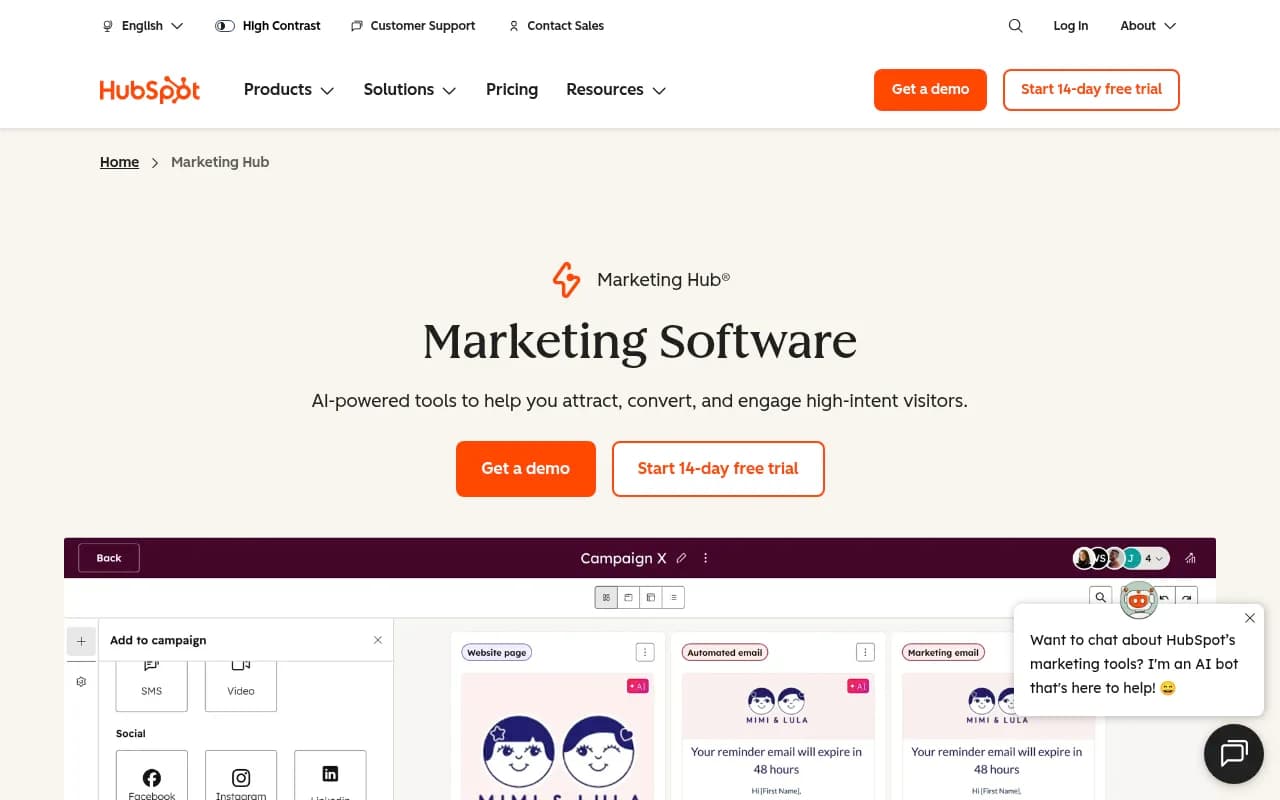
HubSpot is the default answer when someone asks "what's the most complete marketing platform?" and there's a reason for that. It covers email, social, landing pages, forms, ads, workflows, lead scoring, and reporting — all connected to a CRM that tracks every contact's history.
Compared to Glowtify, HubSpot is broader but less AI-native. Glowtify was built from the ground up around AI-driven campaign planning and content generation. HubSpot has added AI features (Breeze AI, AI-powered emails, content suggestions) but they feel bolted on rather than central to the product. If you're primarily looking for AI to help you create and plan content, Glowtify's AI feels more integrated.
Where HubSpot wins decisively is the CRM layer. Every marketing action in HubSpot ties back to contact records, deal stages, and revenue attribution. For teams that care about connecting marketing to sales pipeline, that's invaluable. Glowtify has performance tracking but it's not a CRM.
The pricing gap is significant. HubSpot's free tier is genuinely useful for small teams, and the Starter plan at $15/seat/month is accessible. But the Professional plan — where you get the automation and reporting features that actually compete with Glowtify — starts at $890/month for 3 seats. Enterprise is $3,600/month. So HubSpot isn't necessarily cheaper; it depends heavily on which tier you need.
Best for: Teams that need marketing and sales aligned in one platform, already use or plan to use HubSpot CRM, and want a proven enterprise-grade tool over a newer AI-native one.
Semrush
Semrush is primarily an SEO and digital marketing intelligence platform, not a campaign execution tool. Comparing it directly to Glowtify is a bit of an apples-to-oranges situation, but there's meaningful overlap for teams whose marketing strategy is built around organic search.
Where Semrush is genuinely better than Glowtify: keyword research, backlink analysis, competitor traffic analysis, site audits, and PPC research. These are deep, mature capabilities that Glowtify doesn't attempt to replicate. Semrush also has a content marketing toolkit with topic research, SEO writing assistance, and a content audit tool.
Semrush has also added AI visibility tracking — monitoring how brands appear in ChatGPT, Perplexity, and Gemini responses. It's a useful addition, though it uses fixed prompt sets rather than custom prompt tracking, which limits how actionable the data is. For deeper AI search optimization, a dedicated platform like Promptwatch covers this more thoroughly.

What Semrush doesn't do: it won't help you plan a promotional calendar, generate email campaigns, or publish social posts. It's an intelligence and research tool, not a marketing execution platform.
Pricing starts at $165/month (Starter), $290/month (Pro+), $580/month (Advanced). For teams that need SEO intelligence alongside their marketing work, Semrush plus a lighter content tool might actually be cheaper than Glowtify.
Best for: SEO-focused marketing teams that need deep keyword and competitive intelligence, and who handle campaign execution in separate tools.
Omnisend

Omnisend is built specifically for e-commerce email and SMS marketing, which makes it one of the most direct alternatives to Glowtify's core use case. It integrates natively with Shopify, WooCommerce, BigCommerce, and Wix, and its automation flows are purpose-built for e-commerce sequences: abandoned cart, browse abandonment, post-purchase, win-back.
Compared to Glowtify, Omnisend is narrower but deeper on the channels it covers. The email builder is polished, the segmentation is solid, and the SMS capabilities are genuinely useful for driving repeat purchases. Omnisend claims an average return of $79 for every $1 spent — a figure that reflects how well-tuned its e-commerce automations are.
What you lose relative to Glowtify is the strategic layer. Omnisend doesn't help you set marketing goals, generate a content calendar, or create blog and social content. It's a channel execution tool, not a marketing operating system. If you want AI to help you think about what to promote and when, Omnisend won't do that.
Pricing is more accessible: Omnisend has a free tier, and paid plans scale based on contact count rather than a flat monthly fee. For stores with smaller lists, this can be significantly cheaper than Glowtify.
Best for: E-commerce brands that want best-in-class email and SMS automation without paying for strategy and content features they won't use.
Buffer
Buffer is the simplest social media scheduling tool on this list, and that's not a criticism. It does one thing well: helps you plan, schedule, and publish social content across Instagram, TikTok, LinkedIn, Facebook, Threads, Bluesky, YouTube Shorts, and more.
Compared to Glowtify's social capabilities, Buffer is more limited in scope but much easier to use and dramatically cheaper. There's no AI campaign planning, no email integration, no Shopify connection. But if your primary need is consistent social media publishing without complexity, Buffer delivers that reliably.
The AI Assistant in Buffer helps with post generation and content ideas, but it's a lightweight feature compared to Glowtify's AI content engine. Buffer's analytics are also basic — you get engagement metrics and post performance, but not the kind of cross-channel performance tracking Glowtify offers.
Pricing is genuinely accessible: free for up to 3 channels, $5/month per channel for Essentials, $10/month per channel for Team. For a small brand managing 3–4 social accounts, you're looking at $15–40/month versus Glowtify's $449/month minimum.
Best for: Solopreneurs, small brands, or teams that need reliable social scheduling without the overhead of a full marketing platform.
Klaviyo
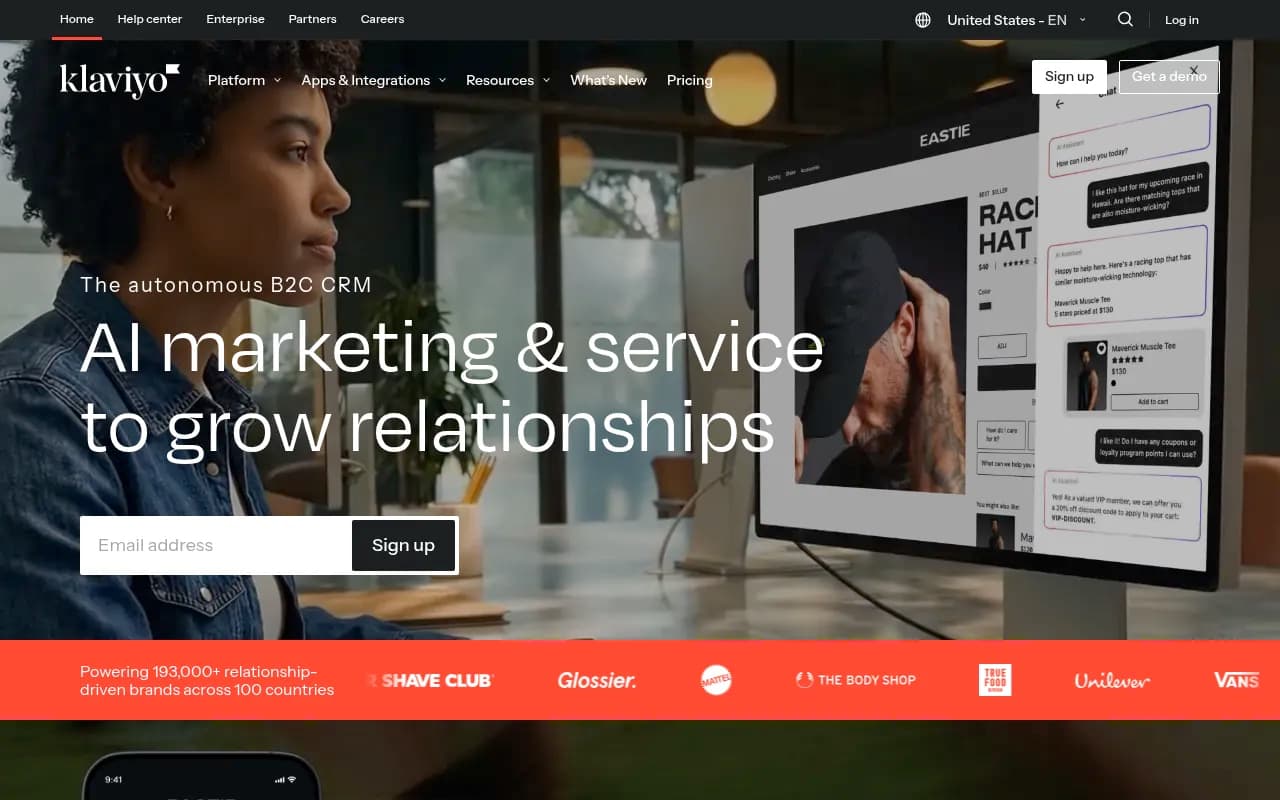
Klaviyo is the dominant email and SMS platform for e-commerce, and it's worth considering seriously as a Glowtify alternative if email and SMS are your highest-ROI channels. It powers 193,000+ brands and has deep integrations with Shopify, WooCommerce, and most major e-commerce platforms.
The core strength is data. Klaviyo's real-time CDP unifies customer behavior, purchase history, and engagement data to power segmentation and personalization that most tools can't match. Its AI features — including the Composer agent that builds campaigns from a prompt, and the Marketing Agent that sets up flows from your URL — are genuinely useful, not just marketing copy.
Compared to Glowtify, Klaviyo wins on email and SMS depth by a wide margin. The automation builder is more sophisticated, the segmentation is more granular, and the predictive analytics (predicted LTV, churn risk, next order date) are features Glowtify doesn't have. What Klaviyo doesn't do is help you plan social content, write blog posts, or manage a multi-channel content calendar. It's a CRM and messaging platform, not a marketing OS.
Pricing starts free for up to 250 profiles, then scales based on contact count from around $20/month. For most e-commerce brands, Klaviyo will be significantly cheaper than Glowtify while being more capable on the specific channels that drive e-commerce revenue.
Best for: E-commerce brands where email and SMS are primary revenue drivers, who want deep customer data, sophisticated automation, and AI-assisted campaign creation without paying for features outside those channels.
Madgicx

Madgicx is a specialized platform for Meta (Facebook and Instagram) ads, and it's worth considering if paid social is a significant part of your marketing mix. Glowtify covers paid ads as part of its multi-channel approach, but it's not a dedicated paid social tool.
What Madgicx does that Glowtify doesn't: autonomous campaign optimization, AI bid management, creative performance analysis, and an "AI Marketer" that audits your ad account and tells you exactly what to change. For brands spending $10K+ monthly on Meta ads, having a tool that actively manages and optimizes that spend is genuinely valuable.
The limitation is obvious — Madgicx is Meta-only. It doesn't help with email, social organic, blog content, or campaign strategy beyond paid social. It's a specialist tool, not a generalist one.
Pricing starts at $49/month with a free trial, scaling based on ad spend. For brands with meaningful Meta budgets, the ROI math on a dedicated optimization tool tends to work out.
Best for: DTC brands and agencies running significant Meta ad budgets who want autonomous optimization rather than manual campaign management.
Triple Whale
Triple Whale is an e-commerce intelligence platform focused on attribution, analytics, and data unification. It's not a content creation or campaign planning tool — it's the answer to "where is my revenue actually coming from?"
The core product is Triple Pixel, a first-party attribution solution that tracks customer journeys across channels more accurately than Meta or Google's native attribution. Moby AI, Triple Whale's AI layer, turns that data into actionable insights and can automate certain optimizations. The platform also has creative analytics that show which ad creatives are actually driving revenue.
Compared to Glowtify, Triple Whale is complementary rather than competitive on most dimensions. Glowtify helps you create and execute marketing; Triple Whale helps you understand what's working. Many brands would benefit from both. But if you're choosing between them, Triple Whale makes more sense for brands where attribution accuracy and data-driven decision-making are the primary pain points.
Pricing starts free, with paid plans from around $549/month based on GMV. That's comparable to Glowtify's pricing, but for a very different type of value.
Best for: DTC brands that have a marketing execution stack in place and need better attribution, analytics, and a single source of truth for performance data.
Needle
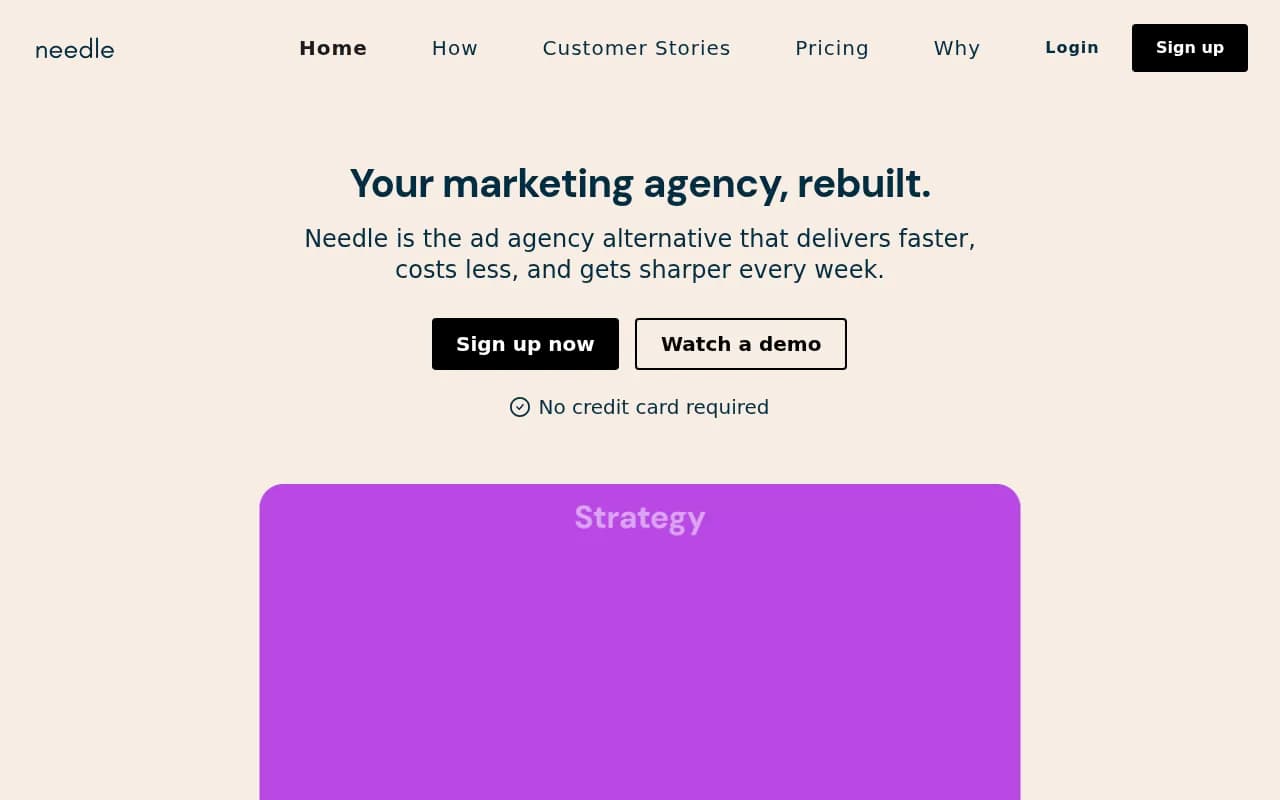
Needle is the most unusual option on this list. It's not a self-serve software platform — it's a hybrid AI-plus-human service that positions itself as an agency alternative for DTC brands doing $1M–$10M in annual revenue.
The model is interesting: Needle's AI analyzes your brand, creates a marketing calendar, generates creatives, and sets up campaigns. Human strategists review and refine everything before it goes live. You approve, they launch. The pitch is agency-quality output at roughly a third of the cost of a traditional agency.
Compared to Glowtify, Needle is more hands-off. You're not logging into a platform and building campaigns yourself — you're approving work that a combination of AI and humans has prepared for you. That's genuinely appealing for founders who don't want to become marketing operators, but it means less control and less flexibility than a self-serve tool.
Pricing is per-creative ($50–$100/image, $200–$500/video) with rolling monthly plans. The total cost depends heavily on volume, but the "1/3 of agency cost" positioning suggests it's aimed at brands currently spending $3K–$10K/month on agency fees.
Best for: DTC founders who want marketing done for them rather than a tool to do it themselves, and who are currently paying agency fees they'd like to reduce.
Which alternative should you pick?
The right choice depends almost entirely on what you're actually trying to solve:
If you want a true Glowtify replacement — one workspace for strategy, content, and multi-channel execution — the honest answer is that nothing on this list does exactly what Glowtify does at the same price point. HubSpot comes closest in terms of breadth, but it's more expensive at the tiers where it's genuinely powerful.
If email and SMS are your primary channels, Klaviyo is the strongest choice for most e-commerce brands. It's deeper on those channels than Glowtify and cheaper for most list sizes.
If you want to reduce tool complexity and get marketing done without managing it yourself, Needle is worth a look — especially if you're currently paying an agency.
If content creation and brand consistency at scale are the priority, Jasper is more mature than Glowtify for enterprise teams.
If social scheduling is all you need, Buffer is the obvious low-cost option.
If paid social is your growth engine, Madgicx for Meta ads or Triple Whale for attribution will serve you better than a generalist platform.
One gap none of these tools address: how your brand appears when someone asks ChatGPT, Perplexity, or Gemini for a product recommendation in your category. As AI search becomes a real traffic and revenue channel, tracking and optimizing that visibility is worth adding to your stack. Promptwatch is built specifically for that.