Klaviyo Review 2026
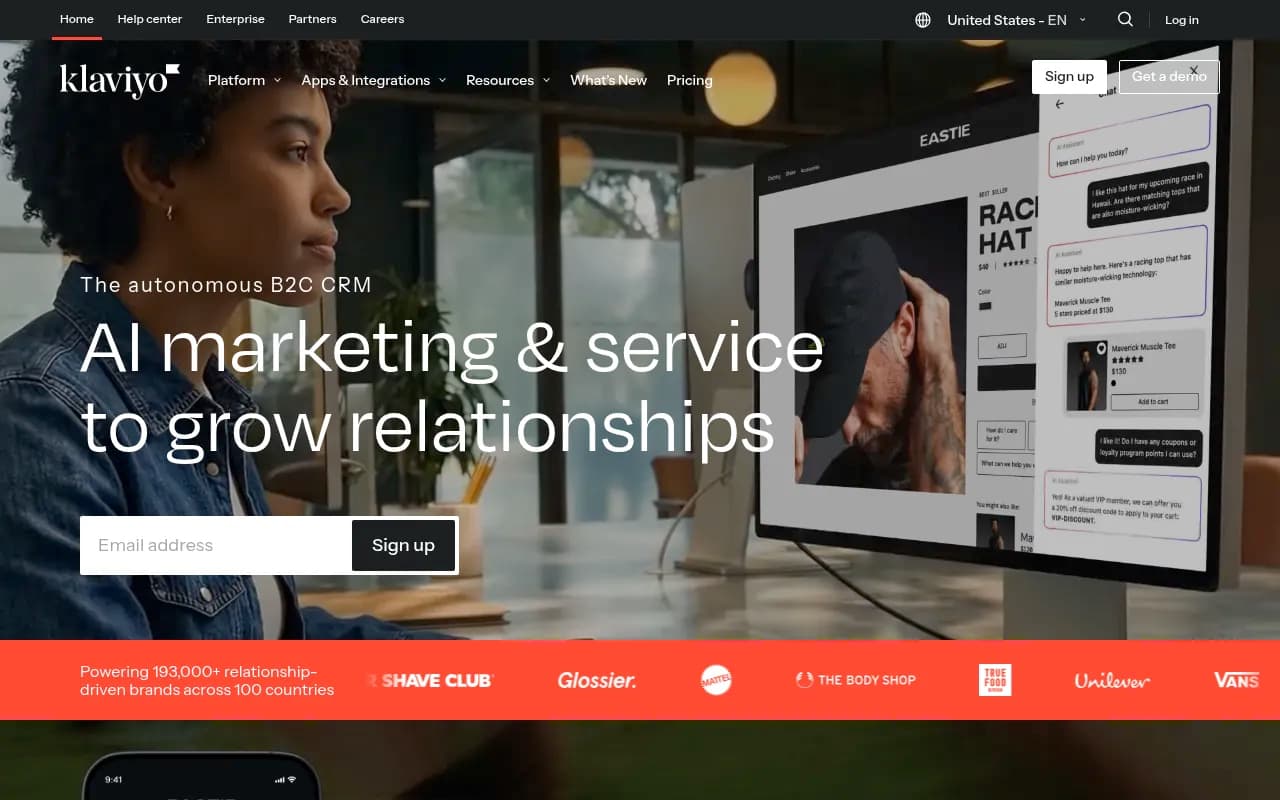
Klaviyo is an AI-powered B2C CRM used by 193,000+ brands, unifying email, SMS, WhatsApp, and mobile push with a real-time CDP. Features autonomous AI agents for campaign creation, customer service, and omnichannel personalization.
Key takeaways
- Klaviyo is one of the most complete B2C marketing platforms available in 2026, combining email, SMS, WhatsApp, mobile push, and a built-in CDP under one roof
- The AI layer (K:AI Agents, Composer, Marketing Agent, Customer Agent) has matured significantly and now handles real campaign creation, not just subject line suggestions
- Pricing scales with contact list size, which means costs can climb fast for high-volume senders -- worth modeling before committing
- The Shopify integration is best-in-class; brands on other platforms get a solid but slightly less seamless experience
- Not the right fit for B2B companies, pure SaaS, or anyone who doesn't need omnichannel consumer marketing
Klaviyo started as an email marketing tool for Shopify stores and has spent the last decade quietly becoming something much bigger. Today it calls itself the "autonomous B2C CRM" -- a description that would have sounded like marketing fluff a few years ago but is now reasonably accurate. The platform covers email, SMS, WhatsApp, RCS, mobile push, reviews, social, a full customer data platform, a helpdesk, and a growing suite of AI agents. It's used by 193,000+ brands across 100 countries, from small DTC startups to Unilever, Vans, and Mattel.
The target audience is B2C brands that sell online -- primarily ecommerce, but also fitness studios, food and beverage, beauty, and any consumer brand that needs to manage relationships at scale. Klaviyo's sweet spot has historically been mid-market Shopify merchants doing $1M-$50M in revenue, but the platform has pushed hard into enterprise territory over the past two years, adding warehouse syncs, advanced CDP features, dedicated CSMs, and SLA-backed uptime. The result is a platform that works for a scrappy 5-person DTC brand and a 500-person global retailer, though the experience at each end of that spectrum is quite different.
Klaviyo went public on the Nasdaq in September 2023 at a valuation of around $9 billion. It was one of the more closely watched SaaS IPOs of that year, partly because it had grown almost entirely through product-led growth and a tight partnership with Shopify (which owns a small stake). Since the IPO, the company has accelerated its AI roadmap significantly, launching autonomous agents and a new Composer feature that generates full campaigns from a single prompt.
Key features
Composer and the K:AI agent suite
Composer is Klaviyo's flagship AI feature as of 2026. You give it a URL or a brief prompt, and it generates a complete, on-brand email campaign -- copy, layout, images, and all. It learns from your existing brand assets and past campaigns, so the output isn't generic. In practice, it's genuinely useful for getting a first draft out fast, though you'll still want a human to review tone and offers before sending. The broader K:AI suite includes:
- Marketing Agent: Scans your website on first setup and builds initial flows, forms, and campaigns automatically. Useful for new accounts that would otherwise spend days on configuration.
- Customer Agent: An AI support agent that resolves roughly 65% of customer questions autonomously, according to Klaviyo's own data. Because it has access to the full customer profile (order history, browsing behavior, past interactions), it can also make product recommendations and upsell -- not just answer "where's my order."
- Remix: Repurposes existing campaign content across channels and formats.
- MCP Server: Lets developers build agentic workflows using Klaviyo's data and actions via the Model Context Protocol.
Email marketing
The email builder is drag-and-drop with a library of pre-built templates. More importantly, it supports dynamic content blocks that change based on customer data -- so a single email template can show different products, copy, or offers to different segments. Conditional splits, A/B testing, and send-time optimization are all built in. The deliverability infrastructure is solid; Klaviyo manages dedicated IP pools for high-volume senders and provides deliverability guidance within the platform.
SMS and RCS marketing
SMS is a first-class channel in Klaviyo, not an afterthought. You can build flows that mix email and SMS steps, with intelligent channel selection based on customer preferences and engagement history. RCS for Business (Google's richer SMS format) is now supported, allowing branded messages with images, carousels, and action buttons on Android. Compliance tools for TCPA and GDPR are built in, including consent management and quiet hours.
Segmentation and the Klaviyo Data Platform (KDP)
This is where Klaviyo genuinely separates itself from simpler email tools. The segmentation engine lets you build audiences based on any combination of behavioral, transactional, and engagement data -- in real time. Someone adds a product to their cart? They can enter a flow within seconds. The KDP unifies data from all connected sources into a single customer profile, and the Advanced KDP tier adds data warehouse syncs (Snowflake, BigQuery, Redshift), custom objects, and higher API rate limits. With 8 billion customer profiles and 3.7 billion events processed daily, the infrastructure is clearly built for scale.
Flows (marketing automation)
Flows are Klaviyo's automation sequences. The library of pre-built flows covers the standard playbook: welcome series, abandoned cart, browse abandonment, post-purchase, win-back, sunset. Each flow supports conditional splits, time delays, A/B tests, and cross-channel steps. The visual flow builder is one of the cleaner ones in the market -- not as flexible as something like Braze for complex enterprise logic, but significantly easier to use. For most ecommerce brands, the pre-built flows alone are worth the subscription.
Analytics and benchmarks
Klaviyo's analytics dashboard shows attributed revenue, campaign performance, flow performance, and list growth over time. The Benchmarks feature is genuinely useful: it compares your open rates, click rates, and revenue per recipient against anonymized data from similar brands (by industry and revenue tier). This gives you a realistic sense of whether your 22% open rate is good or mediocre for your category. The attribution model is configurable (1-day, 5-day, or custom windows), which matters a lot when you're trying to understand true email-driven revenue.
Reviews and social
Klaviyo added a native reviews product that collects and displays product reviews, integrating them into post-purchase flows. It's not as feature-rich as dedicated review platforms like Yotpo or Okendo, but for brands that want to consolidate tools, it works. Social marketing covers Facebook and Instagram audience syncing, TikTok integration, and the ability to use Klaviyo segments as custom audiences for paid social campaigns.
Customer Hub and Helpdesk
The service side of the platform is newer but growing fast. Customer Hub is a self-service portal where customers can track orders, manage subscriptions, and handle returns without contacting support. ThirdLove completed 40,000+ self-service interactions through Customer Hub in 2025. The Helpdesk is a shared inbox for support teams, with full customer profile context visible alongside every ticket.
Who is it for
Klaviyo's primary user is a DTC or ecommerce brand with a meaningful email and SMS list -- say, 10,000+ contacts -- that wants to move beyond basic batch-and-blast campaigns. Think a skincare brand doing $5M/year on Shopify that's ready to invest in proper lifecycle marketing: welcome flows, abandoned cart sequences, VIP segments, post-purchase upsells. At this stage, Klaviyo's combination of real-time data, flexible segmentation, and pre-built flows delivers clear ROI. The case studies on their site (Tatcha, Princess Polly, Daily Harvest) are representative of this core audience.
For larger brands -- $50M+ in revenue, multiple markets, complex tech stacks -- Klaviyo has become a credible alternative to enterprise platforms like Salesforce Marketing Cloud or Adobe Campaign. The Advanced KDP, warehouse syncs, and dedicated support make it viable. Dollar Shave Club reported 30% lower total cost of ownership after consolidating onto Klaviyo, which is the kind of number that gets CFOs interested. The trade-off is that Klaviyo's enterprise features are still maturing; brands with very complex data models or highly customized journey logic may hit limitations.
Who should not use Klaviyo: B2B SaaS companies, professional services firms, or anyone whose primary marketing motion is lead nurturing rather than consumer retention. Klaviyo's data model, pricing, and feature set are built around consumer transactions. Tools like HubSpot, ActiveCampaign, or Marketo are better fits for B2B. Similarly, very small businesses sending fewer than 500 emails per month can use the free tier, but the platform's complexity is overkill -- Mailchimp or ConvertKit would serve them better.
Integrations and ecosystem
Klaviyo has 350+ pre-built integrations, and the quality of the most important ones is high.
- Shopify: The deepest integration in the ecosystem. Real-time sync of orders, products, customers, and events. Shopify's checkout data flows directly into Klaviyo profiles, enabling abandoned checkout flows that fire within minutes.
- WooCommerce, BigCommerce, Magento/Adobe Commerce: Solid integrations, though the real-time sync isn't quite as seamless as Shopify.
- Salesforce Commerce Cloud: Available for enterprise brands running on SFCC.
- Meta (Facebook/Instagram): Audience syncing for paid social retargeting and lookalike audiences.
- TikTok: Custom audience syncing for TikTok ads.
- OpenAI and Anthropic Claude: Native AI integrations that power some of the K:AI features and allow custom agentic workflows.
- Square, Mindbody: For brick-and-mortar and fitness brands that need to connect in-person transaction data.
- Data warehouses: Snowflake, BigQuery, Redshift via Advanced KDP.
The Klaviyo API is well-documented and actively maintained. There's a GitHub organization (github.com/klaviyo) with SDKs for Python, Ruby, PHP, Node.js, Go, and Java. The MCP Server is a newer addition that lets developers build AI-powered workflows using Klaviyo as a data and action layer. Webhooks are available for real-time event streaming to external systems.
There's no dedicated mobile app for marketers to manage campaigns on the go, which is a minor gap. The platform is web-based and mobile-responsive but not optimized for phone use.
Pricing and value
Klaviyo's pricing is contact-based for email and usage-based for SMS, which is standard in the industry but can get expensive as lists grow.
- Free: Up to 250 active profiles, 500 email sends/month, 150 free SMS/MMS credits. Core features included. Good for testing the platform.
- Email plans: Start around $20/month for up to 500 contacts and scale up from there. At 10,000 contacts, you're looking at roughly $150/month. At 50,000 contacts, around $700/month. At 100,000 contacts, pricing is in the $1,200-$1,500/month range.
- Email + SMS plans: Add SMS credits on top of the email plan. SMS pricing varies by country and volume.
- Advanced KDP: Additional cost on top of base plans, for warehouse syncs and advanced data features.
- Enterprise: Custom pricing with dedicated CSM, SLAs, and advanced security features.
Compared to Mailchimp, Klaviyo is more expensive at equivalent contact counts but offers significantly more functionality -- real-time segmentation, better flows, and the CDP layer justify the premium for most ecommerce brands. Compared to Braze or Salesforce Marketing Cloud, Klaviyo is considerably cheaper and faster to implement, though it has less flexibility for very complex enterprise use cases. The value proposition is strongest for ecommerce brands in the $1M-$100M revenue range where the platform's ecommerce-specific features translate directly to measurable revenue lift.
Annual billing offers a discount over monthly, and Klaviyo regularly runs promotions for new accounts.
Strengths and limitations
What Klaviyo does exceptionally well:
- Ecommerce data integration: The depth of Shopify integration and the real-time event processing is genuinely best-in-class. No other platform makes it this easy to turn purchase behavior into personalized flows.
- Segmentation power: The ability to build and update segments in real time, based on any combination of behavioral and transactional data, is a major differentiator. Competitors like Mailchimp and Constant Contact are years behind here.
- Pre-built flow library: The quality and coverage of pre-built automation flows means a new account can have a solid lifecycle marketing program running within a day or two.
- AI agents that actually work: Composer and Customer Agent are not just demos -- they handle real workloads. The Customer Agent's 65% autonomous resolution rate is a meaningful number for brands with high support volume.
- Unified platform consolidation: Replacing separate tools for email, SMS, reviews, helpdesk, and CDP with one platform genuinely reduces complexity and cost, as the Dollar Shave Club case study illustrates.
Honest limitations:
- Cost at scale: The contact-based pricing model means costs compound quickly as lists grow. A brand with 500,000 contacts is paying serious money, and the value calculation becomes less clear if you're not actively monetizing the full list.
- B2B and non-ecommerce use cases: The platform is built for consumer transactions. If your business model doesn't involve repeat purchases and a product catalog, you'll be fighting the data model rather than working with it.
- Enterprise flexibility: For very large brands with complex data architectures or highly customized journey logic, Braze or Adobe Campaign still offer more flexibility. Klaviyo's enterprise features are solid but the platform's opinionated structure can be limiting at the extreme high end.
- No native landing page builder: Unlike HubSpot or ActiveCampaign, Klaviyo doesn't include a landing page builder. You'll need a separate tool for that.
Bottom line
Klaviyo is the default choice for ecommerce and DTC brands that take email and SMS marketing seriously. If you're on Shopify and doing more than $500K/year in revenue, the question isn't really whether to use Klaviyo -- it's whether you're using it well. The platform's combination of real-time data, flexible segmentation, pre-built flows, and now genuinely capable AI agents makes it the most complete B2C marketing platform available at its price point.
For brands evaluating it in 2026, the AI additions (Composer, Marketing Agent, Customer Agent) are worth taking seriously -- they've moved past the gimmick stage. The best use case in one sentence: Klaviyo is the platform for consumer brands that want to turn customer data into personalized, automated revenue without stitching together five different tools.
Frequently asked questions
What is Klaviyo?
Is there a free plan for Klaviyo?
How much does Klaviyo cost?
What ecommerce platforms does Klaviyo integrate with?
How does Klaviyo compare to Mailchimp?
Who should NOT use Klaviyo?
Similar and alternative tools to Klaviyo