Key takeaways
- Unbounce is the closest like-for-like alternative to HubSpot Landing Pages if conversion optimization is your main goal -- Smart Traffic AI, A/B testing, and a solid template library, starting around $74/mo.
- Leadpages is the budget pick for small teams who need a dedicated landing page builder without paying HubSpot's steep Professional tier prices.
- Instapage is worth the premium ($99/mo+) if you're running paid ad campaigns and need real-time team collaboration and deep personalization.
- Webflow is the right call if design control matters more than out-of-the-box conversion features -- but expect a steeper learning curve.
- EngageBay is the most direct HubSpot replacement if you want the full CRM + landing pages + email automation stack at a fraction of the cost.
- Carrd is almost absurdly cheap ($9/year) for simple one-page landing pages, but it's not a serious CRO tool.
HubSpot Landing Pages is genuinely good. The drag-and-drop editor is clean, the CRM personalization is hard to beat, and the free tier gives you a real working product. So why are people looking for alternatives?
Usually it comes down to one of three things: price, scope, or lock-in.
The free tier is limited -- you get basic pages but no A/B testing, no smart content, and no real analytics without upgrading. Content Hub Professional jumps to $500/month, which is a lot to swallow just for landing pages. Then there's the scope problem: HubSpot is a full marketing platform, and if you're already using another CRM or email tool, you're paying for a lot of features you'll never touch. And once you're deep in the HubSpot ecosystem, switching anything becomes painful.
If any of that sounds familiar, here are the best alternatives worth considering in 2026.
The alternatives
Unbounce

Unbounce is probably the most direct competitor to HubSpot Landing Pages as a standalone tool. It's built specifically for landing pages and conversion rate optimization -- not as part of a larger marketing suite, but as the whole product.
The drag-and-drop builder is flexible and fast. You get 100+ conversion-focused templates, dynamic text replacement (useful for matching landing page copy to search ad keywords), and A/B testing without needing a developer. The standout feature is Smart Traffic -- an AI system that analyzes visitor attributes and automatically routes them to the page variant they're most likely to convert on. HubSpot has A/B testing, but it doesn't have anything quite like Smart Traffic's automated optimization.
Where Unbounce falls short compared to HubSpot: there's no built-in CRM, so you're relying on integrations with Salesforce, HubSpot, Mailchimp, etc. If CRM-driven personalization (showing different content based on a contact's lifecycle stage) is important to you, Unbounce can't replicate that natively. You also don't get the broader content management features that come with HubSpot's Content Hub.
Pricing starts around $74/month after the 14-day trial, which is more expensive than HubSpot's free tier but dramatically cheaper than Content Hub Professional at $500/month.
Best for: Marketing teams and agencies who want a dedicated, conversion-focused landing page tool and are already using a separate CRM.
Leadpages

Leadpages has been around long enough to have figured out what small businesses actually need from a landing page builder: something fast, affordable, and that doesn't require a marketing degree to operate.
The builder is straightforward. You pick a template, customize it, connect your email tool or CRM, and publish. A/B testing is included on paid plans. There's also a lead magnet delivery system built in, which is genuinely useful if you're running content-based lead gen campaigns. Pop-ups and alert bars are included, so you're not paying extra for those.
Compared to HubSpot, Leadpages is much simpler -- intentionally so. You won't get CRM personalization, smart content based on lifecycle stage, or the kind of deep analytics HubSpot provides. The AI copywriting features are basic compared to HubSpot's Breeze integration. But if you're a small team that just needs to spin up landing pages quickly and capture leads into an email list, Leadpages does that job well and cheaply.
Pricing starts at $37/month with a 14-day free trial. That's significantly less than HubSpot's paid tiers for comparable functionality.
Best for: Small businesses, solopreneurs, and coaches who need a simple, affordable landing page builder and don't need deep CRM integration.
Instapage

Instapage positions itself at the enterprise end of the landing page market, and the feature set backs that up. The real-time collaboration tools are genuinely impressive -- multiple team members can leave comments and make edits on a live page, which is useful when you have designers, copywriters, and account managers all touching the same campaign.
The personalization features are strong. You can create multiple page variants and serve different versions to different audience segments based on ad source, location, or custom parameters. AdMap is a unique feature that visually maps your ad campaigns to specific landing pages, making it easier to maintain message match across large paid campaigns.
Heatmaps and conversion analytics are built in, which HubSpot doesn't include natively (you'd need to integrate a third-party tool like Hotjar). The A/B testing is solid.
Where Instapage loses to HubSpot: there's no CRM, no email marketing, and no broader content management. It's a landing page tool, full stop. And at $99/month starting price, it's not cheap for what is essentially a single-purpose tool. HubSpot's free tier actually beats Instapage on price for basic use cases.
Pricing: 14-day free trial, then from $99/month.
Best for: Performance marketing teams running high-volume paid campaigns who need collaboration tools, heatmaps, and serious personalization without a full marketing platform.
Landingi

Landingi doesn't get as much attention as Unbounce or Leadpages, but it's a solid option that often gets overlooked. The platform has 300+ templates, a clean drag-and-drop editor, and a feature called EventTracker that logs micro-conversions -- things like button clicks, scroll depth, and form interactions -- without needing to set up Google Tag Manager manually. That's a genuinely useful feature for teams who want conversion data without a technical setup.
A/B testing is available, and the platform supports pop-ups, lightboxes, and sticky bars alongside standard landing pages. The AI assistant helps with copy generation, though it's not as capable as HubSpot's Breeze integration.
Compared to HubSpot, Landingi is a simpler, cheaper tool with no CRM and no native email marketing. The analytics are decent but not as comprehensive as HubSpot's conversion dashboards. Where it wins is price and ease of use -- you can get a page live faster on Landingi than on HubSpot, especially if you're not already in the HubSpot ecosystem.
Pricing starts at $29/month with a 14-day free trial.
Best for: Digital marketers and small agencies who want a budget-friendly landing page builder with better-than-average conversion tracking built in.
ActiveCampaign
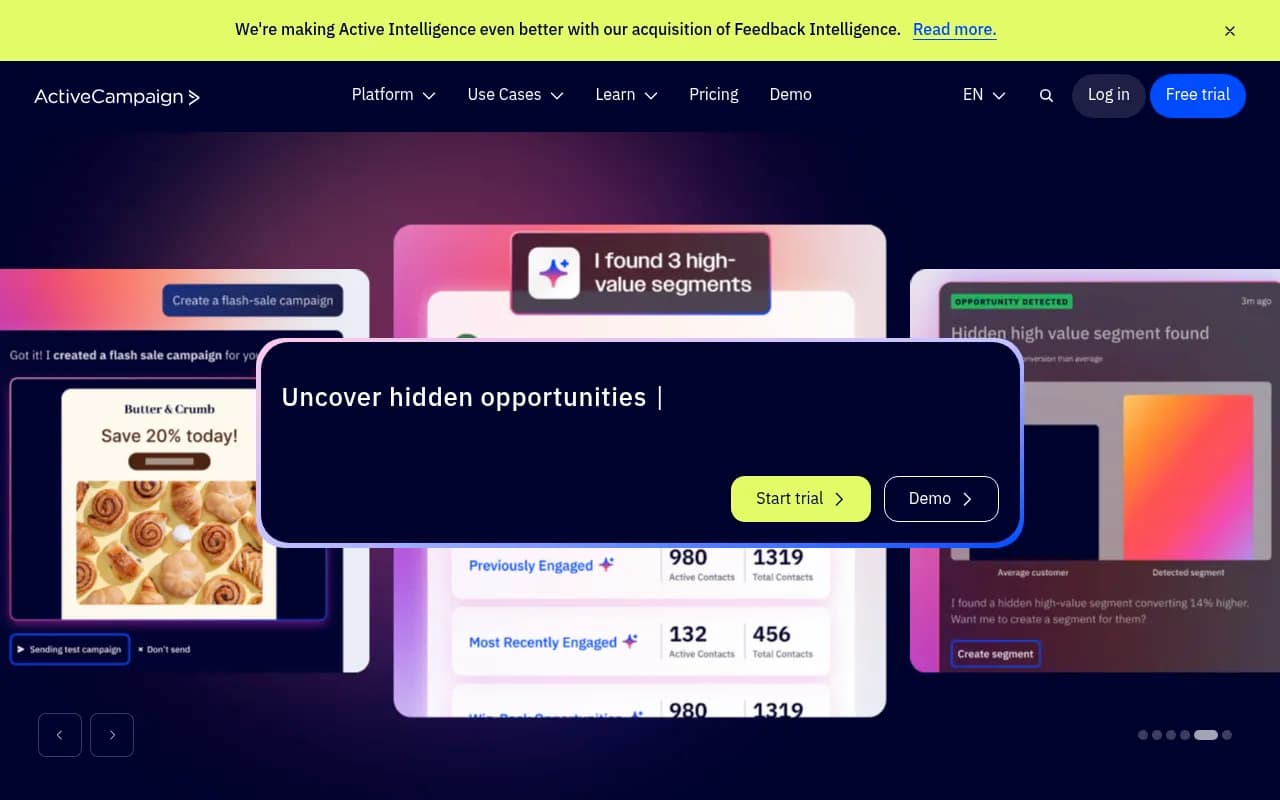
ActiveCampaign is primarily an email marketing and automation platform, but it includes landing page functionality and is worth considering if you're looking to replace HubSpot's broader marketing stack rather than just the landing page builder.
The automation capabilities are where ActiveCampaign genuinely beats HubSpot at comparable price points. The workflow builder is more flexible and the segmentation options are more granular. If you're running complex email sequences triggered by landing page conversions, ActiveCampaign handles that better than HubSpot's Starter tier.
The landing page builder itself is functional but not the main attraction. It's simpler than Unbounce or Instapage, and the template library is smaller. You won't get Smart Traffic-style AI optimization or heatmaps. But if you're switching from HubSpot because you want better email automation and are willing to accept a simpler page builder, ActiveCampaign is a reasonable trade.
Pricing starts at $15/month (Starter) but realistic plans with the features you'd actually use run $49-$259/month depending on contact count. There's a 14-day free trial.
Best for: Teams who care more about email automation and CRM than landing page design, and want a more affordable alternative to HubSpot's full marketing stack.
Webflow
Webflow is a different kind of tool. It's not really a landing page builder in the traditional sense -- it's a visual web development platform that gives designers and developers full control over HTML, CSS, and JavaScript without writing code directly. The output is cleaner and more flexible than anything you'd build in HubSpot or Unbounce.
For landing pages specifically, Webflow is overkill in some ways and underpowered in others. You can build pixel-perfect pages that look exactly how you want them. The CMS is powerful. Hosting is fast. But there's no built-in A/B testing, no Smart Traffic, no CRM personalization, and no conversion analytics beyond what you integrate yourself. You're essentially building a custom website, not using a conversion-optimized landing page tool.
The learning curve is real. Webflow has a logic that takes time to internalize, and it's not the right tool for a marketer who wants to spin up a campaign page in an afternoon without help from a designer.
Where it makes sense as a HubSpot alternative: if your team has design resources and you want to build a full website (not just landing pages) with complete creative control, Webflow is excellent. Many companies use Webflow for their main site and a dedicated tool like Unbounce for campaign-specific landing pages.
Pricing: Free plan available; paid plans scale based on site needs. Worth checking their current pricing directly.
Best for: Design-led teams who want full creative control over their web presence and are willing to invest time in the platform.
Wix
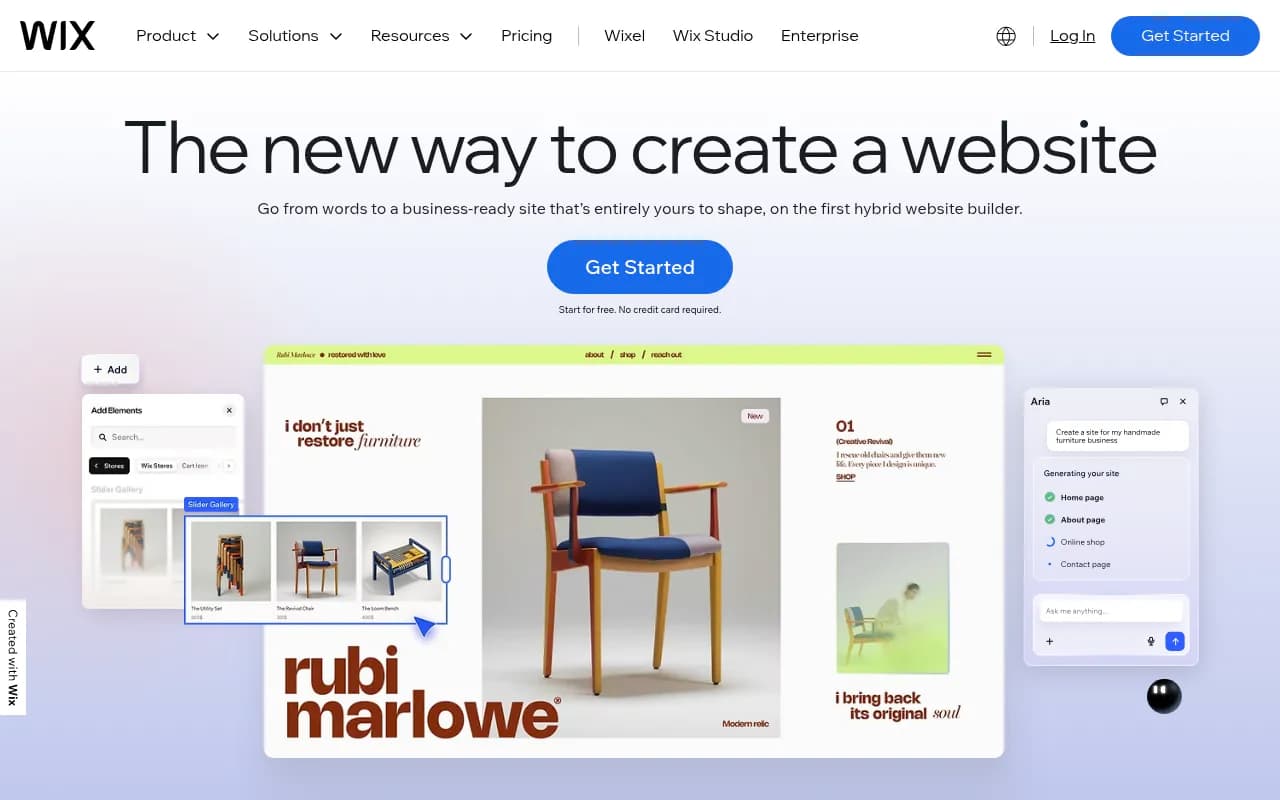
Wix is the most accessible website builder on this list, and it's improved significantly over the past few years. The AI site generator (Aria) can produce a complete website from a text description, which is genuinely impressive for getting something live quickly. There are 2,000+ templates, built-in eCommerce, scheduling tools, and a basic CRM.
For landing pages specifically, Wix works fine. You can create a focused, single-purpose page, connect a form, and capture leads. The editor is easy to use. But Wix isn't optimized for conversion rate optimization the way Unbounce or Instapage are. There's no Smart Traffic, no built-in heatmaps, and A/B testing requires a third-party app or workaround.
Compared to HubSpot, Wix is cheaper and easier to get started with, but it's missing the CRM personalization and conversion analytics that make HubSpot's landing pages genuinely powerful. It's a general-purpose website builder that can do landing pages, not a landing page tool.
Pricing: Free plan available; paid plans from $17/month (Light) to $159/month (Business Elite).
Best for: Small businesses and freelancers who want a simple, affordable way to build a website and landing pages without needing advanced conversion optimization features.
EngageBay
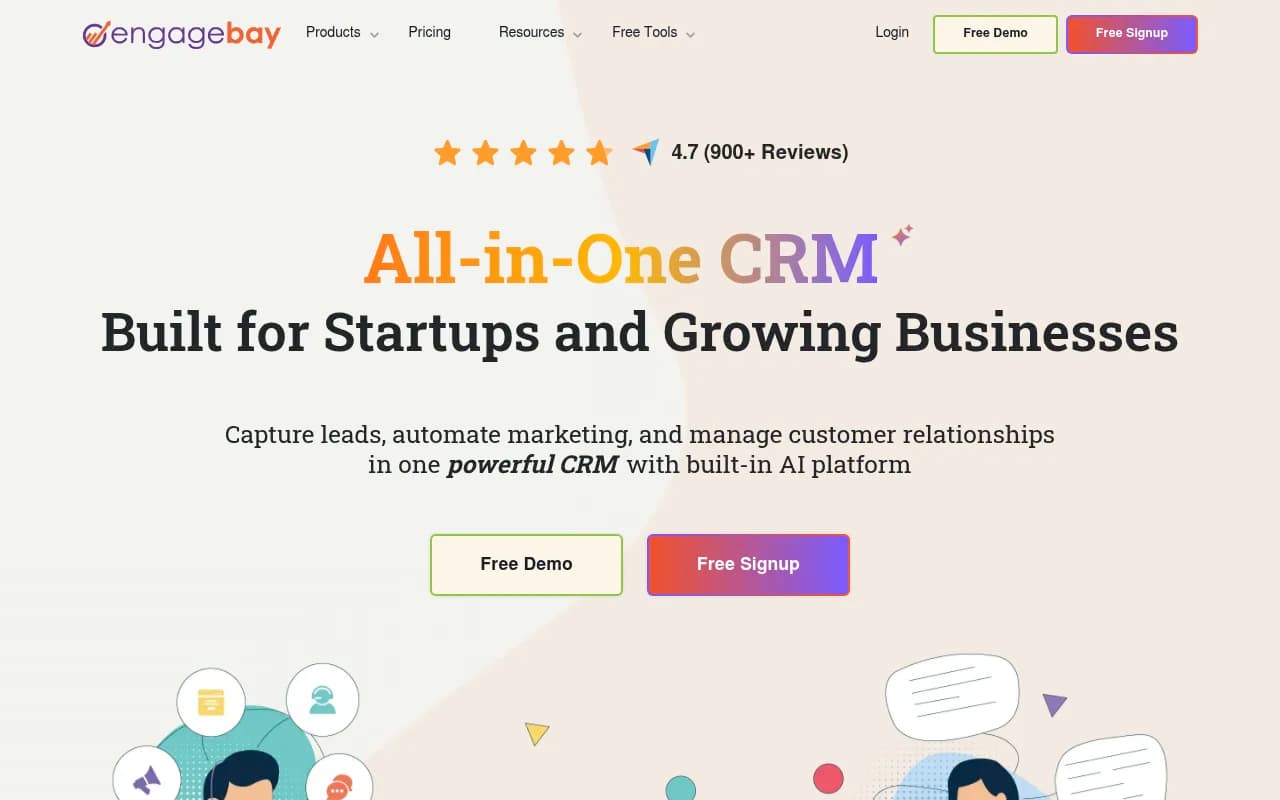
EngageBay is the most direct HubSpot replacement on this list. It's an all-in-one platform covering marketing automation, CRM, sales pipeline, helpdesk, and live chat -- all the things HubSpot does, at a fraction of the price. The free plan supports up to 15 users, which is remarkable.
The landing page builder is included in the marketing module. It's not as polished as HubSpot's, and the template library is smaller, but it covers the basics: drag-and-drop editing, form integration, and basic analytics. A/B testing is available on higher tiers.
Where EngageBay makes a compelling case: if you're a small business currently paying for HubSpot's Starter or Professional tier and feeling the pinch, EngageBay gives you a comparable feature set for dramatically less money. The CRM integration with landing pages works similarly to HubSpot -- contacts captured on a landing page flow directly into your CRM pipeline.
The trade-offs are real though. The UI is less refined than HubSpot's. The ecosystem of integrations is smaller. And if you're a larger team with complex workflows, you may hit limitations faster than you'd expect.
Pricing: Free for up to 15 users; paid plans from $12.74/user/month.
Best for: Small businesses and startups who want the HubSpot experience (CRM + marketing + landing pages) without the HubSpot price tag.
Carrd
Carrd is almost absurdly cheap, and for what it does, it's excellent. The free plan lets you build up to three fully responsive one-page sites. Pro plans start at $9/year -- not per month, per year -- and unlock custom domains, forms, embeds, and Google Analytics.
The obvious limitation: Carrd only does one-page sites. There's no A/B testing, no CRM integration, no conversion analytics beyond Google Analytics, and no AI features. It's a simple tool for simple needs.
But "simple needs" covers more ground than you might think. If you need a quick landing page for a product launch, an event registration, or a lead magnet download, Carrd can handle that in 20 minutes for essentially no money. For solopreneurs, creators, and side projects, it's hard to argue against.
Compared to HubSpot, Carrd isn't really in the same category. HubSpot is a marketing platform; Carrd is a page builder. But if you're on HubSpot's free tier just to get a basic landing page live, Carrd is a simpler and faster option for that specific use case.
Pricing: Free (3 sites); Pro Lite $9/year, Pro Standard $19/year, Pro Plus $49/year.
Best for: Solopreneurs, creators, and anyone who needs a simple, beautiful one-page landing page with zero budget and zero technical complexity.
Which one should you pick?
Here's the honest summary:
If you're leaving HubSpot because it's too expensive and you want a like-for-like landing page tool with strong conversion optimization, Unbounce is the closest match. If price is the main driver and you're a small team, Leadpages or Landingi will cover most of what you need for a lot less money.
If you're running paid campaigns at scale and need collaboration tools and heatmaps, Instapage is worth the premium. If you want to replace HubSpot's entire marketing stack (not just landing pages) without the cost, EngageBay is the most complete alternative.
For design-led teams who want full creative control, Webflow is the answer -- but budget time to learn it. And if you just need something live today for almost nothing, Carrd is genuinely hard to beat.
The one thing none of these tools replicate perfectly is HubSpot's CRM-native personalization -- the ability to show different landing page content based on a contact's lifecycle stage, deal stage, or custom properties. If that feature is central to how you run campaigns, you're either staying on HubSpot or building a custom integration with whatever tool you switch to.