Aomni Review 2026
Uses AI agents to automatically research target accounts and competitors, generating structured briefs and battlecards to prepare sales reps before every call.
Key takeaways
- Aomni automates deep account research for B2B sales reps, pulling from 20+ data sources to generate structured briefs, battlecards, and personalized outreach in minutes rather than hours.
- Trusted by enterprise sales teams at AMD, Oracle, NVIDIA, and Stravito -- with testimonials citing 100% improvement in reply rates and 40% better close rates.
- Pricing starts free (Starter tier), with Pro plans ranging from roughly $100-$300/month depending on the source, and custom Enterprise pricing available.
- Best suited for mid-market and enterprise B2B sales teams doing account-based selling; less useful for high-volume transactional sales or teams without a defined ICP.
- The platform is not a Promptwatch competitor -- it operates in sales intelligence and GTM automation, not AI search visibility or GEO.
Aomni is a sales intelligence platform built around autonomous AI agents that do the research work most sales reps dread. Instead of spending two to three hours digging through LinkedIn, news feeds, annual reports, and company websites before a big call, a rep can hand that job to Aomni and get a structured, actionable brief in minutes. The company raised $4M from Decibel Ventures to build what it calls a "GTM agent army" -- AI agents that work 24/7 to prepare revenue teams for every prospect interaction.
The core problem Aomni is solving is real and well-documented: enterprise sales reps are expected to be consultative and deeply knowledgeable about each account, but the research required to get there is time-consuming and inconsistent. Junior reps skip it. Senior reps do it manually and inconsistently. The result is generic outreach that buyers ignore. Aomni's pitch is that AI agents can do this research at scale, so every rep walks into every call with the same level of preparation that previously only the best reps achieved on their best days.
The company targets B2B revenue teams -- specifically account executives, SDRs, and sales managers at companies doing account-based selling (ABS) or account-based marketing (ABM). Its customer list includes recognizable enterprise names: AMD, Oracle, NVIDIA, Stravito, and WWT. That's a strong signal that the product works at the high end of the market, where deal sizes justify deep pre-call research.
Key features
Autonomous account research agents
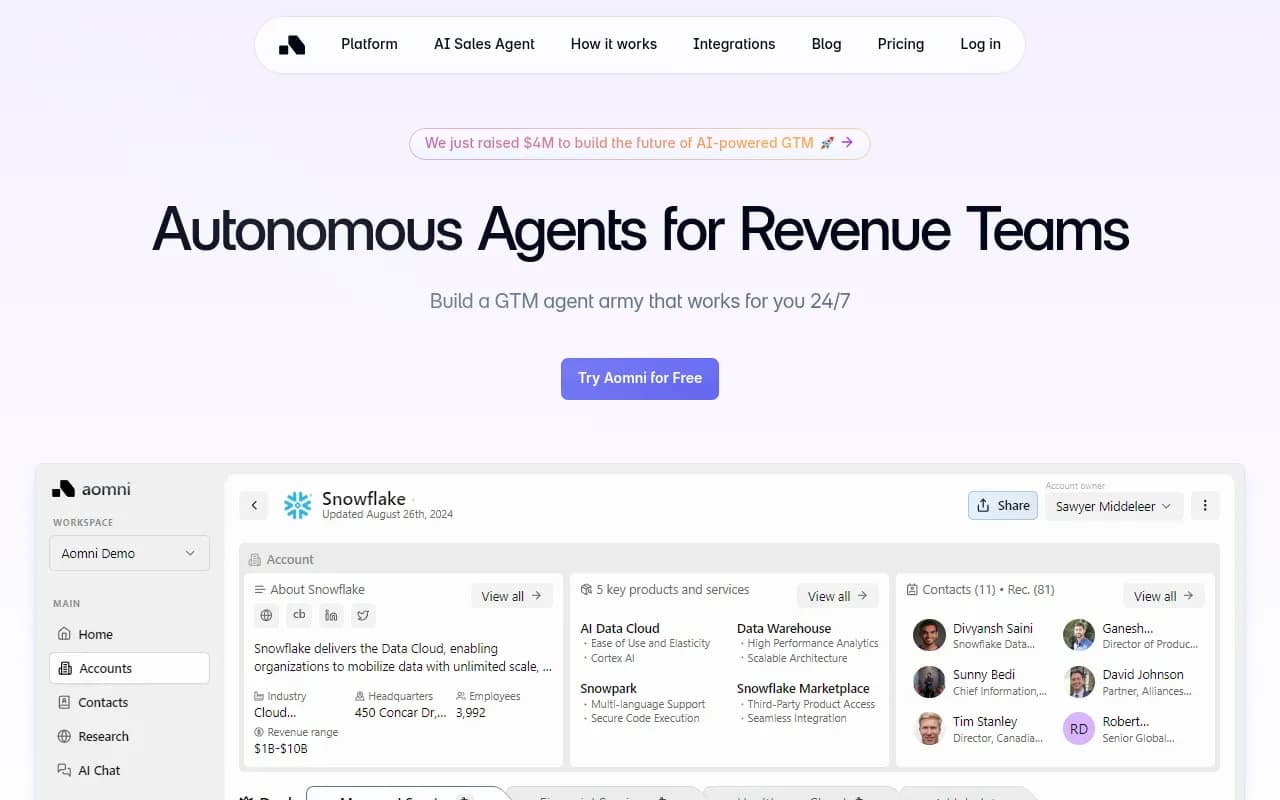
The centerpiece of Aomni is its AI agent that researches a target account end-to-end. You feed it a company name (or connect your CRM), and it pulls from 20+ data sources to build a comprehensive account brief. This includes company financials, recent news, technology stack, hiring signals, executive changes, and competitive positioning. The claim of "1,000+ data points per account" sounds like marketing hyperbole, but the testimonials from AMD and Oracle reps suggest the depth is genuinely useful for enterprise selling. The agent doesn't just aggregate -- it synthesizes, connecting the dots between what the prospect cares about and what your solution offers.
ICP and company knowledge training
Before Aomni can generate useful output, you train it on your company: your ideal customer profile, your differentiators, your competitive positioning, and your sales playbook. This is what separates Aomni from generic research tools. Once trained, the AI knows to frame every account brief through the lens of your specific solution. A rep at a cloud security company gets a different brief on the same prospect than a rep at a data analytics firm would. This customization layer is where the real value lives.
Waterfall contact enrichment
Finding the right decision-maker and getting their contact info is one of the most friction-heavy parts of prospecting. Aomni aggregates 20+ enrichment sources in a waterfall model -- meaning it tries source after source until it finds a verified email or phone number. This is a meaningful time-saver compared to manually checking ZoomInfo, Apollo, and LinkedIn Sales Navigator separately. The platform also builds stakeholder profiles with social insights, so reps can personalize their approach beyond just job title.
Personalized 1:1 outreach generation
Once the research is done, Aomni generates ready-to-send emails and LinkedIn messages tailored to each prospect. The claim that "your prospects won't know you're using AI" is ambitious, but the 100% improvement in reply rates cited by Ensono's Director of Sales suggests the output is at least significantly better than generic templates. The sequences are built around the account research, so the personalization is grounded in actual intelligence rather than just swapping in a first name and company name.
Competitive battlecards
Aomni generates competitor analysis and battlecards as part of its research workflow. These are particularly useful for reps who need to handle objections when a prospect is evaluating multiple vendors. The battlecards are generated dynamically based on the specific competitive landscape of each account, rather than being static documents that go stale.
CRM and workflow integrations
Aomni connects with Salesforce, HubSpot, and Pipedrive for CRM sync, plus Gmail, Outlook, LinkedIn, and calendar tools for day-to-day workflow. This means research and outreach can happen inside the tools reps already use, rather than requiring a context switch to a separate platform. The CRM integration is particularly important for sales managers who want account intelligence centralized and accessible to the whole team.
Team alignment and ABM scaling
One of the less obvious use cases is cross-functional alignment. Aomni positions itself as a platform for aligning sales, marketing, and customer success around shared account strategies. For companies running ABM programs, this means marketing can see the same account intelligence that sales is using, and customer success can access the history of what was researched and promised during the sales cycle. This is genuinely useful for enterprise accounts where multiple people touch the same relationship.
Custom research workflow builder
Beyond the default account brief template, Aomni lets teams build custom research workflows tailored to their specific sales playbook. If your team always needs to know a prospect's current tech stack, recent funding rounds, and regulatory environment before a call, you can build that into a repeatable workflow. This flexibility is what makes Aomni usable across different industries and sales motions rather than being a one-size-fits-all tool.
Who is it for
The primary user is an enterprise or mid-market B2B account executive who sells complex, high-value deals with long sales cycles. Think an Oracle OCI rep managing 30 strategic accounts, or a cloud security AE trying to break into Fortune 500 companies. For these reps, the cost of walking into a call underprepared is a lost deal worth six figures. Aomni's research depth is overkill for transactional sales but exactly right for consultative selling where credibility and relevance are the deciding factors.
SDR teams running outbound campaigns are another strong fit. The combination of account research, contact enrichment, and personalized sequence generation addresses the three biggest friction points in outbound prospecting. A team of five SDRs using Aomni could realistically cover the research workload that would otherwise require a dedicated research analyst. The 3-hours-saved-per-prospect claim is plausible for enterprise accounts where thorough research genuinely takes that long.
Sales managers and revenue operations leaders at companies with 20-200 person sales teams are the economic buyers. They're the ones who care about consistency -- making sure every rep is as prepared as the best rep, not just the ones who happen to be diligent researchers. Aomni's team alignment features and CRM integration speak directly to this persona.
Who should probably look elsewhere: teams doing high-volume, low-touch sales where the deal size doesn't justify deep research per account. If you're selling a $50/month SaaS product to SMBs and sending 500 emails a day, Aomni's depth is more than you need. Similarly, teams without a defined ICP or sales playbook will struggle to get value from the training step -- the AI is only as good as the context you give it.
Integrations and ecosystem
Aomni's integration list covers the core sales stack:
- CRM: Salesforce, HubSpot, Pipedrive
- Email: Gmail, Outlook
- Social/prospecting: LinkedIn
- Calendar: Standard calendar integration for meeting prep triggers
- Data enrichment: 20+ sources aggregated through waterfall enrichment (specific sources not publicly disclosed)
The platform doesn't appear to have a public API or Zapier integration listed on the main site, which limits custom workflow building for technical teams. For most sales teams, the native integrations will cover the basics, but RevOps teams looking to build custom data pipelines may find this limiting.
There's no mention of a browser extension, which is a gap compared to tools like Apollo or Clay that let reps research prospects inline while browsing LinkedIn. Mobile app support is also not mentioned, which matters less for research-heavy workflows but could be a consideration for reps who prep on the go.
Pricing and value
Pricing information across sources is somewhat inconsistent, which suggests Aomni has been actively adjusting its pricing model:
- Starter: Free. Lets you try the platform with no commitment. Likely limited in the number of accounts or research runs per month.
- Pro: Ranges from $100-$300/month depending on the source. One source (Dimmo) cites $200/month for up to 3 seats with additional seats at $100 each. Another source (Software Finder) cites $300/month. The official site lists $100/month. The discrepancy suggests either recent pricing changes or different feature configurations. Includes unlimited account research, AI sequences, and email/LinkedIn integrations.
- Enterprise: Custom pricing. Designed for larger teams with more complex requirements.
At $100-$200/month for a Pro plan covering multiple seats, Aomni is reasonably priced compared to alternatives like 6sense or Demandbase, which run into thousands per month. For a single AE closing enterprise deals, the ROI math is straightforward: if the tool saves 3 hours per prospect and improves close rates meaningfully, it pays for itself on the first deal it helps close.
The free Starter tier is a genuine differentiator for teams that want to evaluate before committing. Most enterprise sales intelligence tools don't offer free tiers at all.
Strengths and limitations
What Aomni does well:
- The depth of account research is genuinely impressive for enterprise selling. Pulling 1,000+ data points per account and synthesizing them into an actionable brief is a real time-saver for reps who would otherwise do this manually.
- The ICP training layer makes the output relevant rather than generic. This is what separates Aomni from a simple web scraper or research aggregator.
- Customer testimonials from recognizable enterprise names (AMD, Oracle, NVIDIA) carry real weight. These aren't small companies easily impressed by basic automation.
- The waterfall enrichment across 20+ sources for contact data is a practical solution to one of the most annoying parts of prospecting.
- Free tier availability lowers the barrier to evaluation significantly.
Honest limitations:
- Pricing transparency is a problem. Three different sources cite three different Pro plan prices ($100, $200, $300/month). Buyers shouldn't have to triangulate pricing from third-party review sites.
- No public API and limited information about a browser extension means technical teams can't easily build custom workflows on top of the platform.
- The platform is heavily dependent on the quality of the training data you provide. Teams without a well-defined ICP, clear differentiators, and a documented sales playbook will get mediocre output. This isn't a criticism of the technology, but it's a real adoption barrier for earlier-stage companies.
- The competitive battlecard feature, while useful, isn't as deep as dedicated competitive intelligence tools like Klue or Crayon, which have entire platforms built around this use case.
Bottom line
Aomni is a well-executed tool for B2B sales teams that sell complex, high-value deals and need every rep to walk into every call prepared. The combination of deep account research, contact enrichment, and personalized outreach generation addresses real pain points that cost enterprise sales teams deals every week. The free tier makes it easy to evaluate, and the enterprise customer list suggests it delivers at scale.
Best use case in one sentence: enterprise and mid-market B2B sales teams doing account-based selling who want to replace hours of manual research with AI-generated account briefs and personalized outreach sequences.
Frequently asked questions
What is Aomni?
How much does Aomni cost?
What CRM and sales tools does Aomni integrate with?
Who is Aomni best suited for?
How does Aomni get its account research data?
Is there a free trial for Aomni?
Similar and alternative tools to Aomni