Coldreach Review 2026
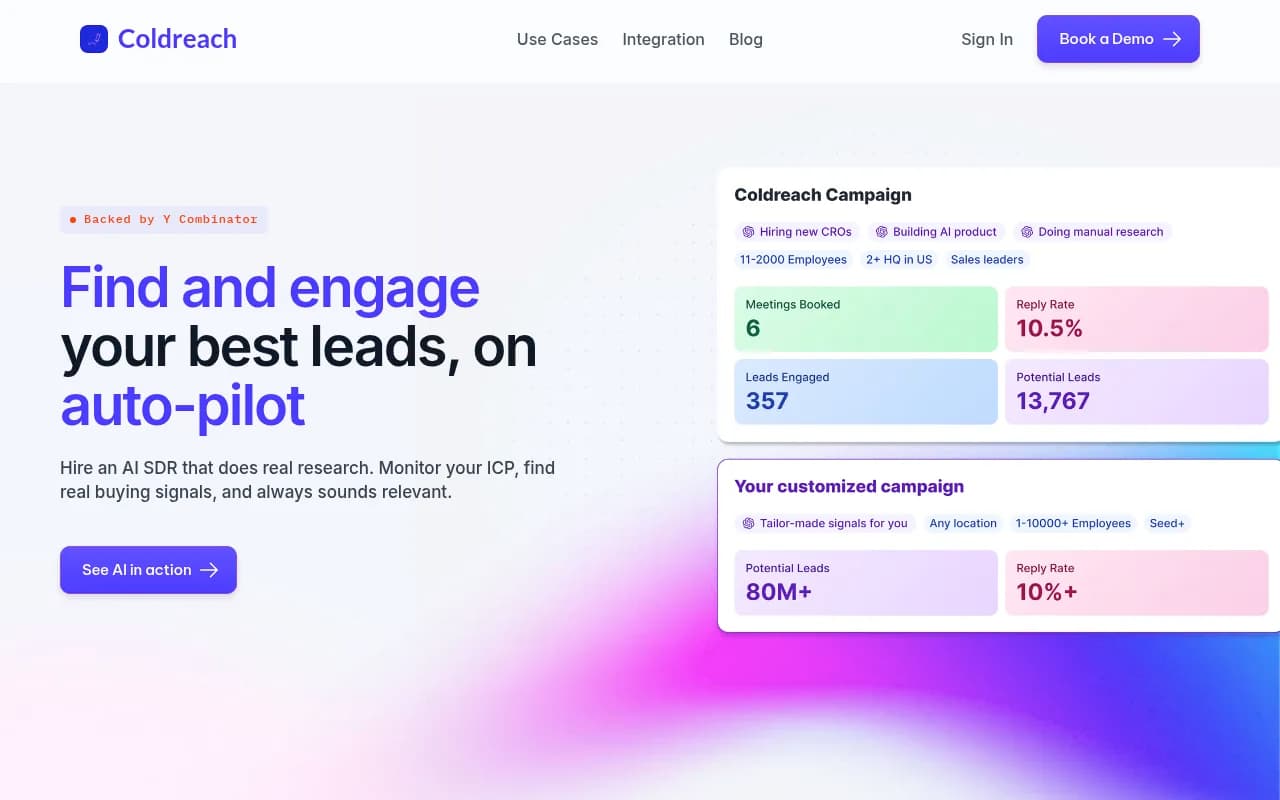
Cold outreach platform that uses AI to surface relevant buying signals and trigger personalized outbound campaigns based on real-time prospect activity.
Key takeaways
- Coldreach is a full-stack AI SDR platform: it handles signal detection, lead research, personalized email/LinkedIn outreach, and deliverability in one tool -- replacing the Clay + Apollo + Instantly stack many teams currently run
- Y Combinator-backed with real customer proof: a claimed 3.8% average reply rate across 500,000+ emails, roughly 10x the industry average of 0.3-0.5%
- Buying signals are fully customizable in plain English -- not locked into preset categories -- across job postings, news, LinkedIn, SEC filings, and company websites
- Pricing starts at $749/month, which is steep for solo reps or early-stage startups but defensible against the cost of a human SDR ($60-80k/year)
- No public pricing page; all plans are demo-gated, which makes it harder to evaluate before committing time to a sales call
Coldreach is an AI-powered sales development platform built for B2B teams that want to run signal-driven outbound at scale without hiring a full SDR team. The company is backed by Y Combinator and positions itself squarely against the fragmented stack most outbound teams currently use: a data provider like Apollo or ZoomInfo, an enrichment layer like Clay, a sequencing tool like Instantly or Outreach, and a human SDR to tie it all together. Coldreach's pitch is that one tool can replace all of that.
The core idea is that cold outreach fails not because of volume, but because of relevance. Generic "Hey [First Name], I noticed you're the VP of Sales at [Company]" emails get ignored. What actually converts is reaching out when a prospect has a real, verifiable reason to care -- a new hire that signals a tech stack shift, a job posting that reveals a pain point, a news event that creates urgency. Coldreach calls these "buying signals," and the platform is built around detecting them, then using them as the foundation for every message it writes.
The company appears to have launched around 2023-2024 and has gained traction with GTM teams at companies including JustiFi (where a VP of Growth reported saving 40 hours/week on account research) and Instawork. Coldreach also claims to book 70% of its own pipeline using its own AI SDR, running roughly 20 qualified meetings per week -- which is either a compelling proof point or a very good marketing story, depending on your level of skepticism.
Key features
Custom buying signal detection
This is the feature that genuinely differentiates Coldreach from most AI SDR tools. Instead of giving you a fixed menu of intent signals (funding rounds, job changes, etc.), Coldreach lets you define signals in plain English. You describe what "intent" looks like for your specific product, and the AI goes looking for it across 97 million accounts.
The examples on the site give a good sense of the range: "Currently hiring 3+ engineers with experience in Next.js," "Faced cybersecurity attacks or data breach in the last 12 months," "Mentions building expense reports in Excel/Spreadsheet in finance job openings in the past 2 years," "Onboarded a Data Engineer in the last 3 months who mentioned Snowflake on their LinkedIn profile." These are not the kind of signals you can set up with a static filter in Apollo. The natural language interface means a sales rep can define a signal without needing a data engineer to build a query.
The platform monitors 5+ data sources: job postings, company news, company websites, LinkedIn posts and employee profiles, and SEC/10-K filings. The 24/7 monitoring means you're not running a one-time list pull -- you're getting a continuously refreshed feed of accounts that match your criteria.
AI-personalized outreach sequences
Once a buying signal is detected, Coldreach uses it as the basis for writing outreach. The AI doesn't just insert the signal as a token ("I saw you're hiring engineers") -- it's supposed to write a message that actually connects the signal to your product's value proposition in a way that sounds human.
The platform supports custom tone instructions, so you can tell it to write like a specific person on your team, avoid certain phrases, or match a particular communication style. This matters because AI-generated outreach has a recognizable cadence that experienced buyers have learned to filter out. The quality of the output here is hard to verify without hands-on testing, but the 3.8% reply rate claim (if accurate) suggests the personalization is working at least for some customer segments.
Email deliverability stack
Coldreach handles the full deliverability infrastructure: dedicated sending domains, automated mailbox warmup (typically 2 weeks for new mailboxes), reputation monitoring, and sending controls. This is a meaningful inclusion because deliverability is where most DIY cold email setups fall apart. Teams using Clay + Instantly often spend significant time managing domain health, warming inboxes, and troubleshooting spam folder issues. Having this built into the platform removes a real operational burden.
LinkedIn outreach
LinkedIn campaigns go live immediately (no warmup required, unlike email). The platform supports LinkedIn as a parallel channel alongside email, which is important for B2B outreach where decision-makers are often more responsive on LinkedIn than in their inbox. The specific mechanics of LinkedIn automation -- whether it uses a browser extension, API, or other method -- aren't detailed publicly, which is worth asking about in a demo given LinkedIn's history of cracking down on automation tools.
Weekly refreshed lead lists
The platform exports a refreshed list of targeted accounts every week, matched against your ICP criteria and buying signal definitions. This is the "campaign" layer -- you're not just getting a one-time list, you're getting a continuously updated pipeline of accounts that have shown relevant signals in the past week. For teams running account-based outbound, this is more useful than a static database pull.
CRM and tech stack integrations
Coldreach integrates with Salesforce, HubSpot, LinkedIn Sales Navigator, Outreach, Salesloft, Apollo, Gong, and Slack. There's also an API for custom integrations. The breadth here is solid -- it covers the major CRM platforms and the most common sales engagement tools, which means you can push signal data and contact records into your existing workflow without rebuilding everything around Coldreach.
ICP monitoring at scale
The platform monitors 97 million accounts in real time against your ICP definition. This is the "always-on" layer that makes Coldreach more like a monitoring system than a one-time list builder. You define your ideal customer profile, set your signal criteria, and the system continuously surfaces new accounts that match as they enter the market or exhibit relevant behavior.
Who is it for
Coldreach is best suited for B2B sales teams that are already running outbound and want to improve reply rates by moving from volume-based to signal-based prospecting. The sweet spot is probably a company with 5-50 salespeople, an established ICP, and a clear sense of what buying signals look like for their product. A VP of Sales or Head of Growth who has already tried generic cold email and found it underwhelming will get the most out of this.
SDR teams at mid-market SaaS companies are an obvious fit. If you're selling a product where timing matters -- HR software, cybersecurity, financial tools, developer infrastructure -- and you can articulate what events indicate a prospect is in-market, Coldreach's custom signal detection is genuinely useful. The Instawork case study (an SDR having the 2nd most qualified demos in a 100+ rep org while making the fewest calls) is the kind of outcome that resonates with sales leaders who are tired of activity metrics.
Agencies and GTM consultants running outbound for multiple clients could also get value here, though the pricing structure (starting at $749/month) means you'd need to be running meaningful volume to justify the cost per client.
Who should probably not use Coldreach: solo founders or early-stage startups doing their first 50 cold outreach attempts. The platform is built for scale, and the pricing reflects that. If you're still figuring out your ICP or testing whether cold outreach works for your business at all, starting with a simpler tool and graduating to Coldreach later makes more sense. Similarly, teams selling to consumers (B2C) won't find much use here -- the signal detection is built around B2B company data.
Integrations and ecosystem
The integration list is genuinely comprehensive for a sales tool at this stage:
- CRM: Salesforce, HubSpot
- Sales engagement: Outreach, Salesloft, Apollo
- LinkedIn: Sales Navigator
- RevOps: Gong
- Notifications: Slack, Email
- Custom: API integration
The Apollo integration is interesting -- Apollo is often positioned as a competitor (it's a contact database), but Coldreach's FAQ explicitly says Apollo doesn't research or write outreach, positioning Coldreach as the layer that sits on top. The Gong integration suggests Coldreach is thinking about the full revenue operations workflow, not just top-of-funnel.
The API availability means technically sophisticated teams can build custom workflows -- pulling signal data into their own systems, triggering outreach based on external events, or connecting to tools not on the native integration list.
No mention of a browser extension or mobile app, which is consistent with Coldreach being a backend automation platform rather than a rep-facing productivity tool.
Pricing and value
Coldreach doesn't publish pricing on its website, which is a friction point for anyone trying to evaluate it without committing to a demo. Based on available information, pricing starts at $749/month and can run to $5,000+/month depending on volume and configuration. Most customers appear to be on quarterly or annual terms rather than month-to-month.
At $749/month, the comparison the company makes is against a human SDR at $60-80k/year in salary alone. If Coldreach can genuinely replace or significantly augment one SDR's output, the math works. The claim that "one AI SDR can match the output of 2-3 human SDRs" is the kind of thing that's hard to verify without running it yourself, but it's the right framing for the buying decision.
There's no free trial mentioned, and the demo-gated pricing means you'll need to talk to sales before you can even see a number. This is a common pattern for tools in this category (Clay, Outreach, and Salesloft all do similar things), but it does create a higher evaluation barrier than tools with self-serve pricing pages.
For comparison: Clay starts at around $149/month but requires significant setup time and a credit system that can get expensive. Apollo's paid plans start much lower but don't include AI research or outreach. Instantly (email sequencing) starts at $37/month but doesn't include signal detection. Coldreach's pricing is higher than any of these individually, but it's replacing all of them -- which is the value proposition.
Strengths and limitations
What Coldreach does well:
- The custom signal definition in plain English is genuinely differentiated. Most intent data tools give you a fixed taxonomy; Coldreach lets you describe what intent looks like for your specific product and goes looking for it. This is a meaningful capability gap versus Apollo, ZoomInfo, or even Clay.
- The all-in-one stack replacement is a real operational benefit. Managing Clay + Apollo + Instantly + a deliverability tool is a part-time job. Having signal detection, research, personalization, sequencing, and deliverability in one platform reduces the coordination overhead significantly.
- The 3.8% average reply rate claim, if accurate, is a strong proof point. The industry average of 0.3-0.5% is well-documented, and a 10x improvement is the kind of outcome that justifies a premium price.
- The 97M account monitoring database and 5+ data source coverage (including SEC filings and 10-K reports) goes deeper than most competitors, which tend to focus on job postings and LinkedIn activity.
Limitations and honest caveats:
- No public pricing is a real friction point. In 2026, buyers expect to be able to evaluate cost before talking to sales. The demo-gated model works for enterprise deals but creates unnecessary friction for mid-market teams.
- LinkedIn automation carries inherent risk. LinkedIn has aggressively cracked down on automation tools, and the platform doesn't publicly explain its technical approach. This is worth a direct question in any demo.
- The quality of AI-generated outreach is hard to verify externally. The reply rate claims are compelling, but they're self-reported. Teams with strong existing copywriters may find the AI output needs significant editing to match their voice.
- No mention of A/B testing capabilities for sequences, which is a gap compared to dedicated sequencing tools like Outreach or Salesloft that have built-in experiment frameworks.
Bottom line
Coldreach is a serious tool for B2B sales teams that have already validated outbound as a channel and want to move from spray-and-pray to signal-driven prospecting. The custom buying signal detection is the standout capability -- it's the kind of feature that makes you rethink how you've been defining "intent" in your outbound motion. If your team is currently stitching together Clay, Apollo, and a sequencing tool, Coldreach is worth a demo to see if consolidation makes sense at your volume.
Best use case in one sentence: a mid-market B2B SaaS company with an established ICP that wants to replace a fragmented outbound stack with a single AI SDR that monitors 97M accounts, detects custom buying signals, and sends personalized email and LinkedIn outreach automatically.
Frequently asked questions
What is Coldreach and what does it do?
How much does Coldreach cost?
What makes Coldreach different from Apollo or Clay?
What reply rates can I expect with Coldreach?
What buying signals can Coldreach detect?
Is there a free trial for Coldreach?
Similar and alternative tools to Coldreach