Crayon Review 2026
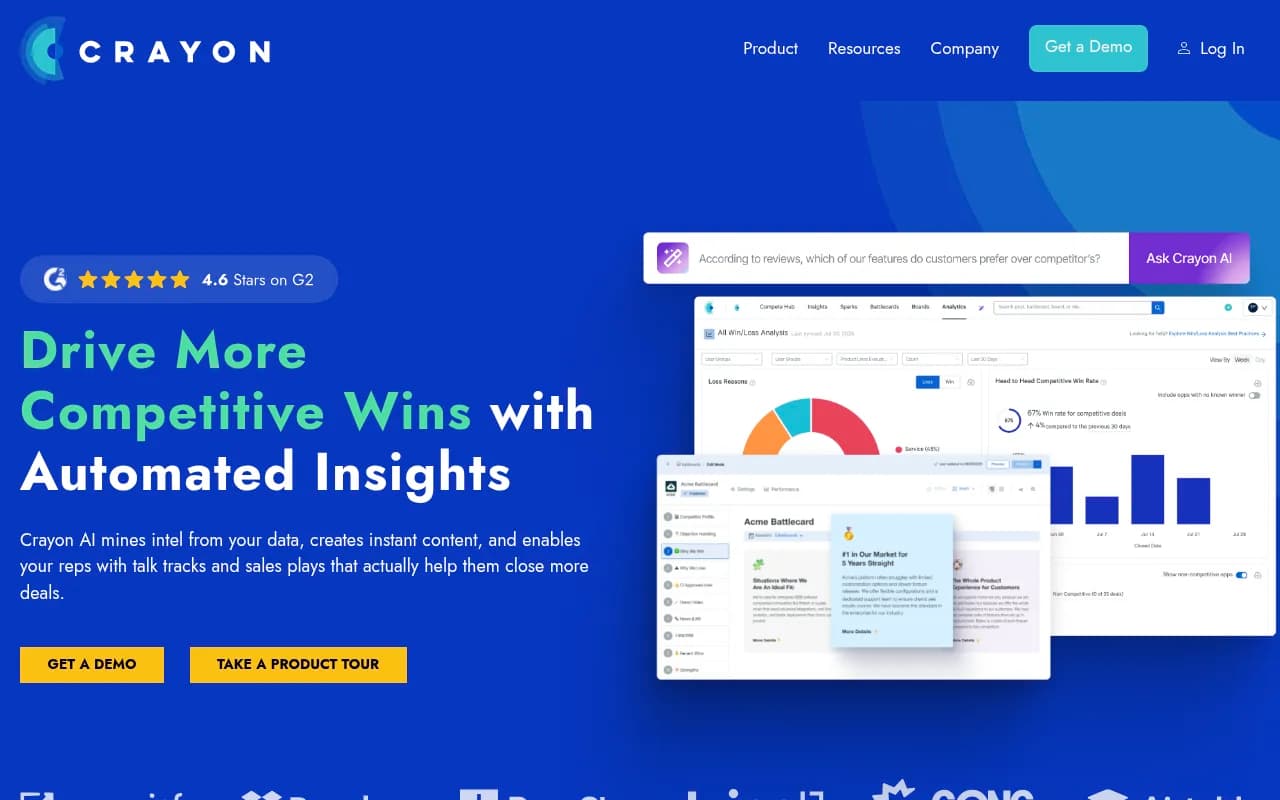
Monitors competitor activity across web, social, and content channels, then surfaces insights and battlecards to help sales and marketing act on competitive data.
Key takeaways
- Crayon is a well-established competitive intelligence platform built specifically for B2B sales and marketing teams, with a strong focus on turning raw competitor data into sales-ready battlecards and enablement content.
- The platform has a genuine AI layer ("Sparks" and AI importance scoring) that reduces manual research time, though it's primarily a monitoring and enablement tool rather than a strategy or content optimization platform.
- Pricing is not publicly listed and requires a demo/sales conversation, which puts it firmly in the mid-to-enterprise segment -- expect costs that reflect that.
- Crayon covers traditional competitive intelligence well but is not designed for AI search visibility or generative engine optimization; teams that need to monitor how their brand appears in ChatGPT, Perplexity, or Google AI Overviews will need a separate tool for that.
- Best fit for product marketing managers and CI analysts at B2B SaaS companies with dedicated sales teams of 20+ reps.
Crayon is a competitive intelligence platform that has been around long enough to become a recognizable name in the B2B go-to-market space. Founded in 2015 and headquartered in Boston, the company built its reputation by solving a specific, painful problem: product marketers and CI analysts were spending enormous amounts of time manually tracking competitor websites, press releases, social posts, and pricing pages, then trying to distill all of that into something sales reps would actually read. Crayon automates the monitoring side and wraps the output in a sales enablement layer that pushes intel directly into the tools reps already use.
The target audience is narrow and well-defined: B2B companies with dedicated go-to-market teams, typically in the SaaS or technology space, where competitive deals are frequent and sales cycles are long enough that having the right objection-handling content at the right moment actually moves the needle. Customers like Cognism, Alteryx, Salsify, and Allego show up in their case studies, which gives a clear picture of the company profile: mid-market to enterprise B2B software businesses with product marketing or CI functions that own the compete program.
Crayon has raised significant venture funding over the years and has grown its customer base substantially. The platform has evolved from a basic web monitoring tool into a more complete competitive enablement suite, with AI features added more recently to keep pace with the broader market shift toward AI-assisted workflows.
Key features
Competitor monitoring and intel feeds
Crayon crawls competitor websites, social media profiles, news sources, job postings, review sites, and other public channels to surface changes in real time. The system tracks things like pricing page updates, new product announcements, messaging shifts, and leadership changes. What makes this more useful than a basic Google Alert setup is the volume and breadth of sources monitored simultaneously, combined with the ability to filter and prioritize by relevance. Users get a daily digest in their inbox that surfaces the highest-priority changes, so you're not staring at a firehose of noise.
- Monitors web pages, social channels, job boards, review sites, and news
- Tracks changes at the page level, not just new content
- Configurable alert thresholds so you only see what matters
AI importance scoring and Sparks
This is Crayon's main AI feature set. Importance scoring automatically ranks incoming intel from high to low priority, so a CI analyst doesn't have to manually triage hundreds of data points per week. "Sparks" is a more proactive AI feature that lets users set up automated analyses that run on a schedule (weekly, monthly) and generate summaries of competitor activity across specific themes like messaging, events, or product strategy. Users in Crayon's own testimonials describe Sparks as a significant time-saver for keeping broader teams informed without manual effort.
- AI-generated news summaries that distill competitor articles into key takeaways
- Scheduled Sparks that auto-generate competitive briefings
- Importance scoring that surfaces signal over noise
Battlecard creation and management
Battlecards are the core output of Crayon's enablement layer. These are structured competitive comparison documents that sales reps can pull up during a deal to understand how to position against a specific competitor. Crayon provides templates and an editor for building these, and the platform tracks which battlecards are being used, by whom, and how that correlates with win rates. The AI layer can help draft battlecard content from monitored intel, which reduces the time from "competitor does something new" to "reps have updated talking points."
- Template-based battlecard editor with AI-assisted drafting
- Version control and update notifications when battlecards change
- Usage tracking tied to deal outcomes
Sales enablement integrations
Crayon pushes battlecards and intel into Salesforce, Slack, Highspot, and other tools where sales reps actually work. This is a meaningful differentiator from platforms that require reps to log into a separate tool to find competitive content. The Salesforce integration surfaces relevant battlecards based on the competitor field in an opportunity record, which means reps get the right content at the right moment without any extra steps.
- Native Salesforce integration with opportunity-level battlecard surfacing
- Slack integration for real-time intel alerts and battlecard access
- Highspot and other sales enablement platform connections
Announcements and newsletters
Beyond battlecards, Crayon has a content distribution layer that lets CI teams push competitive updates to broader audiences. Announcements highlight recent battlecard changes or important competitor moves. Newsletters aggregate competitive intel into a digestible format for go-to-market teams who aren't in the weeds of the compete program but still need to stay informed. Both formats can be generated with AI assistance to reduce the writing burden on the CI analyst.
Win/loss analysis and performance metrics
Crayon includes a measurement layer that connects competitive enablement activity to business outcomes. Win/loss analysis helps prioritize which competitors to focus on based on where the sales team is actually losing deals. Engagement data shows which reps are using battlecards and how that correlates with their win rates in competitive deals. The "influenced revenue" metric attempts to quantify the revenue impact of the compete program, which is useful for justifying the investment to senior leadership.
- Win/loss data tied to CRM opportunity records
- Battlecard engagement tracking at the rep level
- Team leaderboard showing competitive performance by rep
- Manager coaching tools for 1:1 competitive deal reviews
1:1 coaching and team leaderboard
This is a feature that goes beyond what most CI tools offer. Crayon surfaces individual rep performance in competitive deals, allowing managers to identify who is winning against specific competitors and why, then coach underperformers using that data. The leaderboard creates a degree of visibility and accountability around competitive deal performance that can drive adoption of battlecards organically.
Who is it for
Crayon's sweet spot is the product marketing manager or CI analyst at a B2B SaaS company who owns the compete program and is responsible for enabling a sales team of 20 to 200+ reps. If you're spending 10+ hours a week manually tracking competitor websites, writing battlecards from scratch, and then struggling to get reps to actually use them, Crayon addresses all three of those problems in a single platform. The case studies on their site (Cognism achieving $6M in influenced revenue, Salsify improving win rates by 22%, Allego tripling win rates against a top competitor) are representative of the outcomes teams in this profile can realistically expect.
Mid-market to enterprise B2B technology companies are the primary fit. These are organizations with enough competitive deal volume to justify a dedicated CI function, enough sales reps to make battlecard distribution a real challenge, and enough budget to invest in a platform that requires a sales conversation before you even see pricing. Companies in crowded SaaS categories (sales tech, marketing tech, HR tech, fintech) where differentiation is genuinely hard and competitive objections come up in nearly every deal will get the most value.
Who should not use Crayon: small startups with fewer than 10 sales reps, companies where competitive deals are rare, or teams that need a self-serve, low-cost solution. The platform is clearly built for organizations with a dedicated person or team running the compete program. If you're a solo founder or a small team where everyone wears multiple hats, the overhead of managing a platform like this will likely outweigh the benefits. Similarly, if your primary need is monitoring how your brand appears in AI search results (ChatGPT, Perplexity, Google AI Overviews), Crayon is not designed for that use case.
Integrations and ecosystem
Crayon's integration story is one of its genuine strengths. The platform connects to the tools that sales and marketing teams already use, which is critical for adoption. If reps have to log into a new tool to find competitive intel, most of them won't do it.
- Salesforce: Deep integration that surfaces battlecards within opportunity records based on the competitor field. This is the most important integration for sales teams.
- Slack: Real-time intel alerts and battlecard access directly in Slack channels or DMs.
- Highspot: Pushes battlecards into the sales content management platform many enterprise teams use.
- Microsoft Teams: Intel delivery for organizations on the Microsoft stack.
- Gong: Integration with the conversation intelligence platform, allowing competitive intel to be connected to call data.
- HubSpot: CRM integration for teams not on Salesforce.
- Klue and other CI tools are direct competitors, not integrations.
Crayon also mentions the ability to connect competitive intel into AI tools like ChatGPT, Glean, and Copilot, which is a newer capability that reflects the shift toward AI-assisted workflows in sales teams. The idea is that reps can query an AI assistant and get answers grounded in Crayon's competitive data.
There is no publicly documented open API for custom integrations, though enterprise customers likely have access to data export options. The platform does not appear to have a browser extension for on-the-fly competitive research, which is a gap compared to some lighter-weight tools.
Pricing and value
Crayon does not publish pricing on its website. The pricing page redirects to a demo request form, which is a clear signal that this is a sales-led, contract-based product. Based on third-party sources and industry knowledge, Crayon pricing typically starts in the range of $1,500 to $2,500 per month for smaller teams and scales up significantly based on the number of competitors tracked, user seats, and feature tier. Annual contracts are standard.
This puts Crayon firmly in the mid-to-enterprise budget range. For a company with a dedicated CI function and a sales team that regularly faces competitive deals, the ROI math can work out clearly -- Cognism's $6M in influenced revenue in under a year is a compelling data point. But for smaller teams or companies where competitive intelligence is a secondary priority, the price point is hard to justify.
There is no free tier and no self-serve trial. You have to talk to sales to get started, which adds friction for teams that want to evaluate the tool independently. Competitors like Klue operate in a similar price range. Lighter-weight tools like Kompyte (now part of Semrush) or manual setups using tools like Notion and Google Alerts can serve teams with smaller budgets, though with significantly less automation and no sales enablement layer.
Strengths and limitations
What Crayon does well:
- Battlecard adoption and distribution: The integrations with Salesforce, Slack, and Highspot mean battlecards actually get used. This is the hardest part of running a compete program, and Crayon has clearly invested heavily in solving it.
- AI-assisted intel triage: The importance scoring and Sparks features genuinely reduce the manual work of monitoring and summarizing competitor activity. Users consistently cite time savings as a primary benefit.
- Measurement and ROI tracking: The influenced revenue metric and battlecard engagement data give CI teams something concrete to show leadership, which helps justify the program's existence.
- Sales coaching layer: The 1:1 coaching tools and team leaderboard go beyond what most CI platforms offer and create a feedback loop between competitive performance data and rep behavior.
- Breadth of monitoring sources: Tracking job postings, review sites, social media, and web page changes simultaneously gives a more complete picture of competitor activity than tools that only monitor news or websites.
Limitations and honest gaps:
- No AI search visibility monitoring: Crayon monitors traditional web and social channels but does not track how competitors appear in AI-generated search results from ChatGPT, Perplexity, Claude, or Google AI Overviews. As AI search becomes a primary discovery channel for B2B buyers, this is a meaningful gap. Teams that need this capability will need a separate tool.
- Opaque pricing and no self-serve: The lack of published pricing and the requirement to go through a sales process creates friction for evaluation. Teams that want to try before they buy have no good option here.
- Heavy for small teams: The platform is designed for organizations with dedicated CI functions. A solo product marketer at a 50-person startup will likely find the platform more than they need and struggle to justify the cost.
Bottom line
Crayon is a mature, well-built competitive intelligence platform that does what it promises: it monitors competitors, surfaces relevant intel, and gets that intel into the hands of sales reps through the tools they already use. For B2B SaaS companies with dedicated CI or product marketing functions and sales teams that regularly face competitive deals, it's one of the stronger options available in 2026.
The best use case in one sentence: a product marketing team at a mid-market B2B SaaS company that needs to automate competitor monitoring, build and distribute battlecards at scale, and prove the revenue impact of their compete program to leadership.
That said, Crayon is a traditional competitive intelligence tool. It watches what competitors do in the real world -- websites, press releases, job postings, social media. It does not address the growing question of how your brand appears when a buyer asks ChatGPT or Perplexity to recommend solutions in your category. If that's a priority for your team, you'll want to look at a dedicated AI visibility platform alongside Crayon.
Tags:
Frequently asked questions
What is Crayon used for?
Who is Crayon best suited for?
How much does Crayon cost?
Does Crayon have a free trial or free plan?
What integrations does Crayon support?
Does Crayon track AI search visibility or how brands appear in ChatGPT or Perplexity?
Similar and alternative tools to Crayon