Feedly Market Intelligence Review 2026
Feedly Market Intelligence uses AI to monitor competitors, surface emerging trends, and synthesize insights from thousands of sources including trade publications, research journals, and social media. Built for strategy and innovation teams at mid-to-enterprise companies.
Key takeaways
- Feedly Market Intelligence is a strong content aggregation and trend monitoring platform, trusted by companies like Lufthansa, Verizon, Airbus, and Danone
- AI Feeds and AI Actions genuinely reduce manual research time -- Lufthansa Innovation Hub reported 3-5x faster intelligence gathering
- Best suited for strategy, innovation, and competitive intelligence teams that need to monitor industry signals across thousands of sources
- Pricing is not publicly listed for the Market Intelligence tier, which makes budget planning harder without a sales call
- Not a tool for tracking brand visibility in AI search engines (ChatGPT, Perplexity, etc.) -- that's a separate category where platforms like Promptwatch operate
Feedly has been around since 2008, originally as an RSS reader that filled the void left by Google Reader's shutdown in 2013. Over the years it evolved well beyond feed aggregation, and the Market Intelligence product is the clearest expression of where the company has landed: an AI-assisted research platform for teams that need to stay on top of competitors, industry trends, and emerging signals without drowning in noise.
The Market Intelligence product is distinct from Feedly's consumer-facing Pro plans. It's aimed squarely at corporate strategy teams, innovation departments, competitive intelligence analysts, and research functions at mid-size to enterprise companies. The client list -- Lufthansa, Verizon, Airbus, Danone, Royal Bank of Scotland, Delta Dental -- tells you something about the intended buyer. These aren't solo bloggers or small marketing teams. They're organizations with dedicated people whose job is to know what's happening in their industry before it becomes obvious.
The core pitch is straightforward: instead of manually scanning dozens of publications, trade journals, research databases, and social feeds every day, you let Feedly's AI do the filtering and synthesis. The platform ingests from thousands of sources, applies AI models to surface what's relevant, and gives analysts tools to turn raw signals into shareable intelligence.
Key features
AI Feeds are the foundation of the product. Rather than a generic RSS reader, Feedly lets you configure feeds that are filtered and ranked by AI models trained on your specific topics, industries, and competitors. The platform claims to use 10,000+ AI models across its source network. In practice, this means you can set up a feed for something like "battery technology in automotive" and get articles that are actually about that, not just articles that mention those words somewhere. The AI learns from your engagement over time, improving relevance as you use it.
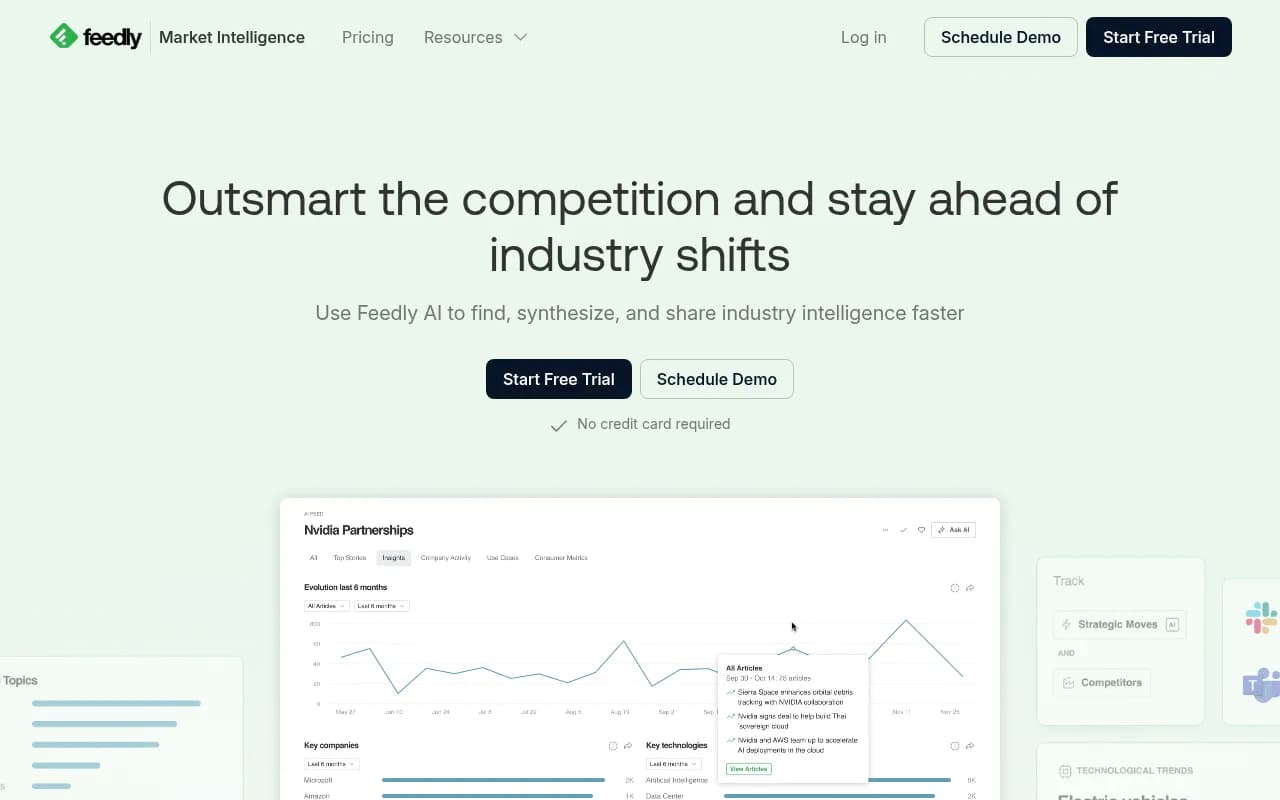
Emerging Trends Dashboard is one of the more distinctive features. It's designed to surface "weak signals" -- early-stage discussions and patterns that haven't yet become mainstream news. The dashboard shows trend volume over time, related companies, technologies, and topics. For innovation teams trying to spot what's coming 12-24 months out, this is more useful than a standard news feed. The energy industry filter shown in their marketing materials gives a sense of the granularity available.
Insights Cards give you a 360-degree view of a specific company or trend. Each card pulls together real-time metrics, top stories, recent activities, and related companies, use cases, and technologies. If you're tracking a competitor like a specific biotech firm or a technology like nuclear-powered data centers, the Insights Card aggregates everything into one view rather than making you piece it together from multiple feeds.
AI Actions are where Feedly gets genuinely useful for analysts. You can select a batch of articles and run a generative AI prompt against them -- asking it to summarize key themes, extract specific data points, or produce a structured report. The inline citations are a smart design choice: every AI-generated claim links back to the source article, so you can verify before you share. A separate AI Actions workflow lets you automatically extract structured data from articles into spreadsheets -- useful for tracking things like funding rounds, product launches, or regulatory changes across a set of companies.
Automated Newsletters let teams package their intelligence into branded, shareable digests for stakeholders who don't live in Feedly day-to-day. You can personalize content, add analyst commentary, and set up automated delivery. This is a practical feature for competitive intelligence teams that need to brief executives or business units without those people needing to log into another tool.
Source breadth is a genuine strength. Feedly covers business magazines (Business Insider, Harvard Business Review), strategy publications (McKinsey), tech blogs (TechCrunch, Wired), trade publications (Industry Dive, Business of Fashion), research journals (Nature, PubMed), and social media including Reddit and Twitter/X. The ability to pull from research journals alongside trade press in a single interface is something many competitors don't do well.
Integrations round out the workflow. Feedly connects to tools like Slack, Microsoft Teams, and various no-code platforms, letting you push intelligence to where teams already work. There's also an API for custom integrations. The specific integration list isn't exhaustively documented in their public materials, but the no-code integration emphasis suggests Zapier-style connectivity.
Collaboration features allow teams to annotate articles, share boards, and work together on intelligence projects. For a team of analysts, the ability to tag an article with context and share it with a colleague inside the platform -- rather than forwarding links by email -- is a workflow improvement that adds up over time.
Who is it for
The primary user is a competitive intelligence or strategy analyst at a company with 500+ employees, working in a team that has a formal mandate to monitor the market. Think of a three-person innovation team at an airline or a competitive intelligence function at a pharmaceutical company. They're reading dozens of sources daily, producing weekly briefings for leadership, and trying to spot trends before they become obvious. Feedly Market Intelligence replaces a combination of manual RSS feeds, Google Alerts, and ad-hoc research with something more structured and AI-assisted.
A second strong persona is the corporate innovation team at a large enterprise -- the kind of team that Lufthansa Innovation Hub represents. They need to track emerging technologies, startup activity, and adjacent industry moves to inform R&D priorities and partnership decisions. The Emerging Trends Dashboard and Insights Cards are particularly well-suited to this use case, where the goal is foresight rather than just awareness.
Industries where Feedly MI seems to perform especially well include financial services (Royal Bank of Scotland, River Cap are clients), aerospace and defense (Airbus, Lufthansa), life sciences (Agenus), and consumer goods (Danone, Pernod Ricard). These are sectors with high information density, long planning cycles, and real consequences for missing a competitive move.
Who should probably look elsewhere: small marketing teams that just want to monitor brand mentions, solo consultants who don't need team collaboration features, or anyone whose primary need is tracking how their brand appears in AI-generated search results. Feedly MI is a content intelligence tool, not an AI search visibility platform.
Integrations and ecosystem
Feedly's integration story is built around pushing intelligence outward to where decisions get made. The platform connects to Slack and Microsoft Teams for real-time alerts, and supports no-code integration platforms for custom workflows. There's a documented API that enterprise customers can use to pipe Feedly data into internal tools, dashboards, or data warehouses.
The Twitter/X integration is worth noting -- Feedly lets you follow Twitter accounts, lists, and hashtags as feeds, which means social signals get treated the same as editorial content in your intelligence workflow. Reddit is also supported as a source, which matters for industries where community discussions are early indicators of sentiment or emerging issues.
Import and export capabilities include the ability to export AI Actions outputs directly to spreadsheets, and the Automated Newsletter feature effectively serves as a structured export for human consumption. OPML import for existing RSS setups is supported for users migrating from other feed readers.
There's no dedicated mobile app mentioned prominently for the Market Intelligence tier, though Feedly has iOS and Android apps for its broader product.
Pricing and value
Feedly's pricing structure has multiple tiers, and the Market Intelligence product sits above the consumer plans. The publicly documented tiers for the broader Feedly platform include a Free plan, Pro, Pro+, and Enterprise. The Market Intelligence product appears to be positioned at the Enterprise level, with pricing available on request -- the website directs users to a free trial or demo booking rather than listing specific numbers.
For context, Feedly Pro starts around $8/month and Pro+ around $18/month for individual users, but these are not the Market Intelligence product. Enterprise and Market Intelligence pricing is negotiated based on team size and feature requirements, which is standard for this category of tool.
The value proposition is clearest for teams that are currently spending significant analyst hours on manual research. If a three-person team is each spending 5 hours a week on source monitoring, and Feedly cuts that by 60%, the ROI math works quickly even at enterprise pricing. The Lufthansa case study citing 3-5x faster intelligence gathering is the kind of concrete claim that makes the value case.
Compared to alternatives like Crayon, Klue, or Contify in the competitive intelligence space, Feedly MI's strength is source breadth and the AI synthesis layer. Tools like Klue are more focused on sales enablement and battlecards; Feedly MI is more oriented toward strategic research and trend monitoring.
Strengths and limitations
What it does well:
- Source coverage is genuinely broad -- research journals, trade publications, social media, and business press in a single interface is hard to match
- AI Actions with inline citations is a thoughtful implementation that makes AI-generated summaries actually trustworthy and verifiable
- The Emerging Trends Dashboard addresses a real gap in most monitoring tools, which tend to surface what's already mainstream rather than what's emerging
- Automated Newsletters solve a real distribution problem for intelligence teams that need to brief stakeholders who won't log into another tool
- The client roster (Airbus, Verizon, Danone) suggests the platform holds up at enterprise scale
Limitations:
- Pricing opacity is a genuine friction point. Not listing Market Intelligence pricing publicly means every evaluation requires a sales conversation, which slows down procurement for teams with tight timelines
- The platform is fundamentally a content monitoring and synthesis tool. It doesn't track how your brand or content appears in AI-generated answers from ChatGPT, Perplexity, or Google AI Overviews -- that's a different problem requiring a different tool
- Customization depth for AI Feeds requires time investment to tune properly. Teams that want immediate out-of-the-box relevance may find the initial setup period frustrating
- No clear self-serve onboarding path for the Market Intelligence tier -- the trial requires a request form, which suggests a sales-assisted process rather than instant access
Bottom line
Feedly Market Intelligence is a well-built platform for corporate strategy and innovation teams that need to monitor large volumes of information across diverse source types and turn it into shareable intelligence. The AI synthesis features are practical rather than gimmicky, and the source breadth is a real competitive advantage for teams covering complex, multi-dimensional industries.
If your team's job is to know what's happening in your industry and communicate it to leadership, Feedly MI is worth evaluating seriously. Best use case: a 2-5 person competitive intelligence or innovation team at a mid-to-large enterprise that produces regular briefings and needs to cut manual research time without sacrificing source quality.
Tags:
Frequently asked questions
What is Feedly Market Intelligence?
Who is Feedly Market Intelligence designed for?
How much does Feedly Market Intelligence cost?
What are AI Actions in Feedly?
Does Feedly Market Intelligence track brand visibility in AI search engines like ChatGPT or Perplexity?
What integrations does Feedly Market Intelligence support?
Similar and alternative tools to Feedly Market Intelligence